Europe Personalized Medicine Biomarkers Market Size, Share, and Growth Forecast for 2024 - 2031

Europe Personalized Medicine Biomarkers Market by Application (Diagnosis, Monitoring, Early Detection/Screening, Treatment Selection, Others), Indication (Oncology Diseases, Autoimmune Diseases, Cardiology, Diabetes, Neurology, Others), and Country Analysis from 2024 to 2031

ID: PMRREP34951
Calendar

November 2024

183 Pages

Author : Pravin Rewale

Europe Personalized Medicine Biomarkers Market Size and Share Analysis

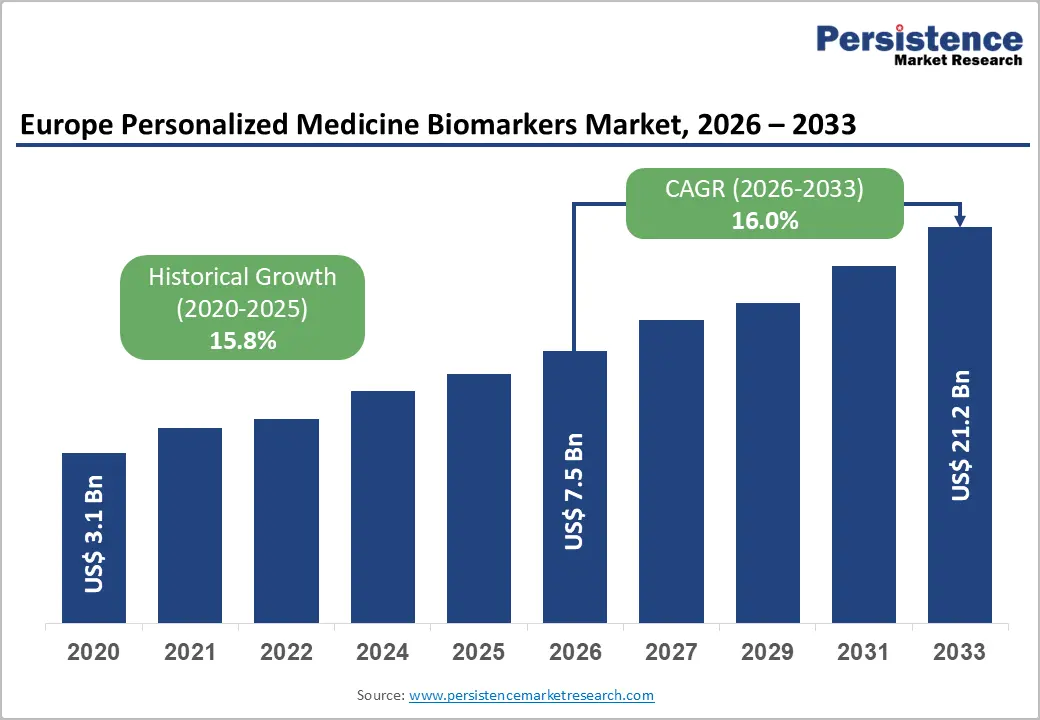
The Europe personalized medicine biomarkers market is projected to witness a healthy CAGR of 15.3% during the forecast period from 2024 to 2031. It is anticipated to increase from US$ 5.2 Bn recorded in 2024 to a staggering US$ 14.1 Bn by 2031.

Advancements in genomics, biotechnology, and diagnostics is significantly driving the personalized medicine biomarkers market in Europe. The increasing demand for precision medicine, especially in oncology, rare diseases, and genetic disorders, is fueling Europe market growth.

Growing emphasis on early diagnosis and targeted treatments, a strong healthcare infrastructure across countries in Europe and rising government initiatives is offering significant opportunities for market players. Consequently, making Europe a hub for innovation in biomarker development.

Key Highlights of the Market

  • Next-generation sequencing (NGS) technology accelerates biomarker discovery and diagnostic accuracy, creating significant opportunities in the Europe personalized medicine biomarkers market.
  • European policies like Horizon 2020 and EIP-AHA drive research and investment in precision medicine and biomarker development
  • Increasing integration of biomarker-driven therapies into clinical protocols to enhance personalized care in oncology and genetics.
  • Increased partnerships between pharma, biotech, and diagnostic companies to develop novel biomarkers and personalized treatments.
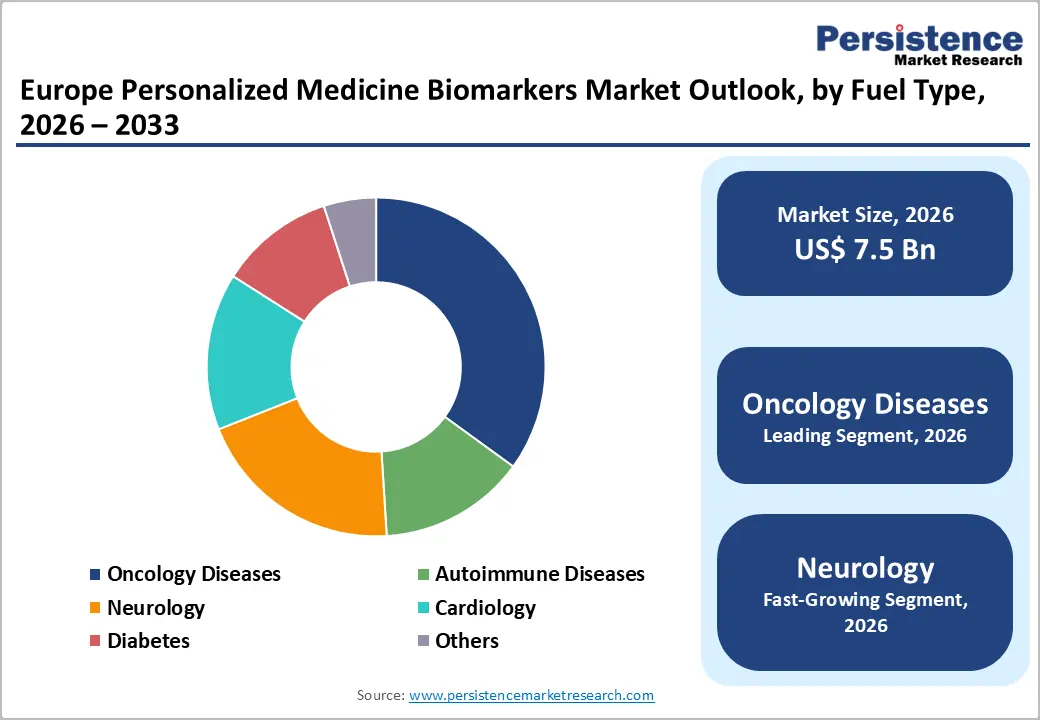
  • In terms of indication, the oncology category is anticipated to witness a CAGR of 14.4% by 2031.
  • Based on application, the early detection/screening segment is projected to showcase a remarkable CAGR of 16.3% through 2031.
  • In Europe, Germany is estimated to dominate with a CAGR of 14.2% through 2031. Country growth is driven by its robust healthcare infrastructure, and strong investment in research and development.

Market Attributes

Key Insights

Europe Personalized Medicine Biomarkers Market Size (2024E)

US$ 5.2 Bn

Projected Market Value (2031F)

US$ 14.1 Bn

Global Market Growth Rate (CAGR 2024 to 2031)

15.3%

Historical Market Growth Rate (CAGR 2019 to 2023)

13.6%

Germany to be the Next-door Opportunity for the Market Players

In Europe, Germany is anticipated to record a considerable CAGR of 14.2% through 2031 due to its strong research capabilities, robust healthcare infrastructure, and supportive regulatory environment. The country has a well-established healthcare system facilitating integration of innovative diagnostic technologies, including biomarkers, into clinical practice.

Germany’s extensive network of research institutions, such as the German Cancer Research Center (DKFZ) and various universities, fosters cutting-edge advancements in genomics and personalized medicine. Moreover, Germany has made significant investments in personalized medicine, with government-backed initiatives like the “National Genome Research Network” (NGFN) supporting large-scale genomic projects.  

The country’s regulatory framework, governed by the European Medicines Agency (EMA) and the Federal Institute for Drugs and Medical Devices (BfArM), is conducive to fast approval of innovative biomarker-based therapies and diagnostics. These factors collectively position Germany at the forefront of the personalized medicine biomarkers market in Europe.

Personalized Medicine Biomarker Adoption for Oncology Disease Indication Tops the Market

Category

CAGR through 2031

Indication - Oncology Diseases

14.4%

In terms of indication, oncology diseases category is anticipated to lead in the foreseeable future by capturing a CAGR of around 14.4% driven by the increasing demand for targeted therapies and the potential for improved patient outcomes. As cancer treatments become more sophisticated, biomarkers play a crucial role in identifying specific genetic mutations or molecular profiles in tumors, enabling more precise, individualized therapies.

This shift towards personalized cancer care leads to better efficacy, fewer side effects, and optimized treatment regimens, which are key drivers for their growing use. The rise in companion diagnostics further supports the adoption of biomarkers in oncology. These advancements support Europe's shift toward precision medicine, aiming to improve cancer survival and quality of life through tailored, evidence-based treatments.

Growing Demand for Personalized Medicine Biomarkers for Early Detection/Screening

Category

CAGR through 2031

Application - Early Detection/Screening

16.3%

Based on application, the early detection and screening segment is projected to exhibit a CAGR of 16.3% during the period from 2024 to 2031. This growth is driven by the increasing focus on preventive healthcare and the growing need for non-invasive, accurate diagnostic tools. Early detection biomarkers enable the identification of diseases at their most treatable stages, significantly improving patient outcomes.

The rise of screening programs for hereditary cancers, cardiovascular diseases, and other conditions is fueling market demand. As healthcare systems across Europe prioritize early diagnosis to reduce treatment costs and improve survival rates, the adoption of personalized biomarkers for early detection is becoming a cornerstone of precision medicine.

Market Introduction and Trend Analysis

The Europe market for personalized medicine biomarkers focuses on using molecular biomarkers to tailor treatments to individual patients, optimizing therapeutic outcomes in fields such as oncology, cardiology, and rare diseases. Advances in genomic technologies, growing demand for targeted therapies and increasing awareness of precision medicine are the key factors driving the European market.

Non-invasive liquid biopsy technologies are gaining momentum, providing alternatives to traditional biopsies for early disease detection and real-time monitoring. Next-generation sequencing (NGS) further facilitates the identification of biomarkers and personalizing treatment strategies.

European initiatives, such as Horizon 2020 and national genomics programs, are fueling innovation and supporting research in precision medicine. The increasing emphasis on early detection and prevention of diseases is driving the adoption of personalized diagnostics, improving patient outcomes while reducing treatment costs. These trends are expected to propel the market, with biomarkers becoming integral to clinical practice and healthcare systems across Europe.

Historical Growth and Course Ahead

The Europe personalized medicine biomarkers industry recorded a CAGR of 13.6% during the period from 2019 to 2023. Market growth was due to factors such as increasing adoption of precision medicine in clinical practice and growing advancements in genomic research and biotechnology.

Use of biomarkers in oncology application have played a significant role in immuno-oncology and targeted therapies. EU-funded initiatives like Horizon 2020 have further fostered research and collaboration, accelerating the development of novel biomarkers.

Europe market for personalized medicine biomarkers is estimated to record a CAGR of 15.3% during the forecast period with, expanding applications in early detection, and growing patient demand for personalized, and effective treatments.

Market Growth Drivers

Increasing Demand for Targeted Therapies Across Europe

In Europe, the shift toward personalized medicine is being fueled by the growing number of U.S.FDA and EMA-approved targeted therapies and the increasing availability of companion diagnostics that match patients with the right treatment. Targeted therapies designed to target specific molecules or genetic mutations involved in the growth and spread of diseases, particularly cancer, are often effective and have few side effects.

With growing understanding of genetic variations and molecular profiles of diseases, personalized treatments leveraging specific biomarkers are becoming the standard of care, especially in oncology, improving treatment efficacy and minimizing adverse effects. The rise in demand for personalized, precision therapies is thus, accelerating the use of biomarkers, driving the growth of the personalized medicine biomarkers market in Europe.

Growing Use of Liquid Biopsy Technologies

The growing use of liquid biopsy technologies is a significant driver of the Europe personalized medicine biomarkers market. Liquid biopsy offers a non-invasive alternative to traditional tissue biopsies as its analyses blood or other body fluids to detect circulating tumor DNA (ctDNA), circulating tumor cells (CTCs), or other biomarkers. It further allows for early cancer detection, monitoring treatment response, and tracking disease progression in real-time.

Associated advantages including patient comfort, reduced procedural risks, and faster turnaround times for results adds to the growing demand for liquid biopsy in Europe. Additionally, it allows healthcare providers to adjust therapies based on the genetic profile of tumors, even as they evolve during treatment, making it valuable for monitoring cancer patients who require frequent assessments. The adoption of liquid biopsy technologies is expected to continue driving the growth of personalized medicine biomarkers in Europe.

Market Restraining Factors

Limited Adoption Due to High Costs and Accessibility

Personalized medicine requires advanced diagnostic tools, high-quality biomarker testing, and specialized therapies to tailor treatments based on individual genetic profiles. However, high costs and accessibility challenges limit the adoption of personalized medicine biomarkers into routine practice in Europe.

Biomarker based test for genetics, proteomics and other biomarkers are expensive to develop and perform. Out-of-pocket expenses and long approval times for reimbursement further delay the access to these vital tests. High treatment costs for personalized therapies like targeted biologics or gene therapies, further compound this issue, making these treatments inaccessible for some patients.

Leading healthcare centres in Western Europe may have access to state-of-the-art biomarker testing and treatments, rural or less-developed areas often lack the necessary facilities and expertise. This geographic disparity exacerbates inequities in patient care, limiting the reach of personalized medicine.

Ethical and Privacy Concerns in the Use of Biomarkers for Personalized Medicine

Ethical and privacy concerns play a significant role in the adoption of biomarkers for personalized medicine, as they involve sensitive genetic and health information. Furthermore, personalized medicine often involves complex genetic testing, and patients may not fully understand the implications of undergoing such tests.

Many countries in Europe have legal protections against such genetic discriminations; however, these laws are not universal and may not be comprehensive enough to cover all possible scenarios, leading to patient reluctance in sharing genetic data. These ethical and privacy challenges need careful regulation to protect patient rights and encourage broader acceptance of personalized medicine.

Key Market Opportunities

Leveraging Advanced Genomic Technologies for Market Differentiation

Advanced technologies like next-generation sequencing (NGS), CRISPR gene-editing, and single-cell RNA sequencing are at the forefront of genomic innovation. These techniques provide an accurate, comprehensive, and affordable genomic data, enabling the identification of biomarkers for a wide range of diseases.

Integration of AI/ML tools help in discovering new biomarkers and developing more personalized treatments. Key players within this market space are harnessing these technologies to enhance the quality of their offerings, as well as to provide more precise and detailed genetic insights in order to gain a competitive edge.

Leveraging advanced genomic technologies is a critical strategy for market differentiation in the European personalized medicine biomarker sector. With the rise of precision medicine, where treatments are tailored based on individual genetic profiles, the ability to offer cutting-edge genomic tools can help companies stand out in an increasingly competitive market.

Rising Demand for Non-Invasive Biomarker Testing in Europe

Non-invasive tests, such as liquid biopsies, are increasingly being preferred over the more invasive traditional tissue biopsies. They represent one of the most promising opportunities in the personalized medicine sector in Europe as it offers a less risky, fast and comfortable alternative for patients, contributing to their increasing appeal in clinical practice.

Growing emphasis on early detection and precision medicine, particularly in areas like oncology and genetic disorders have significantly added to this demand. Non-invasive biomarker tests enable earlier diagnosis of conditions, allow for real-time monitoring of disease progression and treatment response, making them valuable for personalized treatment plans.

Their potential to reduce the healthcare costs by minimizing the need for invasive procedures, hospital stays, and follow-up treatments, is also driving broader adoption, making non-invasive biomarker testing a cost-effective solution for healthcare systems across Europe. This shift towards more affordable, efficient care presents significant opportunities for market players to innovate and capture growing demand.

Competitive Landscape for the Europe Personalized Medicine Biomarkers Market

Europe market for personalized medicine biomarker is a highly dynamic industry with a mix of established players, innovative startups, and research-driven collaborations. Leading players like Thermo Fisher Scientific Inc., and Illumina, Inc., offer genomic testing solutions and biomarker discovery platforms. These benefit from strong research and development capabilities and partnerships with academic institutions and healthcare providers.

Emerging players on the other hand leverage proteomics and metabolomics technologies to discover novel biomarkers. Companies are increasingly engaging in collaborations with pharmaceutical firms to co-develop companion diagnostics, while addressing the demand for fast, accurate, and cost-effective biomarker solutions in clinical settings.

Recent Industry Developments

  • In August 2024, Illumina, Inc., received U.S.FDA approval for its in vitro diagnostic (IVD) TruSight™ Oncology (TSO) Comprehensive test and its first two companion diagnostic (CDx) indications such as adult and pediatric patients with solid tumors.
  • In August 2024, AI startup company Paige launched an AI-powered biomarker module called OmniScreen, to evaluate more than 505 genes and identify 1,228 molecular biomarkers from standard pathology slides. The product analyzes digital images of cancer tissue slides that are stained using hematoxylin and eosin (H&E).
  • In April 2024, Bio-Rad Laboratories, Inc., launched its first ultrasensitive multiplexed digital PCR assay, the ddPLEX ESR1 Mutation Detection Kit enabling simultaneous detection, discrimination, and absolute quantification of seven known relevant ESR1 mutations, in a single well, with an analytical sensitivity down to 0.01% variant allele fraction (VAF). 

Companies Covered in Europe Personalized Medicine Biomarkers Market

  • Laboratory Corporation of America Holding
  • Quest Diagnostics Incorporated
  • Agilent Technologies, Inc.
  • Genome Medical, Inc.
  • Coriell Life Sciences.
  • Roche Diagnostics
  • NeoGenomics Laboratories
  • FOUNDATION MEDICINE, INC.
  • Illumina, Inc.
  • Guardant Health
  • PerkinElmer
  • Bio-Rad Laboratories
  • GE Healthcare
  • Qiagen
  • Thermo Fisher Scientific Inc.
Frequently Asked Questions

Yes, the market is set to reach US$ 14.1 Bn by 2031.

The market is set to expand at a CAGR of 15.3% through 2031.

Germany is estimated to witness a high market share in Europe in 2031.

Germany is likely to expand at a CAGR of 14.2% over the forecast period.

Demand for personalized medicine biomarker for oncology disease indication is considered as the leading segment.

Europe Personalized Medicine Biomarkers Market Report Scope

Attributes

Details

Forecast Period

2024 to 2031

Historical Data Available for

2019 to 2023

Market Analysis

US$ Million for Value

Key Regions Covered

  • Germany
  • France
  • U.K.
  • Italy
  • Spain
  • Russia
  • Rest of Europe

Key Market Segments Covered

  • Application
  • Indication
  • Country

Key Companies Profiled in the Report

  • Laboratory Corporation of America Holding
  • Quest Diagnostics Incorporated
  • Agilent Technologies, Inc.
  • Genome Medical, Inc.
  • Coriell Life Sciences.
  • Roche Diagnostics
  • NeoGenomics Laboratories
  • FOUNDATION MEDICINE, INC.
  • Illumina, Inc.
  • Guardant Health
  • PerkinElmer
  • Bio-Rad Laboratories
  • GE Healthcare
  • Qiagen
  • Thermo Fisher Scientific Inc.

Report Coverage

  • Market Forecast and Trends
  • Company Share Analysis
  • Competitive Intelligence
  • DROT Analysis
  • Market Dynamics and Challenges
  • Strategic Growth Initiatives  

Customization & Pricing

Available upon request

Europe Personalized Medicine Biomarkers Market Segmentation

By Application

  • Diagnosis
  • Monitoring
  • Early Detection/Screening
  • Treatment Selection
  • Others

By Indication

  • Oncology Diseases
  • Autoimmune Diseases
  • Cardiology
  • Diabetes
  • Neurology
  • Others

By Country

  • Germany
  • France
  • U.K.
  • Italy
  • Spain
  • Russia
  • Rest of Europe

Related Reports

1. Executive Summary
    1.1. Europe Personalized Medicine Biomarkers Market Snapshot, 2024 and 2031
    1.2. Market Opportunity Assessment, 2024 - 2031, US$ Mn
    1.3. Key Market Trends
    1.4. Future Market Projections
    1.5. Premium Market Insights
    1.6. Industry Developments and Key Market Events
    1.7. PMR Analysis and Recommendations
2. Market Overview
    2.1. Market Scope and Definition
    2.2. Market Dynamics
        2.2.1. Drivers
        2.2.2. Restraints
        2.2.3. Opportunity
        2.2.4. Key Trends
    2.3. Macro-Economic Factors
        2.3.1. Europe Sectorial Outlook
        2.3.2. Europe GDP Growth Outlook
    2.4. COVID-19 Impact Analysis
    2.5. Forecast Factors - Relevance and Impact
3. Value Added Insights
    3.1. Product Adoption Analysis
    3.2. Recent Product Approvals and Launches Insights
    3.3. Regulatory Landscape
    3.4. Value Chain Analysis
    3.5. PESTLE Analysis
    3.6. Porter’s Five Force Analysis
4. Europe Personalized Medicine Biomarkers Market Outlook: Historical (2019 - 2023) and Forecast (2024 - 2031)
    4.1. Key Highlights
        4.1.1. Market Size (US$ Mn) and Y-o-Y Growth
        4.1.2. Absolute $ Opportunity
    4.2. Market Size (US$ Mn) Analysis and Forecast
        4.2.1. Historical Market Size (US$ Mn) Analysis, 2019-2022
        4.2.2. Current Market Size (US$ Mn) Analysis and Forecast, 2023-2031
    4.3. Europe Personalized Medicine Biomarkers Market Outlook: Application
        4.3.1. Introduction / Key Findings
        4.3.2. Historical Market Size (US$ Mn) Analysis, By Application, 2019 - 2022
        4.3.3. Current Market Size (US$ Mn) Analysis and Forecast, By Application, 2023 - 2031
            4.3.3.1. Diagnosis
            4.3.3.2. Monitoring
            4.3.3.3. Early Detection/Screening
            4.3.3.4. Treatment Selection
            4.3.3.5. Others
        4.3.4. Market Attractiveness Analysis: Application
    4.4. Europe Personalized Medicine Biomarkers Market Outlook: Indication
        4.4.1. Introduction / Key Findings
        4.4.2. Historical Market Size (US$ Mn) Analysis, By Indication, 2019 - 2022
        4.4.3. Current Market Size (US$ Mn) Analysis and Forecast, By Indication, 2023 - 2031
            4.4.3.1. Oncology Diseases
            4.4.3.2. Autoimmune Diseases
            4.4.3.3. Cardiology
            4.4.3.4. Diabetes
            4.4.3.5. Neurology
            4.4.3.6. Others
        4.4.4. Market Attractiveness Analysis: Indication
5. Europe Personalized Medicine Biomarkers Market Outlook: Country
    5.1. Key Highlights
    5.2. Historical Market Size (US$ Mn) Analysis, By Country, 2019 - 2022
    5.3. Current Market Size (US$ Mn) Analysis and Forecast, By Country, 2023 - 2031
        5.3.1. Germany
        5.3.2. France
        5.3.3. U.K.
        5.3.4. Italy
        5.3.5. Spain
        5.3.6. Russia
        5.3.7. Rest of Europe
    5.4. Market Attractiveness Analysis: Country
6. Germany Europe Personalized Medicine Biomarkers Market Outlook: Historical (2019 - 2023) and Forecast (2024 - 2031)
    6.1. Key Highlights
    6.2. Historical Market Size (US$ Mn) Analysis, By Market, 2019 - 2022
        6.2.1. By Application
        6.2.2. By Indication
    6.3. Current Market Size (US$ Mn) Analysis and Forecast, By Application, 2023 - 2031
        6.3.1. Diagnosis
        6.3.2. Monitoring
        6.3.3. Early Detection/Screening
        6.3.4. Treatment Selection
        6.3.5. Others
    6.4. Current Market Size (US$ Mn) Analysis and Forecast, By Indication, 2023 - 2031
        6.4.1. Oncology Diseases
        6.4.2. Autoimmune Diseases
        6.4.3. Cardiology
        6.4.4. Diabetes
        6.4.5. Neurology
        6.4.6. Others
    6.5. Market Attractiveness Analysis
7. France Europe Personalized Medicine Biomarkers Market Outlook: Historical (2019 - 2023) and Forecast (2024 - 2031)
    7.1. Key Highlights
    7.2. Historical Market Size (US$ Mn) Analysis, By Market, 2019 - 2022
        7.2.1. By Application
        7.2.2. By Indication
    7.3. Current Market Size (US$ Mn) Analysis and Forecast, By Application, 2023 - 2031
        7.3.1. Diagnosis
        7.3.2. Monitoring
        7.3.3. Early Detection/Screening
        7.3.4. Treatment Selection
        7.3.5. Others
    7.4. Current Market Size (US$ Mn) Analysis and Forecast, By Indication, 2023 - 2031
        7.4.1. Oncology Diseases
        7.4.2. Autoimmune Diseases
        7.4.3. Cardiology
        7.4.4. Diabetes
        7.4.5. Neurology
        7.4.6. Others
    7.5. Market Attractiveness Analysis
8. UK Europe Personalized Medicine Biomarkers Market Outlook: Historical (2019 - 2023) and Forecast (2024 - 2031)
    8.1. Key Highlights
    8.2. Historical Market Size (US$ Mn) Analysis, By Market, 2019 - 2022
        8.2.1. By Application
        8.2.2. By Indication
    8.3. Current Market Size (US$ Mn) Analysis and Forecast, By Application, 2023 - 2031
        8.3.1. Diagnosis
        8.3.2. Monitoring
        8.3.3. Early Detection/Screening
        8.3.4. Treatment Selection
        8.3.5. Others
    8.4. Current Market Size (US$ Mn) Analysis and Forecast, By Indication, 2023 - 2031
        8.4.1. Oncology Diseases
        8.4.2. Autoimmune Diseases
        8.4.3. Cardiology
        8.4.4. Diabetes
        8.4.5. Neurology
        8.4.6. Others
    8.5. Market Attractiveness Analysis
9. Italy Europe Personalized Medicine Biomarkers Market Outlook: Historical (2019 - 2023) and Forecast (2024 - 2031)
    9.1. Key Highlights
    9.2. Historical Market Size (US$ Mn) Analysis, By Market, 2019 - 2022
        9.2.1. By Application
        9.2.2. By Indication
    9.3. Current Market Size (US$ Mn) Analysis and Forecast, By Application, 2023 - 2031
        9.3.1. Diagnosis
        9.3.2. Monitoring
        9.3.3. Early Detection/Screening
        9.3.4. Treatment Selection
        9.3.5. Others
    9.4. Current Market Size (US$ Mn) Analysis and Forecast, By Indication, 2023 - 2031
        9.4.1. Oncology Diseases
        9.4.2. Autoimmune Diseases
        9.4.3. Cardiology
        9.4.4. Diabetes
        9.4.5. Neurology
        9.4.6. Others
    9.5. Market Attractiveness Analysis
10. Spain Europe Personalized Medicine Biomarkers Market Outlook: Historical (2019 - 2023) and Forecast (2024 - 2031)
    10.1. Key Highlights
    10.2. Historical Market Size (US$ Mn) Analysis, By Market, 2019 - 2022
        10.2.1. By Application
        10.2.2. By Indication
    10.3. Current Market Size (US$ Mn) Analysis and Forecast, By Application, 2023 - 2031
        10.3.1. Diagnosis
        10.3.2. Monitoring
        10.3.3. Early Detection/Screening
        10.3.4. Treatment Selection
        10.3.5. Others
    10.4. Current Market Size (US$ Mn) Analysis and Forecast, By Indication, 2023 - 2031
        10.4.1. Oncology Diseases
        10.4.2. Autoimmune Diseases
        10.4.3. Cardiology
        10.4.4. Diabetes
        10.4.5. Neurology
        10.4.6. Others
    10.5. Market Attractiveness Analysis
11. Russia Europe Personalized Medicine Biomarkers Market Outlook: Historical (2019 - 2023) and Forecast (2024 - 2031)
    11.1. Key Highlights
    11.2. Historical Market Size (US$ Mn) Analysis, By Market, 2019 - 2022
        11.2.1. By Application
        11.2.2. By Indication
    11.3. Current Market Size (US$ Mn) Analysis and Forecast, By Application, 2023 - 2031
        11.3.1. Diagnosis
        11.3.2. Monitoring
        11.3.3. Early Detection/Screening
        11.3.4. Treatment Selection
        11.3.5. Others
    11.4. Current Market Size (US$ Mn) Analysis and Forecast, By Indication, 2023 - 2031
        11.4.1. Oncology Diseases
        11.4.2. Autoimmune Diseases
        11.4.3. Cardiology
        11.4.4. Diabetes
        11.4.5. Neurology
        11.4.6. Others
    11.5. Market Attractiveness Analysis
12. Competition Landscape
    12.1. Market Share Analysis, 2023
    12.2. Market Structure
        12.2.1. Competition Intensity Mapping By Market
        12.2.2. Competition Dashboard
    12.3. Company Profiles (Details - Overview, Financials, Strategy, Recent Developments)
        12.3.1. Illumina, Inc.
            12.3.1.1. Overview
            12.3.1.2. Segments and Product
            12.3.1.3. Key Financials
            12.3.1.4. Market Developments
            12.3.1.5. Market Strategy
        12.3.2. Laboratory Corporation of America Holding
        12.3.3. Quest Diagnostics Incorporated
        12.3.4. Agilent Technologies, Inc.
        12.3.5. Genome Medical, Inc.
        12.3.6. Coriell Life Sciences.
        12.3.7. Roche Diagnostics
        12.3.8. NeoGenomics Laboratories
        12.3.9. FOUNDATION MEDICINE, INC.
        12.3.10. Guardant Health
        12.3.11. PerkinElmer
        12.3.12. Bio-Rad Laboratories
        12.3.13. GE Healthcare
        12.3.14. Qiagen
        12.3.15. Thermo Fisher Scientific Inc.
13. Appendix
    13.1. Research Methodology
    13.2. Research Assumptions
    13.3. Acronyms and Abbreviations

Research Methodology Framework for Market Research Excellence

At Persistence Market Research, we implement a comprehensive, validated, and multi-dimensional approachto market analysis that delivers actionable insights across complex market landscapes. Our methodology combines the analytical rigor of leading consulting firms with innovative research techniques, ensuring robust market assessments that guide strategic decision-making with confidence.

Core Research Philosophy

Our methodology is built on four foundational pillars:

Research Philosophy Image

At Persistence Market Research, our methodology is designed to transcend conventional market studies by combining analytical rigor, multi-source validation, and future-focused insights.

We integrate advanced research frameworks, robust data collection strategies, cutting-edge analytics, and innovative technologies to deliver a 360-degree view of complex markets.

We integrate advanced research frameworks, robust data collection strategies, cutting-edge analytics, and innovative technologies to deliver a 360-degree view of complex markets.

Each stage spanning from strategic scoping and hypothesis-building to competitive intelligence, quality validation, and actionable recommendations is engineered to provide clients with unmatched clarity, precision, and confidence in decision-making.

By embedding innovation and technology at the core, our approach ensures that insights are not only comprehensive but also predictive, empowering businesses to seize opportunities, mitigate risks, and achieve sustainable growth

Research Philosophy Image

Capturing Key Information and Events

During this phase, key research objectives focus on essential information and data points for assessing the market, including:

Research Philosophy Image

TAM-SAM-SOM Framework Implementation

We employ both top-down and bottom-up approaches to ensure accurate market sizing.

Top-Down Market SizingBottom-Up Market Sizing
Universe Definition: Total global/regional market identificationUnit Economics: Average transaction values, purchase frequencies, customer lifecycle
Segmentation Filters: Geographic, demographic, and behavioral constraintsCustomer Segmentation: Detailed buyer persona development and sizing
Market Share Analysis: Competitive landscape assessment and share allocationPenetration Analysis: Market penetration rates by segment and geography
Growth Rate Application: Historical trends and forward-looking growth assumptionsScaling Methodology: Extrapolation techniques with confidence intervals

Validation & Cross-Verification

  • Triangulation: Comparing top-down and bottom-up results for consistency
  • Sensitivity Analysis: Testing key assumptions and parameter variations
  • Peer Benchmarking: Comparison with analogous markets and industry benchmarks
  • Expert Review: External validation through industry specialist consultation

Research Philosophy Image

Forecasting & Projection Modeling

Our proprietary forecasting models incorporate multiple variables and scenarios.

Forecasting Components

  • Historical Trend Analysis: 10-year historical growth patterns and cyclical variations
  • Driver-Based Modeling: Economic indicators, demographic shifts, technology adoption
  • Scenario Planning: Base case, optimistic, and conservative projections
  • Monte Carlo Simulations: Probability-weighted outcomes and risk assessments

Model Validation

  • Back-Testing: Historical accuracy assessment over 3–5-year periods
  • Cross-Validation: Multiple modeling approaches for result comparison
  • External Benchmarking: Comparison with established market forecasts
  • Continuous Calibration: Quarterly model updates based on new data

Comprehensive Data Collection Strategy

Our secondary research phase establishes a robust knowledge base utilizing diverse, credible sources.

Secondary Data Sourcess

  • Industry Publications & Reports
  • Government & Regulatory Data
  • Financial Intelligence (filings & reports)
  • Academic Research & Digital Intelligence

Quality Assurance Protocol

  • Source credibility assessment and publication date validation
  • Data consistency checks across multiple sources
  • Bias identification and neutralization techniques
  • Information gap tracking for primary research prioritization

Research Philosophy Image

Primary Research Excellence

Our primary research methodology employs best-in-class techniques to capture unique market insights.

Quantitative Research Methods

  • Large-Scale Surveys: Statistically representative samples with 95% confidence intervals
  • Survey Methodology: Multi-channel deployment (online, telephone, in-person)
  • Question Architecture and Response Optimization

Qualitative Research Methods

  • Executive Interviews
  • Focus Groups
  • Expert Consultations

Quality Assurance & Validation Framework

Multi-Stage Validation Process

  • Source Verification and Consistency Testing
  • Outlier Detection and Bias Assessment
  • Peer Review Process and External Validation
  • Sensitivity Analysis and Confidence Intervals

Research Philosophy Image

Methodology Validation & Credibility

Our research methodology has been extensively validated through:

  • Academic Partnerships: Collaborations with top-tier business schools and research institutions
  • Client Success Stories: Documented case studies demonstrating research impact and ROI
  • Continuous Benchmarking: Performance comparison with leading global research firms

This comprehensive methodology framework positions Persistence Market Research at the forefront of market intelligence, combining the analytical sophistication of top-tier consulting firms with innovative research techniques. Our approach ensures that every market assessment delivers precise, actionable, and strategically valuable insights that drive business success in competitive market environments.

Ready to unlock your market potential? Contact our research experts to discuss how our validated methodology can transform your strategic decision-making with data-driven market intelligence.

Copyright © 2026 Persistence Market Research. All Rights Reserved

Connect With Us -