




- Beauty & Personal Care
- Delivery Systems in Personal Care Market
Delivery Systems in Personal Care Market Size, Share, and Growth Forecast, 2026 - 2033
Delivery Systems in Personal Care Market by Delivery Technology (Liposomes, Microcapsules, Nanoparticles, Micro/Nano Emulsions, Misc.) Distribution Channel (B2B Ingredient Supply, B2C Finished Products), Application (Skin Care, Hair Care, Misc.), and Regional Analysis for 2026 - 2033

Delivery Systems in Personal Care Market Size and Trends Analysis
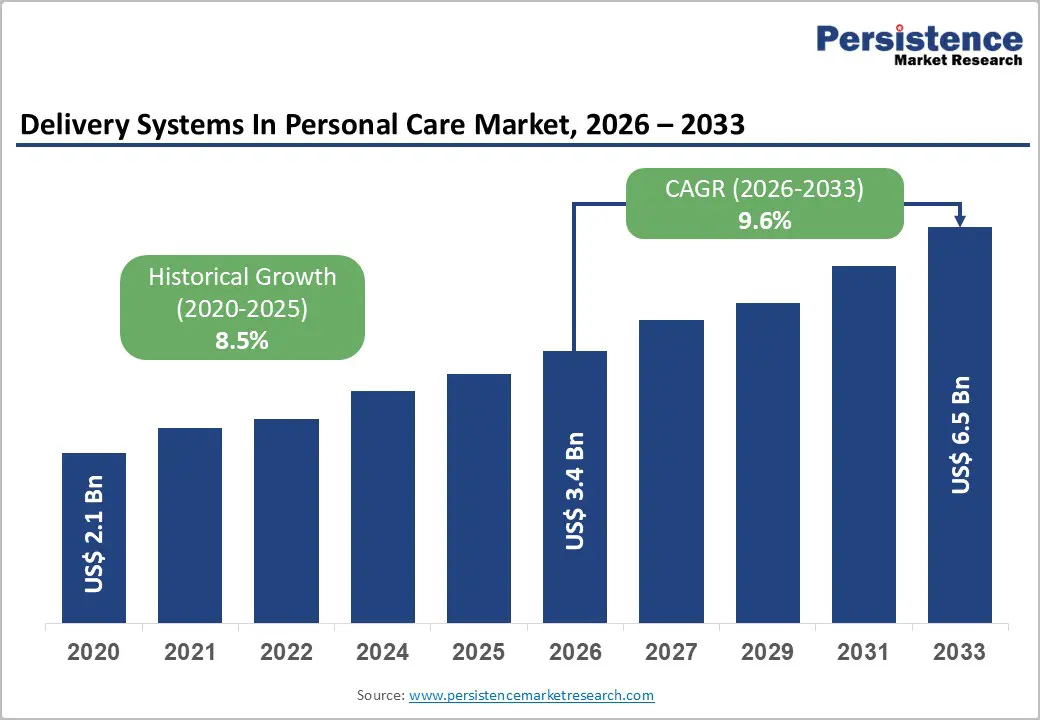
The global delivery systems in personal care market size was valued at US$3.4 billion in 2026 and is projected to reach US$6.5 billion by 2033, growing at a CAGR of 9.6% between 2026 and 2033. This robust expansion is driven by escalating consumer demand for efficacy-driven skincare and haircare solutions, the integration of nanotechnology into cosmetic formulations, and regulatory pressure requiring scientifically substantiated product claims.
Consumers increasingly prioritise functional benefits delivered through advanced encapsulation and targeted release technologies, compelling personal care manufacturers to invest in sophisticated delivery mechanisms that enhance active ingredient bioavailability and skin penetration. The convergence of consumer demand for personalised beauty solutions, technological capability to customise formulation profiles, and regulatory mandates for safety documentation creates sustained momentum for expansion within the Delivery Systems in personal care market through the forecast period.
Key Industry Highlights:
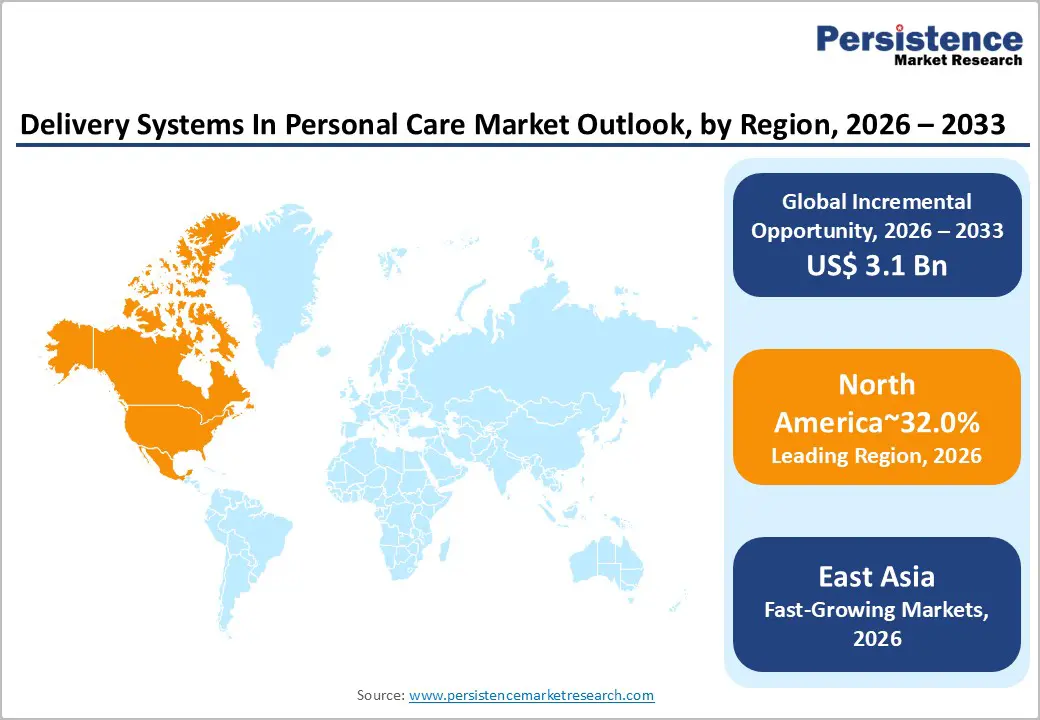
- Regional Leadership: North America leads the global delivery systems in personal care market with 30% share, supported by MoCRA-driven safety substantiation, premium consumer spending, and strong innovation ecosystems.
- Strong European Innovation Presence: Europe accounts for 27% of the market, supported by stringent regulatory compliance under Regulation (EC) 1223/2009, sustainability-driven product differentiation, and advanced nanotechnology R&D.
- Fast-Growing East Asian Market: East Asia holds 22% share and is the fastest-growing region, driven by China’s large-scale cosmetics industrial investments, K-beauty-led product sophistication, and expanding personalised skincare demand.
- Leading Application Segment: Skincare dominates with a 63% share, driven by high consumer prioritisation of anti-ageing, hyperpigmentation, and acne treatment efficacy, as well as measurable clinical performance in premium formulations.
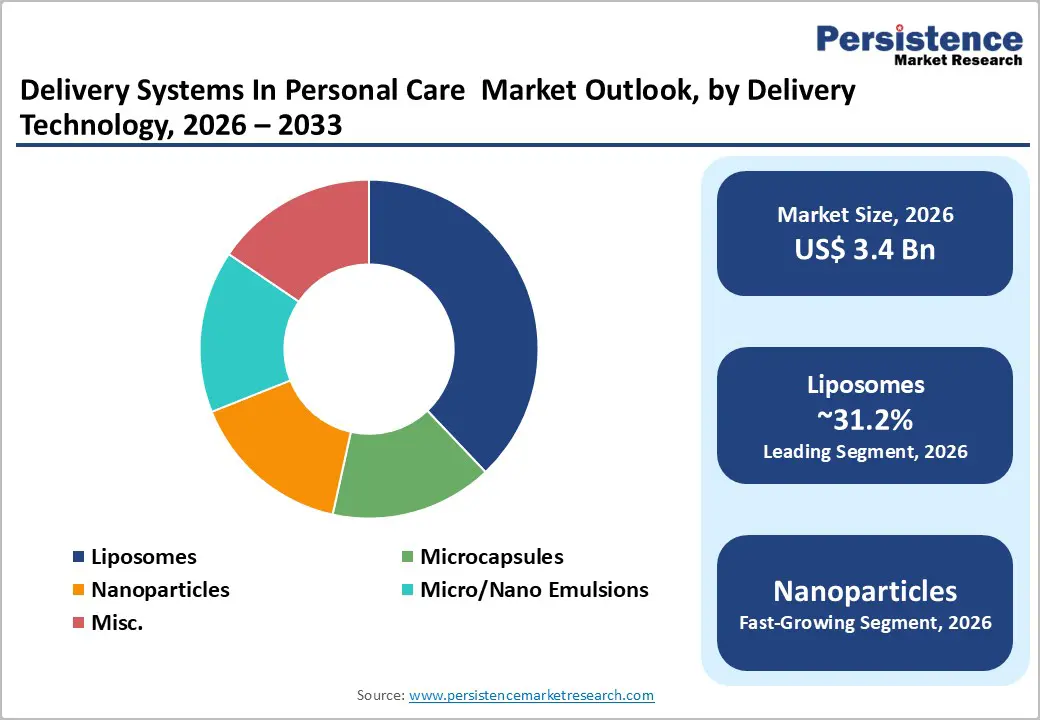
- Leading Delivery Technology Segment: Liposomes command leadership with ~31% share, attributed to proven biocompatibility, regulatory familiarity, and efficacy advantages in active ingredient penetration and irritation reduction.
- Fastest-Growing Technology Segment: Nanoparticles represent the fastest-growing segment, supported by targeted delivery, controlled-release benefits, and superior performance in advanced skincare and emerging scalp health formulations.
| Global Market Attributes | Key Insights |
|---|---|
| Delivery Systems in Personal Care Market Size (2026E) | US$ 3.4 Bn |
| Market Value Forecast (2033F) | US$ 6.5 Bn |
| Projected Growth (CAGR 2026 to 2033) | 9.6% |
| Historical Market Growth (CAGR 2020 to 2025) | 8.5% |
Market Dynamics
Growth Drivers
Consumer Demand for Measurable Efficacy and Clinically Validated Product Performance
Consumer behaviour has shifted fundamentally toward evidence-based cosmetics, with around 70 to 75percent of skincare users willing to trial new ingredients if the results justify premium pricing or low switching costs. This efficacy-centric consumer mindset has become a primary growth catalyst for the delivery systems in personal care market, as advanced delivery technologies, including liposomes, nanoparticles, and microencapsulation systems, directly enhance the bioavailability of active ingredients and demonstrate efficacy outcomes.
The global skincare market is reflecting consumer prioritisation of performance-validated formulations. Personal care brands investing in advanced delivery systems achieve competitive differentiation through measurable clinical outcomes, including reduced irritation profiles, extended duration of action, and deeper skin penetration compared to conventional formulations. Liposomal delivery systems, featuring encapsulated actives with superior absorption characteristics, command premium pricing justified by clinical validation supporting margin expansion for manufacturers investing in delivery technology integration. The Market directly benefits from this consumer shift toward efficacy validation, as delivery system sophistication becomes essential infrastructure for establishing regulatory compliance, clinical credibility, and consumer confidence in marketed claims.
Regulatory Mandate for Safety Documentation and Substantiation Requirements
Regulatory frameworks across North America and Europe have systematically tightened product safety requirements, compelling manufacturers to implement comprehensive safety documentation and clinical substantiation protocols. The FDA's 2022 Modernisation of Cosmetics Regulation Act (MoCRA) and its phased implementation through 2025 require cosmetic manufacturers to register facilities, submit complete product listings with full ingredient disclosure, and maintain documented safety substantiation before consumer distribution. By March 2025, all cosmetic products must demonstrate safety through scientific evidence, testing data for formulation components, and batch-track records.
The European Union's Regulation (EC) No. 1223/2009 establishes equivalently stringent requirements, mandating pre-market safety assessments from qualified experts and comprehensive product notifications to the Cosmetic Products Notification Portal (CPNP). These regulatory frameworks explicitly recognise advanced delivery technologies as mechanisms to enhance product safety profiles. For instance, encapsulation systems reduce the potential for active ingredient irritation by using controlled-release mechanisms that minimise peak-concentration exposure. Market expansion is directly catalysed by regulatory recognition that delivery system sophistication supports safety objectives. Manufacturers implementing liposomal delivery or nanoparticle encapsulation technologies can substantiate reduced irritation profiles and enhanced safety margins, directly support regulatory compliance and enable differentiated marketing claims.
Market Restraining Factors
Regulatory Uncertainty Surrounding Nanomaterial Safety and Labelling Requirements
Regulatory ambiguity regarding the substantiation of nanomaterial safety and labelling obligations creates significant constraints on the delivery systems in the personal care market's expansion. The European Union explicitly requires notification of cosmetic products containing nanomaterials to the European Commission, yet scientific consensus regarding appropriate safety testing protocols for nanoparticles remains contested. Consumer concerns regarding potential systemic absorption of nanoparticles through compromised skin barriers, and uncertainty regarding long-term accumulation effects, create perception risks that constrain market adoption despite technological benefits.
Manufacturers must navigate divergent international requirements, EU mandates explicit nanomaterial labelling, while FDA guidance on appropriate testing methodologies remains under development. This regulatory complexity increases product development timelines and compliance costs, particularly for brands pursuing international market expansion that requires navigating multiple jurisdictions. Resource constraints particularly impact smaller personal care manufacturers lacking regulatory expertise, creating competitive advantages for established companies with dedicated compliance infrastructure, thereby fragmenting market participation.
Key Market Opportunities
Sustainable and Biodegradable Delivery System Innovation Addressing Environmental Concerns
Environmental consciousness among personal care consumers creates a substantial market opportunity for innovations in sustainable delivery systems. Consumers increasingly prioritise eco-friendly formulations utilising biodegradable encapsulation materials, plant-derived carriers, and renewable resource sourcing. This opportunity directly addresses consumer preferences, particularly among Gen Z consumers, who represent around 42 percent of global skincare consumers and evaluate product sustainability alongside efficacy. Biodegradable polymer microencapsulation systems, plant-derived liposomal carriers utilising naturally occurring lipids, and ocean-friendly nanoparticle materials represent emerging technologies with sustainability credentials that justify premium pricing and differentiated brand positioning.
The C-beauty market (Chinese cosmetics exports) achieved around 18 to 20 percent growth in 2024, driven partly by consumer demand for natural ingredients and sustainable delivery mechanisms. Brands that incorporate sustainable delivery technologies can capture market share among environmentally conscious consumers willing to pay a premium for aligned brand values. Companies developing biodegradable microencapsulation systems, compostable delivery vehicles, and renewable-resource-based encapsulation platforms position themselves advantageously within the Market to capture growing consumer demand for sustainable personal care solutions. The regulatory environment increasingly supports sustainability initiatives through incentive structures and reduced compliance friction for proven biodegradable materials, creating favourable conditions for the commercialisation and market penetration of sustainable delivery systems.
Advanced Delivery Technology Application in Male Grooming and Specialised Hair Care Segments
The male grooming and specialised haircare segments represent emerging application categories for advanced delivery technologies, creating significant market opportunities. Male personal care consumption is expanding at an accelerating rate, with male consumers increasingly investing in targeted treatments addressing hair thinning, scalp health, skin irritation, and anti-ageing concerns. Micellar nanoparticle technology, recognised as among the most effective nanotechnology-based delivery mechanisms, has demonstrated particular efficacy in haircare formulations, including micellar shampoos that offer superior emulsification of fatty deposits and enhanced cleansing performance compared to conventional shampoos.
Specialised haircare applications, including scalp microbiome-targeted treatments, volumising agents for hair-thinning management, and conditioning actives with enhanced penetration at the skin-hair interface, represent growth opportunities for advanced delivery systems. Vesiderm's lipid-based nanocarrier platforms, enabling time-released delivery of sensitive actives like retinol and peptides historically targeting skincare applications, are being adapted for haircare formulations addressing scalp irritation and follicle health optimisation.
The expansion of male grooming product development, combined with personalisation technology that enables individualised hair treatment formulations, directly supports the adoption of advanced delivery technologies in haircare segments. Market analysis suggests male grooming expansion and specialised haircare application diversification, creating substantial commercialisation opportunities for manufacturers developing delivery system innovations specifically optimised for haircare application requirements.
Category-wise Analysis
Delivery Technology Insights
Liposomes holding shares of around 31.2% represent the largest delivery technology segment within the Delivery Systems in Personal Care Market, commanding established market leadership through proven efficacy, regulatory familiarity, and extensive cosmetic application history. Liposomal technology demonstrates superior biocompatibility characteristics, with phospholipid-based vesicles mimicking cellular membranes and enabling enhanced skin penetration while minimising irritation profiles.
The global liposomal pharmaceutical market demonstrates sustained expansion momentum, with liposomal finished pharmaceuticals demonstrating manufacturing maturation and regulatory pathway establishment that directly supports cosmetic application expansion. Established cosmetic manufacturers, including Mibelle Biochemistry, are pioneering plant-derived exosome delivery systems, such as nanoscale vesicles transporting active ingredients deep into skin layers exemplify innovation momentum within liposomal technologies, creating clinical differentiation through enhanced collagen and elastin production stimulation.
Liposomal delivery systems benefit from regulatory pathway maturation and industry expertise developed through decades of pharmaceutical applications, enabling rapid commercialisation of cosmetic formulations with clinical validation. Technology’s ability to encapsulate both hydrophilic and lipophilic active ingredients, addressing diverse skincare ingredient requirements, supports adaptability across varied cosmetic formulations and consumer applications. Liposomal market dominance reflects proven efficacy, established manufacturing infrastructure, and regulatory familiarity, enabling a justification for premium pricing and establishing consumer confidence, supporting continued market leadership through 2033.
Nanoparticle delivery systems represent the fastest-growing technology segment, driven by emerging applications in targeted delivery, controlled-release mechanisms, and integration with personalisation technologies. Nanoparticles, including silica nanoparticles (size range 5-100 nm), lipid nanoparticles, and solid lipid nanoparticles, enable customisation for safe and effective skin permeation of cosmeceutical products incorporating antioxidants, anti-wrinkle agents, and salicylic acid formulations. These systems demonstrate superior efficiency in delivering topically applied cosmetics to target skin layers compared to conventional liposomes, driving accelerated adoption among personal care manufacturers pursuing advanced formulation differentiation.
Technology Insights
Skincare applications dominate the Delivery Systems in Personal Care Market, commanding 63% market share, driven by universal consumer prioritisation of facial skincare addressing wrinkles, hyperpigmentation, acne, and anti-ageing concerns. The global skincare market is demonstrating sustained market expansion that directly supports advanced delivery system adoption. Skincare consumers increasingly demand personalised solutions targeting specific skin conditions, such as acne-prone skin, sensitive dermatitis-prone skin, and ageing skin, compelling manufacturers to develop precision delivery systems addressing condition-specific requirements.
Haircare applications represent the fastest growing segment within the Delivery Systems In Personal Care Market, driven by emerging consumer recognition of scalp microbiome importance, hair health optimisation potential, and treatment efficacy advancement through delivery system sophistication. Micellar nanoparticle technology has demonstrated particular efficacy in specialised haircare formulations, with micellar shampoo products exhibiting superior viscosity, enhanced emulsification of fatty deposits, and improved performance compared to conventional shampoo formulations. Advanced delivery systems enable targeted delivery of conditioning actives, anti-thinning agents, and scalp-health-supporting ingredients directly to follicles and scalp tissue applications where conventional delivery mechanisms demonstrate limited efficacy.
Regional Insights and Trends
North America Market Trend
North America commands 30% global market share within the delivery systems in personal care market, characterised by mature consumer markets, sophisticated regulatory frameworks, and innovation-driven competitive positioning. The region's skincare market is demonstrating sustained momentum in the adoption of advanced delivery systems. North American consumers prioritise measurable efficacy, clinical validation, and personalised skincare solutions, compelling manufacturers to implement sophisticated delivery technologies enabling precision ingredient targeting and performance substantiation.
Regulatory acceleration through the FDA's 2022 Modernisation of Cosmetics Regulation Act (MoCRA) explicitly strengthened product safety substantiation requirements, creating compliance advantages for manufacturers utilising advanced delivery systems that reduce irritation profiles and support documented safety claims. The region's robust research and development infrastructure, supported by premier universities and independent research organisations, creates an innovative ecosystem advantage, enabling rapid commercialisation of delivery systems and clinical validation.
North American brands, including established players and emerging direct-to-consumer companies, are systematically investing in advanced delivery technologies to establish competitive differentiation within mature, crowded skincare markets. Affluent consumer demographics supporting premium pricing for advanced cosmetic formulations, combined with a strong emphasis on health and wellness, create favourable commercial conditions for delivery system adoption. The region's robust retail infrastructure, encompassing both physical retail and digital commerce channels, supports rapid product commercialisation and consumer accessibility. North America's position reflects mature market dynamics combined with continuous innovation requirements, sustaining competitive positioning.
East Asia Market Trend
East Asia commands 22% of the global market share, though this share significantly understates the region's strategic importance within the Delivery Systems in Personal Care Market. China, Japan, and South Korea are the region's growth engines, with complementary dynamics driving adoption of advanced delivery systems across diverse consumer applications.
China's government commitment of $30 billion over five years to the cosmetics industry, combined with the nation's position as the world's largest cosmetics manufacturer and exporter, creates scale dynamics that support rapid commercialisation of delivery systems. The C-beauty market (Chinese cosmetics exports) grew by 18-20 percent in 2024, with total sales exceeding US$8 billion, demonstrating substantial export capacity for delivery-system-enhanced personal care products. South Korea's K-beauty innovation momentum, emphasising sophisticated skincare routines and advanced ingredient delivery, continues driving regional expectations for product sophistication and technical innovation. Japanese manufacturers, including Asahi Kasei, are pioneering advanced membrane systems for pharmaceutical solvent dehydration and specialised formulations, demonstrating innovation momentum directly transferable to cosmetic applications. India's food processing and cosmetics sectors are expanding rapidly, with personalised formulation capabilities emerging through domestic manufacturers. The region's cultural emphasis on skincare, combined with emerging purchasing power expansion among growing middle-class populations, creates sustained demand for advanced delivery system technologies supporting personalised solutions and efficacy validation.
Europe Market Trend
Europe represents 27% global market share, characterised by stringent regulatory requirements, technological innovation leadership, and emphasis on sustainable and natural delivery system methodologies. The region's skincare market demonstrates robust expansion momentum driven by AI-driven personalisation adoption, with European brands leveraging advanced skin analysis tools to recommend customised delivery-system-enhanced formulations. European regulatory frameworks, encompassing the EU's Regulation (EC) No. 1223/2009 and emerging nanomaterial-specific requirements, establish high compliance barriers that favour established manufacturers with sophisticated regulatory expertise but create competitive advantages through substantiated product claims.
The European regulatory environment explicitly recognises advanced delivery systems as mechanisms enhancing product safety and efficacy, supporting differentiated regulatory positioning for delivery-system-enhanced formulations. Sustainability emphasis across European consumer markets creates opportunities for biodegradable and eco-friendly delivery system innovations, supporting premium positioning for environmentally conscious formulations.
European manufacturers, including Arkema and emerging innovators, including Vesiderm, are advancing specialised delivery technologies addressing consumer demands for reduced-irritation formulations and sustainable encapsulation materials. The region's technological innovation leadership, combined with stringent regulatory compliance requirements and sustainability emphasis, positions Europe as the innovation hub for advanced delivery system development, though North American and East Asian markets demonstrate higher volume growth momentum.
Competitive Landscape
The global delivery systems in personal care market is moderately consolidated, with a cluster of multinational Speciality chemical and ingredient suppliers holding strong competitive positions. Leading players such as Evonik Industries, Croda International Plc, BASF SE, Clariant International Ltd., Lonza Group Ltd., and Salvona Technologies LLC drive market direction through sustained investments in encapsulation technologies, bio-based actives, and controlled-release systems for cosmetics and skincare applications. These investments support the development of innovative formulations and enable the delivery of targeted actives, enhancing product performance and consumer satisfaction. The market benefits from high barriers to entry due to stringent cosmetic regulations, formulation IP, application expertise, and long validation cycles with beauty brands, favouring established players. Innovation pipelines remain focused on microencapsulation, lipid carriers, anhydrous systems, film-formers, and sensory modifiers, often supported by strong technical service and contract development capabilities.
While niche firms like Centerchem Inc., International Flora Technologies Ltd., and Lipo Chemicals Inc. contribute specialised botanical and functional systems, overall competitive intensity leans toward collaboration over pricing wars. As premium skincare, dermocosmetics, and clean beauty trends expand globally, large suppliers are expected to consolidate their leadership via partnerships with beauty brands, strategic acquisitions, and sustainable technology platforms.
Key Industry Developments
- June 18, 2025 - SV Labs announced the launch of direct compression tablet technology in the U.S., enabling solid-format beauty and personal care products that support concentrated, waterless, and refillable delivery systems. The investment enhances domestic supply chain resilience and provides scalable, sustainable formulation options for brands, positioning SV Labs as a leader in anhydrous delivery formats within the personal care market.
- April 16, 2024 - Ashland Inc. announced multiple sustainable ingredient innovations at in-cosmetics Global (Paris), including Gantrez™ soja delivery system, a nature-derived, biodegradable technology that enhances the retention of oral care actives for long-lasting benefits. The launch reinforces Ashland’s position in advanced delivery systems for personal care, aligning with clean-label and biodegradable formulation trends.
Companies Covered in Delivery Systems in Personal Care Market
- Clariant International Ltd.
- Centerchem Inc.
- Croda International Plc.
- Lonza Group Ltd.
- Air Products and Chemicals, Inc.
- Minerals Technologies Inc.
- International Flora Technologies, Ltd.
- Unipex Group Inc.
- BASF SE.
- Lipotec SAU.
- Salvona Technologies LLC.
- Lipo Chemicals, Inc.
- Glenn Corporation.
Frequently Asked Questions
The global Delivery Systems in Personal Care Market is projected to be valued at US$ 3.4 Bn in 2026.
The Liposomes segment is expected to account for approximately 31.2% of the Global Delivery Systems in Personal Care market by Delivery Technology in 2026.
The market is expected to witness a CAGR of 9.6% from 2026 to 2033.
The Delivery Systems in Personal Care Market is driven by rising consumer demand for clinically validated product efficacy and tightening regulatory requirements for safety substantiation and ingredient performance documentation.
Key opportunities lie in sustainable biodegradable delivery systems and the expanding use of advanced delivery technologies in male grooming and specialised haircare segments.
Key players in the Delivery Systems in Personal Care Market: Evonik Industries, Croda International Plc, BASF SE, Clariant International Ltd., Lonza Group Ltd., and Salvona Technologies LLC.


