




- Technology
- Nano Bubble Generators Market
Nano Bubble Generators Market Size, Share, and Growth Forecast 2026 - 2033
Nano Bubble Generators Market by Gas Type (Oxygen Nano Bubble Generators, Ozone Nano Bubble Generators, Air Nano Bubble Generators, Others), Technology Type (Hydrodynamic Cavitation Systems, Electrolytic Nano Bubble Generators, Ultrasonic Nano Bubble Generators, Others), Application, and Regional Analysis, 2026 - 2033

Nano Bubble Generators Market Size and Trend Analysis
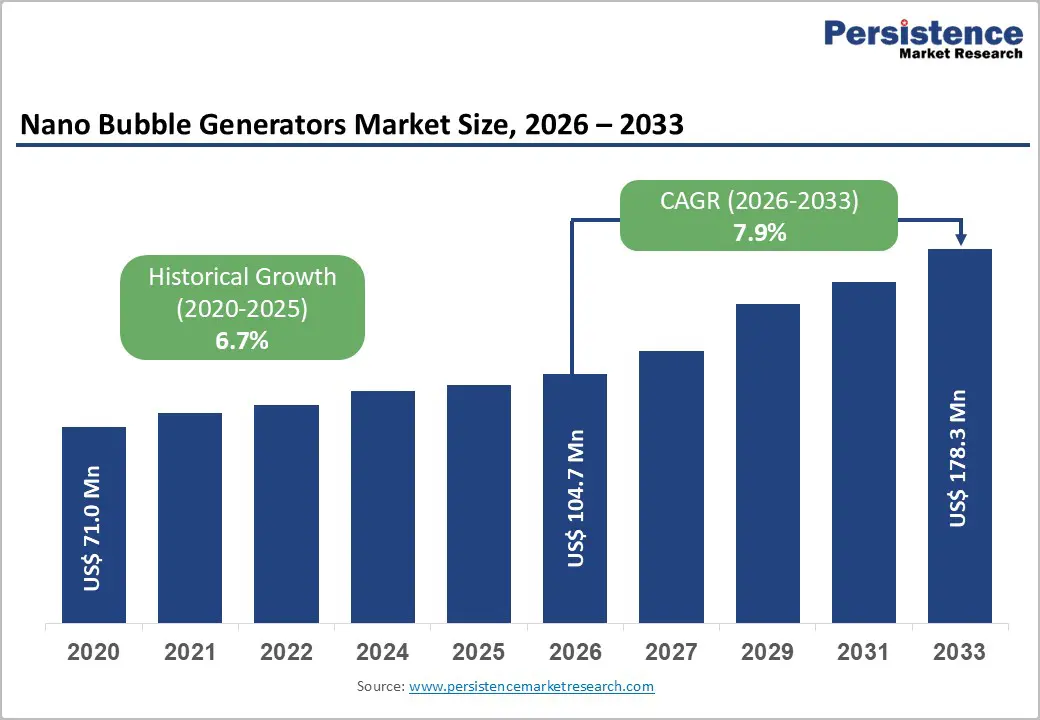
The global nano bubble generators market size is expected to be valued at US$ 104.7 million in 2026 and projected to reach US$ 178.3 million by 2033, growing at a CAGR of 7.9% between 2026 and 2033.
This growth is primarily driven by rising demand for sustainable water treatment technologies, as nano-bubbles enhance oxygen transfer and pollutant removal more efficiently than conventional methods. The expansion of aquaculture activities worldwide, particularly in leading fish-producing countries such as China and Norway, further supports adoption. Nano bubble aeration has been associated with significantly improved yields and healthier aquatic environments. Moreover, stringent environmental regulations and increasing global water scarcity are accelerating investments in energy-efficient nano bubble solutions.
Key Market highlights
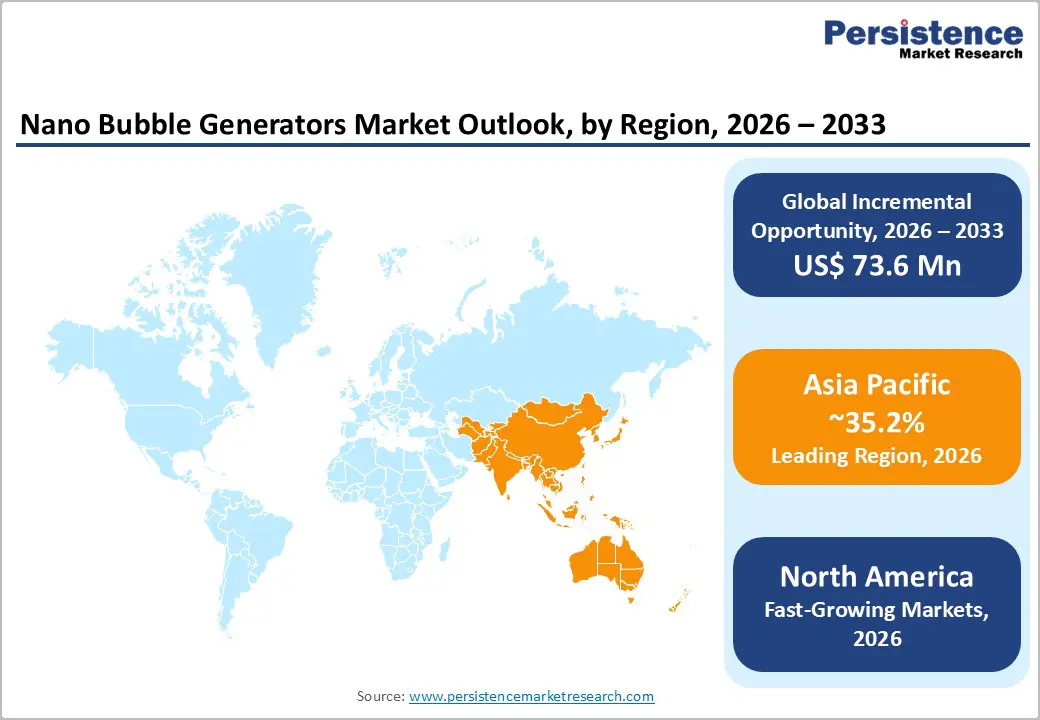
- Leading Region: Asia Pacific dominates the market with 35.2% share in 2025, supported by strong manufacturing capacity and expanding aquaculture adoption.
- Fastest-Growing Region: Europe is projected to grow at a strong 8.2% CAGR, driven by stringent wastewater reuse regulations and aquaculture innovation.
- Leading Gas Type Category: Oxygen Nano Bubble Generators lead with a 45% share in 2025, driven by superior dissolved oxygen performance in aquaculture.
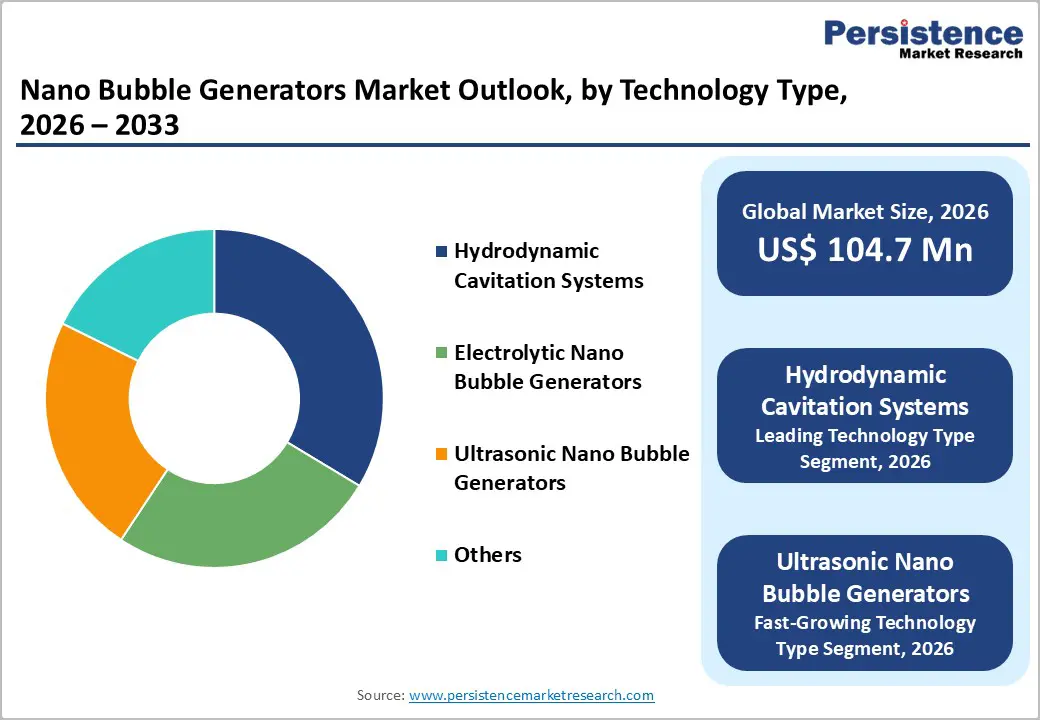
- Leading Technology Category: Hydrodynamic Cavitation Systems command 40% share, favored for scalable, energy-efficient nano-bubble generation.
- Key Growth Opportunity Area: Precision agriculture is emerging as a major opportunity, delivering up to 30% gains in irrigation efficiency in water-scarce regions.
| Key Insights | Details |
|---|---|
| Nano Bubble Generators Size (2026E) | US$ 104.7 million |
| Market Value Forecast (2033F) | US$ 178.3 million |
| Projected Growth CAGR (2026 - 2033) | 7.9% |
| Historical Market Growth (2020 - 2025) | 6.7% |
Market Dynamics
Drivers - Expanding Aquaculture Industry Requiring Advanced Oxygenation Systems
Global aquaculture output surpassed 120 million tons in 2024 (FAO), driving strong demand for nano-bubble generators to maintain higher dissolved oxygen levels in intensive fish farming. Nano-bubbles remain suspended longer due to neutral buoyancy, thereby improving nutrient circulation and reducing fish mortality by up to 30% relative to conventional aerators. This enhanced efficiency is especially valuable in major aquaculture hubs such as China and Norway.
Additionally, nano-bubble aeration can lower energy consumption by nearly 50%, making it a cost-effective solution for large-scale operations. With rising global seafood consumption fueled by population growth and dietary shifts, farms increasingly adopt nano-bubble systems to improve yields, water quality, and sustainability.
Rising Need for Efficient and Sustainable Water Treatment Technologies
UNESCO estimates that 2.2 billion people still lack access to safely managed drinking water, prompting municipalities to adopt advanced treatment technologies such as nanobubble technology. Nano bubbles support advanced oxidation processes by generating free radicals that degrade contaminants such as VOCs more effectively, thereby reducing reliance on heavy chemical dosing. This aligns with EPA-driven sustainability goals in water infrastructure.
Moreover, nanobubbles exhibit 10–100 times higher mass-transfer efficiency due to their extremely large surface area. This improves disinfection performance, reduces sludge generation, and lowers operational costs for wastewater and drinking water utilities, making nano-bubble generators an increasingly attractive technology amid global water scarcity concerns.
Restraints - High Initial Capital Investments Limiting Adoption by Smaller Users
Nano bubble generators involve upfront costs 20–50% higher than conventional aerators, mainly due to specialized components such as cavitation nozzles and high-pressure pumps. This higher capital requirement often discourages small- and medium-scale aquaculture and industrial operators from adopting the technology. NIFA studies also highlight that maintenance of electrolytic systems, including electrode replacement and wear management, can increase annual operating expenses by 15–25%.
The lack of standardization across different nano-bubble technologies further complicates procurement and deployment, particularly in emerging markets. Without uniform performance benchmarks, companies face challenges in planning large-scale installations, thereby limiting adoption despite the long-term efficiency and sustainability benefits of nano-bubble systems.
Technical Scalability and Performance Challenges at Industrial Volumes
Consistently producing stable nano-bubbles at industrial-scale volumes remains a key technical challenge. Ultrasonic generation methods, while effective in labs, can consume up to twice as much energy as hydrodynamic systems, increasing operational costs. Moreover, variability in bubble size, ranging from 1 to 100 nanometers, can affect oxygen transfer efficiency and disinfection performance across diverse applications, including aquaculture, water treatment, and food processing.
These inconsistencies in performance and energy requirements slow large-scale deployment. Even with proven laboratory results, industries are cautious about investing in nano-bubble technology without assurances of consistent efficacy and cost-effectiveness under real-world, high-volume conditions.
Opportunity - Growing Opportunities in Precision Agriculture Through Enhanced Irrigation Efficiency
The expansion of precision agriculture presents significant opportunities for nano-bubble technology, as these systems improve irrigation efficiency by up to 30%, particularly in water-stressed regions such as India. USDA-funded trials demonstrate that nano bubbles enhance root oxygenation, promoting healthier plant growth and reducing fertilizer requirements by approximately 20%.
Additionally, the rise of hydroponic and controlled-environment farming is driving demand for ozone-based nanobubble generators, which help control pathogens without excessive chemical use. By improving water and nutrient utilization, nano-bubble systems align with sustainable agriculture initiatives and support farmers in maximizing yields while conserving resources.
Policy-Driven Opportunities in Wastewater Recycling and Industrial Treatment
Stringent wastewater recycling mandates, such as the EU Water Framework Directive, which requires 50% reuse by 2030, are creating opportunities for the adoption of nano-bubbles. These systems facilitate advanced oxidation and pollutant removal processes, achieving up to 99% contaminant elimination with lower chemical inputs.
Innovations like electric-field-based nano-bubble generators, exemplified by AquaB’s technology, allow industrial users, especially in the Asia Pacific, to meet regulatory standards while minimizing energy consumption. As governments increasingly promote water sustainability and energy-efficient treatment solutions, nano-bubble generators are becoming an attractive option for both municipal and industrial wastewater management.
Category-wise Analysis
Gas Type Insights
Oxygen nano bubble generators lead the market with a 45% share in 2025, driven by their superior solubility and ability to maintain dissolved oxygen (DO) levels above 8 mg/L in aquaculture. NIFA aquaponic trials show that they outperform conventional macro bubbles by a factor of 3. High adoption is fueled by improved fish health and reduced mortality, addressing oxygen deficits that cause 20-30% annual losses globally (FAO).
Ozone and air-based nano-bubble generators are emerging rapidly in applications such as pathogen control, water sterilization, and wastewater treatment. Their ability to generate reactive oxygen species without chemical reagents positions them as promising alternatives for sustainable aquaculture and industrial water management, thereby supporting disease reduction, water quality improvement, and energy-efficient operation.
Technology Type Insights
Hydrodynamic cavitation systems account for the largest share (40%) in 2025, owing to their energy efficiency and scalability. ScienceDirect reviews confirm that they use approximately 30% less power than ultrasonic methods while generating stable nanobubbles via pressure drops. Their reliability makes them dominant in industrial water treatment, municipal wastewater management, and large-scale aquaculture operations.
Ultrasonic and electrolysis-based nano-bubble technologies are emerging as the fastest-growing segments. Their precise control over bubble size and reactive gas generation allows specialized applications in laboratories, medical sterilization, and high-value food processing. Continuous innovation in these methods enhances versatility, enabling adoption across diverse industries where traditional cavitation systems may be less effective.
Application Insights
Aquaculture accounts for the largest application share at 35% in 2025, driven by nano bubbles’ ability to boost yields by 25-45% in systems such as Norway’s salmon farms. Enhanced dissolved oxygen levels, pathogen control, and improved wastewater management reduce disease outbreaks and increase survival rates, which are critical as global aquaculture output reaches 120 million tons.
Water treatment is the fastest-growing application, as nano-bubble systems enhance oxidation, pollutant degradation, and disinfection without heavy chemical use. Municipal and industrial facilities increasingly deploy these technologies for sustainable wastewater recycling, energy-efficient aeration, and advanced oxidation processes, thereby meeting stringent regulatory requirements and addressing global water scarcity.
Regional Insights
North America Nano Bubble Generators Market Trends and Insights
North America holds a significant share of the global nano bubble generators market, with the U.S. leading adoption due to the EPA's endorsement of nano bubbles as non-chemical disinfectants. Municipal water treatment facilities increasingly integrate these systems in response to Clean Water Act updates, while companies like Moleaer drive innovation in oil & gas water recycling and industrial applications. California’s drought policies have also accelerated agricultural adoption, improving irrigation efficiency by up to 25% in almond farms through nano-bubble aeration trials.
Canada and Mexico are gradually adopting nano-bubble technology for aquaculture and wastewater management, thereby expanding regional deployment. Growing awareness of sustainable water management, coupled with R&D incentives and supportive state-level policies, positions North America as a strong, stable market, accounting for approximately 30.6% of the market.
Europe Nano Bubble Generators Market Trends and Insights
Europe is witnessing steady growth, with a projected CAGR of 8.2%, driven by environmental regulations and aquaculture initiatives. Germany and Norway lead in salmon and shellfish farming using nanobubble systems, supported by €10 million in EU funding for nanotechnology R&D under Horizon programs. The UK and France harmonize standards through REACH, encouraging wastewater recycling, while Spain’s hydroponics sector grows 15% annually, leveraging ozone-based generators to enhance greenhouse production in line with the Water Framework Directive.
The region’s emphasis on regulatory compliance, energy-efficient water treatment, and sustainable aquaculture drives adoption across multiple industries. Investments in R&D and pilot projects for industrial and municipal water applications are accelerating, solidifying Europe as a key growth region in the global nano bubble market.
Asia Pacific Nano Bubble Generators Market Trends and Insights
Asia-Pacific dominates the global market with an estimated 35.2% share, led by China’s manufacturing capacity and export dominance, which account for 60% of global nano bubble generators. Japan focuses on R&D, particularly in ultrasonic nanobubble technology, to advance precision water treatment and industrial cleaning applications. India’s NAMO scheme supports the adoption of agri-irrigation, with reported crop yield improvements of up to 30%, while ASEAN countries benefit from cost-effective hydrodynamic systems, supporting regional aquaculture growth at an approximately 10% CAGR (FAO).
Rapid industrialization, population growth, and rising seafood demand are driving adoption across aquaculture, agriculture, and municipal water treatment. Government incentives, technological innovation, and cost-effective solutions are strengthening the Asia-Pacific market, which is the largest regional contributor to global nano bubble generator deployment.
Competitive Landscape
The nano bubble generators market is highly fragmented, with numerous manufacturers competing across regions. Leading players focus on innovation through R&D collaborations and expanding their presence in key manufacturing hubs, particularly in Asia. Product differentiation is largely driven by energy efficiency, operational reliability, and adaptability to diverse applications, ranging from aquaculture to wastewater treatment.
Emerging models increasingly incorporate smart features, including IoT-enabled sensors for real-time monitoring, predictive maintenance, and remote control. Companies are also customizing solutions to meet specific industrial, agricultural, and municipal requirements, enhancing adoption in both established and emerging markets while responding to sustainability and efficiency demands.
Key Developments:
- In July 2025, Moleaer unveiled a nanobubble process for thin films, enhancing battery efficiency and improving water filtration performance, marking a significant advancement in both energy storage and sustainable water treatment applications.
- In December 2025, AquaB commissioned Vulcan-500 nano bubble generators at Saudi Aramco, enabling more sustainable oil recovery operations by improving water reuse, reducing chemical usage, and enhancing overall process efficiency in large-scale industrial applications.
- In February 2025, Acniti expanded exports of its GaLF series nano bubble generators to over 50 countries, supporting aquaculture oxygenation, improving dissolved oxygen levels, and promoting healthier fish farming practices across international markets.
Companies Covered in Nano Bubble Generators Market
- Moleaer Inc.
- acniti LLC
- Agrona B.V.
- Nano Technical Center
- Newman Technology
- OxyDoser
- NANOBBLE (Energenius Technologies Pvt Ltd)
- Asuplus Nanobubble Technology
- Pacific Water Technology
- Qingdao Ozonier Purification Equipment Co., Ltd.
- Holly Technology Co., Ltd.
- Dino Purification
- Rapid Water Technologies
- Shanghai Mutao Environmental Technology Co., Ltd.
- Nanobubble Systems Inc.
Frequently Asked Questions
The global nano bubble generators market is expected to reach US$ 104.7 million in 2026.
Rising aquaculture demand is driving adoption, with nano bubbles boosting yields by 25-45% through improved oxygenation.
Asia Pacific leads with 35.2% share in 2025, supported by strong manufacturing and aquaculture growth.
Precision agriculture offers a major opportunity, delivering up to 30% irrigation efficiency gains in water-scarce regions.
Leading players Moleaer Inc., acniti LLC, Agrona B.V., Nano Technical Center, and Newman Technology, focusing on sustainable innovations.


