




- Biotechnology
- Molecular Grade Plates Market
Molecular Grade Plates Market Size, Share, Trends, Growth, and Regional Forecast, 2025 to 2032
Molecular Grade Plates Market by Product (PCR Plates, Deep Well Plates, Sample Preparation Filter Plates), Application (PCR, Next Gen Sequencing, Sample Storage), End-user, Regional Analysis, 2025 - 2032

Molecular Grade Plates Market Share and Trends Analysis
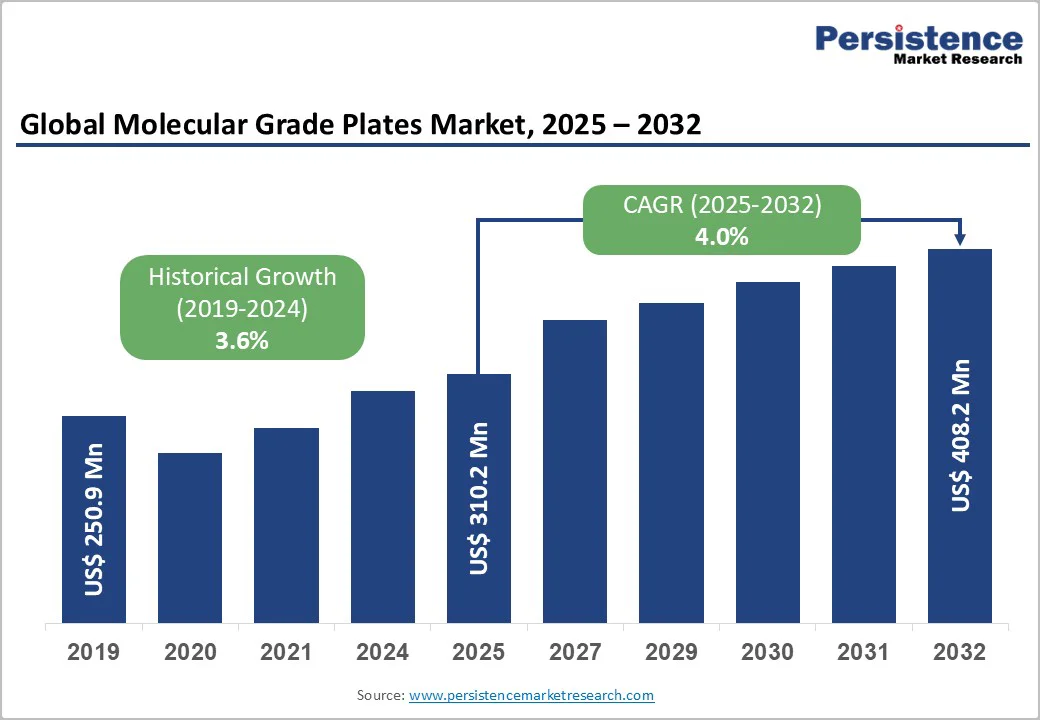
The global molecular-grade plates market is valued at US$310.2 million in 2025 and is projected to reach US$408.2 million, growing at a CAGR of 4.0% from 2025 to 2032.
The growth of the life sciences sector, driven by biopharmaceutical research, genomics, proteomics, and molecular biology, is fueling continuous demand for advanced lab products.
Emerging technologies such as virtual clinical trials, AI, and telemedicine are reshaping research methodologies. At the same time, healthcare R&D increasingly focuses on novel treatments for chronic diseases, improved patient compliance, and innovative dosage forms. In this context, tear-off PCR plates are a key trend, enabling efficient, cost-effective experimentation and helping researchers advance scientific discoveries in a rapidly evolving, technology-driven environment.
Key Industry Highlights
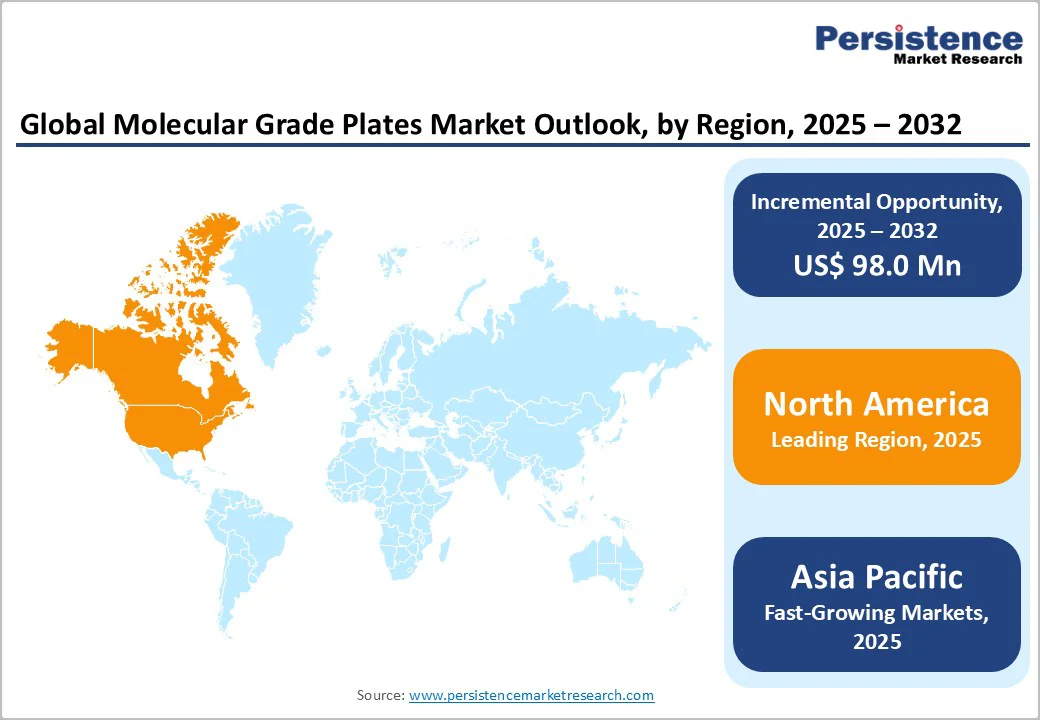
- Leading Region: North America leads the market with 34% share, driven by its research infrastructure and investment in molecular diagnostics and genomics.
- Fastest Growing Region: Asia Pacific posts the fastest CAGR, reflecting heavy pharmaceutical and life science investments across China, Japan, and India.
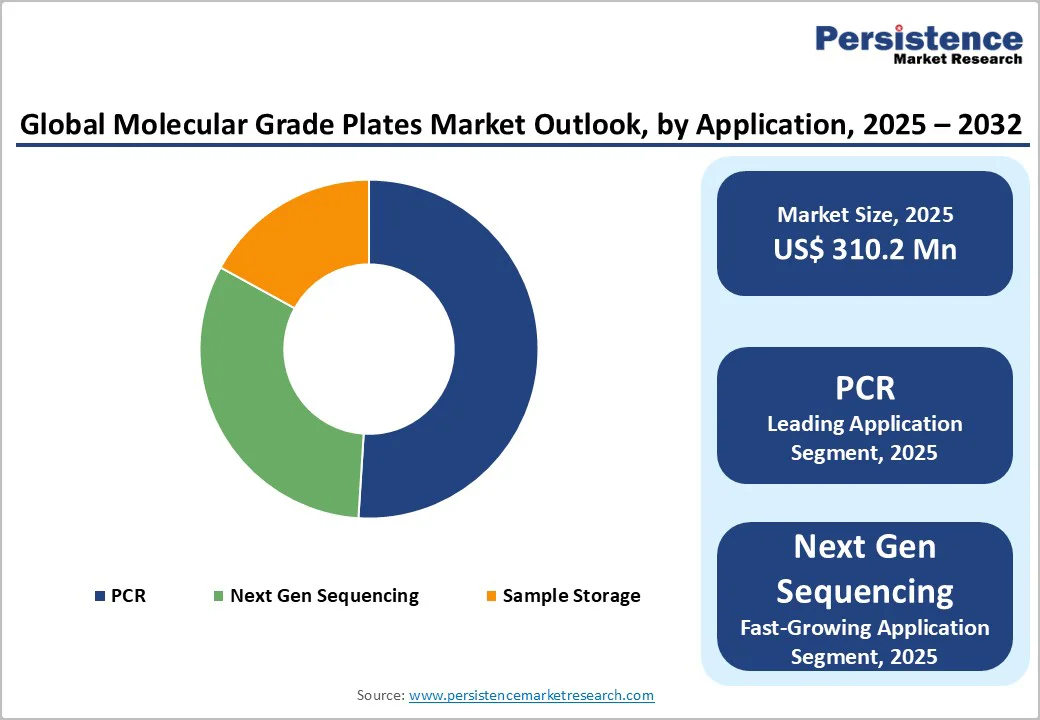
- Dominant Segment: PCR plates dominate the product category with a 62% share, underpinning key applications in diagnostics, research, and life science automation.
- Fastest Growing: Next Generation Sequencing applications are the fastest-growing segment, driven by automated workflows and precision medicine efforts.
| Key Insights | Details |
|---|---|
| Molecular Grade Plates Market Size (2025E) | US$ 310.2 Mn |
| Market Value Forecast (2032F) | US$ 408.2 Mn |
| Projected Growth (CAGR 2025 to 2032) | 4.0% |
| Historical Market Growth (CAGR 2019 to 2024) | 3.6% |
Market Dynamics
Driver - Growing R&D Expenditures and Novel Product Launch Activities
The R&D and technology spend is moving from North America and Europe to the Asia Pacific, particularly in the life sciences. There are more opportunities for outsourcing biotech projects in developing nations like India because they have an availability of qualified personnel at affordable prices.
Additionally, with tax exemptions for expanded budgets and funding for R&D, creating public and private corporations, and luring foreign direct investments, the Asia Pacific government is assisting the expansion of the domestic biotechnology industry.
Furthermore, there is significant potential for market expansion due to the growing use of molecular biology applications in academia and research. R&D investment in the life sciences is among the highest in all industries and is expected to increase steadily over the coming years. Businesses that invest in delivering products and services to meet the needs of research can anticipate reliable returns.
The need for molecular-grade plates in developing regions is expected to increase as rising nations invest more in the healthcare sector. Major players are expanding their manufacturing and distribution capabilities to reach as many end consumers as possible worldwide.
Additionally, local firms are gaining market share with their cutting-edge products and innovations. Growing government R&D programmes are anticipated to open up significant market potential for molecular-grade plates in emerging nations.
Restraints - Regulatory Impositions, Lack of Skilled Professionals, and Financial Constraints in Establishing New Businesses
The main obstacle to the market expansion for molecular-grade plates is the high cost of PCR and next-generation sequencing systems and equipment. Additionally, the main barrier to market expansion is the hesitation among small and medium-sized businesses in many developing nations to adopt new PCR systems due to a lack of funding. Although PCR is a widely utilised technique, many research institutes are hesitant to modernise their infrastructure and adopt cutting-edge techniques.
It is increasingly challenging for individuals to align their skill sets with employers' needs due to accelerating technological advancements and the digitization of the workplace. The life sciences industry is anticipated to experience market growth restraints due to a lack of knowledgeable and trained workers, which may have an influence on the market for molecular-grade plates.
PCR and other molecular applications are delicate processes, and carelessness or a lack of expertise can cause a procedure to fail. Highly competent and trained individuals who are familiar with the technology and mechanisms are needed for such procedures.
Additionally, the development of new products is affected by ethical and regulatory restrictions on plastic. This will probably prevent the market for molecular-grade plates from expanding. Nevertheless, medical plastics play a significant role in the contemporary healthcare system. Due to stringent government regulations in many regions, manufacturers of these plastic materials must adhere to international regulatory standards.
Opportunity - Growth in Next-Generation Sequencing (NGS) and Automation-Driven Sample Preparation
The expansion of Next-Generation Sequencing (NGS) applications is creating significant opportunities in the molecular and life sciences research consumables market. Molecular-grade PCR and microplates are increasingly used in NGS workflows, including library preparation, multiplexed assays, and high-throughput screening. Plates designed for automation and robotic liquid handling improve laboratory efficiency, minimize contamination risks, and enable reproducible results, making them highly desirable in modern research settings.
Leading suppliers such as PerkinElmer Inc., Corning Incorporated, and Cytiva are developing plates optimized for robotic integration, flexible formats, and high-throughput applications, reflecting strong industry focus on automation compatibility.
Rising investments in personalized genomics, precision medicine, and molecular diagnostics are driving demand for advanced sample preparation tools, particularly in emerging regions like Asia-Pacific, where research infrastructure and healthcare R&D are rapidly expanding.
The shift toward automated workflows and high-throughput experimentation not only reduces operational costs but also accelerates data generation, supporting faster scientific discoveries. Consequently, the market for NGS-compatible, automation-ready molecular plates presents a substantial growth opportunity for manufacturers aiming to meet the evolving needs of genomics, diagnostics, and translational research laboratories globally.
Category-wise Analysis
By Product, PCR Plates Dominate the Molecular Grade Plates Market
The PCR plates segment accounted for approximately 62% of the global molecular-grade plates market in 2024, establishing it as the dominant product category. PCR plates are widely used in molecular biology research, particularly for identifying and analyzing bacterial infections, viral pathogens, and genetic markers. They simplify DNA amplification, making sequencing faster and more efficient by providing a stable platform for polymerase chain reactions.
One key advantage of PCR plates is their ability to support single-stranded DNA amplification without requiring fully complementary primers, increasing experimental flexibility. Their compatibility with automated liquid handling systems and high-throughput workflows further enhances laboratory efficiency. Researchers benefit from reduced sample loss, minimized contamination, and consistent, reproducible results.
The widespread use of PCR in genomics, diagnostics, and pharmaceutical research continues to drive demand for high-quality plates. As a result, PCR plates maintain a leading position in the molecular-grade plates market and are expected to continue dominating due to their essential role in modern molecular biology applications worldwide.
By Application, PCR Dominates, NGS Emerges as Fastest-Growing Segment
The PCR application segment remains the largest in the molecular grade plates market, representing approximately 51% of total usage in 2024. PCR technology enables rapid, accurate, and high-throughput amplification of genetic material, making it indispensable in infectious disease testing, cancer genomics, and forensic analysis.
Standardized plate formats are critical in both research and clinical diagnostics, ensuring reproducibility, minimizing contamination, and meeting regulatory requirements. Continuous advancements in instrumentation, reagents, and laboratory automation further support PCR’s widespread adoption across academic, clinical, and pharmaceutical laboratories, reinforcing its dominant market position.
At the same time, Next-Generation Sequencing (NGS) is emerging as the fastest-growing application. NGS workflows rely heavily on molecular-grade plates for library preparation, multiplexed assays, and automated sample handling. The adoption of high-throughput, automation-compatible formats enables researchers to process large volumes of samples efficiently while reducing contamination risks.
Rising investments in personalized genomics, precision medicine, and molecular diagnostics, particularly in emerging regions like the Asia-Pacific, are accelerating NGS adoption. As sequencing technologies expand across healthcare and life sciences research, NGS is expected to drive the fastest growth in the molecular grade plates market over the forecast period.
Region-wise Insights
North America Molecular Grade Plates Market Trends
North America continues to lead the global molecular grade plates market, holding approximately 34% of the total market in 2024, driven by world-class research infrastructure, widespread adoption of PCR and NGS platforms, and supportive regulatory frameworks.
The U.S. dominates the region, accounting for around 92.6% of the North American market, a trend expected to continue over the forecast period. Strong investments from the federal government, universities, private organizations, and healthcare institutions fuel research and development in genomics, diagnostics, and pharmaceutical studies.
Rising healthcare costs and the increasing need for innovative treatments have accelerated the examination of novel compounds and high-throughput experimentation, directly boosting demand for molecular grade plates. The presence of biotechnology clusters, academic medical centers, and advanced laboratories facilitates rapid commercialization of new technologies and reagents.
Continuous FDA approvals, research grants, and funding programs for molecular biology and diagnostics further strengthen North America’s leadership.
Combined, these factors support consistent growth in the market for PCR plates, NGS-compatible plates, and other molecular grade consumables, as laboratories prioritize efficiency, reproducibility, and high-throughput capabilities in modern research workflows.
Asia and Pacific Molecular Grade Plates Market Trends
Asia Pacific is emerging as the fastest-growing region in the molecular grade plates market, driven by rapid expansion in genomics research, infectious disease monitoring, and precision medicine initiatives. China dominates the Asia Pacific market, supported by increasing R&D investments and establishment of innovation centers by major global players.
Countries such as China, Japan, and India are at the forefront of this growth, benefiting from strong government support for life sciences R&D, pharmaceutical innovation, and academic-industry collaborations. Competitive manufacturing costs, high-throughput sequencing infrastructure, and increasing adoption of automation-compatible molecular grade plates further drive market demand.
Expanding genomics and diagnostics applications, coupled with rising investments in laboratory infrastructure, position Asia Pacific as a key hub for future market growth, offering significant opportunities for manufacturers and researchers seeking to tap into the region’s rapidly evolving life sciences ecosystem.
Market Competitive Landscape
In addition to providing products for sensitive applications, leading companies of molecular grade plates are also manufacturing low binding plates for sample preparation for next-generation sequencing. Low binding polypropylene plates are chosen because they allow for several incubation and transfer phases without sample loss during investigations. Increasing or maintaining sample yield is a critical requirement for molecular biology applications.
Key Industry Developments:
- In April 2024, Eppendorf introduced new biobased PCR plates aimed at improving sustainability in laboratory workflows.
- In October 2023, Eppendorf launched new biobased PCR plates designed to accelerate research in diagnostics, therapeutics, and personalized medicine, while improving precision, workflow complexity, and automation in laboratories.
Companies Covered in Molecular Grade Plates Market
- Thermo fisher scientific
- Merck KGA
- Bio-Rad
- Takara Bio, Inc.
- QIAGEN N.V.
- Pall Corporation
- Eppendorf Corporate
- Tarsons
- Applied Biological Applications Inc.
- Greiner AG
- Brooks Life Sciences
- Corning Incorporated
- Cytiva
- PerkinElmer Inc (Euroimmun AG).
- Others
Frequently Asked Questions
The global molecular grade plates market is projected to be valued at US$ 310.2 Mn in 2025.
Expansion of PCR and NGS applications, as well as adoption by biotechnology and research institutions, are principal growth drivers.
The global market is poised to witness a CAGR of 4.0% between 2025 and 2032.
Automation integration, eco-friendly consumable launches, and rapid uptake in Asia Pacific present major growth pathways.
Major players include Thermo Fisher Scientific, Merck KGaA, Bio-Rad, QIAGEN N.V., Takara Bio, Inc., and others.


