




- Specialty & Fine Chemicals
- Metal Polish Products Market
Metal Polish Products Market Size, Share, and Growth Forecast, 2026 – 2033
Metal Polish Products Market by Form (Liquid, Cream, Gel, Foam, Spray, Wipes), Application (Household Furniture, Automotive Detailing, Industrial Equipment, Marine & Aviation, Jewelry & Luxury Goods), Metal (Stainless Steel, Brass, Aluminum, Copper, Silver, Gold, Others), and Regional Analysis for 2026 – 2033

Metal Polish Products Market Share and Trends Analysis
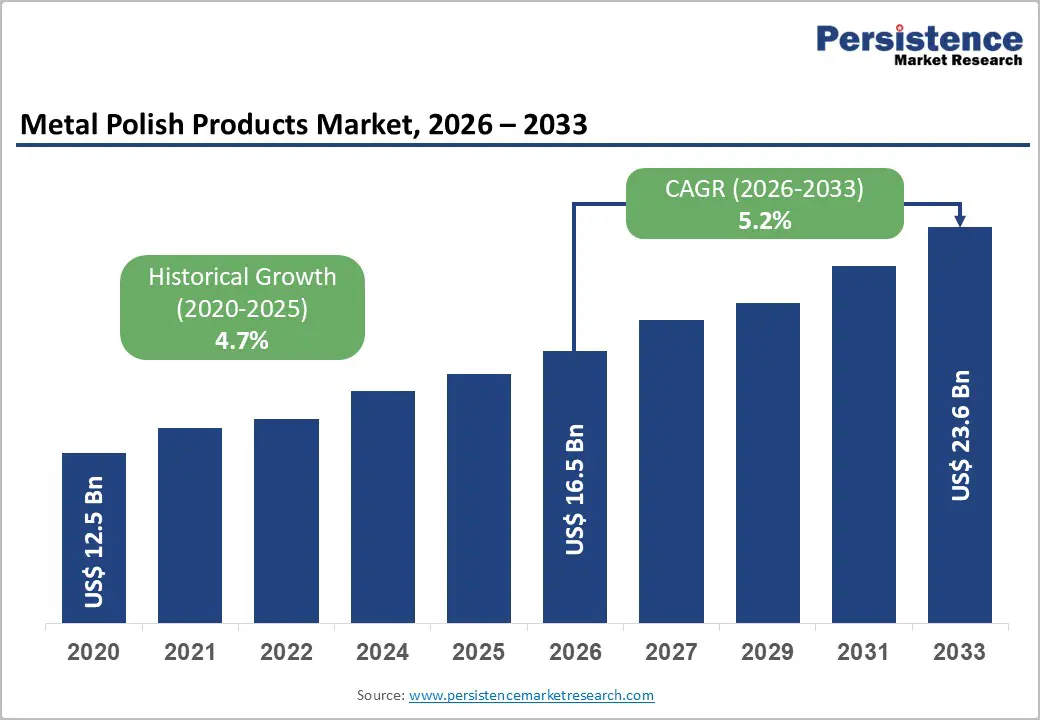
The global metal polish products market size is likely to be valued at US$ 16.5 billion in 2026, and is projected to reach US$ 23.6 billion by 2033, growing at a CAGR of 5.2% during the forecast period 2026–2033.
This market demonstrates strong growth fueled by increasing industrialization, rising automotive maintenance needs, and growing consumer focus on maintaining the aesthetic and functional quality of metal surfaces. The demand for metal polish products is reinforced by widespread usage across household furniture, automotive detailing, and industrial equipment maintenance, where maintaining a polished finish enhances durability, appearance, and corrosion resistance. Emerging applications in the marine and aviation sectors are creating additional opportunities due to stringent surface protection requirements and specialized metal care needs. Moreover, tightening environmental regulations and sustainability standards are encouraging manufacturers to innovate with eco-friendly formulations, driving the adoption of advanced and compliant polishing solutions across both commercial and consumer markets.
Key Industry Highlights
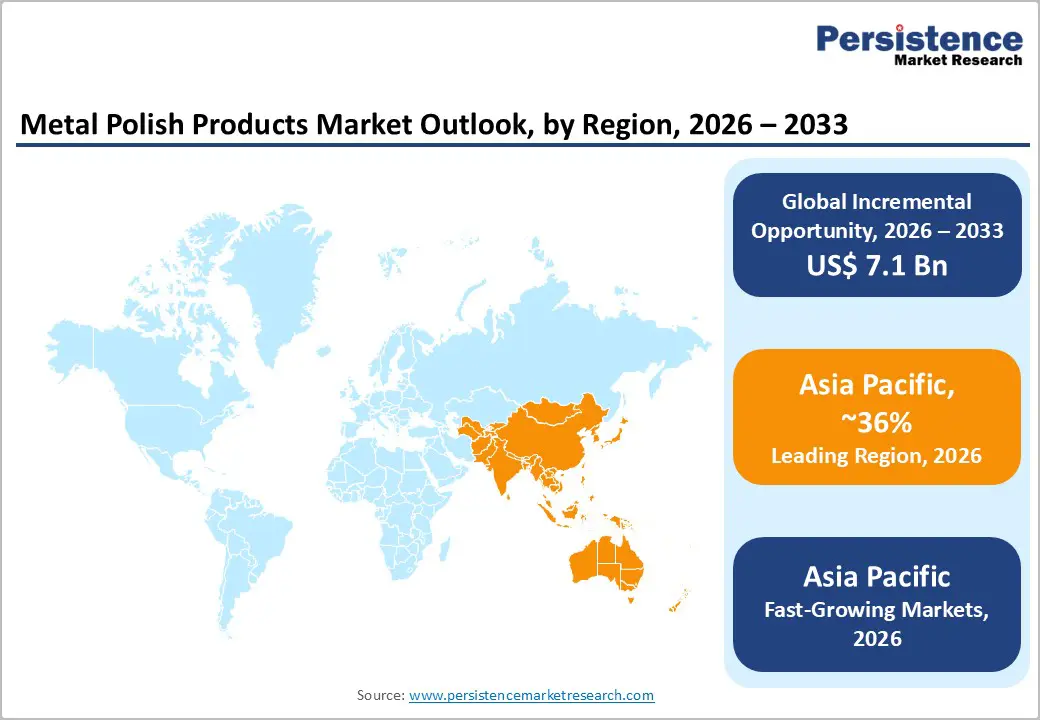
- Regional Leadership: Asia Pacific is poised to dominate with an estimated 36% share in 2026 and register a 6.2% CAGR through 2033, led by industrial expansion, automotive production, and urbanization in China, India, and ASEAN nations.
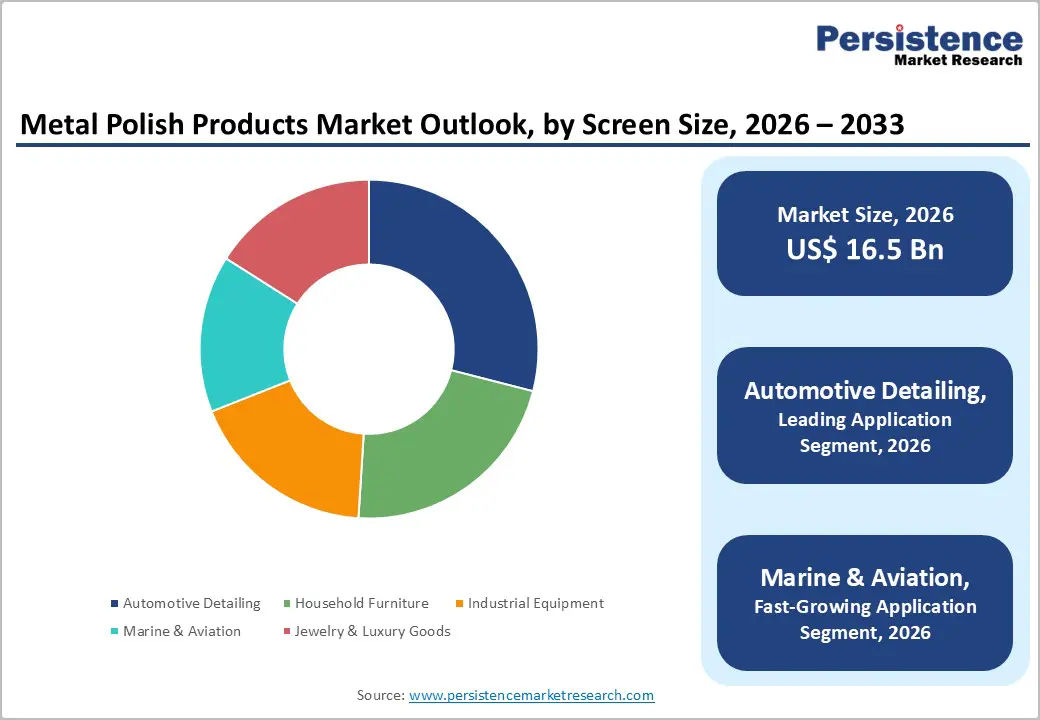
- Leading Applications: Automotive detailing is expected to lead with approximately 29% share in 2026, while marine & aviation applications are likely to grow the fastest at about 6.5% CAGR during 2026–2033, reflecting increased demand for specialized corrosion and surface protection solutions.
- Dominant Forms: Liquid formats are projected to account for around 38% of revenue in 2026, while spray products are expected to be the fastest-growing segment through 2033, driven by convenience and professional detailing adoption.
- Dominant Metals: Stainless steel is projected to hold the largest revenue share at around 32% in 2026, while aluminum is expected to be the fastest-growing through 2033, driven by its extensive utilization in automotive, aerospace, and industrial applications.
- Competitive Environment: The market is moderately fragmented, with top firms holding approximately 35–40% share, focusing on innovation, strategic partnerships, and geographic expansion to strengthen global positioning.
| Key Insights | Details |
|---|---|
| Metal Polish Products Market Size (2026E) | US$ 16.5 Bn |
| Market Value Forecast (2033F) | US$ 23.6 Bn |
| Projected Growth (CAGR 2026 to 2033) | 5.2% |
| Historical Market Growth (CAGR 2020 to 2025) | 4.7% |
Market Factors – Growth, Barriers, and Opportunity Analysis
Automotive Production and Aftermarket Demand
The automotive sector remains a foundational growth driver for the metal polish products market, as evidenced by notable increases in production and shipments in early 2026. Major original equipment manufacturers (OEMs) such as Stellantis reported a 9% year-over-year increase in consolidated shipments in Q4 2025, underscoring strong delivery momentum across key markets, including North America, Asia Pacific, and South America. Rising global vehicle outputs translate directly into greater downstream demand for surface care products, including metal finishes, corrosion protection solutions, and aesthetic maintenance formulations. This demand spans both OEM assembly operations and the expanding aftermarket sector, where automotive detailers and consumers maintain vehicle appearance and metal integrity during service cycles.
The influence of automotive dynamics on polish product demand is further supported by continued passenger vehicle sales momentum in markets such as India, where strong year-end performance in December 2025 reflects resilient consumer engagement with vehicle purchases and upkeep. Moreover, expanded vehicle showcases such as the Indonesia International Motor Show 2026, featuring expanded global brand participation, signify industry confidence that continues to reinforce aftermarket ecosystem activity. Together, these factors create strategic opportunities for metal polish manufacturers to align formulations and go-to-market strategies with the evolving outputs and maintenance cycles of the automotive sector.
Industrial Growth and Regulatory-Driven Innovation
Rapid industrialization across manufacturing hubs continues to elevate the utilization of metal surface care solutions as production volumes expand across machinery, construction, electronics, and transportation sectors. Infrastructure and heavy-equipment deployment, supported by advanced corrosion-resistant materials, naturally increases the need for surface protection products that maintain metal performance and prevent deterioration. Concurrently, regulatory developments in 2025–2026 are shaping metal polish product innovation with real policy impact. Notably, environmental agencies in Germany, the Netherlands, Norway, Denmark, and Sweden submitted updated restriction proposals covering thousands of per- and polyfluoroalkyl substances (PFAS) to the European Chemicals Agency (ECHA), signaling broader regulatory momentum towards stricter chemical controls that will affect formulation and compliance strategies industry-wide.
Similarly, the U.S. Environmental Protection Agency (EPA) finalized amendments to national volatile organic compound (VOC) emission standards for aerosol coatings in 2025, tightening criteria for emissions and compliance reporting across coatings categories, including sprays and solvents. These regulatory actions not only push manufacturers towards low-VOC, eco-compliant formulations but also create long-term incentives for innovation in environmentally friendly polish chemistries. Industrial stakeholders facing these regulatory environments are increasingly adapting their R&D pipelines to comply with updated safety standards while capturing emerging demand for sustainable surface-care solutions. The combined effect of industrial demand growth and tightening environmental regulation is fostering a competitive landscape where metal polish suppliers differentiate through advanced, compliant, and performance-oriented products.
Volatility in Raw Material Costs
Fluctuating costs of key raw materials, including solvents, abrasives, specialty chemicals, and packaging components, continue to exert pressure on manufacturers' margins. Recent structural volatility in global supply chains, attributed to geopolitical tensions, shifting trade policies, and energy transition impacts, has complicated procurement planning for chemical producers and industrial users alike. According to the World Economic Forum (WEF), global supply chains entered an era of structural volatility in early 2026, forcing companies to reassess sourcing and inventory strategies to maintain resilience.
Commodity markets remain unpredictable, with raw material prices, such as metals and feedstock chemicals, experiencing fluctuating demand signals. Wider volatility in metals, such as platinum group metals, was reported in early 2026, with prices unstable due to supply deficits and production uncertainties, illustrating how material cost swings can directly affect downstream product manufacturing. These dynamics can delay production timelines, disrupt inventory replenishment schedules, and ultimately complicate pricing strategies in competitive markets where cost pass-through is constrained. Companies must increasingly consider multi-supplier sourcing, forward contracts, and flexible inventory planning to mitigate the risks posed by fluctuations in raw material prices.
Regulatory Compliance and Reformulation Burdens
Evolving regulatory frameworks around chemical safety and product labeling are creating compliance challenges that translate into additional costs and operational complexity for manufacturers. In January 2026, the European Union (EU) implemented a new “one substance, one assessment” (OSOA) framework to streamline chemical evaluations across multiple legislative areas, reinforcing stricter data requirements and earlier risk identification for chemicals used in products. These changes require detailed documentation, testing, and continuous monitoring of substances throughout the production lifecycle.
At the same time, governments globally are revising national chemical laws to modernize oversight and enforce enhanced safety standards. For example, Vietnam’s newly enacted Law on Chemicals (effective January 2026) establishes an updated regulatory architecture requiring more comprehensive compliance processes for classification, handling, and control of industrial chemicals. These regulatory shifts place pressure on manufacturers to reformulate existing products, redesign supply chain compliance protocols, and invest in certification processes. For smaller producers, the incremental cost and technical resources required to meet new standards may reduce product rollouts and constrain competitive positioning against larger, better-capitalized peers, potentially affecting market access in key regions.
Industrial and Infrastructure Expansion in Emerging Economies
Emerging economies across South Asia, Southeast Asia, the Middle East, and Africa continue to present significant growth corridors for metal polish products, driven by robust infrastructure and industrial investments. For example, Vietnam has commenced construction on a major US$ 7.72 billion rail link to China, part of a broader US$ 129 billion infrastructure portfolio aimed at sustained economic growth and industrial connectivity through 2030. Local infrastructure spending incentives are also evident in India, where the Maharashtra cabinet approved a new public-private partnership policy in 2026 to attract capital and accelerate large-scale projects, indicating stronger domestic infrastructure development momentum.
These ongoing projects broaden the installed base of metal assets, such as rail networks, industrial facilities, and transportation corridors that require long-term surface protection and maintenance. As governments facilitate expansions in manufacturing zones, transport links, and urban amenities, demand rises for industrial-grade metal polish solutions that enhance durability and preserve surface integrity. Localized production advantages in these regions help manufacturers optimize costs while capturing value, and tailoring products to regional environmental needs, such as anti-corrosion solutions for coastal climates, can lead to incremental revenue streams and diversified global supply footprints.
Premium and Application-Specific Product Development
The market offers compelling opportunities for premium performance. focused metal polish solutions, particularly in high-value verticals such as aviation, marine, and luxury goods. Government policy highlights this potential, for instance, India’s Budget 2026 introduced significant incentives to expand aviation manufacturing, maintenance, repair, and overhaul (MRO) services, including customs duty exemptions on components and major capital investment plans for modernizing air traffic control. The inauguration of major aircraft MRO facilities in Hyderabad, including deep-level engine servicing hubs for civil and military aircraft, underscores the expanding ecosystem that will require specialized surface care and maintenance products.
As airlines expand their fleets and government-backed aviation strategies increase service capacity, demand for specialized metal-polishing formulations, such as scratch-resistant coatings for aerospace alloys and high-performance solutions for marine metal finishes, rises materially. Targeting premium applications allows manufacturers to capture higher margins while meeting the sophisticated performance needs of institutional customers. Furthermore, cross-segment innovation in multi-metal and ceramic-compatible solutions enhances usability across both professional industrial settings and high-end consumer markets, strengthening competitive positioning and long-term growth potential.
Category-wise Analysis
Form Insights
Liquid form is likely to continue its dominance in 2026 with an estimated 38% of the metal polish products market revenue share in 2026, due to its broad applicability and strong performance across consumer and industrial use cases. Liquids provide uniform surface coverage, deep penetration, and effective tarnish removal, ensuring oxidation control and finish enhancement on metals such as stainless steel and aluminum. Compatible with both manual and mechanical polishing processes, they are favored by automotive detailers, maintenance teams, and household users, while simplifying inventory management for distributors. Recent launches, such as Autosmart’s MetalliX 3-in-1 metal polish in early 2026, demonstrate ongoing innovation that balances cleaning, cutting, and polishing functions. Enhanced drying times, protective layering, and alloy compatibility further strengthen performance, sustaining demand across professional and do-it-yourself (DIY) segments and reinforcing the format’s versatility and retention among end users.
The spray format is likely to be the fastest-growing product form, projected to achieve a 6.1% CAGR through 2033, driven by convenient, precise application with minimal labor. Sprays provide consistent coverage and rapid surface results, making them popular for automotive detailing and quick maintenance. Innovations such as HISKI’s 3-in-1 Nano Ceramic Coating Spray launched in 2025 combine polishing, scratch repair, and waterless shine, appealing to both enthusiasts and professionals. Enhanced spray mechanisms and nano-technology improve performance across alloys and surface types, supporting wider adoption. Its portability, user-friendliness, and compatibility with professional and DIY workflows position sprays as a high-growth, premium segment in the market.
Application Insights
Automotive detailing is expected to remain the largest application area, holding roughly 29% of the metal polish products market share in 2026, driven by global vehicle ownership, aftermarket services, and DIY enthusiast engagement. Polishes enhance trim, wheels, and metal accents, supporting repeat purchases and long-term loyalty. Product innovations such as Avant Guard Coatings’ Formula 1051, launched at SEMA 2025, combine protective layers with high shine, demonstrating the integration of polish and coating technologies. Frequent maintenance cycles, advanced alloy finishes, and evolving consumer aesthetics ensure sustained demand. The segment continues to dominate due to professional and residential adoption, product reliability, and continuous innovation in protective metal care.
The marine & aviation segment is projected to expand rapidly at approximately 6.5% CAGR through 2033, driven by corrosion protection and surface integrity needs in harsh operational environments. Aviation infrastructure expansions, such as the Safran Aircraft Engine Services India MRO facility inaugurated in Hyderabad in 2025, underscore demand for specialized polishing solutions for aerospace alloys and engine components. Marine vessels similarly require high-performance formulations to combat saltwater exposure. The adoption of premium, corrosion-resistant polishes in these industries supports high-value contracts. Ongoing government-backed infrastructure investment and fleet modernization initiatives further accelerate adoption, establishing this segment as the fastest-growing application area.
Regional Insights
North America Metal Polish Products Market Trends
In North America, the market for metal polish products is led by the United States, benefiting from robust automotive aftermarket activity and strong consumer spending on vehicle maintenance and detailing solutions. The increase in the average age of vehicles, reaching 12.8 years in 2025, is driving higher repair and part replacement activity, supporting demand for surface care and metal polish products as owners extend vehicle lifespans. This trend is highlighted in the Auto Care Association’s 2026 Auto Care Factbook, which reports sustained aftermarket growth in the U.S. despite broader economic pressures. Rising interest in vehicle personalization and protective treatments further enhances product uptake.
Regional resilience is further reinforced by major trade shows and industry events, such as AAPEX 2025, showcasing the economic impact of the aftermarket supply chain spanning parts, accessories, and repair services, including detailing and surface care products. Regulatory focus on low-VOC and environmentally compliant formulations by federal and state authorities is driving product innovation, while extensive retail networks and e-commerce channels maintain broad consumer access. Continued innovation in eco-friendly formulations, coupled with ongoing domestic demand for automotive upkeep and surface maintenance, underpins steady and reliable market growth.
Europe Metal Polish Products Market Trends
The Europe market, with Germany, the U.K., France, and Spain as key contributors, gains multiple advantages from a mature mix of automotive, industrial, and consumer markets. High consumer awareness of vehicle aesthetics and environmental standards is accelerating the adoption of low-emission and sustainable surface care solutions, aligning with EU regulatory frameworks. Regulations such as EU VOC limits and REACH chemical safety standards require manufacturers to develop water-based or low-VOC metal polish formulations that comply without compromising performance. Professional detailing services, along with a strong culture of DIY maintenance, further support consistent market demand.
Growth is supported by a strong manufacturing base that requires protective surface finishes for industrial equipment and automotive refinishing. The region’s professional detailing culture and retrofit maintenance services also drive steady product demand. Investments in eco-friendly coatings and maintenance chemicals continue to rise as businesses and consumers prioritize compliance and performance. Manufacturers leveraging localized production, sustainable product lines, and tailored formulations remain well positioned to maintain competitiveness in Europe’s regulated and mature market, with innovation being a key differentiator among leading providers.
Asia Pacific Metal Polish Products Market Trends
Is Asia Pacific projected to be the largest and fastest-growing regional market for metal polish products, accounting for about 36% of global demand, owing to rapid industrialization, expanding automotive manufacturing, and burgeoning consumer markets in China, India, Japan, and ASEAN economies. China’s manufacturing dominance continues to anchor the region’s industrial ecosystem, with integrated logistics, production scale, and innovation capacity reinforcing robust supply chains. Recent government and industry push to expand vehicle production, including China’s 2025–2026 automotive growth plan, which targets over 32.3 million units sold in 2025, sustains aftermarket and surface care demand as vehicle fleets grow.
India’s accelerating automotive manufacturing footprint, highlighted by Mahindra’s US$ 1.65 billion expansion plan and establishment of a major new vehicle plant, demonstrates rising regional production capacity and consequent polish product demand. Similarly, global and emerging OEM investments, such as VinFast’s US$ 500 million launch of an electric vehicle (EV) factory in Tamil Nadu, underscore the growth of manufacturing ecosystems that will stimulate demand for metal care and maintenance solutions. The growth is supported by industrial development, urbanization, and rising consumer spending. Asia Pacific remains both the largest and most dynamic market for metal polish products worldwide.
Competitive Landscape
The global metal polish products market exhibits a moderately fragmented structure, with leading players such as 3M, Meguiar’s, Turtle Wax, Autosmart, and Sonax holding a significant portion of overall revenue. These established companies leverage strong brand recognition, extensive distribution networks, and product innovation capabilities to maintain market leadership. Heavy investment in R&D, eco-friendly formulations, and multi-metal compatibility allows them to respond to evolving consumer and industrial requirements, while maintaining high-quality performance standards. Strategic alliances and premium positioning in professional detailing and industrial markets further strengthen their competitive edge.
Regional and niche competitors, including HISKI, Farecla, and Eagle One, focus on specialized segments such as marine & aviation, luxury metals, and DIY consumer products. Barriers such as formulation compliance, environmental regulations, and high product development costs limit new entrants, but emerging e-commerce channels and localized manufacturing enable smaller players to access high-growth markets. Industry consolidation is ongoing, with strategic acquisitions and product portfolio expansions, such as 3M’s 2025 acquisition of Sonax division, highlighting the trend toward geographic and technological growth. Collaborations with specialty chemical providers and innovation in low-VOC or biodegradable solutions are also shaping the competitive dynamics, emphasizing differentiation through both sustainability and performance.
Key Industry Developments
- In November 2025, Mothers® marked its 50th anniversary at the SEMA Show by returning as title sponsor of the Battle of the Builders competition while unveiling three new automotive care products, including a ceramic spray coating and surface restoration tools, to reinforce its innovation and brand presence in the aftermarket sector.
- In September 2025, Valence Surface Technologies acquired C.I.L. Metal Finishing and C.I.L. Electroplating to strengthen its aerospace, defense, and space surface treatment capabilities, adding specialized metal finishing services and two Massachusetts facilities with expansion capacity.
Companies Covered in Metal Polish Products Market
- 3M Company
- Henkel AG & Co. KGaA
- Reckitt
- Rust Oleum Corporation
- Illinois Tool Works Inc.
- Turtle Wax Inc.
- SC Johnson Professional
- Würth Group
- Mothers Polishes Waxes Cleaners
- Menzerna Polishing Compounds
- Autoglym
- Sonax GmbH
- Liqui Moly GmbH
- Flitz International
- Blue Magic Inc.
Frequently Asked Questions
These formulations typically include a variety of products such as pastes, creams, sprays, and wipes. They are specifically crafted to eliminate tarnish, oxidation, and grime from different metal substrates like stainless steel, aluminum, brass, copper, and chrome.
By the end of 2031, the market size is forecast to expand at a CAGR of 5.9%.
In 2024, the metal polish products market size is expected to reach a valuation of US$17.3 billion.
As of 2023, the US represented the global market leader.
Some of the key manufacturers in the market include White Diamond Detail Products, Weiman Products, LLC, Wizards Products, and Turtle Wax, Inc.


