




- Home Care & Utilities
- Laundry Scent Booster Market
Laundry Scent Booster Market Size, Share, and Growth Forecast, 2026 - 2033
Laundry Scent Booster Market by Form (Beads, Crystals, Pacs, Liquid, Sprays, Powder), Fragrance (Floral, Fresh, Apple, Lavender, Linen, Vanilla, Wood), End-User (Residential, Commercial), and Regional Analysis for 2026 - 2033

Laundry Scent Booster Market Share and Trends Analysis
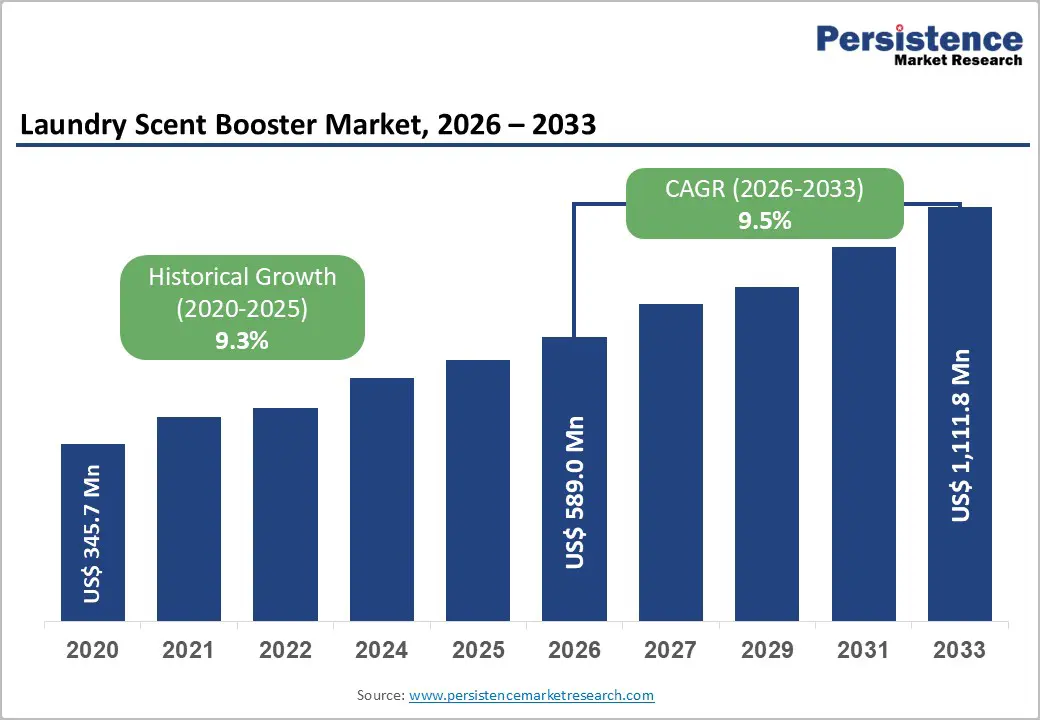
The global laundry scent booster market size is likely to be valued at US$ 589.0 million in 2026, and is projected to reach US$ 1,111.8 million by 2033, growing at a CAGR of 9.5% during the forecast period 2026−2033.
The market is positioned for sustained expansion, driven by premiumization in home care, rising hygiene awareness, and innovation in fragrance encapsulation technologies. Urbanization and rising dual-income households are increasing expenditure on differentiated laundry care products that enhance sensory appeal beyond basic cleaning performance. Heightened public focus on sanitation standards following global health events has reinforced demand for products that deliver prolonged freshness, influencing repeat purchase behavior.
Technological integration, including microencapsulation and controlled fragrance-release systems, improves product performance and strengthens brand differentiation, supporting pricing power. Expansion of organized retail and digital commerce infrastructure enhances product visibility and accessibility across developed and emerging markets. In parallel, sustainability-focused formulations aligned with guidance from agencies such as the U.S. Environmental Protection Agency (EPA) and the European Chemicals Agency (ECHA) are influencing ingredient transparency and eco-conscious packaging innovation.
Key Industry Highlights
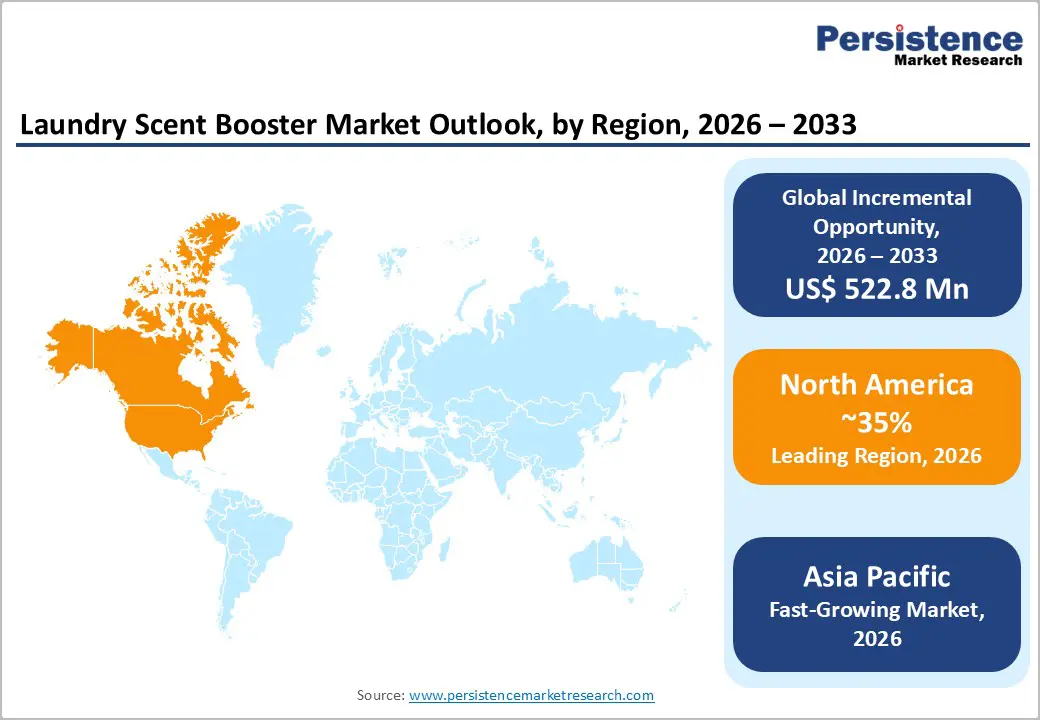
- Dominant Region: North America is predicted to hold a 35% market share in 2026, driven by high consumer adoption of premium home care products.
- Fastest-growing Market: Asia Pacific is expected to be the fastest-growing market through 2033, supported by expanding adoption of modern washing appliances and e-commerce platforms.
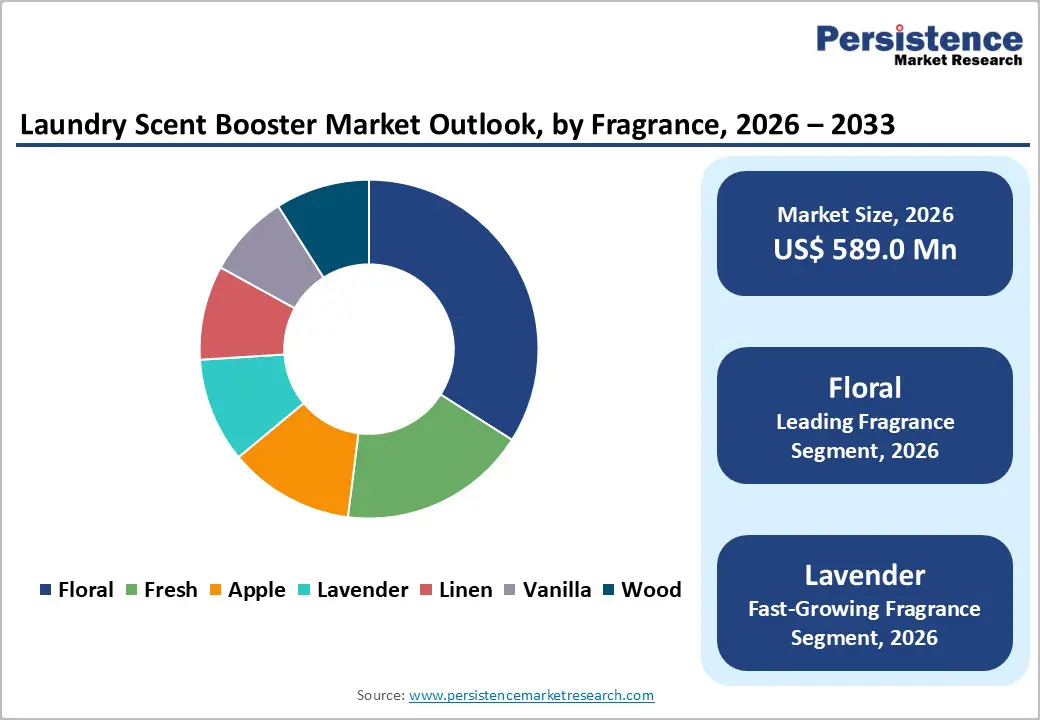
- Leading Fragrance: Floral is likely to lead with around 34% revenue share in 2026, fueled by consumer association with freshness, cultural familiarity, and strong retail and brand presence.
- Fastest-growing Fragrance: Lavender is expected to grow the fastest between 2026 and 2033, owing to aromatherapy benefits, digital targeting, and natural ingredient preference.
- September 2025: Dropps launched Odor Eraser, a laundry additive featuring proprietary TriCore Erase technology that targets embedded odors at the source rather than masking them.
| Key Insights | Details |
|---|---|
|
Laundry Scent Booster Market Size (2026E) |
US$ 589.0 Mn |
|
Market Value Forecast (2033F) |
US$ 1,111.8 Mn |
|
Projected Growth (CAGR 2026 to 2033) |
9.5% |
|
Historical Market Growth (CAGR 2020 to 2025) |
9.3% |
Market Factors - Growth, Barriers, and Opportunity Analysis
Premiumization of Home Care and Fragrance-Led Differentiation
Rising inclination toward premium household solutions is strengthening demand momentum across fragrance-enhanced laundry additives. Higher disposable income levels, urban lifestyle shifts, and greater emphasis on experiential consumption have elevated expectations regarding fabric care outcomes. Buyers increasingly evaluate products through sensory performance, brand perception, and formulation sophistication rather than price alone. Premium positioning supports higher margins for manufacturers while reinforcing perception of superior efficacy, long-lasting freshness, and textile compatibility. Retail analytics indicate that trade-up behavior expands average transaction value when packaging aesthetics, scent longevity claims, and ingredient transparency align with aspirational living standards.
Distinct fragrance profiling functions as a strategic differentiation lever within a category characterized by functional similarity. Olfactory innovation enables product lines to establish identity through signature scent notes such as botanical blends, spa-inspired accords, or seasonal compositions. Emotional association with fragrance memory increases brand recall and supports repeat purchase frequency. Competitive benchmarking shows that scent intensity control technology, microencapsulation delivery systems, and multi-layer aroma release formats enhance perceived product sophistication. Shelf competition in modern retail environments favors variants that communicate fragrance uniqueness through clear labeling and sensory descriptors.
Expansion of Organized Retail and Digital Commerce Infrastructure
The growth of structured retail networks and advanced digital commerce platforms has transformed consumer purchasing behavior, providing wider accessibility and convenience for household products. Supermarkets, hypermarkets, and modern retail chains enable consistent product availability, premium shelf placement, and targeted in-store promotions that enhance visibility and influence buying decisions. Organized retail ensures standardized product presentation and stock management, creating trust and familiarity among consumers. E-commerce platforms also offer on-demand purchasing options, detailed product information, and personalized recommendations, streamlining the decision-making process for busy consumers.
Furthermore, e-commerce penetration supports efficient supply chain operations and data-driven marketing strategies, allowing brands to track consumer preferences and adjust inventory in real time. Subscription models, loyalty programs, and digital advertising enhance engagement, fostering repeated purchases and long-term brand loyalty. Regional and global logistics improvements ensure timely delivery and product freshness, while competitive pricing on online channels encourages trial and bulk purchases. The synergy between organized retail and digital commerce establishes multiple touchpoints for consumer interaction, reinforcing awareness and accessibility.
Raw Material Volatility and Fragrance Supply Chain Complexity
Fluctuations in raw material pricing and availability significantly impact production planning and cost management. Key ingredients used in scent formulations, such as essential oils and synthetic fragrance compounds, are often sourced from regions prone to climatic variability, geopolitical tensions, or agricultural uncertainties. These factors can lead to unpredictable cost escalations and procurement delays, forcing manufacturers to adjust pricing strategies or limit product offerings. Supply chain disruptions extend beyond sourcing to transportation and storage, where specialized handling of fragrance components is required to maintain quality and stability. Firms face increased operational risks as sudden shortages may affect production schedules and overall market responsiveness.
Fragrance formulation relies on consistent quality and timely delivery of multiple raw materials, making the supply chain inherently complex. Long lead times, dependency on multiple suppliers, and regulatory compliance for imported ingredients create challenges in maintaining steady inventory levels. This complexity restricts agility in responding to evolving consumer preferences and limits the ability to introduce new variants swiftly. Companies must invest in risk mitigation strategies, such as diversified sourcing, strategic stockpiling, and alternative ingredient research, which increases operational overhead. Such pressures place constraints on profitability and slow expansion efforts in competitive markets.
Environmental Scrutiny and Waste Management Pressures
Stringent regulations governing chemical usage in household products have increased operational complexity for manufacturers. Governments in multiple regions enforce limits on volatile organic compounds (VOCs), phosphates, and microplastics, demanding rigorous compliance in formulation and labeling. Companies face higher costs for research, testing, and certification to meet these environmental standards. Supply chains are also impacted as raw material sourcing must align with sustainable practices, affecting production timelines and cost efficiency. Non-compliance can lead to product recalls, fines, and reputational damage, influencing investment decisions and strategic planning. This regulatory environment creates a barrier to innovation and product expansion, particularly for smaller players with limited resources.
Waste treatment and disposal challenges further constrain growth potential. The use of fragrance beads and synthetic additives generates microplastic residues and chemical effluents during washing and manufacturing processes. Wastewater treatment infrastructure in several regions struggles to remove these residues effectively, prompting stricter disposal requirements. Manufacturers must implement advanced filtration and waste management systems to mitigate environmental impact, increasing operational expenditure. Consumer demand for sustainable products intensifies pressure on companies to reformulate products using biodegradable or eco-friendly alternatives, which may compromise performance or raise production costs.
Eco-friendly Formulations and Biodegradable Delivery Systems
Rising consumer awareness of environmental impact and regulatory pressure on chemical usage is reshaping product development. Formulations designed with natural or eco-friendly ingredients reduce ecological footprint, attract environmentally conscious buyers, and align with emerging sustainability standards. These solutions address concerns over water pollution and chemical residues in wastewater treatment systems, creating compliance advantages for manufacturers. As governments enforce stricter regulations on synthetic fragrances and non-biodegradable components, products incorporating renewable, biodegradable elements gain faster market access and long-term resilience. Companies leveraging green chemistry techniques and renewable raw materials can differentiate offerings, build brand credibility, and respond to a growing preference for clean-label products.
Biodegradable delivery systems enhance efficiency in product performance while minimizing environmental persistence. Encapsulation technologies and controlled-release mechanisms improve scent longevity without increasing chemical load, optimizing both consumer experience and sustainability metrics. This combination of high-performance functionality with environmental responsibility positions companies to capture a segment of the market that values innovation aligned with ethical consumption. Shifting consumer preferences towards low-impact, high-quality products drive demand for solutions that meet both sensory expectations and sustainability criteria. Investments in research and development for eco-compatible carriers and packaging further strengthen competitive advantage, opening opportunities for premium positioning and strategic partnerships focused on green innovation.
Penetration in Emerging Markets through Affordable Premiumization
Targeting emerging economies with accessible premium offerings presents a significant growth avenue. Rising disposable income, expanding middle-class populations, and increasing exposure to global lifestyle trends are driving demand for products that combine perceived luxury with affordability. Consumers in these regions are willing to explore enhanced home care experiences if the value proposition aligns with their purchasing power. Price-sensitive strategies that maintain a premium image enable brands to achieve broader market acceptance while differentiating from mass-market alternatives. Urbanization and increasing retail penetration support distribution channels that facilitate product accessibility across tier-1 and tier-2 cities, ensuring that high-quality scent boosters reach a wide audience without diluting brand positioning.
Affordably premium products can stimulate trial, foster brand loyalty, and encourage repeat consumption. A curated blend of quality ingredients, appealing fragrances, and visually attractive packaging resonates with aspirational consumers, reinforcing the perception of indulgence within reachable price brackets. Strategic communication emphasizing quality, lifestyle enhancement, and sensory appeal strengthens emotional engagement and justifies incremental expenditure. Companies adopting this approach can capitalize on the evolving consumer mindset in emerging economies, positioning offerings as attainable luxuries while achieving scalable growth.
Category-wise Analysis
Form Insights
Beads are poised to lead with a forecasted 38% of the laundry scent booster market revenue share in 2026, owing to widespread consumer familiarity and compatibility with standard washing machines. These products benefit from advanced encapsulation technologies that allow fragrance release to occur gradually during both agitation and drying cycles, delivering a consistent sensory experience. Their convenient format encourages repeat usage and loyalty among households accustomed to traditional laundry routines. Retail strategies that position beads alongside detergents improve visibility and stimulate impulse purchases. Stability during storage, resistance to humidity, and an extended shelf life support large-scale distribution across supermarket chains and e-commerce platforms, while ongoing innovation in polymer shell design addresses residue concerns and enhances performance reliability, reinforcing overall consumer confidence and satisfaction.
Liquid laundry scent boosters are anticipated to register the highest 2026-2033 CAGR, fueled by ease of dosing, compatibility with cold-water washing, and integration with concentrated detergent trends. Liquid formats allow consistent fragrance dispersion throughout laundry loads, ensuring uniform scent retention. They support packaging innovations such as compact refill pouches and ergonomic bottles, which appeal to convenience-focused consumers. Rising adoption of high-efficiency washing machines drives demand for liquid-based delivery systems, as these formats minimize waste and enhance performance. Flexibility in formulation enables hypoallergenic and plant-based variants, broadening the product’s appeal to environmentally conscious and health-focused households, while reinforcing perception of innovation and premium positioning in accessible formats.
Fragrance Insights
Floral is likely to dominate with a projected 34% revenue share in 2026, due to longstanding consumer association with freshness and cleanliness. The scent evokes a universal perception of hygiene and comfort, making it a default choice for households across multiple regions. Cultural familiarity across North America, Europe, and Asia Pacific reinforces repeat purchase behavior, as consumers consistently choose scents that align with traditional preferences. Retail strategies routinely allocate prominent shelf space to floral variants, ensuring visibility and accessibility. Brand campaigns leverage floral narratives in both packaging and advertising, enhancing emotional engagement, reinforcing product relevance, and consolidating dominance within the laundry fragrance category across multiple distribution channels.
Lavender is expected to witness the fastest growth between 2026 and 2033, powered by rising consumer interest in aromatherapy-linked relaxation benefits. The scent’s association with stress reduction and calming environments drives adoption in both urban and suburban households. Digital commerce platforms facilitate precise consumer targeting, promoting lavender variants as wellness-oriented lifestyle products. Product innovations incorporating essential oil-derived extracts align with natural ingredient trends and premium positioning strategies, appealing to environmentally conscious and health-focused segments. Expanded offerings include blends with complementary fragrances and concentrated formats, strengthening brand differentiation and reinforcing consumer perception of indulgence combined with functional benefits in everyday laundry routines.
Regional Insights
North America Laundry Scent Booster Market Trends
North America is expected to dominate with an estimated 35% of the laundry scent booster market share in 2026, reflecting high consumer adoption of premium home care solutions and widespread use of modern washing appliances. In the United States, households increasingly prefer beads and liquid formats that deliver controlled fragrance release and convenience, supported by high penetration of high-efficiency washing machines. Advanced retail networks, including supermarkets, hypermarkets, and e-commerce platforms such as Walmart and Amazon, ensure extensive product availability and visibility, supporting frequent purchases and repeat consumption. Familiarity with enhanced laundry experiences, combined with willingness to invest in convenience and sensory appeal, drives preference for accessible premium offerings. Data-driven marketing and targeted loyalty programs enable brands to engage aspirational households effectively, reinforcing brand equity and sustaining demand.
Innovation also plays a critical role in maintaining dominance, with products incorporating encapsulation technologies, concentrated fragrances, and eco-conscious ingredients capturing consumer interest. Procter & Gamble and Henkel have introduced hypoallergenic and plant-based formulations aligning with health and environmental trends, enhancing perceived product value. Strategic collaborations with appliance manufacturers and integration with digital commerce platforms optimize product discovery and facilitate seamless repurchase cycles. Continuous promotion of functional and lifestyle-oriented benefits, coupled with strong brand visibility, ensures sustained growth, consolidates leadership, and maintains high entry barriers for emerging competitors.
Europe Laundry Scent Booster Market Trends
Europe demonstrates a mature landscape in the laundry scent booster market, characterized by high consumer awareness and established preferences for premium and eco-conscious products. Household adoption of advanced washing appliances and high-efficiency machines is strong, which complement formats such as beads and liquid boosters designed for controlled fragrance release and optimal performance. Distribution channels are highly organized, encompassing large supermarket chains, specialty retailers, and well-developed e-commerce platforms, facilitating consistent product availability and supporting frequent repeat purchases. Consumers show preference for scents associated with cleanliness, freshness, and subtle sophistication, leading brands to emphasize floral, linen, and lavender variants in their product portfolios.
Innovation and regulatory alignment further define market dynamics, with formulations incorporating biodegradable polymers, plant-based fragrances, and hypoallergenic ingredients responding to stringent environmental and safety standards. Packaging trends focus on sustainability, including recyclable bottles and concentrated refill formats, reducing environmental impact while maintaining convenience. Strategic collaborations with appliance manufacturers, coupled with targeted digital campaigns, optimize product discovery and promote trial among tech-savvy and premium-seeking consumers. Brand differentiation is increasingly driven by value-added features, such as long-lasting fragrance encapsulation and multifunctional boosters that enhance fabric care.
Asia Pacific Laundry Scent Booster Market Trends
Asia Pacific is expected to be the fastest-growing market for laundry scent boosters, driven by rapid urbanization and rising disposable income across key economies such as China, India, and Indonesia. Expanding middle-class populations are increasingly seeking enhanced home care experiences that combine affordability with premium appeal. Growth is supported by increasing penetration of modern washing appliances in urban households, which allows effective use of advanced formats like beads and liquid boosters. E-commerce platforms, including Alibaba’s Tmall and Flipkart, provide access to tier-2 and tier-3 cities, enabling brands to reach previously underserved consumers. Consumer exposure to international lifestyle trends and marketing campaigns has accelerated preference for sensory-driven laundry products, stimulating trial and repeat purchases at scale.
Innovation and localization strategies reinforce rapid adoption, with products tailored to regional fragrance preferences, including floral, apple, and linen variants, aligning with cultural sensibilities. Formulations emphasizing plant-based ingredients and hypoallergenic profiles address growing environmental and health awareness, appealing to younger, aspirational demographics. Retail strategies combining offline visibility in modern trade with targeted digital campaigns enhance brand recall and engagement. Flexible packaging, such as refill pouches and compact formats, reduces cost barriers and encourages frequent usage.
Competitive Landscape
The global laundry scent booster market structure reflects moderate concentration, with multinational consumer goods corporations capturing substantial global presence while regional private-label manufacturers maintain niche positions. Procter & Gamble, Unilever, Henkel, Kao Chemicals Europe, S.L.U., and Church & Dwight are shaping competitive dynamics through extensive research & development (R&D) investments, focusing on fragrance innovation, formulation efficiency, and eco-conscious product attributes. Companies leverage brand equity to differentiate offerings and justify premium pricing, while strong retail partnerships secure optimal shelf visibility across supermarkets, hypermarkets, and e-commerce platforms. Distribution reach, including integration with online marketplaces and modern trade networks, enhances product accessibility and supports repeat consumption.
Strategic initiatives revolve around innovation pipelines, sustainability positioning, and multi-channel engagement. Fragrance encapsulation, long-lasting scent delivery, and multifunctional boosters serve as key differentiators in product portfolios. Environmental and regulatory compliance, including biodegradable and plant-based formulations, strengthens corporate positioning among eco-conscious consumer segments. Marketing strategies emphasize sensory appeal, lifestyle alignment, and wellness benefits, while collaborations with appliance manufacturers and digital campaigns optimize trial and repurchase behavior. Moderate market concentration allows leading players to influence pricing and distribution standards, while continued product differentiation, consumer education, and brand loyalty initiatives maintain competitive advantage.
Key Industry Developments
- In January 2026, Kind Laundry launched plant-based, non-toxic scent boosters featuring fine-fragrance–inspired formulations and microcapsule technology to deliver long-lasting fragrance while supporting fabric protection and premium garment care positioning.
- In November 2025, Givaudan expanded its biodegradable PlanetCaps fragrance encapsulation portfolio with the launch of a patent-pending laundry serum featuring a high fragrance load and microplastic-free technology designed to deliver long-lasting freshness while meeting regulatory sustainability requirements.
- In September 2025, Procter & Gamble reintroduced Gain’s iconic Original scent through its new Tango In-Wash Scent Boosters line, responding to strong consumer demand while expanding fragrance customization options within the laundry care category.
Companies Covered in Laundry Scent Booster Market
- Procter & Gamble Co.
- Unilever
- Henkel AG & Co. KGaA
- Kao Chemicals Europe, S.L.U.
- Church & Dwight Co., Inc.
- Lion Corporation.
- Colgate-Palmolive Company.
- SC Johnson Professional USA, Inc.
- LG H&H Co., Ltd.
- The Clorox Company.
Frequently Asked Questions
The global laundry scent booster market is projected to reach US$ 589 million in 2026.
Rising consumer demand for premium laundry experiences, increasing adoption of modern washing appliances, and growing preference for long-lasting, fragrance-enhancing products are driving the market.
The market is poised to witness a CAGR of 9.5% from 2026 to 2033.
Expanding presence in emerging economies through affordable premium products, fragrance innovation, and eco-conscious formulations is opening new market opportunities.
Some of the key market players include Procter & Gamble Co., Unilever, Henkel AG & Co. KGaA, Kao Chemicals Europe, S.L.U., and Church & Dwight Co., Inc.


