




- Home Appliances
- Coin Operated Laundry Machine Market
Coin Operated Laundry Machine Market Trends, Size, Share, and Growth Forecast 2026 - 2033
Coin Operated Laundry Machine Market by Product Type (Top Load Washing Machines, Front Load Washing Machines, Stackable Washer-Dryer Units, and Commercial Dryers), Application (Residential and Commercial), and Regional Analysis, 2026 - 2033

Coin Operated Laundry Machine Market Size and Share Analysis
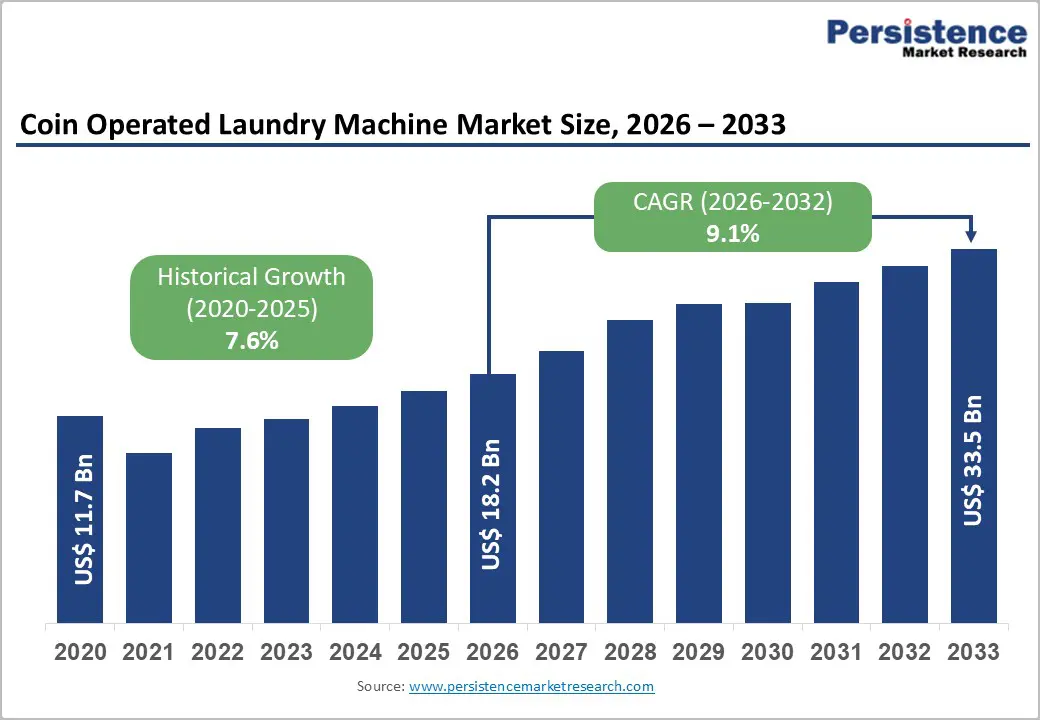
The global coin operated laundry machine market size is likely to be valued at US$ 18.2 billion in 2026 and is projected to reach US$ 33.5 billion by 2033, growing at a CAGR of 9.1% between 2026 and 2033.
The market's robust expansion trajectory is fundamentally driven by accelerating urbanization patterns combined with shifting household demographics emphasizing rental accommodations and single-person dwelling configurations. Rapid urbanization worldwide has created substantial demand for convenient, accessible laundry solutions among apartment dwellers, particularly students, young professionals, and transient populations lacking individual in-unit laundry facilities.
Key Market Highlights
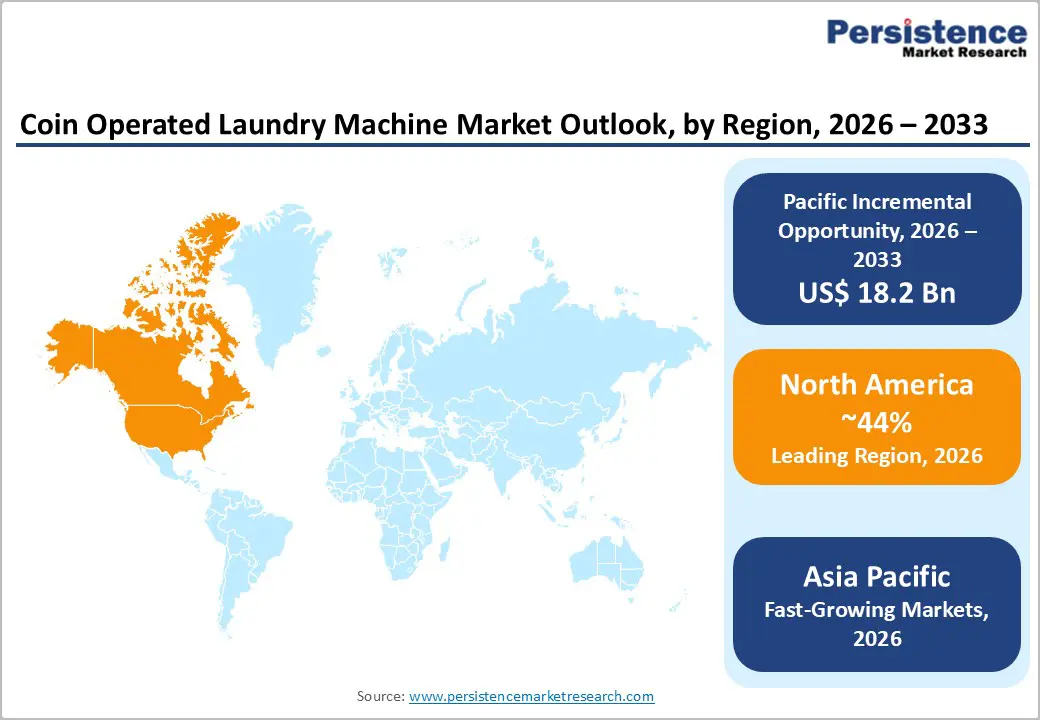
- Leading Region: North America, is poised to account for 44% share. It dominates the global coin-operated laundry machine market through well-established laundry infrastructure, significant rental housing populations and consumer demand for convenience-oriented solutions.
- Fastest Growing Region: Asia Pacific demonstrates highest growth rates driven by accelerating urbanization across China, India, Japan, and Southeast Asia, expanding middle-class populations, higher education sector growth, tourism infrastructure development, and mobile payment technology.
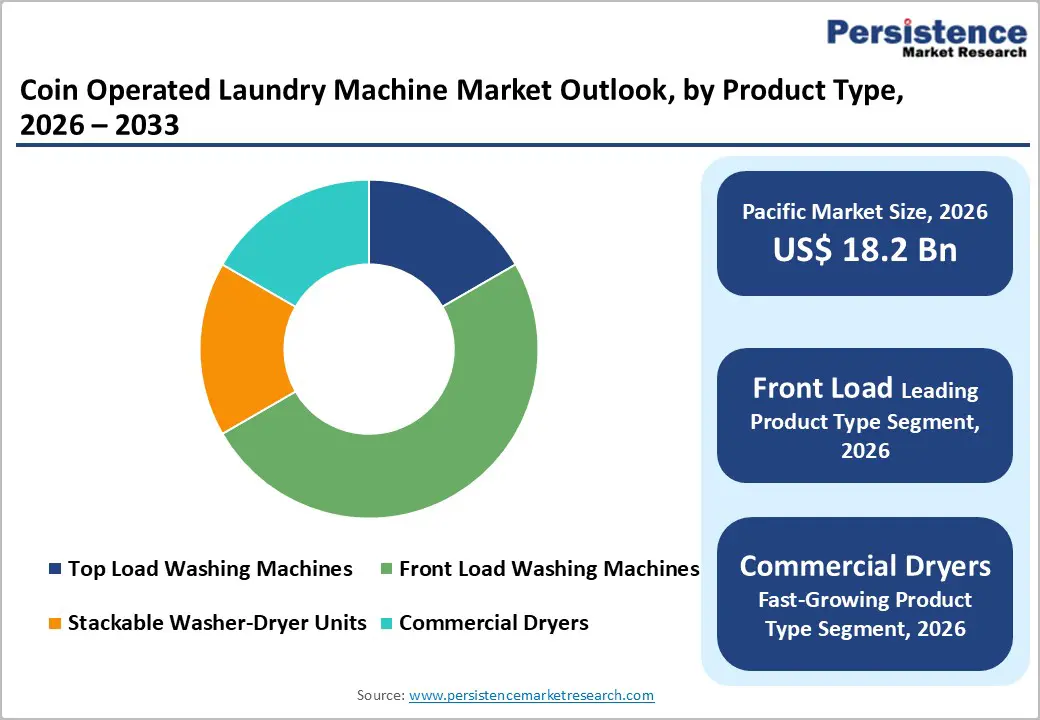
- Dominant Product Type: Front Load Washing Machines command 52% market share through superior cleaning performance, 450G high-speed extraction, energy-efficient operation, and rapid wash-dry cycles under 45 minutes.
- Dominant Application: Commercial Application segment captures 58% market value through sustained institutional demand from hospitality establishments, healthcare facilities, educational institutions.
- Key Market Opportunity: Energy-Efficient and Sustainable Technology Deployment creates substantial growth opportunities amid rising demand for energy-efficient washing machine.
| Key Insights | Details |
|---|---|
| Global Coin Operated Laundry Machine Market Size (2026E) | US$ 18.2 Bn |
| Market Value Forecast (2033F) | US$ 33.5 Bn |
| Projected Growth CAGR(2026 - 2033) | 9.1% |
| Historical Market Growth (2020 - 2025) | 7.6% |
Market Dynamics
Drivers - Rise in Urbanization and Apartment-Based Living Driving Market Growth
Global urbanization has accelerated dramatically, with urban population concentrations reaching unprecedented levels in both developed and emerging economies. The transition toward apartment-based residential configurations, particularly in densely populated metropolitan areas, has fundamentally transformed laundry infrastructure requirements. In developed markets such as North America, approximately 88% of new multifamily apartments completed in 2024 included individual laundry facilities, while 12% relied on shared or non-existent laundry infrastructure, according to Census Bureau housing data.
This substantial proportion of shared-facility demand creates sustained investment requirements in coin-operated laundry equipment deployment across residential complexes, apartment buildings, student dormitories, and affordable housing developments. Urban space constraints, combined with rise in housing costs and property values, continue incentivizing multifamily housing configurations that depend on centralized laundry solutions rather than individual in-unit appliances. The global laundromat industry generates over $5 billion in annual revenue in the United States alone, substantiating the market's substantial economic significance and consistent growth trajectory.
Digital Payment Revolution and Technology Integration
The rapid proliferation of contactless payment systems, mobile wallet integration, and cashless transaction methodologies has fundamentally transformed coin-operated laundry equipment functionality and customer accessibility. Internet of Things (IoT) enabled machines equipped with real-time monitoring sensors, smartphone connectivity, and artificial intelligence-powered cycle optimization are revolutionizing operational efficiency and revenue optimization capabilities for laundry facility owners. Mobile applications now enable customers to locate available machines, reserve washers and dryers, monitor cycle progress, and receive automated notifications upon completion, eliminating the traditional inconvenience and uncertainty associated with shared facility operations.
Modern systems support multiple payment methodologies, including Apple Pay, Google Pay, Visa, Mastercard, American Express, and proprietary laundry account systems, dramatically expanding accessibility to populations preferring contactless transactions or lacking physical currency. Smart machines equipped with predictive maintenance algorithms, dynamic pricing capabilities, and remote monitoring functionality enable facility operators to optimize equipment deployment, minimize downtime, and maximize revenue generation across multiple locations through centralized operational dashboards. This technological convergence of laundry equipment, digital payment infrastructure, and customer-facing mobile applications has established elevated barriers to market entry while simultaneously driving substantial revenue growth opportunities for operators adopting advanced technology platforms.
Market Restraints
Competition from In-Unit Laundry Solutions and Outsourced Services
The increasing prevalence of in-unit laundry facilities in new multifamily residential construction represents a significant competitive headwind for coin-operated laundry market expansion. Real estate developers increasingly incorporate individual washing machines and dryers within residential units as a standard amenity to enhance property appeal and justify premium pricing strategies, directly reducing demand for shared laundry facilities. The proliferation of on-demand laundry service providers offering pickup, washing, drying, and delivery services through mobile applications represents an alternative competitive model targeting convenience-conscious consumers willing to pay premium pricing for time-saving solutions.
Commercial sectors including hotels, hospitals, and foodservice establishments increasingly outsource laundry operations to specialized industrial laundry service providers including Cintas, Aramark, and UniFirst rather than maintaining in-house equipment and operations, further restricting market expansion opportunities within traditional commercial customer segments.
Market Opportunities
Energy-Efficient and Sustainable Laundry Technology Deployment
The global emphasis on environmental sustainability, resource conservation, and carbon footprint reduction has created substantial market opportunities for advanced, energy-efficient laundry equipment incorporating innovative technologies. Consumer awareness regarding water consumption, energy efficiency, and the environmental impact of household appliances has intensified dramatically, with regulatory frameworks including European Union energy efficiency standards and government sustainability incentive programs driving market demand toward environmentally conscious solutions.
Modern washing machines incorporating advanced technologies, including heat pump technology, water recycling systems, AI-driven cycle optimization, and IoT-based resource management, achieve significant operational cost reductions while simultaneously delivering environmental performance benefits. Facility operators adopting advanced, energy-efficient equipment can simultaneously reduce operational expenditures by 40-50% for water consumption and 30-40% for energy costs, while enhancing environmental credentials and marketing appeal to environmentally conscious consumer demographics. Government incentive programs, tax credits, and rebate mechanisms supporting energy-efficient appliance adoption further accelerate market penetration and investment attractiveness.
Robust Hospitality Sector Growth and Rising Demand from Emerging Markets
Rapidly developing economies across Asia Pacific, Latin America, and Africa demonstrate accelerating urbanization trends, rising middle-class populations, and expanding hospitality infrastructure, creating sustained demand for laundry services and equipment deployment. The global hospitality sector, encompassing hotels, resorts, restaurants, and educational institutions, continues to expand robustly, particularly across emerging economies where tourism development and business travel represent priority governmental development initiatives.
Commercial laundry services for hospitality applications address critical hygiene, operational efficiency, and cost management requirements that are non-negotiable across competitive hospitality environments. The commercial laundry market serving hospitals, hotels, restaurants, and educational institutions is projected to expand as healthcare infrastructure investment accelerates, tourism demand recovers and expands beyond pre-pandemic levels, and educational institution enrollment grows in emerging markets. Strategic expansion into underserved emerging markets through partnerships with local equipment distributors, installation of coin-operated laundry facilities within hospitality properties and residential complexes, and integration of advanced payment technologies compatible with regional payment methodologies creates substantial revenue growth opportunities.
Category-wise Analysis
Product Type Insights
Front load washing machines command the dominant market position, capturing approximately 52% of the coin-operated laundry machine market, driven by superior operational characteristics including exceptional cleaning performance, enhanced water extraction capabilities, and energy-efficient functionality relative to competing machine types. Front-load configurations utilize horizontal drum rotation mechanisms that enable gentler fabric handling while delivering superior soil removal, moisture extraction, and drying time optimization, critical performance parameters for commercial laundry facility operators targeting high customer satisfaction and rapid machine utilization cycles.
Front-load technology enabling complete wash and dry cycles in under 45 minutes substantially increases customer throughput during peak operational periods, driving revenue optimization and facility utilization efficiency. The dominance of front-load equipment reflects superior environmental performance credentials, enhanced operational efficiency, and premium customer experience characteristics justifying elevated equipment investment costs relative to alternative machine configurations.
Application Analysis
Commercial Application emerges as the dominant market segment, representing approximately 58% of the coin-operated laundry machine market value, encompassing deployment across hospitality establishments including hotels and resorts, healthcare facilities including hospitals and nursing homes, educational institutions including universities and student dormitories, and commercial laundry service facilities. Commercial segment demand is driven by institutional requirements for high-capacity, reliable laundry solutions supporting large-scale garment and linen processing operations with stringent hygiene and regulatory compliance requirements.
Hotels, resorts, and hospitality properties maintain substantial linen inventories requiring continuous processing and rapid turnaround times, creating sustained and predictable demand for commercial-grade laundry equipment. Healthcare facilities, including hospitals, nursing homes, and rehabilitation centers, operate under strict hygiene protocols and regulatory compliance mandates requiring specialized laundry equipment capable of processing contaminated linens, protective garments, and medical textiles at prescribed temperature and chemical treatment specifications. Educational institutions including universities, student dormitories, and residential colleges, also represent concentrated customer bases with seasonal demand patterns and consistent linen processing requirements.
Regional Insights
North America Coin Operated Laundry Machine Trends
North America is likely to account for a 44% share in 2026, driven by well-established laundry service infrastructure, substantial rental housing populations, and premium consumer demand for convenience-oriented, technology-enabled laundry solutions. The United States laundromat industry generates over US$ 5 billion annually, substantiating the region's market significance and consistent revenue generation capabilities. Urban concentration, particularly across major metropolitan areas including New York, Los Angeles, Chicago, and Houston, creates concentrated populations of apartment dwellers, transient residents, and consumers lacking personal laundry facilities, generating sustained demand for shared laundry infrastructure.
The region demonstrates advanced technological adoption rates, with facility operators increasingly deploying IoT-enabled smart machines, mobile payment systems, and app-based machine availability tracking to enhance competitive positioning and customer experience. Recent facility launches, including Wash Works Laundromat featuring smartphone-controlled machines and integrated pickup/delivery services, exemplify technological innovation driving market evolution.
Europe Coin Operated Laundry Machine Trends
Europe exhibits mature market characteristics combined with robust regulatory frameworks emphasizing energy efficiency, environmental sustainability, and consumer protection. Germany, United Kingdom, France, and Spain represent substantial regional markets, each characterized by distinct regulatory environments and consumer preferences influencing equipment specifications and market dynamics. The region demonstrates exceptional sustainability consciousness, with consumers actively preferring environmentally certified equipment and governments implementing financial incentive programs supporting energy-efficient appliance adoption.
Regulatory harmonization across EU member states facilitates standardized equipment specifications and cross-border market expansion, while simultaneously creating elevated compliance requirements limiting market entry to technically sophisticated manufacturers. The commercial segment, serving hospitality and healthcare institutions across the region, demonstrates steady growth driven by expanding tourism infrastructure, healthcare sector modernization, and institutional emphasis on operational efficiency.
Asia Pacific Coin Operated Laundry Machine Trends
Asia Pacific represents the fastest-growing regional market, driven by accelerating urbanization, rising middle-class populations, expanding higher education sectors, and increasing tourism infrastructure development. China, India, Japan, and Southeast Asian nations demonstrate robust urbanization trajectories, creating substantial residential apartment construction and shared laundry facility demand. Urban apartment dwellers in rapidly developing cities including Shanghai, Delhi, Bangkok, and Jakarta, represent target consumer demographics with limited personal laundry facility access and a preference for convenient, affordable self-service laundry solutions.
Technological innovation adoption is rapidly accelerating across the region, with emerging markets increasingly deploying mobile payment systems compatible with local payment methodologies including WeChat Pay, Alipay, and regional banking applications. Educational institutions including universities and residential colleges, are deploying laundry facilities at accelerating rates to accommodate growing student enrollment, while hospitality sector expansion creates sustained demand for commercial laundry processing equipment.
Competitive Landscape
The coin operated laundry machine market exhibits moderate consolidation with diversified competitive structures spanning equipment manufacturers, facility operators, and integrated service providers. Equipment manufacturers, including Electrolux Group, Miele, Primus, and IPSO compete on technology innovation, equipment reliability, energy efficiency credentials, and comprehensive support service capabilities. Market concentration reflects substantial capital requirements for research and development, manufacturing infrastructure, and established distribution networks, creating competitive advantages for established manufacturers with proven technology platforms.
Strategic competition emphasizes energy-efficient technology integration, IoT connectivity, predictive maintenance algorithms, and remote operational management capabilities enabling facility operators to enhance revenue optimization and reduce operational expenditures. Service providers and facility operators, including Elis SA (commanding 25% of the European textile services market), Aramark, Cintas Corporation, and UniFirst Corporation, leverage vertical integration, combining equipment procurement, facility operations, maintenance services, and customer-facing technology platforms to establish customer lock-in and recurring revenue streams.
Key Market Developments:
- In August 2025, Smart Laundry Technology Integration and IoT Expansion Market participants accelerated deployment of Internet of Things (IoT) enabled coin-operated machines featuring real-time monitoring, predictive maintenance algorithms, mobile payment integration, and app-based cycle notifications, driving customer experience enhancement and operational efficiency optimization across facility networks.
- In May 2025, Electrolux Professional continued expanding Line 6000 commercial laundry equipment deployment across North American laundromats, emphasizing 450G extraction technology, intelligent dosing systems, and advanced control interfaces.
- In January 2024, Elis SA completed the strategic acquisition of LAROSÉ, a German-based industrial laundry company serving healthcare sector clients including nursing and retirement homes, expanding regional market presence and demonstrating consolidation trends within institutional laundry service sectors.
Companies Covered in Coin Operated Laundry Machine Market
- Electrolux Group
- Elis SA
- Aramark
- Cintas Corp.
- UniFirst Corp.
- Johnson Service Group
- Franz Haniel & Cie. GmbH
- Spotless Group Holdings Limited
- Bel & Blanc
- Champion Cleaners
- IPSO
- Primus
- Miele
- Spotless
Frequently Asked Questions
The Coin Operated Laundry Machine market is projected to reach US$ 33.5 billion by 2032, expanding from US$ 18.2 billion in 2025 at a compound annual growth rate of 9.1%, driven by accelerating urbanization, technological innovation, and expanding demand from both residential and commercial segments.
Key demand drivers include escalating global urbanization creating substantial apartment-dwelling populations, proliferation of dual-income households and busier lifestyles, and, IoT technology integration.
Front Load Washing Machines dominate the market, capturing approximately 52% market share, driven by superior cleaning performance, 450G high-speed water extraction, and exceptional energy efficiency.
North America maintains the highest absolute market value, driven by well-established laundry infrastructure and substantial rental housing populations,
Energy-Efficient and Sustainable Laundry Technology Deployment creates substantial growth opportunities.
Leading market participants include Electrolux Group, Elis SA, Aramark Corporation, Cintas Corporation, UniFirst Corporation, and emerging technology providers including IPSO, Primus, and Miele.


