




- Clothing, Footwear, & Accessories
- Laptop Bags Market
Laptop Bags Market Size, Share, and Growth Forecast, 2026 - 2033
Laptop Bags Market by Product Type (Backpacks, Briefcases, Messenger Bags, Sleeves), Material (Leather, Polyester, Nylon), Distribution Channel (Online, Offline), and Regional Analysis for 2026 - 2033

Laptop Bags Market Share and Trends Analysis
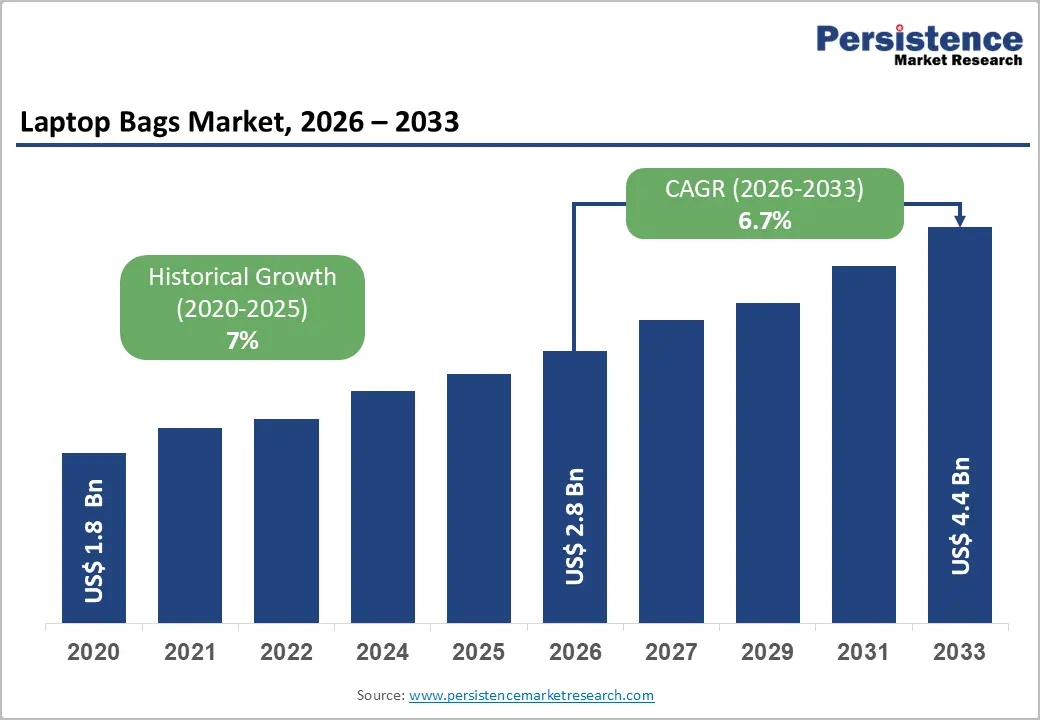
The global laptop bags market size is likely to be valued at US$ 2.8 billion in 2026, and is projected to reach US$ 4.4 billion by 2033, growing at a CAGR of 6.7% during the forecast period 2026 - 2033.
Remote work infrastructure has expanded steadily worldwide, fueling the demand for laptop bags. Laptop ownership is rising rapidly in emerging economies such as Asia and Africa, where mobile professionals are multiplying. Consumers are actively favoring multifunctional carriers that handle daily essentials beyond device protection. In response, producers are developing novel ergonomic designs and sustainable fabrics to match these shifts.
E-commerce platforms are further broadening access for diverse buyers across geographies, while brands are innovating continuously to stay resilient in this space, prioritizing eco-friendly materials to attract environmentally aware customers. Digital channels are deepening engagement with varied demographics. Forward-thinking companies are integrating tech components and durable designs for hybrid lifestyles and diversifying product offerings to drive long-term growth.
Key Industry Highlights
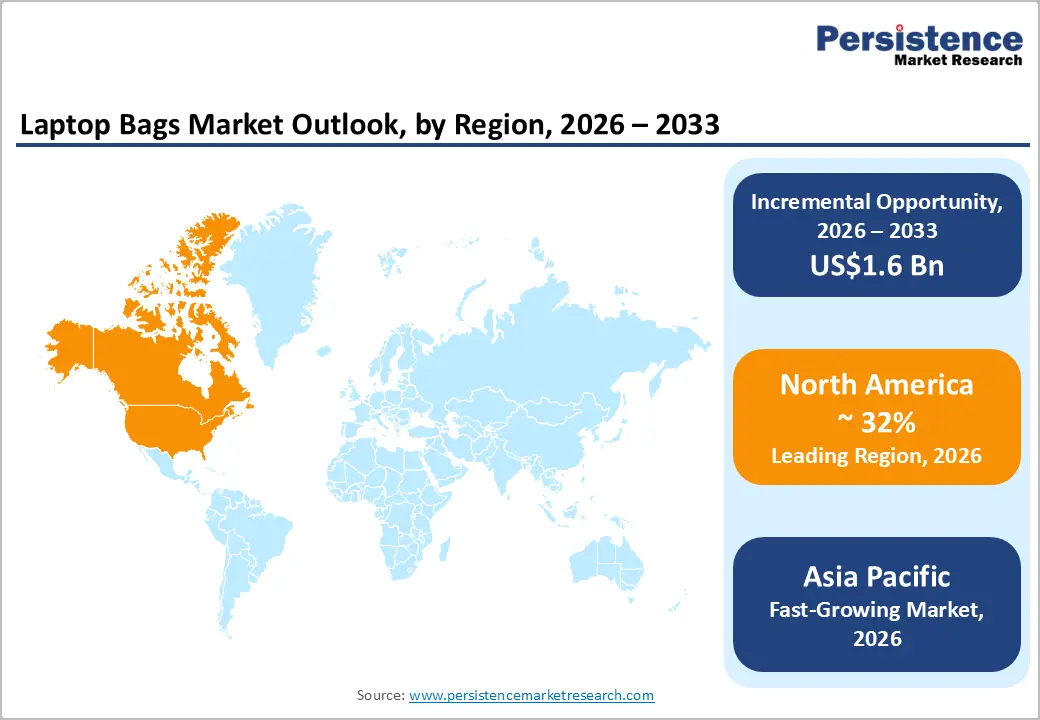
- Dominant Region: North America is expected to secure a market share of about 32% in 2026, supported by a high level of technology adoption and well-established remote and hybrid work practices.
- Fastest-growing Market: The Asia Pacific market is set to grow the fastest through 2033, due to sustained increases in laptop ownership and rising disposable incomes.
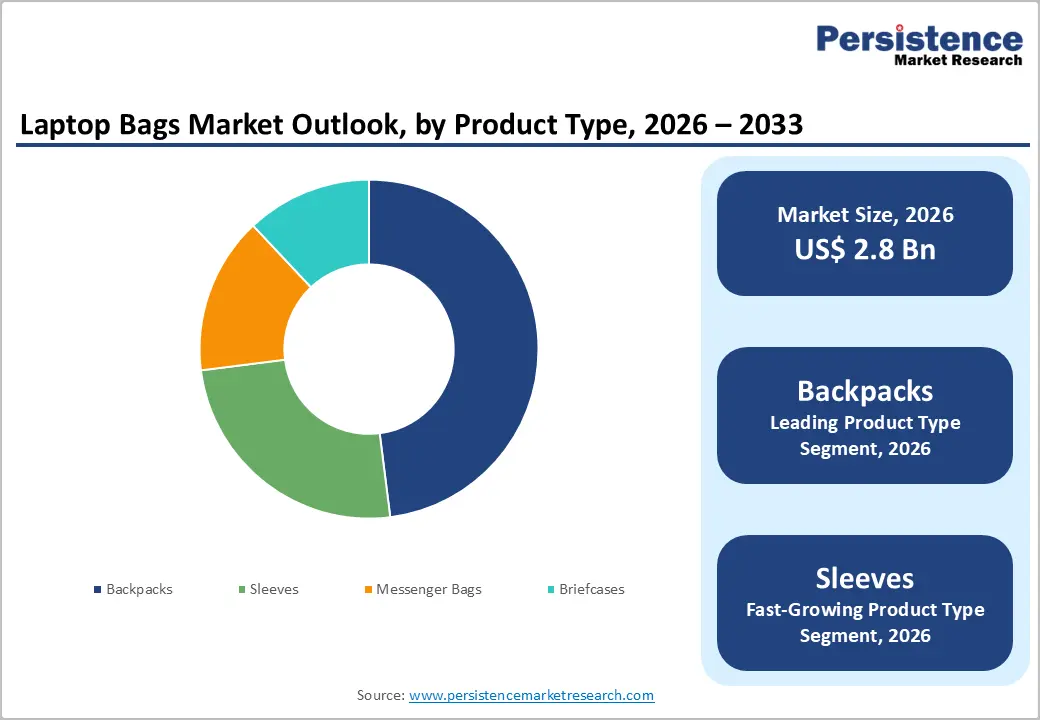
- Leading & Fastest-growing Product Type: Backpacks are slated to lead with an estimated 2026 share of 48%, while sleeves are likely to be the fastest-growing segment during the 2026 - 2033 forecast period.
- Leading & Fastest-growing Material: Nylon is estimated to hold around 52% revenue share in 2026, with leather posting the highest CAGR during the 2026 - 2033 forecast period.
- July 2025: Swiss Military launched its ultra-premium Black Gold Collection of laptop bags and travel backpacks & essentials, blending sleek designs with durable functionality for modern travelers at accessible prices.
| Key Insights | Details |
|---|---|
| Laptop Bags Market Size (2026E) | US$ 2.8 Bn |
| Market Value Forecast (2033F) | US$ 4.4 Bn |
| Projected Growth (CAGR 2026 to 2033) | 6.7% |
| Historical Market Growth (CAGR 2020 to 2025) | 7% |
Market Factors - Growth, Barriers, and Opportunity Analysis
Technological Advancement in Laptop Design and Portability
The continuous evolution of laptop specifications has reshaped expectations for carrying solutions in both consumer and enterprise environments. As devices become thinner and lighter, manufacturers are integrating higher processing power and more delicate components, which increases the need for effective impact protection and structural stability. This trend raises the importance of carefully engineered padding, reinforced edges, and secure device cradles that can absorb shocks without adding unnecessary bulk.
From a procurement and policy perspective, organizations now view laptop bags as integral components of device protection strategies, treating them as essential to extending hardware lifecycles and reducing incidental damage-related costs.
The way professionals use technology has shifted, with users routinely carrying multiple accessories such as wireless mice, portable power banks, tablets, and noise-canceling headphones. This ecosystem-oriented usage pattern has increased demand for internal layouts that support clear, intuitive organization rather than simple open compartments. In response, manufacturers are prioritizing dedicated pockets for specific devices, integrated cable management, and identity protection solutions, such as radio frequency identification (RFID) blocking compartments. These enhancements go beyond convenience by boosting productivity, safeguarding sensitive information, and aligning the laptop bag with modern mobile workflows and evolving security expectations.
Increasing Competition from Counterfeit Products
The growing prevalence of counterfeit products intensifies price-based competition and erodes brand equity. Fake laptop bags, typically offered at significantly lower prices, undermine genuine manufacturers by imitating designs while failing to match durability, safety, or warranty standards. For example, Amazon's Nymera Turn-Lock Handbag, priced at US$ 45, mimics the iconic Hermès Birkin with its trapezoidal shape, rolled handles, gold turn-lock buckle, and protective feet, offering a chic, durable dupe without the US$ 20,000 and above premium. This performance gap can lead to product failures that consumers may mistakenly attribute to the original brand, ultimately weakening loyalty and long-term customer relationships. To mitigate this challenge, established brands need to adopt a structured brand protection strategy that combines technology, enforcement, and consumer awareness.
Companies are increasingly integrating security features, such as holographic labels, scannable quick response (QR) codes, and blockchain-based traceability systems, to verify product origin throughout the supply chain. In parallel, targeted educational campaigns can help customers recognize authentic products, understand the functional and safety risks of counterfeits, and appreciate the total value offered by legitimate brands, thereby strengthening trust and supporting premium positioning.
Customization and Personalization of Laptop Bags
Growing demand for individualized products is reshaping expectations in the laptop bags category, as consumers increasingly look for items that express their personal style and functional preferences. Customization options such as monogramming, interchangeable color panels, adjustable straps, and tailored internal layouts allow brands to move beyond standard designs and position their offerings as experience-driven rather than purely utilitarian. For decision-makers, this shift creates an opportunity to segment customers more precisely and capture higher margins by aligning product configurations with specific professional, student, and lifestyle needs, rather than competing solely on price.
Technological progress is making this personalization commercially viable at scale, as tools such as three-dimensional (3D) printing, computer-aided design (CAD) platforms, and automated cutting systems reduce the cost and lead time of tailored production. Manufacturers can integrate online configurators that allow buyers to select materials, colors, hardware, and compartment layouts, then feed those selections directly into flexible manufacturing lines. Strategic collaborations with fashion designers, lifestyle brands, and digital influencers can further elevate the perceived value of customized laptop bags by associating them with specific aesthetics, communities, or professional identities.
Category-wise Analysis
Product Type Insights
Backpacks are slated to command an estimated 48% of the laptop bags market revenue share in 2026. This leadership reflects the superior ergonomic benefits, hands-free convenience, and capacity for carrying multiple items beyond laptops of backpacks. These carry-ons also appeal to diverse consumer segments, including commuters, travelers, and professionals who prioritize comfort during extended wear periods. The design versatility of backpacks enables manufacturers to address varied price points and style preferences, from minimalist urban designs to feature-rich tactical configurations.
Backpacks are particularly popular among students and young professionals who often need to carry books, gadgets, and other essentials along with their laptops. The versatility and ergonomic design of backpacks make them a preferred choice for daily commutes and travel.
Sleeves are likely to be the fastest-growing segment during the 2026 - 2033 forecast period, driven by the proliferation of ultraportable laptops and minimalist carrying preferences. These lightweight, form-fitting solutions appeal to consumers seeking basic protection without extensive organizational features, particularly popular among urban professionals who use public transportation or work from multiple locations daily. The segment benefits from lower manufacturing costs enabling competitive pricing, while premium variants incorporate high-quality materials and designer collaborations.
Material Insights
Nylon is expected to hold the highest revenue share, reaching nearly 52% in 2026, on account of its exceptional combination of durability, lightweight properties, water resistance, and cost-effectiveness, which appeals to both manufacturers and consumers across diverse price points. Nylon fabrics, particularly ballistic nylon and ripstop variants, provide superior abrasion resistance and tear strength, making them ideal for daily commuting and travel applications where bags endure frequent handling and environmental exposure.
The material's versatility enables manufacturers to achieve a range of aesthetic finishes, from matte professional appearances to glossy contemporary styles, while maintaining consistent performance characteristics.
Leather is expected to register the highest CAGR between 2026 and 2033, driven by increasing consumer preference for premium aesthetics, professional appearance, and products that develop distinctive patina characteristics over time. This accelerated growth reflects the aspirational positioning of leather laptop bags among upwardly mobile professionals, entrepreneurs, and executives who view carrying accessories as extensions of personal brand and professional image. Full-grain leather, top-grain leather, and premium variants command price premiums of 60-80% above synthetic alternatives, with consumers justifying investment through perceived longevity, timeless design, and status signaling.
Distribution Channel Insights
The online retail segment is poised to dominate, accounting for approximately 52% of market revenue share in 2026. This segment leadership reflects the fundamental transformation in consumer purchasing behavior, accelerated by pandemic-era digital adoption and sustained through superior convenience, competitive pricing, and extensive product selection. Online channels encompass multiple sub-segments, including e-commerce marketplaces, such as Amazon, Alibaba, and Flipkart, brand direct-to-consumer websites, and specialized online retailers, each offering distinct value propositions that collectively address diverse consumer preferences and shopping behaviors. Price transparency and comparison tools enable consumers to evaluate multiple options simultaneously, while promotional events, flash sales, and subscription discounts create compelling value propositions.
Offline retail is anticipated to be the fastest-growing segment during the 2026 - 2033 forecast period. This accelerated growth reflects a strategic evolution in physical retail, transitioning from transactional commodity distribution toward experiential brand environments that provide value propositions online channels cannot replicate. Specialty stores that focus exclusively on laptop bags, travel accessories, or premium lifestyle goods create curated shopping experiences that emphasize expert consultation, tactile product evaluation, and immediate purchase gratification, appealing to specific consumer segments willing to invest in premium products.
Regional Insights
North America Laptop Bags Market Trends
North America is set to command a significant portion of the laptop bags market share at approximately 32% in 2026. The United States drives most of this regional performance because of its high level of technology adoption, well-established remote and hybrid work practices, and strong consumer purchasing power. In this environment, laptop bags are not seen as basic accessories but as integral elements of a broader mobile productivity ecosystem, where functionality, ergonomic design, and aesthetic appeal shape both consumer choices and corporate procurement strategies.
Strong brand awareness and a clear preference for high-quality products encourage buyers to upgrade to solutions that provide better protection, more effective organization, and closer alignment with their professional image or lifestyle needs.
Growth momentum in North America increasingly comes from structural trends rather than short-term cycles, and this shift has significant implications for both strategy and capital allocation. At the same time, the ongoing expansion of digital learning in schools and universities helps to secure long-term baseline demand, as students and educators consistently need dependable protection for laptops and associated devices. The presence of leading manufacturers and a well-established retail infrastructure also contribute to the market's strength in North America. The regional market is expected to maintain steady growth with a focus on innovative and premium products.
Europe Laptop Bags Market Trends
Europe is anticipated to account for a considerable share of the global demand for laptop bags and the market here is being increasingly shaped by sustainability, regulatory rigor, and premium product preferences. Key countries such as Germany, the United Kingdom, France, and Spain underpin regional value, with Germany in particular benefiting from a strong industrial base, high levels of laptop adoption, and a culture that emphasizes engineering quality and long-lasting products. Across these markets, many consumers now view a laptop bag as part of a broader mobility and lifestyle solution rather than as a simple accessory, which increases the importance of design, ergonomic comfort, and traceable material sourcing in purchase decisions.
Regulatory alignment within the European Union (EU) supports long-term, structurally driven growth in the laptop bags market, but it also raises the threshold for companies seeking to compete in the region. Policy frameworks that advance circular economy principles, such as directives on waste reduction, material recycling, and extended producer responsibility, tend to reward manufacturers that can demonstrate robust compliance while disadvantaging those that depend on low-cost, opaque supply chains. Investment priorities are increasingly shifting toward circular business models, including repair and refurbishment services, product take-back programs, and the use of carbon-neutral or other low-impact materials, which collectively position Europe as both a regulatory reference point and a proving ground for next-generation sustainable laptop bag solutions.
Asia Pacific Laptop Bags Market Trends
Asia Pacific is anticipated to emerge as the fastest-growing regional market for laptop bags from 2026 to 2033, supported by rapidly widening laptop ownership and rising disposable incomes across key emerging economies such as China and India. Massive digitalization drives across education, government services, and enterprise operations continue to push a broadening array of households and professionals toward personal computing, which directly expands the addressable base for protective and functional carrying solutions. As more first-time buyers enter the market, there is also a progressive shift from generic backpacks to purpose-designed laptop bags that offer better device protection, organization, and aesthetics.
Demographic trends further reinforce this trajectory. A growing middle-class population, higher urbanization, and an expanding student base in markets such as India, Indonesia, Vietnam, and the Philippines are driving sustained, volume-driven demand for entry-level and mid-range laptop bags. At the same time, domestic and regional manufacturers play a prominent role, leveraging cost-efficient production and proximity to raw material supply to offer a wide spectrum of designs at competitive price points. This abundance of suppliers and strong price sensitivity among consumers make the Asia Pacific market intensely competitive, which encourages continuous product innovation, localization of design features, and experimentation with online-first distribution models to capture and retain market share.
Competitive Landscape
The global laptop bags market structure is moderately fragmented, dominated by leading players such as Samsonite International S.A., Targus, Belkin International, Inc., Thule Group AB and SwissGear. These players collectively capture 35-40% of the market share. The laptop bag market remains highly competitive as a wide range of companies compete for share by focusing on innovation, product quality, and distinctive brand positioning.
The landscape features a mix of well-established international brands and agile local manufacturers, all aiming to address varied consumer requirements across price points, lifestyles, and usage occasions. To succeed, market participants increasingly rely on strategies such as continuous product development, collaborative partnerships, and precisely targeted marketing initiatives that speak to specific user segments.
Key Industry Developments
- In July 2025, Fantasy Enterprises rolled out Meyvin, a premium bag brand targeting professionals with high-end backpacks, laptop sleeves, office bags, and corporate gifting options made from durable materials. The brand also debuted an online store that emphasizes style, functionality, and customization for both individual and bulk orders.
- In May 2025, Harber London unveiled its Legacy Sleeves collection, featuring a Laptop Sleeve and iPad Sleeve crafted from pebbled and smooth full-grain leather in Black, Brown, or Caoba. Designed for device protection plus organized storage of chargers and cables, these slim, luxurious sleeves complement the brand's backpacks and wallets as premium, gift-worthy accessories
- In March 2025, FREEE Recycle, a Nigerian tire recycling firm, launched the ÀJÀLÁ Tote and Laptop Bags made from 80% recycled waste tires, turning environmental hazards into stylish, durable, weather-resistant accessories. Named after the Yoruba word for "traveler," these bags tackle Nigeria's tire waste crisis while aiming to recycle over 5 million tires annually.
Companies Covered in Laptop Bags Market
- Samsonite International S.A.
- Targus
- Belkin International, Inc.
- Thule Group AB
- SwissGear (Wenger SA)
- Tumi Holdings, Inc.
- Crumpler
- Herschel Supply Co.
- Bellroy
- Everki
- STM Goods
- Knomo London
- Incase Designs Corp.
- Booq LLC
- WaterField Designs
Frequently Asked Questions
The global laptop bags market is projected to reach US$ 2.8 billion in 2026.
Increasing laptop adoption across work, education, and personal use, combined with remote/hybrid work trends and demand for stylish, protective, and functional carry solutions, is driving the market.
The market is poised to witness a CAGR of 6.7% from 2026 to 2033.
Eco-friendly and smart-featured bags, expansion via e-commerce and online retail, and rising demand from emerging markets and corporate gifting/customization segments are presenting new opportunities.
Samsonite International S.A., Targus, Belkin International, Inc., Thule Group AB, and SwissGear are some of the key players in the market.


