Kosher Salt Market Size, Share, Growth, and Regional Forecast, 2026 to 2033

Kosher Salt Market by Product Type (Fine Kosher Salt, Flake Kosher Salt, Coarse Kosher Salt), Application (Meat and Poultry Processing, Seasonings and Marinades, Sauces and Condiments, Baking, Others) Sales Channel (Hypermarkets/Supermarkets, Convenience Stores, Specialty Stores, Independent Grocery Stores, Online Retail, Others), and Regional Analysis from 2026 to 2033

ID: PMRREP12577
Calendar

March 2026

192 Pages

Author : Amol Patil

Key Industry Highlights:

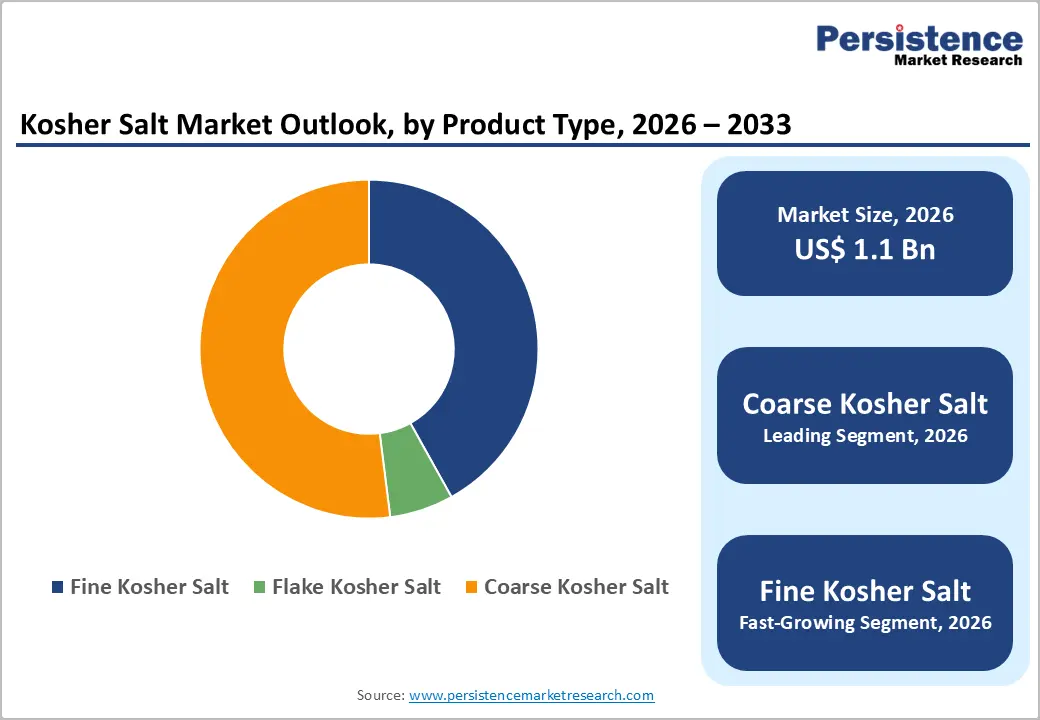
  • Dominant Segment: Coarse kosher salt held the largest share in 2025 with 52.0% share, favored for meat processing, brining, and culinary uses due to its texture, ease of handling, and widespread adoption in both home cooking and foodservice applications globally.
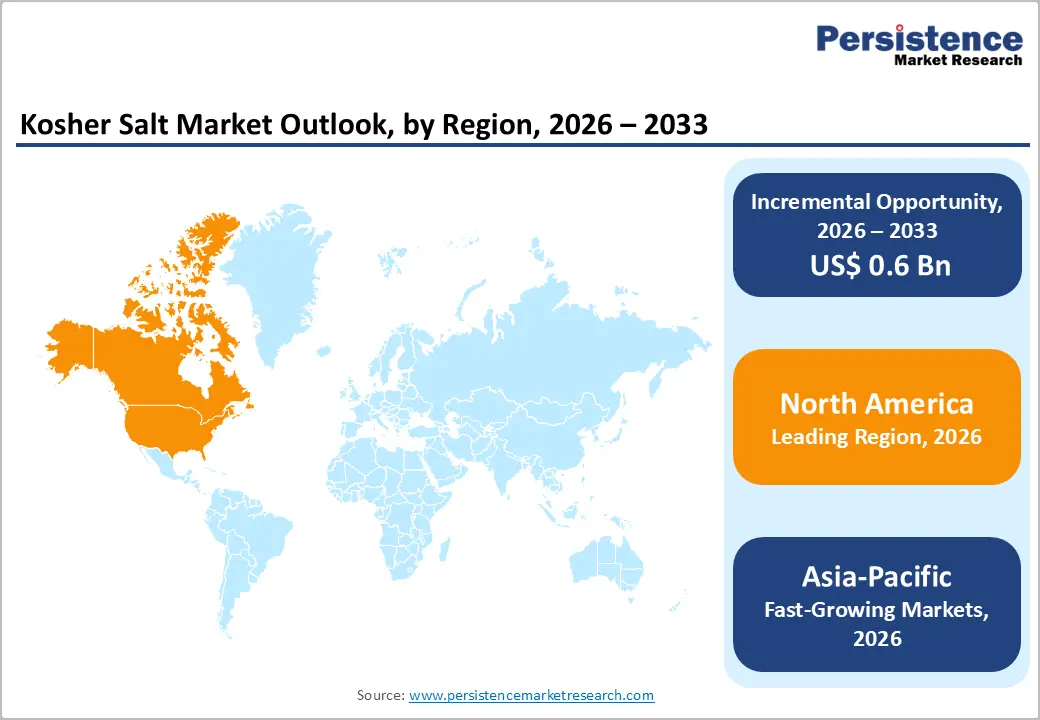
  • Dominant Region: North America held a significant share in the kosher salt market in 2025, driven by high health awareness, strong demand for premium and specialty salts, widespread use in foodservice and retail, and growing preference for gourmet cooking and plant-based diets across the United States and Canada.
  • Market Drivers: Growth is fueled by rising food consumption, expanding foodservice and packaged food sectors, increasing home cooking trends, and the culinary preference for kosher salt’s purity and texture.
  • Market Opportunity: Opportunities exist in premium and flavored kosher salts, specialty gourmet variants, online retail expansion, and rising adoption in emerging markets across Asia, Africa, and Latin America.
Global Market Attributes Key Insights
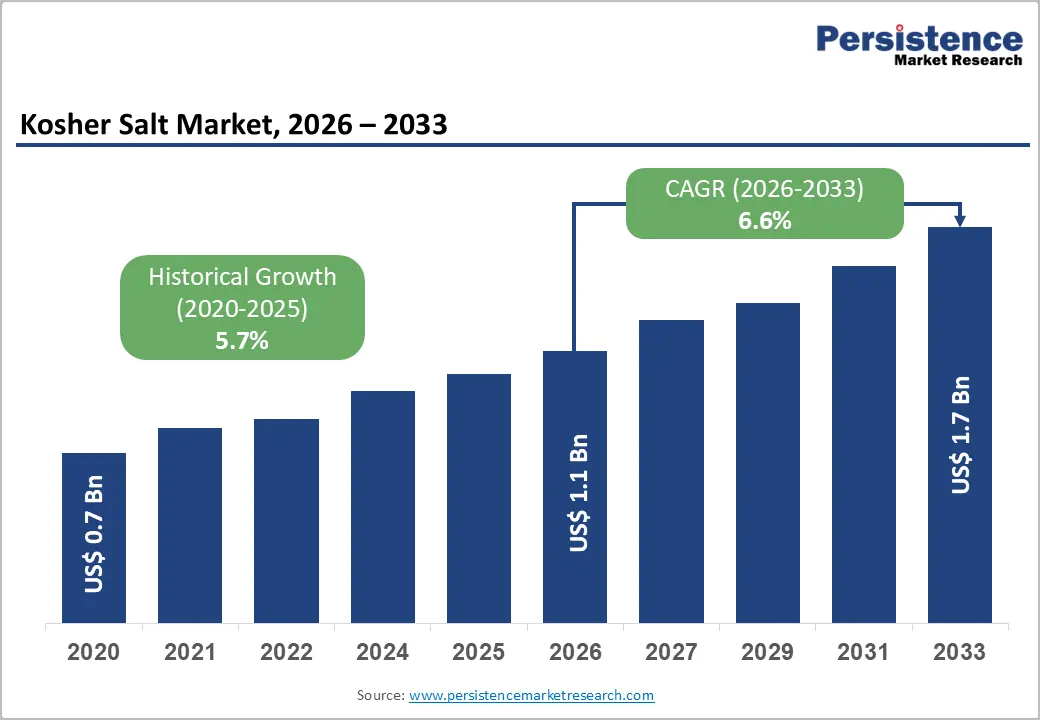
Global Kosher Salt Market Size (2026E) US$ 1.1 Bn
Market Value Forecast (2033F) US$ 1.7 Bn
Projected Growth (CAGR 2026 to 2033) 6.6%
Historical Market Growth (CAGR 2020 to 2025) 5.7%

kosher-salt-market-2033

Market Dynamics

Driver: Increasing adoption in meat and poultry processing

Salt plays a fundamental functional role in meat and poultry processing, beyond simple seasoning. According to U.S. Department of Agriculture (USDA) analytical studies, enhancement techniques such as marination and injection containing salts (including kosher salt) are used in about 30% of chicken and 40% of fresh pork products sold in retail markets to improve taste, tenderness, and water retention. Sodium chloride helps extract proteins, increases water binding, and improves texture, functions that are essential in processed meat products such as hams, sausages, and deli meats. These roles drive kosher salt demand, particularly for coarse, additive-free varieties used in dry brining and curing processes that optimize quality and yield.

Kosher salt’s coarse crystals make it especially suited for surface salting and dry brining in larger meat cuts. Government nutritional guidance (e.g., FDA) acknowledges sodium’s culinary roles in enhancing flavor, retaining moisture, and preserving foods, underscoring why salt (including kosher varieties) remains critical in meat and poultry processing. While broader sodium use is scrutinized for health reasons, the meat industry’s reliance on salt for functional and quality attributes supports sustained and growing demand for kosher salt applications in processing lines globally.

Restraint: High cost compared with regular table salt

Kosher salt typically commands a higher price per unit than regular table salt due to its manufacturing, crystal structure, and positioning as a premium culinary ingredient. Trade data on international salt pricing shows kosher salt retail often ranges from about $1.50 to $5.00 per unit, whereas common table salt is more economical, often $0.10 to $0.50 at bulk or retail prices. This significant difference sometimes 3-10× more expensive than basic table salt, can discourage cost-sensitive buyers in large-volume food processing and emerging markets where price is a primary driver of ingredient selection.

Government dietary guidance also highlights broader concerns about sodium reduction, reinforcing some manufacturers’ incentives to limit high-salt ingredients. For example, the FDA recommends limiting sodium intake to less than 2,300 mg per day, prompting processors to reformulate products with lower overall sodium content or substitutes. This public health focus may constrain overall salt use (including kosher salt) in processed foods where cost plus regulatory pressure influences reformulation strategies. Thus, both price premium and sodium reduction policies act as restraints on wider kosher salt adoption in some sectors.

Opportunity: Rising demand for flavored, smoked, and specialty kosher salts

Culinary preferences are evolving, with consumers and chefs increasingly seeking novel flavors, textures, and premium ingredients. Independent industry sources show that flavored and specialty salts command significantly higher retail prices than standard salts, with flavored varieties often priced multiple times above conventional table salt. Gourmet cooking practices championed by culinary schools, cooking shows, and foodservice chefs have driven salt diversification, making varieties such as smoked, herb-infused, and specialty kosher salts desirable for finishing, seasoning, and signature dishes.

Government and academic food science resources acknowledge that salt types and textures affect culinary performance, which fuels consumer preference for distinctive salts like kosher with specialized infusions. Additionally, the broader trend toward artisanal, high-quality culinary ingredients supports increased use of premium kosher salts among foodservice professionals and home cooks alike. As global demand for diverse cuisines and gourmet experiences grows, kosher salt producers can capitalize on this opportunity by expanding flavored and specialty lines that cater to imaginative cooking and elevated taste experiences across markets.

Category-wise Analysis

By Product Type Insights

Coarse kosher salt dominates with 52.0% share because of its functional advantages in food preparation and processing. According to the U.S. Department of Agriculture (USDA), coarse salts are preferred in dry brining and curing because larger crystals draw out moisture more slowly and evenly, improving texture in meat products such as poultry and beef. USDA food science research shows that coarse grains enhance surface salting, increasing protein extraction and water binding, which meat processors rely on for quality and yield. Larger granules also make it easier to control salt addition in recipes, reducing over-salting in culinary applications. Additionally, coarse salt’s physical structure improves handling in automated industrial lines, supporting its broad adoption over fine or flake varieties.

By Application Insights

Seasonings and marinades dominate kosher salt usage because salt is the primary flavor enhancer in global cuisines. The U.S. Food and Drug Administration (FDA) notes sodium chloride’s role in enhancing flavor and improving palatability across foods, including seasonings. In the United States alone, per capita salt consumption averages about 3,400 mg of sodium daily (equivalent to ~8.5 g salt), reflecting extensive use in seasoning blends and marinades. Kosher salt’s crystal size makes it especially effective for seasoning meats, vegetables, and sauces, as its texture distributes flavor uniformly. Further, the National Chicken Council reports that many processors use salt-based marinades to improve juiciness and flavor retention, reinforcing kosher salt’s central role in seasoning applications.
kosher-salt-market-outlook-by-product-type-2026-2033

Regional Insights

North America Kosher Salt Market Trends

North America dominates because of high processed food production, extensive foodservice demand, and culinary traditions that favor kosher salt. In the United States, the annual per-capita consumption of salt surpasses ~8.5 g/day (FDA sodium intake data), reflecting widespread use in seasoning, brining, and food manufacturing. The U.S. food industry processes over 95 billion pounds of meat annually (USDA Agricultural Marketing Service), where kosher salt is preferred for brining and curing due to its crystal size and purity. Additionally, the National Restaurant Association reports that foodservice sales exceeded $900 billion pre-pandemic, indicating strong demand for quality ingredients like kosher salt. These factors combine to sustain North America’s dominant position in kosher salt consumption and production.

Europe Kosher Salt Market Trends

Europe is important due to its diverse culinary traditions, strong food safety regulations, and robust food processing sector. The European Food Safety Authority (EFSA) reports that average adult salt intake in many EU countries ranges from ~7-10 g/day, illustrating extensive salt use in cooking and processing. European regulations on salt quality and purity support the adoption of kosher salt in artisanal and industrial applications. The EU’s meat processing sector produces millions of tonnes of processed products annually (Eurostat data), where kosher salt is valued for texture and flavor enhancement. Moreover, gourmet cooking trends across France, Italy, and Spain elevate specialty salts, making Europe a significant regional market for kosher salt.

Asia-Pacific Kosher Salt Market Trends

Asia Pacific is the fastest-growing region due to rising food consumption, expanding food processing industries, and increasing culinary diversity. The Food and Agriculture Organization (FAO) reports that per-capita food supply and demand are rising sharply in China and India, with total meat production in Asia increasing by over 50 percent from 2010 to 2020. Growing middle classes in China, India, Japan, and South Korea are shifting diets toward processed and convenience foods that utilize kosher salt in seasoning and preservation. Additionally, rapid urbanization in Asia (UN data shows ~50 percent urban population in 2000 rising to ~55 percent by 2025) drives foodservice growth, further boosting kosher salt demand. These demographic and consumption trends position Asia Pacific as the fastest-growing region for kosher salt.
kosher-salt-market-outlook-by-region-2026-2033

Market Competitive Landscape

The kosher salt market is highly competitive, dominated by major players like Cargill, Morton Salt, and Wilmar International. Companies focus on expanding production, ensuring consistent global supply, adopting sustainable sourcing, and introducing premium or specialty kosher salts to meet rising culinary, foodservice, and processed food demand worldwide.

Key Industry Developments:

  • In February 2026, The annual Kosher Food & Wine Experience was held, featuring a wide array of kosher-certified foods and beverages. The event brought together chefs, wineries, and specialty food producers to showcase innovative culinary creations, including products incorporating kosher salt. Attendees explored tasting stations, cooking demonstrations, and networking opportunities, highlighting trends in gourmet kosher cuisine.
  • In June 2025, Sprinkles bakery debuted a limited-edition cupcake in a nationwide collaboration with Maple Hill and Diamond Crystal Salt Co. The special cupcake featured Diamond Crystal kosher salt as a key ingredient, highlighting its flavor-enhancing properties.

Companies Covered in Kosher Salt Market

  • Cargill, Incorporated
  • Morton Salt, Inc.
  • San Francisco Salt Company
  • Atisale Spa
  • SaltWorks®
  • Windsor Salt Ltd.
  • Selina Naturally®
  • Redmond Life
  • Salinity
  • Jacobsen Salt Co.
  • Windsor Salt Ltd.
  • Others
Frequently Asked Questions

The global kosher salt market is projected to be valued at US$ 1.1 Bn in 2026.

Rising food consumption, culinary demand, meat processing, health awareness, and preference for premium salts drive growth.

The global kosher salt market is poised to witness a CAGR of 6.6% between 2026 and 2033.

Rising demand for flavored, specialty, gourmet kosher salts, e-commerce growth, and emerging market expansion.

Cargill, Incorporated, Morton Salt, Inc., San Francisco Salt Company, Atisale Spa, SaltWorks®, Windsor Salt Ltd.

Kosher Salt Market Report Scope
Report Attribute Details
Historical Data/Actuals 2020 - 2025
Forecast Period 2026 - 2033
Market Analysis
  • Value: US$ Bn
  • Volume: Tons
Geographical Coverage
  • North America
  • Europe
  • East Asia
  • South Asia & Oceania
  • Latin America
  • Middle East and Africa
Segmental Coverage
  • Product Type
  • Application
  • Sales Channel
  • Region
Competitive Analysis
  • Cargill, Incorporated
  • Morton Salt, Inc.
  • San Francisco Salt Company
  • Atisale Spa
  • SaltWorks®
  • Windsor Salt Ltd.
  • Selina Naturally®
  • Redmond Life
  • Salinity
  • Jacobsen Salt Co.
  • Windsor Salt Ltd.
  • Others
Report Highlights
  • Market Forecast and Trends
  • Competitive Intelligence & Share Analysis
  • Growth Factors and Challenges
  • Strategic Growth Initiatives
  • Pricing Analysis
  • Future Opportunities and Revenue Pockets
  • Market Analysis Tools
Market Segmentation

By Product Type

  • Fine Kosher Salt
  • Flake Kosher Salt
  • Coarse Kosher Salt

By Application

  • Meat and Poultry Processing
  • Seasonings and Marinades
  • Sauces and Condiments
  • Baking
  • Others

By Sales Channel

  • Hypermarkets/Supermarkets
  • Convenience Stores
  • Specialty Stores
  • Independent Grocery Stores
  • Online Retail
  • Others

By Region

  • North America
  • Europe
  • East Asia
  • South Asia & Oceania
  • Latin America
  • Middle East and Africa

Related Reports

  1. Executive Summary
    1. Global Kosher Salt Market Snapshot, 2026 and 2033
    2. Market Opportunity Assessment, 2026 - 2033, US$ Bn
    3. Key Market Trends
    4. Future Market Projections
    5. Premium Market Insights
    6. Industry Developments and Key Market Events
    7. PMR Analysis and Recommendations
  2. Market Overview
    1. Market Scope and Definition
    2. Market Dynamics
      1. Drivers
      2. Restraints
      3. Opportunity
      4. Challenges
      5. Key Trends
    3. Macro-Economic Factors
      1. Global Sectorial Outlook
      2. Global GDP Growth Outlook
    4. COVID-19 Impact Analysis
    5. Forecast Factors - Relevance and Impact
  3. Value Added Insights
    1. Product Adoption Analysis
    2. Regulatory Landscape
    3. Value Chain Analysis
    4. Key Deals and Mergers
    5. PESTLE Analysis
    6. Porter’s Five Force Analysis
  4. Price Trend Analysis, 2020 - 2033
    1. Key Highlights
    2. Key Factors Impacting Product Prices
    3. Pricing Analysis, By Product Type
    4. Regional Prices and Product Preferences
  5. Global Kosher Salt Market Outlook:
    1. Key Highlights
      1. Market Volume (Tons) Projections
      2. Market Size (US$ Bn) and Y-o-Y Growth
      3. Absolute $ Opportunity
    2. Market Size (US$ Bn) Analysis and Forecast
      1. Historical Market Size (US$ Bn) Analysis, 2020-2025
      2. Market Size (US$ Bn) Analysis and Forecast, 2026-2033
    3. Global Kosher Salt Market Outlook: Product Type
      1. Introduction / Key Findings
      2. Historical Market Size (US$ Bn) and Volume (Tons) Analysis, By Product Type, 2020-2025
      3. Market Size (US$ Bn) and Volume (Tons) Analysis and Forecast, By Product Type, 2026-2033
        1. Fine Kosher Salt
        2. Flake Kosher Salt
        3. Coarse Kosher Salt
      4. Market Attractiveness Analysis: Product Type
    4. Global Kosher Salt Market Outlook: Application
      1. Introduction / Key Findings
      2. Historical Market Size (US$ Bn) Analysis, By Application, 2020-2025
      3. Market Size (US$ Bn) Analysis and Forecast, By Application, 2026-2033
        1. Meat and Poultry Processing
        2. Seasonings and Marinades
        3. Sauces and Condiments
        4. Baking
        5. Others
      4. Market Attractiveness Analysis: Application
    5. Global Kosher Salt Market Outlook: Sales Channel
      1. Introduction / Key Findings
      2. Historical Market Size (US$ Bn) Analysis, By Sales Channel, 2020-2025
      3. Market Size (US$ Bn) Analysis and Forecast, By Sales Channel, 2026-2033
        1. Hypermarkets/Supermarkets
        2. Convenience Stores
        3. Specialty Stores
        4. Independent Grocery Stores
        5. Online Retail
        6. Others
      4. Market Attractiveness Analysis: Sales Channel
  6. Global Kosher Salt Market Outlook: Region
    1. Key Highlights
    2. Historical Market Size (US$ Bn) and Volume (Tons) Analysis, By Region, 2020-2025
    3. Market Size (US$ Bn) and Volume (Tons) Analysis and Forecast, By Region, 2026-2033
      1. North America
      2. Europe
      3. East Asia
      4. South Asia and Oceania
      5. Latin America
      6. Middle East & Africa
    4. Market Attractiveness Analysis: Region
  7. North America Kosher Salt Market Outlook:
    1. Key Highlights
    2. Historical Market Size (US$ Bn) and Volume (Tons) Analysis, By Market, 2020-2025
      1. By Country
      2. By Product Type
      3. By Application
      4. By Sales Channel
    3. Market Size (US$ Bn) Analysis and Forecast, By Country, 2026-2033
      1. U.S.
      2. Canada
    4. Market Size (US$ Bn) and Volume (Tons) Analysis and Forecast, By Product Type, 2026-2033
      1. Fine Kosher Salt
      2. Flake Kosher Salt
      3. Coarse Kosher Salt
    5. Market Size (US$ Bn) Analysis and Forecast, By Application, 2026-2033
      1. Meat and Poultry Processing
      2. Seasonings and Marinades
      3. Sauces and Condiments
      4. Baking
      5. Others
    6. Market Size (US$ Bn) Analysis and Forecast, By Sales Channel, 2026-2033
      1. Hypermarkets/Supermarkets
      2. Convenience Stores
      3. Specialty Stores
      4. Independent Grocery Stores
      5. Online Retail
      6. Others
    7. Market Attractiveness Analysis
  8. Europe Kosher Salt Market Outlook:
    1. Key Highlights
    2. Historical Market Size (US$ Bn) and Volume (Tons) Analysis, By Market, 2020-2025
      1. By Country
      2. By Product Type
      3. By Application
      4. By Sales Channel
    3. Market Size (US$ Bn) Analysis and Forecast, By Country, 2026-2033
      1. Germany
      2. France
      3. U.K.
      4. Italy
      5. Spain
      6. Russia
      7. Rest of Europe
    4. Market Size (US$ Bn) and Volume (Tons) Analysis and Forecast, By Product Type, 2026-2033
      1. Fine Kosher Salt
      2. Flake Kosher Salt
      3. Coarse Kosher Salt
    5. Market Size (US$ Bn) Analysis and Forecast, By Application, 2026-2033
      1. Meat and Poultry Processing
      2. Seasonings and Marinades
      3. Sauces and Condiments
      4. Baking
      5. Others
    6. Market Size (US$ Bn) Analysis and Forecast, By Sales Channel, 2026-2033
      1. Hypermarkets/Supermarkets
      2. Convenience Stores
      3. Specialty Stores
      4. Independent Grocery Stores
      5. Online Retail
      6. Others
    7. Market Attractiveness Analysis
  9. East Asia Kosher Salt Market Outlook:
    1. Key Highlights
    2. Historical Market Size (US$ Bn) and Volume (Tons) Analysis, By Market, 2020-2025
      1. By Country
      2. By Product Type
      3. By Application
      4. By Sales Channel
    3. Market Size (US$ Bn) Analysis and Forecast, By Country, 2026-2033
      1. China
      2. Japan
      3. South Korea
    4. Market Size (US$ Bn) and Volume (Tons) Analysis and Forecast, By Product Type, 2026-2033
      1. Fine Kosher Salt
      2. Flake Kosher Salt
      3. Coarse Kosher Salt
    5. Market Size (US$ Bn) Analysis and Forecast, By Application, 2026-2033
      1. Meat and Poultry Processing
      2. Seasonings and Marinades
      3. Sauces and Condiments
      4. Baking
      5. Others
    6. Market Size (US$ Bn) Analysis and Forecast, By Sales Channel, 2026-2033
      1. Hypermarkets/Supermarkets
      2. Convenience Stores
      3. Specialty Stores
      4. Independent Grocery Stores
      5. Online Retail
      6. Others
    7. Market Attractiveness Analysis
  10. South Asia & Oceania Kosher Salt Market Outlook:
    1. Key Highlights
    2. Historical Market Size (US$ Bn) and Volume (Tons) Analysis, By Market, 2020-2025
      1. By Country
      2. By Product Type
      3. By Application
      4. By Sales Channel
    3. Market Size (US$ Bn) Analysis and Forecast, By Country, 2026-2033
      1. India
      2. Southeast Asia
      3. ANZ
      4. Rest of South Asia & Oceania
    4. Market Size (US$ Bn) and Volume (Tons) Analysis and Forecast, By Product Type, 2026-2033
      1. Fine Kosher Salt
      2. Flake Kosher Salt
      3. Coarse Kosher Salt
    5. Market Size (US$ Bn) Analysis and Forecast, By Application, 2026-2033
      1. Meat and Poultry Processing
      2. Seasonings and Marinades
      3. Sauces and Condiments
      4. Baking
      5. Others
    6. Market Size (US$ Bn) Analysis and Forecast, By Sales Channel, 2026-2033
      1. Hypermarkets/Supermarkets
      2. Convenience Stores
      3. Specialty Stores
      4. Independent Grocery Stores
      5. Online Retail
      6. Others
    7. Market Attractiveness Analysis
  11. Latin America Kosher Salt Market Outlook:
    1. Key Highlights
    2. Historical Market Size (US$ Bn) and Volume (Tons) Analysis, By Market, 2020-2025
      1. By Country
      2. By Product Type
      3. By Application
      4. By Sales Channel
    3. Market Size (US$ Bn) Analysis and Forecast, By Country, 2026-2033
      1. Brazil
      2. Mexico
      3. Rest of Latin America
    4. Market Size (US$ Bn) and Volume (Tons) Analysis and Forecast, By Product Type, 2026-2033
      1. Fine Kosher Salt
      2. Flake Kosher Salt
      3. Coarse Kosher Salt
    5. Market Size (US$ Bn) Analysis and Forecast, By Application, 2026-2033
      1. Meat and Poultry Processing
      2. Seasonings and Marinades
      3. Sauces and Condiments
      4. Baking
      5. Others
    6. Market Size (US$ Bn) Analysis and Forecast, By Sales Channel, 2026-2033
      1. Hypermarkets/Supermarkets
      2. Convenience Stores
      3. Specialty Stores
      4. Independent Grocery Stores
      5. Online Retail
      6. Others
    7. Market Attractiveness Analysis
  12. Middle East & Africa Kosher Salt Market Outlook:
    1. Key Highlights
    2. Historical Market Size (US$ Bn) and Volume (Tons) Analysis, By Market, 2020-2025
      1. By Country
      2. By Product Type
      3. By Application
      4. By Sales Channel
    3. Market Size (US$ Bn) Analysis and Forecast, By Country, 2026-2033
      1. GCC Countries
      2. Egypt
      3. South Africa
      4. Northern Africa
      5. Rest of Middle East & Africa
    4. Market Size (US$ Bn) and Volume (Tons) Analysis and Forecast, By Product Type, 2026-2033
      1. Fine Kosher Salt
      2. Flake Kosher Salt
      3. Coarse Kosher Salt
    5. Market Size (US$ Bn) Analysis and Forecast, By Application, 2026-2033
      1. Meat and Poultry Processing
      2. Seasonings and Marinades
      3. Sauces and Condiments
      4. Baking
      5. Others
    6. Market Size (US$ Bn) Analysis and Forecast, By Sales Channel, 2026-2033
      1. Hypermarkets/Supermarkets
      2. Convenience Stores
      3. Specialty Stores
      4. Independent Grocery Stores
      5. Online Retail
      6. Others
    7. Market Attractiveness Analysis
  13. Competition Landscape
    1. Market Share Analysis, 2025
    2. Market Structure
      1. Competition Intensity Mapping By Market
      2. Competition Dashboard
    3. Company Profiles (Details - Overview, Financials, Strategy, Recent Developments)
      1. Cargill, Incorporated
        1. Overview
        2. Segments and Product Types
        3. Key Financials
        4. Market Developments
        5. Market Strategy
      2. Morton Salt, Inc.
      3. San Francisco Salt Company
      4. Atisale Spa
      5. SaltWorks®
      6. Windsor Salt Ltd.
      7. Selina Naturally®
      8. Redmond Life
      9. Salinity
      10. Jacobsen Salt Co.
      11. Windsor Salt Ltd.
      12. Others
  14. Appendix
    1. Research Methodology
    2. Research Assumptions
    3. Acronyms and Abbreviations

Research Methodology Framework for Market Research Excellence

At Persistence Market Research, we implement a comprehensive, validated, and multi-dimensional approachto market analysis that delivers actionable insights across complex market landscapes. Our methodology combines the analytical rigor of leading consulting firms with innovative research techniques, ensuring robust market assessments that guide strategic decision-making with confidence.

Core Research Philosophy

Our methodology is built on four foundational pillars:

Research Philosophy Image

At Persistence Market Research, our methodology is designed to transcend conventional market studies by combining analytical rigor, multi-source validation, and future-focused insights.

We integrate advanced research frameworks, robust data collection strategies, cutting-edge analytics, and innovative technologies to deliver a 360-degree view of complex markets.

We integrate advanced research frameworks, robust data collection strategies, cutting-edge analytics, and innovative technologies to deliver a 360-degree view of complex markets.

Each stage spanning from strategic scoping and hypothesis-building to competitive intelligence, quality validation, and actionable recommendations is engineered to provide clients with unmatched clarity, precision, and confidence in decision-making.

By embedding innovation and technology at the core, our approach ensures that insights are not only comprehensive but also predictive, empowering businesses to seize opportunities, mitigate risks, and achieve sustainable growth

Research Philosophy Image

Capturing Key Information and Events

During this phase, key research objectives focus on essential information and data points for assessing the market, including:

Research Philosophy Image

TAM-SAM-SOM Framework Implementation

We employ both top-down and bottom-up approaches to ensure accurate market sizing.

Top-Down Market SizingBottom-Up Market Sizing
Universe Definition: Total global/regional market identificationUnit Economics: Average transaction values, purchase frequencies, customer lifecycle
Segmentation Filters: Geographic, demographic, and behavioral constraintsCustomer Segmentation: Detailed buyer persona development and sizing
Market Share Analysis: Competitive landscape assessment and share allocationPenetration Analysis: Market penetration rates by segment and geography
Growth Rate Application: Historical trends and forward-looking growth assumptionsScaling Methodology: Extrapolation techniques with confidence intervals

Validation & Cross-Verification

  • Triangulation: Comparing top-down and bottom-up results for consistency
  • Sensitivity Analysis: Testing key assumptions and parameter variations
  • Peer Benchmarking: Comparison with analogous markets and industry benchmarks
  • Expert Review: External validation through industry specialist consultation

Research Philosophy Image

Forecasting & Projection Modeling

Our proprietary forecasting models incorporate multiple variables and scenarios.

Forecasting Components

  • Historical Trend Analysis: 10-year historical growth patterns and cyclical variations
  • Driver-Based Modeling: Economic indicators, demographic shifts, technology adoption
  • Scenario Planning: Base case, optimistic, and conservative projections
  • Monte Carlo Simulations: Probability-weighted outcomes and risk assessments

Model Validation

  • Back-Testing: Historical accuracy assessment over 3–5-year periods
  • Cross-Validation: Multiple modeling approaches for result comparison
  • External Benchmarking: Comparison with established market forecasts
  • Continuous Calibration: Quarterly model updates based on new data

Comprehensive Data Collection Strategy

Our secondary research phase establishes a robust knowledge base utilizing diverse, credible sources.

Secondary Data Sourcess

  • Industry Publications & Reports
  • Government & Regulatory Data
  • Financial Intelligence (filings & reports)
  • Academic Research & Digital Intelligence

Quality Assurance Protocol

  • Source credibility assessment and publication date validation
  • Data consistency checks across multiple sources
  • Bias identification and neutralization techniques
  • Information gap tracking for primary research prioritization

Research Philosophy Image

Primary Research Excellence

Our primary research methodology employs best-in-class techniques to capture unique market insights.

Quantitative Research Methods

  • Large-Scale Surveys: Statistically representative samples with 95% confidence intervals
  • Survey Methodology: Multi-channel deployment (online, telephone, in-person)
  • Question Architecture and Response Optimization

Qualitative Research Methods

  • Executive Interviews
  • Focus Groups
  • Expert Consultations

Quality Assurance & Validation Framework

Multi-Stage Validation Process

  • Source Verification and Consistency Testing
  • Outlier Detection and Bias Assessment
  • Peer Review Process and External Validation
  • Sensitivity Analysis and Confidence Intervals

Research Philosophy Image

Methodology Validation & Credibility

Our research methodology has been extensively validated through:

  • Academic Partnerships: Collaborations with top-tier business schools and research institutions
  • Client Success Stories: Documented case studies demonstrating research impact and ROI
  • Continuous Benchmarking: Performance comparison with leading global research firms

This comprehensive methodology framework positions Persistence Market Research at the forefront of market intelligence, combining the analytical sophistication of top-tier consulting firms with innovative research techniques. Our approach ensures that every market assessment delivers precise, actionable, and strategically valuable insights that drive business success in competitive market environments.

Ready to unlock your market potential? Contact our research experts to discuss how our validated methodology can transform your strategic decision-making with data-driven market intelligence.

Copyright © 2026 Persistence Market Research. All Rights Reserved

Connect With Us -
Kosher Salt Market Size, Share & Growth Report, 2033