




- Metalworking & Fabrication
- Industrial Laser Market
Industrial Laser Market Size, Share, and Growth Forecast 2026 - 2033
Industrial Laser Market by Product Type (Fiber Lasers, Solid-state Lasers, CO2 Lasers, Diode Lasers) Application (Cutting, Welding, Marking, Drilling, Engraving) End-user (Electronics, Metal Processing, Automotive, Non-Metal Processing), and Regional Analysis for 2026 - 2033

Industrial Laser Market Size and Trend Analysis
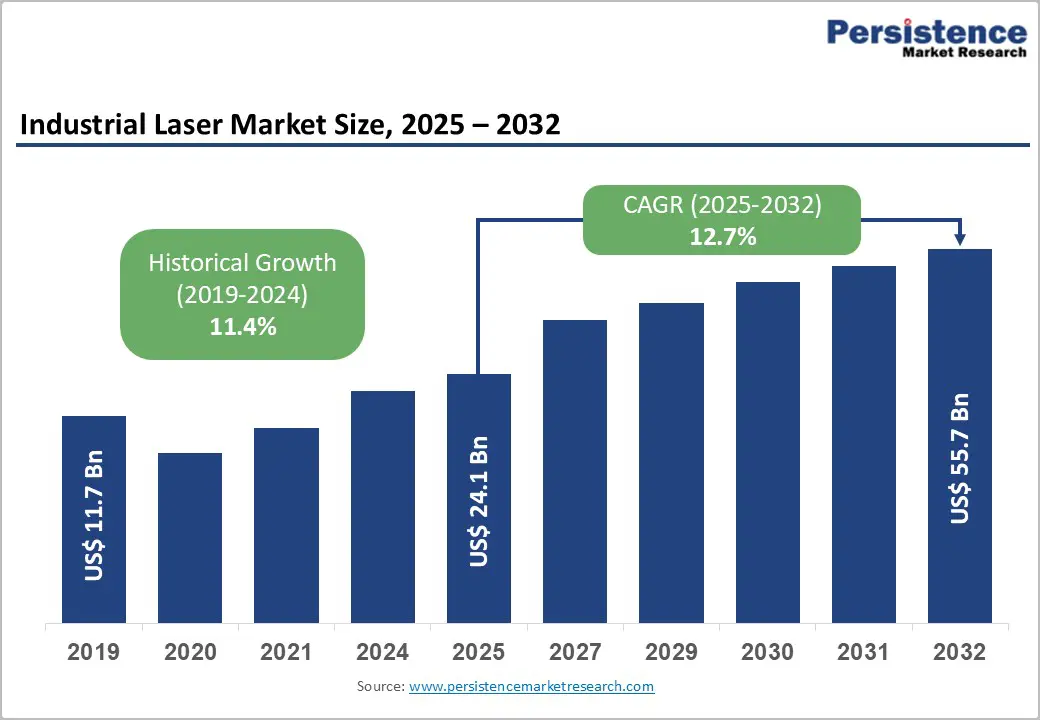
The global industrial laser market size is likely to be valued at US$24.2 billion in 2026 and is expected to reach US$55.9 billion by 2033, growing at a CAGR of 12.7% during the forecast period from 2026 and 2033, driven by the expansion of industrial capacity, increased investments in sectors such as oil and gas, chemicals, power generation, and metals processing, as well as the growing demand for efficient high-precision material processing and automation.
Industrial laser systems are essential for enhancing process efficiency, protecting downstream equipment, and meeting increasingly stringent emission and operational regulations. The tightening of environmental standards related to particulate and liquid droplet emissions is encouraging industries to upgrade their manufacturing and laser-based processing technologies.
Key Industry Highlights:
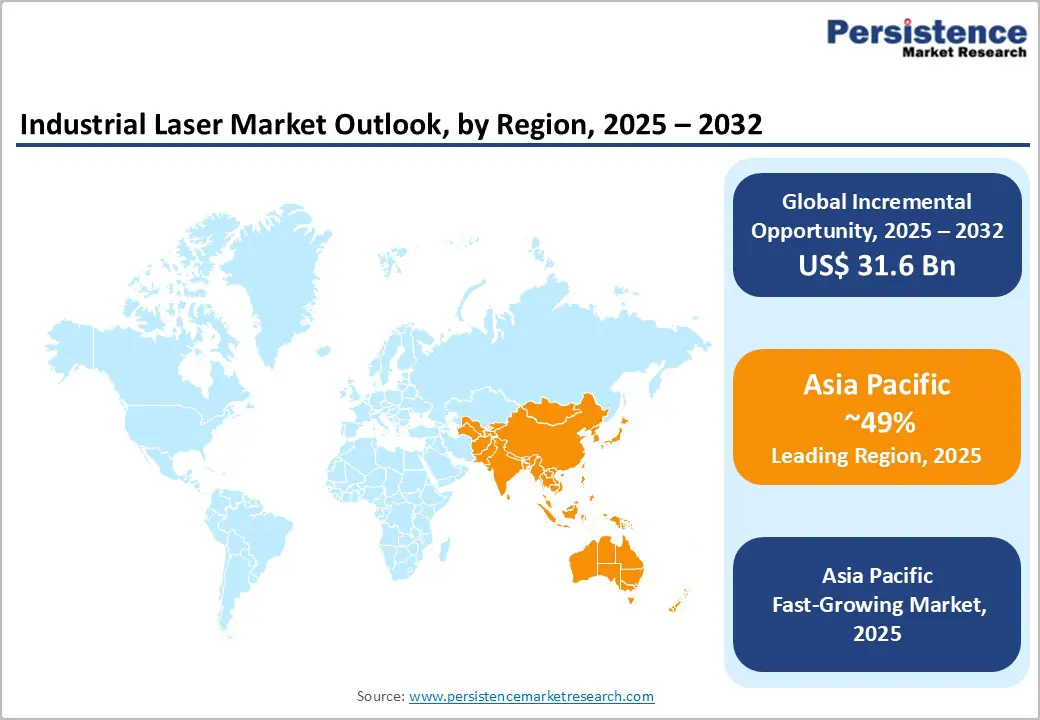
- Leading Region: Asia Pacific is anticipated to be the leading region, accounting for a market share of 49% in 2026, driven by strong manufacturing in China, Japan, India & ASEAN and government-backed industrialization initiatives.
- Fastest-growing Region: Asia Pacific is likely to be the fastest-growing region, supported by government incentives, developed supply chains, and rapid adoption of advanced laser technologies.
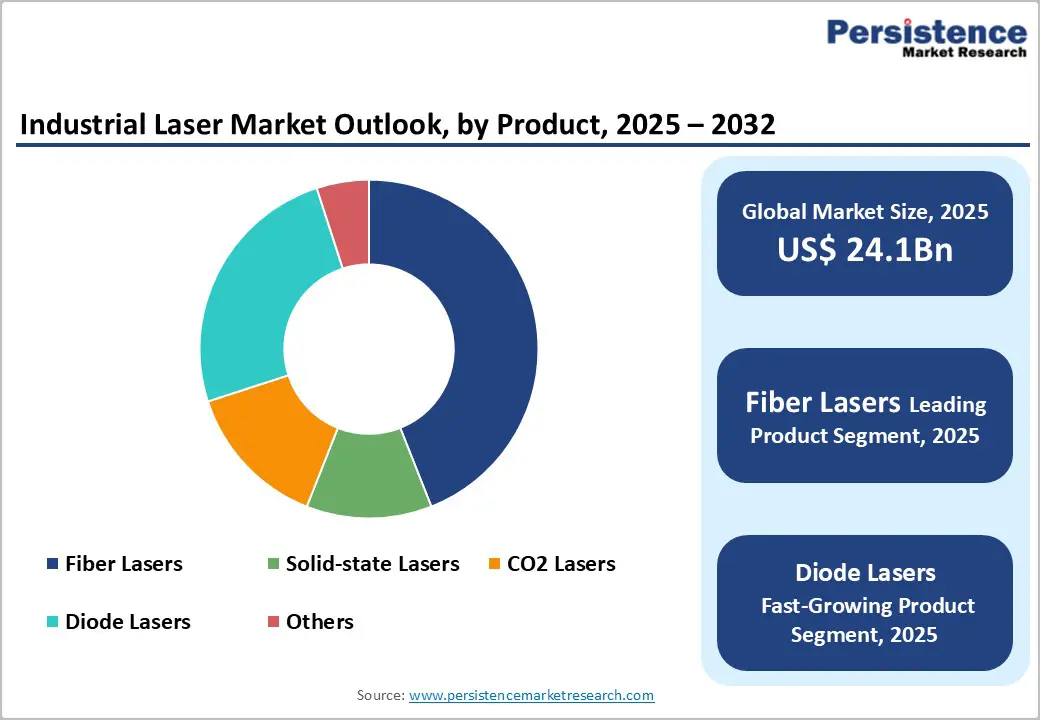
- Leading Product Type: Fiber lasers are projected to represent the leading product type in 2026, accounting for 38% of the revenue share, favored for metal cutting, marking, and micro-machining due to their high beam quality, scalability, low operating costs, and reduced maintenance.
- Leading Application: The cutting segment is anticipated to be the leading application type, accounting for over 41% of the revenue share in 2026, driven by high-power fiber and CO2 lasers used in automotive, aerospace, and heavy equipment manufacturing, with the ability to cut complex patterns in metals and composites efficiently.
- Leading End-user Type: The electronics segment is projected account for 31% of the revenue share, driven by the growing demand for semiconductors, advanced displays, and mobile devices, which in turn is increasing the need for laser-based marking, micro-drilling, and scribing in next-generation components.
| Key Insights | Details |
|---|---|
|
Industrial Laser Market Size (2026E) |
US$24.2 Bn |
|
Market Value Forecast (2033F) |
US$55.9 Bn |
|
Projected Growth CAGR (2026-2033) |
12.7% |
|
Historical Market Growth (2020-2025) |
11.4% |
Market Factors - Growth, Barriers, and Opportunity Analysis
Technological Innovation in Laser Efficiency
Technological advancements in laser efficiency are driving significant growth, as manufacturers increasingly focus on boosting productivity, reducing operating costs, and enhancing process reliability. Innovations in laser source design, particularly with fiber and diode lasers, have greatly improved electrical-to-optical conversion efficiency. This allows for higher output power with reduced energy consumption. Modern fiber lasers, for example, provide superior beam quality with minimal power loss, enabling faster cutting, deeper welding, and finer micromachining while minimizing heat input and material waste.
The integration of intelligent control and thermal management technologies into laser systems is enhancing overall performance. Upgraded cooling systems, optimized beam delivery, and real-time power modulation contribute to better system stability and longer component lifespan, reducing downtime and maintenance needs. Software-driven solutions such as adaptive process control, AI-based monitoring, and predictive maintenance also play a key role in ensuring consistent output quality, even during prolonged production cycles. This is particularly crucial in industries such as electronics, automotive, and metal fabrication, where precise tolerances and continuous operation are vital.
High Capital Outlay and Maintenance
A major constraint is the substantial upfront capital required to purchase advanced laser systems, particularly high-power fiber or CO2 lasers. These systems can cost anywhere from US$500,000 to US$2 million, depending on factors such as power output, configuration, and the need for auxiliary automation. This high cost presents a significant challenge for small and medium-sized enterprises, limiting their ability to invest in cutting-edge laser technology. For many companies, especially in cost-sensitive industries or emerging markets, the initial investment can delay the adoption or restrict system upgrades, even when the potential for increased productivity is clear.
In addition to the high capital costs, the maintenance and operating expenses of industrial laser systems pose barriers. High-power lasers require substantial energy for operation, along with dedicated cooling systems and routine calibration. Optical components such as mirrors and fiber delivery systems also need periodic servicing, and downtime during maintenance can result in production losses. The complexity of these systems often necessitates hiring specialized technicians or contracting external expertise, which drives up operational costs. Integrating laser systems into automated production lines frequently requires customized engineering, software integration, and operator training, all of which contribute to the overall expense.
Emerging Markets and Localized Manufacturing
The rapid industrial expansion in emerging economies presents a significant growth opportunity. Countries across Asia, Latin America, Eastern Europe, and the Middle East are witnessing accelerated growth in sectors such as electronics, automotive, metal fabrication, and precision engineering. Government initiatives such as India’s PLI scheme, Vietnam’s growing electronics hubs, and Mexico’s near-shoring boom are driving the shift toward local high-precision manufacturing. Integrating laser systems into automated production lines often requires customized engineering, software integration, and operator training, which adds to the overall cost.
As industries restructure and establish regional production hubs, the demand for advanced laser systems is increasing, driven by the need for process automation, quality improvement, and high-throughput production. The development of new semiconductor packaging plants, battery gigafactories, and electric vehicle (EV) component facilities in emerging markets is creating particularly valuable opportunities. As companies move production closer to end markets, the adoption of industrial lasers for cutting, welding, marking, and micromachining is rising due to their speed, precision, and reliability. Purchasing decisions are often influenced by factors such as return-on-investment timelines, access to financing, and the availability of local service support.
Category-wise Analysis
Product Type Insights
Fiber lasers are expected to lead the industrial laser market, accounting for approximately 38% of the revenue share in 2026. Their dominance is attributed to their exceptional beam quality, high electrical efficiency, and the ability to scale power with minimal loss. These characteristics make fiber lasers the preferred choice for applications such as metal cutting, precision marking, welding, and micro-machining, particularly in high-volume manufacturing environments where uptime and throughput are critical. The solid-state design of fiber lasers ensures greater durability, lower maintenance, and an extended service life. For example, fiber lasers are commonly used in automotive body-in-white cutting and welding lines, where consistent beam quality is crucial for high-speed production, as well as in sheet metal fabrication for aerospace and heavy machinery, enabling the creation of complex geometries with minimal post-processing.
Diode lasers are likely to represent the fastest-growing segment, driven by continuous advancements in wall-plug efficiency, thermal management, and modulation speed. With their compact size, enhanced reliability, and lower energy consumption, diode lasers are becoming the preferred solution for micromachining, plastics processing, and precision welding. The expansion of the electronics and plastics industries, where low-thermal-impact processing is essential, is accelerating the adoption of diode lasers. For instance, in the electronics industry, diode lasers are used for plastic welding of connectors and sensor housings, while in consumer goods and medical device manufacturing, they enable precise bonding and surface treatment, where minimal thermal impact is critical.
Application Type Insights
The cutting segment is projected to lead the market, capturing around 41% of the revenue share in 2026, driven by the widespread adoption of high-power fiber and CO2 lasers across industries such as automotive, aerospace, metal fabrication, and heavy equipment. Laser cutting offers superior accuracy, high processing speeds, and the ability to create complex geometries in metals, alloys, and composite materials. These advantages minimize the need for secondary finishing and enhance production efficiency compared to traditional cutting methods. For instance, laser cutting is extensively used in automotive stamping and body panel fabrication to ensure consistent dimensional accuracy, as well as in structural steel and pipe cutting for construction and infrastructure projects, where both speed and precision are essential.
Laser welding is likely to be the fastest-growing application during the forecast period, driven by the rising adoption of electric vehicles (EVs), where lasers play a crucial role in battery module welding, EV chassis fabrication, and high-precision electronic assemblies. Laser welding offers deep penetration, smaller heat-affected zones, and high repeatability, making it ideal for joining thin metals and complex components. As industries transition to laser-based welding, they are able to meet stringent quality standards and achieve greater automation. For example, laser welding is increasingly used in the welding of battery tabs and busbars for EV powertrains, as well as in aerospace component assembly, where precise, low-distortion joints are needed for thin, high-value materials.
End-user Type Insights
The electronics sector is projected to lead the market, accounting for approximately 31% of the revenue share in 2026. The rapid expansion of semiconductors, advanced displays, mobile devices, and miniaturized electronic components continues to drive the demand for high-precision laser processes. Lasers are essential in marking, micro-drilling, scribing, wafer processing, and PCB manufacturing, providing the speed and accuracy needed for increasingly compact device designs. For instance, lasers are widely used in smartphone and tablet display cutting and scribing, ensuring clean edges with minimal material waste, as well as in semiconductor wafer dicing and packaging, where ultra-fine precision is crucial for yield and reliability.
The automotive sector is likely to represent the fastest-growing end-user segment in 2026, primarily driven by the shift toward electric vehicles (EVs). Lasers are vital for applications such as battery module welding, busbar cutting, motor components, and lightweight structural assemblies. The growing integration of Advanced Driver-Assistance Systems (ADAS) and electronic systems is increasing the demand for laser-based precision machining and component marking. Laser automation is helping manufacturers address labor shortages while maintaining consistent quality in high-volume production. For example, laser systems are used for EV motor hairpin welding to ensure consistent electrical performance, as well as in the welding of chassis and structural parts for lightweight vehicles, enabling high-strength joints with minimal distortion and full automation compatibility.
Regional Insights
North America Industrial Laser Market Trends
North America is likely to be a significant market for industrial lasers in 2026, driven by reshoring efforts and investments in smart factory technologies, particularly in the U.S. and Canada. Manufacturers are increasingly deploying lasers for automation in industries such as metal processing, aerospace, and additive manufacturing. Ongoing research and development, supported by North America's robust photonics infrastructure and government funding, are fostering innovation and the adoption of high-power fiber lasers, particularly in aerospace, defense, and semiconductor sectors. The growing emphasis on supply-chain resilience is promoting domestic production of critical components, fueling demand for precision laser processing.
The integration of lasers with automation systems is also on the rise. The laser automation market in North America is expanding as companies move away from traditional machining methods in favor of laser cutting, welding, and marking to enhance precision, throughput, and flexibility. Leading companies such as IPG Photonics and Coherent are advancing high-power, rack-integrated platforms and cobot-friendly systems to support these automated, high-volume production lines. The increasing use of robotics, AI-driven monitoring, and digital twins is increasing laser adoption. Labor shortages in skilled machining roles are accelerating the transition to laser-based automated manufacturing solutions.
Europe Industrial Laser Market Trends
Europe is expected to remain a major market in 2026, supported by its strong manufacturing base. Countries such as Germany, France, Italy, and the U.K. are increasingly adopting laser technologies for cutting, welding, marking, and micromachining across industries, including automotive, electronics, aerospace, and metal fabrication. Manufacturers across the region are upgrading facilities by integrating laser systems into smart production cells, robotics, and Industry 4.0 frameworks to improve productivity, precision, and process consistency. The rising demand for lightweight materials and complex component designs in the automotive and aerospace sectors is further accelerating laser adoption.
Europe’s robust photonics ecosystem continues to support its leadership in industrial lasers. Organizations such as Photonics21, along with major research institutions in Germany and the Netherlands, are making substantial investments in high-power beam delivery, ultrafast lasers, and smart monitoring technologies. The European Union's emphasis on reducing industrial energy consumption is driving the adoption of fiber lasers, which offer higher efficiency and lower maintenance needs compared to traditional CO2-based systems. Collaborative efforts between research institutions and industrial OEMs are speeding up the commercialization of next-generation laser technologies.
Asia Pacific Industrial Laser Market Trends
Asia Pacific is anticipated to be the leading region, accounting for a market share of 49% in 2026, driven by its vast manufacturing ecosystem and rapid technological advancements. The region’s dominance is largely attributed to China and India, both of which are making significant investments in high-precision manufacturing, semiconductor production, electric vehicle (EV) platforms, and metal fabrication. Industrial lasers are vital in sectors such as electronics, displays, automotive, and HDI PCB production, reinforcing Asia Pacific's pivotal role in supply chains. For example, Han's Laser supplies laser systems for PCB drilling and electronics assembly in China.
The Asia Pacific region is also likely to be the fastest-growing region over the forecast period. The use of fiber lasers, ultrafast lasers, and solid-state systems is growing rapidly as manufacturers seek higher throughput, tighter tolerances, and lower operating costs. This demand is driven by large-scale investments in EV battery plants, semiconductor manufacturing, and precision-component machining. Regional incentives and smart-factory initiatives are accelerating the adoption of laser technologies such as cutting, welding, marking, and micromachining. For example, TRUMPF supplies fiber lasers for EV battery welding in China, and IPG Photonics provides ultrafast fiber lasers for semiconductor wafer processing and microelectronics manufacturing in Taiwan and South Korea.
Competitive Landscape
The global industrial laser market is moderately fragmented, shaped by a mix of established leaders, regional manufacturers, and specialized technology providers. Market growth is driven by continuous technological advancements, the increasing adoption of fiber, diode, and ultrafast lasers, and the rising demand for high-precision manufacturing in industries such as automotive, electronics, aerospace, and metal fabrication. In Asia Pacific region, market players are rapidly expanding by offering cost-competitive solutions, while smaller niche vendors focus on specialized applications such as micro-machining and additive manufacturing.
Leading companies in the market, including TRUMPF, IPG Photonics, Coherent, BWT, and Han’s Laser, dominate through ongoing innovation aimed at enhancing power output, beam quality, and system integration capabilities. These key players compete by frequently launching new products, developing high-efficiency fiber and diode lasers, expanding regional manufacturing operations, and forming strategic collaborations. They also differentiate themselves by offering comprehensive after-sales services, including predictive maintenance, operator training, and integration support.
Key Industry Developments:
- In October 2025, TRUMPF introduced its next-generation TruFiber laser series at LASER World of Photonics in Munich. The series offers power outputs ranging from 500 W to 50 kW and is engineered for industrial welding applications, including EV battery manufacturing and precision metal processing. TruFiber lasers deliver exceptional beam quality, dynamic power control, and intuitive, user-friendly operation. Fully integrated within TRUMPF’s laser system ecosystem, the series features remote diagnostics and a modular design that enables rapid maintenance, ensuring high system uptime and consistent, repeatable weld quality on demanding materials such as copper.
Companies Covered in Industrial Laser Market
- Coherent, Inc.
- IPG Photonics Corporation
- Trumpf GmbH + Co. KG
- Bystronic AG
- Hanslaser Technology Co., Ltd.
- Laserline GmbH
- Lasea S.A.
- Lumibird Group
- Lumentum Holdings Inc.
- Mitsubishi Electric Corporation
Frequently Asked Questions
The global industrial laser market is valued at US$24.2 billion in 2026 and expected to reach US$55.9 billion by 2033, reflecting strong market growth.
The primary demand drivers for the industrial laser market include the rise of smart factory automation, advancements in laser technology, and the growing need for high-precision manufacturing across industries such as electronics, automotive, and metal processing.
The cutting application segment leads the industrial laser market with a 41% share, driven by the use of high-power fiber and CO₂ lasers in automotive, aerospace, and heavy equipment manufacturing. These lasers are highly efficient at cutting intricate patterns in metals and composites.
Asia Pacific dominates, capturing over 49%, driven by strong manufacturing in China, Japan, India & ASEAN, and government‑backed industrialization initiatives.
A key opportunity in the industrial laser market lies in the rapid growth of localized manufacturing in emerging economies, which is driving significant demand for advanced laser cutting, welding, and micromachining technologies.


