




- Food and Beverages
- Food Emulsifier Market
Food Emulsifier Market Size, Trends, Share, Growth, and Regional Forecast, 2026 - 2033
Food Emulsifier Market by Product Type (Lecithin, Mono and di-glycerides, Diacetyl tartaric acid esters of monoglycerides (DATEM) , Stearoyl lactylates (SSL, CSL), Others), by Source (Plant-based, Animal-based), by End-user (Bakery & confectionery, Dairy & frozen desserts, Beverages, Convenience & processed foods, Others), and Regional Analysis from 2026 - 2033

Food Emulsifier Market Share and Trends Analysis
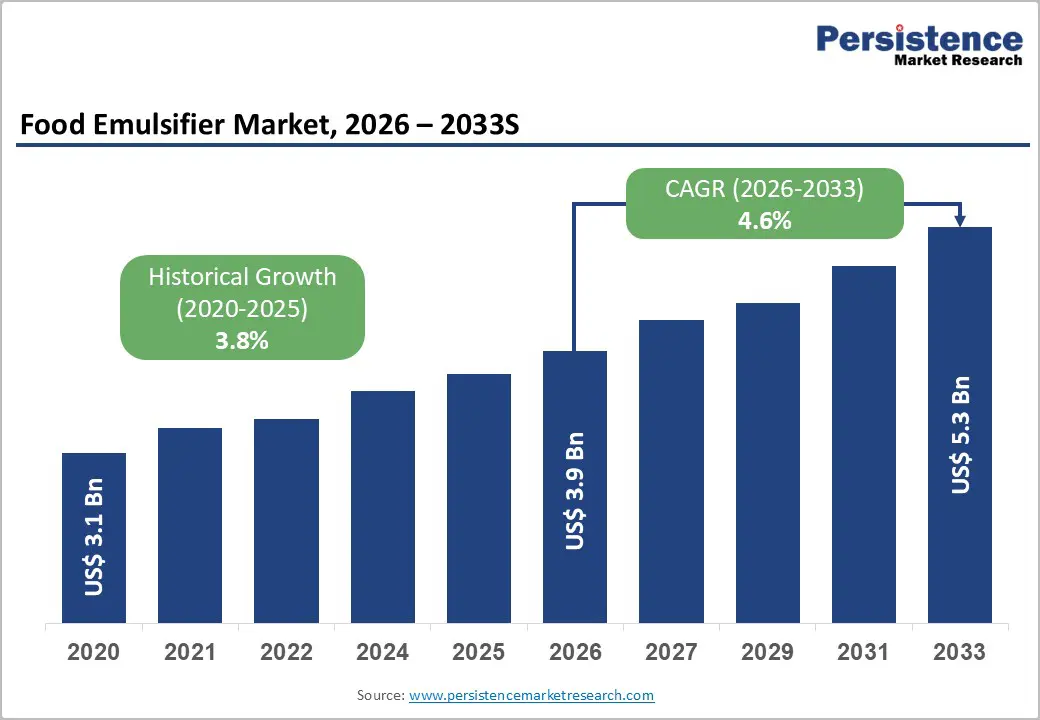
The global food emulsifier market size is likely to be valued at US$ 3.9 billion in 2026 to US$ 5.3 billion by 2033 growing at a CAGR of 4.6% during the forecast period from 2026 to 2033. The global market is evolving rapidly as consumer demand for clean-label, plant-based, and high-performance ingredients reshapes product development across bakery, dairy, and processed foods. Innovation, sustainability, and regulatory compliance are driving both established companies and agile startups to differentiate, expand, and capture emerging opportunities worldwide.
Key Industry Highlights:
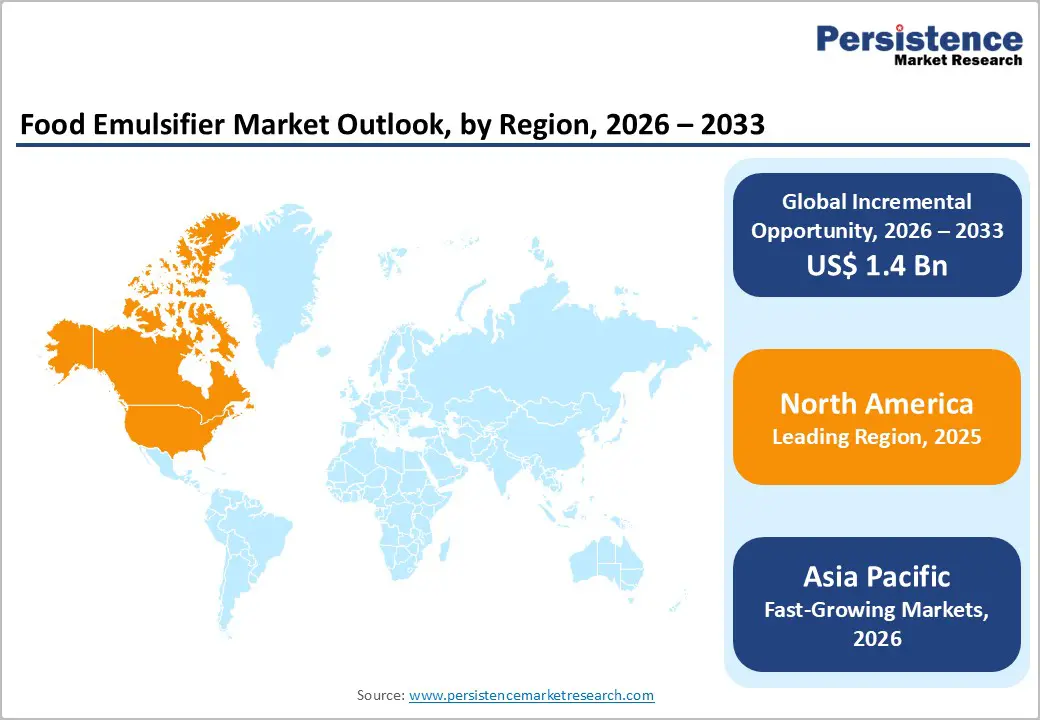
- Leading Region: North America, holding 38% market share, driven by a mature bakery and processed foods sector, high consumer demand for quality, and adoption of plant-based, clean-label emulsifiers.
- Fastest-Growing Region: Asia Pacific, fueled by rising urbanization, disposable incomes, and increasing processed food and convenience product consumption across India, China, Japan, and South Korea.
- Fastest-Growing Product Type Segment: Plant-based emulsifiers, driven by clean-label trends, sustainability initiatives, and reformulation of bakery, dairy, and confectionery products.
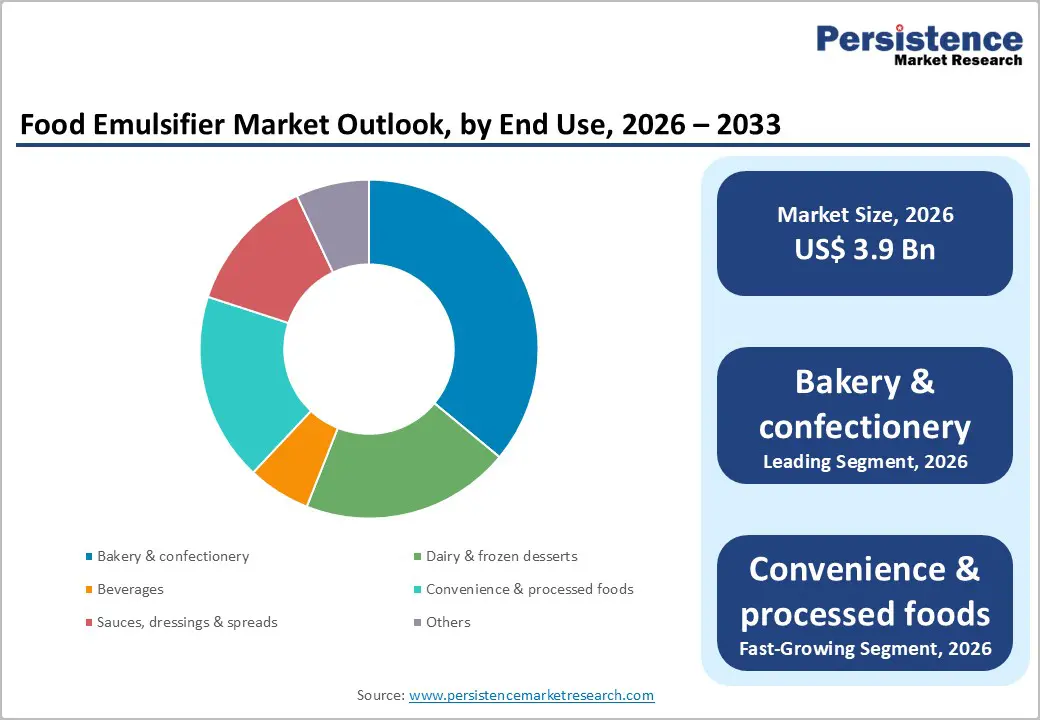
- Market Drivers: The growth of bakery and confectionery products sustains consistent emulsifier use to enhance texture, stability, and shelf life.
- Opportunities: Developing clean-label, plant-based emulsifiers to replace synthetic additives and tapping into health-conscious, environmentally aware consumers.
- Key Developments: In December 2025, Palsgaard showcased the sustainability benefits of its emulsifiers for pistachio chocolate at Gulfood Manufacturing 2025. In December 2025, Bako Group acquired Bako Western to expand in the UK. In May 2025, Indovinya launched a new line of Sorbitan esters. In March 2025, Bob’s Red Mill was recognized on Fast Company’s World's Most Innovative Companies list.
| Key Insights | Details |
|---|---|
|
Food Emulsifier Market Size (2026E) |
US$ 3.9 Bn |
|
Market Value Forecast (2033F) |
US$ 5.3 Bn |
|
Projected Growth (CAGR 2026 to 2033) |
4.6% |
|
Historical Market Growth (CAGR 2020 to 2025) |
3.8% |
Market Dynamics
Driver - Growth of bakery and confectionery products drives consistent usage of emulsifiers for quality control
Soft, fluffy, and visually appealing bakery products are increasingly becoming a daily staple for consumers worldwide, creating structural demand for emulsifiers. In bread, cakes, pastries, and chocolates, emulsifiers enhance dough stability, improve texture, and extend shelf life, ensuring consistent product quality across large-scale production. Manufacturers rely on these functional ingredients to maintain uniformity in volume, moisture retention, and crumb structure, which are critical for consumer satisfaction and brand loyalty.
The rapid growth of the global bakery and confectionery sector, fueled by urbanization, rising disposable incomes, and the expansion of retail chains, further amplifies emulsifier consumption. With product innovation introducing new flavors, fillings, and textures, emulsifiers remain indispensable for achieving the desired sensory experience while supporting efficient industrial processing.
Restraints - Regulatory scrutiny and labeling restrictions limit formulation flexibility
Growing consumer demand for clean labels and transparent ingredient lists has intensified regulatory oversight, constraining flexibility in emulsifier formulations. Strict rules and restrictions on certain synthetic additives challenge manufacturers in achieving optimal texture, stability, and shelf life while complying with labeling standards across different regions.
This regulatory environment forces companies to explore approved or natural alternatives, often increasing costs or affecting product performance. Striking a balance between compliance and functional effectiveness is particularly challenging for large-scale bakery, confectionery, and processed food production. Such constraints can slow innovation, complicate new product launches, and limit the adoption of advanced emulsifier solutions, creating a significant restraint on global market growth.
Opportunity - Developing clean-label and plant-based emulsifiers to replace synthetic additives in reformulated foods
Consumer demand for transparency and healthier food options is driving innovation in clean-label and plant-based emulsifiers. These natural alternatives allow manufacturers to reformulate bakery, dairy, and processed foods while reducing reliance on synthetic additives. By delivering comparable functionality in texture, stability, and shelf life, plant-based emulsifiers meet the growing preference for minimally processed, sustainable ingredients without compromising product performance.
This trend presents significant opportunities for both established players and agile startups to differentiate through ingredient innovation and sustainability narratives. Companies can develop emulsifiers from soy, sunflower, or other plant-derived sources while leveraging clean-label marketing to appeal to health-conscious and environmentally aware consumers. Expanding these offerings across global markets can strengthen brand positioning and unlock new revenue streams in the food emulsifier sector.
Category-wise Analysis
By End-user Insights
Plant-based food emulsifiers are projected to grow at a CAGR of 7.9% during the forecast period in the global Food Emulsifier market, fueled by rising consumer preference for natural, clean-label, and sustainably sourced ingredients. Derived from sources such as soy, sunflower, and rapeseed, these emulsifiers offer functionality comparable to synthetic alternatives, enhancing texture, stability, and shelf life in bakery, dairy, and confectionery products. Manufacturers increasingly leverage plant-based options to align with health-conscious and environmentally aware consumer segments.
The shift toward plant-derived emulsifiers is reinforced by reformulation trends across processed foods, where regulatory pressures and clean-label expectations encourage the substitution of synthetic additives. Startups and established players are innovating with novel extraction techniques and multifunctional blends to meet demand while supporting sustainable supply chains.
By Source Insights
Plant-based food emulsifiers are projected to grow at a CAGR of 7.9% during the forecast period in the global Food Emulsifier market, fueled by rising consumer preference for natural, clean-label, and sustainably sourced ingredients. Derived from soy, sunflower, and rapeseed, these emulsifiers offer functionality comparable to synthetic alternatives, enhancing texture, stability, and shelf life in bakery, dairy, and confectionery products. Manufacturers increasingly leverage plant-based options to align with health-conscious and environmentally aware consumer segments.
The shift toward plant-derived emulsifiers is reinforced by reformulation trends across processed foods, where regulatory pressures and clean-label expectations encourage the substitution of synthetic additives. Startups and established players are innovating with novel extraction techniques and multifunctional blends to meet demand while supporting sustainable supply chains.
Region-wise Insights
North America Food Emulsifier Market Trends
North America holds approximately 38% market share in the global food emulsifier market, driven by a mature bakery and processed foods sector and high consumer demand for consistent product quality. In the U.S., manufacturers are increasingly adopting plant-based and clean-label emulsifiers to cater to health-conscious consumers and meet regulatory transparency standards. Innovation in texture, moisture retention, and shelf stability is enabling brands to differentiate their bakery, dairy, and confectionery offerings, while hybrid formulations combining natural emulsifiers with functional additives are gaining traction.
In Canada, sustainability and traceability are shaping product development, with a growing focus on locally sourced plant-based emulsifiers and environmentally friendly processing. Cross-border distribution, e-commerce expansion, and tailored flavor profiles further reinforce North America’s leadership and sustained growth in the food emulsifier sector.
Asia Pacific Food Emulsifier Market Trends
The Asia Pacific Food Emulsifier Market is expected to grow at a CAGR of 7.6%, driven by rapid urbanization, rising disposable incomes, and a growing appetite for processed and convenience foods across the region. In India, bakery and confectionery expansion is encouraging the use of emulsifiers to improve texture, shelf life, and dough stability, while local producers explore plant-based alternatives to meet clean-label trends. China’s growing functional foods and dairy sectors are adopting emulsifiers to enhance product consistency, moisture retention, and sensory appeal.
In Japan, premium confectionery and health-focused baked goods are fueling demand for natural and high-performance emulsifiers, while South Korea’s snack and bakery innovation emphasizes multifunctional ingredients with sustainable sourcing. Regional investment in manufacturing infrastructure, supply chain optimization, and tailored flavor profiles is strengthening the Asia Pacific’s position in the global market.
Competitive Landscape
The global food emulsifier market is moderately fragmented, with a mix of large multinational companies and agile regional players driving competition. Leading companies are focusing on product innovation through clean-label and plant-based emulsifiers that enhance texture, shelf life, and sensory appeal across bakery, dairy, and processed foods. Sustainability initiatives are shaping strategies, with manufacturers investing in sourcing natural ingredients, energy-efficient production, and environmentally responsible packaging to meet growing consumer demand for eco-conscious products.
Global expansion remains a priority, as firms enter emerging markets in the Asia Pacific, Latin America, and the Middle East to capitalize on rising processed food consumption. Compliance with government regulations around labeling and additive use is critical, pushing companies to maintain transparency while innovating with multifunctional, clean-label solutions to strengthen brand loyalty and market share.
Key Developments:
- In December 2025, Palsgaard showcased the cost-saving and sustainability benefits of its emulsifiers for pistachio chocolate at Gulfood Manufacturing 2025 in Dubai.
- In December 2025, Bako Group acquired Bako Western as part of its continued UK expansion. The move follows the 2024 merger of its regional divisions and the acquisition of Finlay’s Foods in Northern Ireland.
- In May 2025, Indovinya, the specialty chemicals arm of Indorama Ventures, launched a new line of Sorbitan esters. The portfolio expansion strengthens its offering in emulsifiers for food, personal care, and industrial applications.
- In March 2025, Bob's Red Mill was recognized on Fast Company's World's Most Innovative Companies list, highlighting over 40 years of leadership in the healthy food movement.
Companies Covered in Food Emulsifier Market
- IFF
- ADM
- Cargill, Incorporated
- Associated British Foods plc
- Palsgaard
- Kerry Group plc.
- AAK Foods
- British Bakels
- Ervesa
- BAKO Group Limited.
- Bob’s Red Mill Natural Foods
- PATCO Products
- Spell Organics
- Others
Frequently Asked Questions
The global food emulsifier market is projected to be valued at US$ 1.6 Bn in 2026.
Rising bakery and confectionery demand drives consistent use of emulsifiers, boosting the global market.
The global food emulsifier market is poised to witness a CAGR of 5.6% between 2026 and 2033.
Developing clean-label and plant-based emulsifiers to replace synthetic additives in reformulated foods is a key opportunity.
Major players in the global Food Emulsifier market include IFF, ADM, Cargill, Incorporated, Associated British Foods plc, Kerry Group plc., AAK Foods, BAKO Group Limited. , Bob’s Red Mill Natural Foods., and others.


