




- Off-Road Equipment & Machinery
- Concrete Finishing Equipment Market
Concrete Finishing Equipment Market Size, Share, and Growth Forecast, 2025 - 2032
Concrete finishing equipment market By Product Type (Concrete Trowels, Concrete Screeds, Power Floats, Others), Application (Residential Construction, Others), End-use, and Regional Analysis for 2025 – 2032

Concrete Finishing Equipment Market Size and Trends Analysis
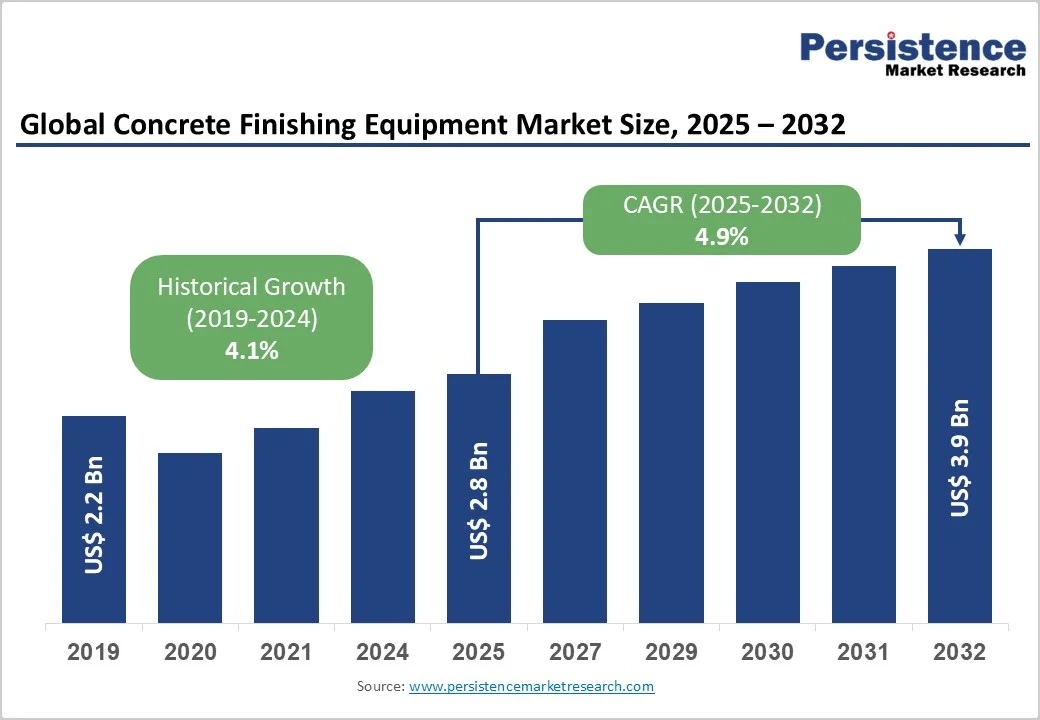
The global concrete finishing equipment market size is likely to be valued US$2.8 Billion in 2025, estimated to reach US$3.9 Billion by 2032, achieving at a CAGR of 4.9% during the forecast period from 2025 to 2032. The market is experiencing steady growth driven by increasing global construction activities, rising demand for high-quality concrete finishes, and advancements in automated finishing technologies.
The market is further propelled by innovations in electric-powered and laser-guided equipment, catering to preferences for precision and eco-friendly solutions. The growing acceptance of concrete floor finishing tools as essential for achieving aesthetic and functional concrete surfaces, especially in large-scale projects, is a key growth factor.
Key Industry Highlights:
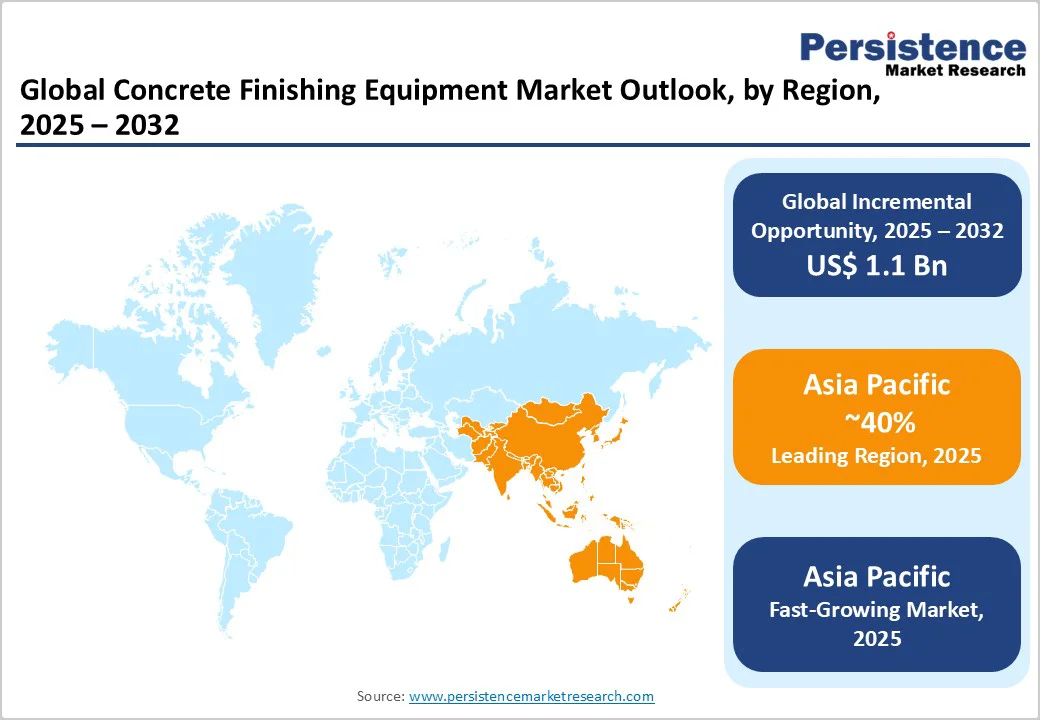
- Leading Region: Asia Pacific, commanding a 40% market share in 2025, driven by rapid urbanization and infrastructure investments in China and India.
- Fastest-growing Region: Asia Pacific, fueled by government-led infrastructure projects and construction growth.
- Dominant Product Type: Concrete Trowels, holding approximately 35% of the market share, due to widespread use in surface smoothing.
- Leading Application: Infrastructure Projects, accounting for over 30% of market revenue, driven by global infrastructure spending.
- Key Market Driver: Expanding global investments in roads, bridges, and urban projects are driving demand for advanced concrete finishing tools.
- Growth Opportunity: Adoption of automated and electric equipment for sustainable construction practices.
| Key Insights | Details |
|---|---|
|
Concrete Finishing Equipment Market Size (2025E) |
US$2.8 Bn |
|
Market Value Forecast (2032F) |
US$3.9 Bn |
|
Projected Growth (CAGR 2025 to 2032) |
4.9% |
|
Historical Market Growth (CAGR 2019 to 2024) |
4.1% |
Market Factors – Growth, Barriers, and Opportunity Analysis
Rising Global Construction and Infrastructure Development
The increasing global construction activities and infrastructure investments are primary drivers of the concrete finishing equipment market. Rapid urbanization, population growth, and economic expansion are fueling large-scale projects in residential, commercial, and industrial sectors.
Governments worldwide are investing heavily in modernizing infrastructure, including roads, bridges, airports, railways, and public utilities, to support economic growth and connectivity. This surge in construction activity is increasing the demand for efficient, high-performance finishing equipment capable of delivering durable, smooth, and aesthetically appealing concrete surfaces.
In emerging economies such as China, India, and Indonesia, government-led initiatives such as the Belt and Road Initiative and Smart Cities Mission are accelerating the adoption of advanced construction machinery.
Similarly, developed regions such as North America and Europe are witnessing upgrades in aging infrastructure and sustainable building projects that require precise and eco-friendly finishing solutions. The growing focus on speed, quality, and sustainability in construction practices has further pushed contractors toward automated and electric-powered finishing tools.
High Initial Costs and Skilled Labour Requirements
High initial costs and the need for skilled operators pose significant restraints on market growth. Advanced finishing tools, such as automated trowels, laser screeds, and power grinders, require substantial upfront investments, which can strain small and medium-sized contractors with limited budgets. The integration of smart technologies, robotics, and eco-friendly components further increases production and purchase costs, making affordability a key restraint, particularly in developing regions. Additionally, maintenance, calibration, and spare part costs add to the overall ownership burden.
Alongside financial challenges, the operation of advanced cement finishing tools demands skilled and trained personnel. Automation and digital controls require specialized knowledge in handling sensors, programming, and safety protocols. The shortage of skilled labour, especially in emerging markets, often leads to underutilization of equipment or suboptimal performance. Training programs are essential, but add to operational expenses and project timelines.
Advancements in Automated and Eco-Friendly Equipment
Advancements in automated and electric-powered Concrete Finishing Equipment present significant growth opportunities. Automation technologies, including AI-driven controls, robotics, and sensor integration, allow machines such as trowels, grinders, and screeds to operate with minimal human intervention while maintaining consistent surface quality.
These innovations reduce labour dependency, improve productivity, and ensure uniform finishing across large-scale commercial and infrastructure projects. Moreover, automated systems can monitor parameters such as concrete moisture, temperature, and curing status in real time, optimizing operations and minimizing material waste.
The shift toward eco-friendly equipment addresses growing environmental concerns and regulatory mandates. Manufacturers are developing electric and hybrid-powered finishing tools, reducing fuel consumption, emissions, and noise pollution on construction sites. Energy-efficient designs and durable materials further lower the overall environmental footprint, aligning with global sustainability goals.
Category-wise Analysis
Product Type Insights
Concrete trowels dominate the market, accounting for 35% of the share in 2025, owing to their versatility and essential role in producing smooth, even concrete surfaces across residential, commercial, and infrastructure projects. Their efficiency, ease of operation, and compatibility with various project scales make them indispensable tools in modern construction and finishing applications worldwide.
Concrete grinders are the fastest-growing segment, driven by the rising demand for polished concrete flooring in commercial and industrial spaces. Their ability to deliver smooth, reflective, and low-maintenance surfaces makes them ideal for retail outlets, offices, and warehouses. Increasing adoption of decorative concrete and renovation projects further supports the strong growth of this segment.
Application Insights
Infrastructure projects lead with 30% share, driven by substantial global investments in roads, bridges, airports, and public utilities. Governments and private players are prioritizing durable, high-performance concrete finishes to enhance structural longevity and safety, boosting demand for advanced finishing equipment that ensures precision, efficiency, and compliance with modern construction standards.
Commercial construction is the fastest-growing, fueled by the rising demand for aesthetically appealing and durable concrete finishes in retail outlets, office complexes, and hospitality spaces. Developers are increasingly investing in advanced finishing equipment to achieve smooth, decorative, and high-quality surfaces that enhance visual appeal while ensuring long-term structural performance and cost efficiency.
End-use Insights
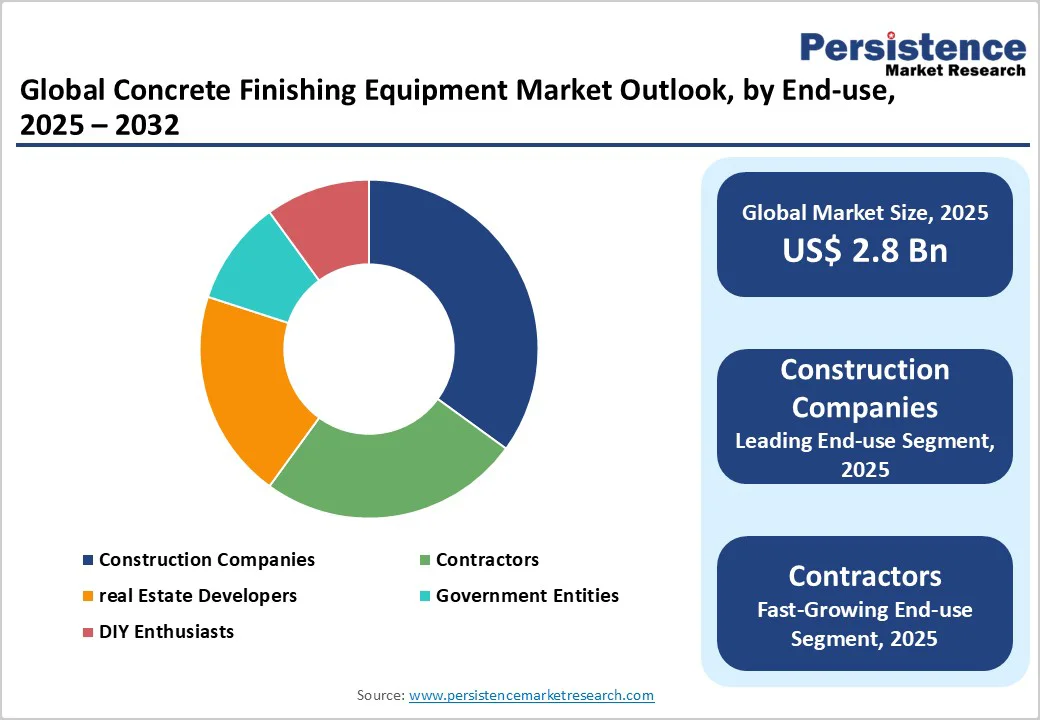
Construction companies hold over 40% share, utilizing concrete smoothing equipment extensively for large-scale infrastructure, commercial, and residential projects. Their focus on achieving high-quality surface finishes, operational efficiency, and project standardization drives continuous adoption of advanced equipment, ensuring precision, durability, and compliance with modern construction and sustainability standards.
Contractors are the fastest-growing, driven by the rising trend of outsourcing construction and infrastructure projects. As developers and governments increasingly rely on specialized contractors for efficient, high-quality project delivery, demand for advanced and automated finishing equipment continues to surge, enabling faster execution, cost savings, and superior surface precision.
Regional Insights
Asia Pacific Concrete Finishing Equipment Market Trends
Asia Pacific commands around 40% share and is the fastest-growing region, driven by rapid urbanization, large-scale infrastructure projects, and government-led development programs. China’s Belt and Road Initiative has significantly boosted demand for modern construction machinery, including concrete smoothing equipment, across transportation, energy, and industrial sectors. India’s Smart Cities Mission and ongoing infrastructure investments in housing, metro networks, and industrial corridors are accelerating equipment adoption.
The region’s expanding construction sector, coupled with rising labour costs, is pushing contractors toward automated and efficient finishing solutions to improve productivity and quality. Increasing foreign investments, supportive government policies, and the availability of low-cost manufacturing enhance the region’s attractiveness for global equipment manufacturers. Emerging economies such as Indonesia, Vietnam, and Malaysia are also contributing to the regional surge through robust urban and commercial development.
North America Concrete Finishing Equipment Market Trends
North America is expected to account for 30% of the market in 2025, driven by the U.S. Infrastructure Investment and Jobs Act, which allocates substantial funding for roads, bridges, airports, and public facilities. This large-scale investment is fueling demand for advanced, automated, and high-efficiency finishing equipment to accelerate project timelines and reduce labour dependency. The growing focus on sustainable and durable construction practices is also boosting the adoption of electric and low-emission machinery.
In Canada, ongoing urban development and public housing projects further contribute to steady market growth. Interestingly, the U.K. market, although geographically part of Europe, reflects similar trends to those seen in North America. Major projects such as the HS2 high-speed rail line and urban redevelopment initiatives are driving the adoption of modern, eco-friendly, and precision-based concrete finishing solutions. Both regions share an emphasis on sustainability, efficiency, and technology integration, underscoring a shift toward smarter construction practices.
Europe Concrete Finishing Equipment Market Trends
Europe holds about 25% market share, led by Germany and France. The market is strongly influenced by the European Union’s sustainability directives, which emphasize energy-efficient construction practices, low-emission machinery, and the adoption of eco-friendly technologies. These regulations are encouraging manufacturers to develop electric and hybrid-powered finishing equipment to align with the EU’s carbon reduction goals.
Ongoing infrastructure investments amounting to nearly €10 billion annually across the region are driving steady demand for advanced concrete finishing solutions in roadways, bridges, and smart building projects. Germany’s strong engineering base and France’s urban renewal initiatives further stimulate the adoption of high-performance and automated finishing tools. The trend toward digitalization in construction, through the use of IoT, robotics, and AI, also supports productivity and precision in concrete finishing operations.
Competitive Landscape
The global concrete finishing equipment market is highly competitive, with a few major players holding significant market shares. These companies are increasingly focusing on automation, sustainability, and product innovation to gain a competitive edge.
Automation is emerging as a key trend, as advanced finishing machines equipped with sensors and AI-driven controls enhance precision, productivity, and labor efficiency on construction sites. Eco-friendly designs are also gaining traction, with manufacturers developing energy-efficient equipment and integrating electric or hybrid power systems to reduce emissions and operational costs.
Global expansion strategies, including partnerships, acquisitions, and localized manufacturing, are helping companies cater to growing construction demands in emerging markets across Asia-Pacific, the Middle East, and Latin America. The rising emphasis on urban infrastructure, smart cities, and green buildings is further driving the need for technologically advanced and sustainable finishing solutions.
Key Developments
- In October 2024, Caterpillar launched a new line of electric concrete finishing equipment designed to align with global sustainability goals and reduce carbon emissions at construction sites.
- In August 2024, Wacker Neuson acquired an IoT-based startup specialising in smart monitoring solutions for construction equipment, boosting its analytics and real-time performance tracking capabilities.
Companies Covered in Concrete Finishing Equipment Market
- Beton Tool Company
- Allen Engineering Corporation
- Atlas Copco Limited
- Mekaster Engineering Limited
- Ligchine International
- Masterpac Corporation
- Gomaco Corporation
- Universal Construction Machinery
- Bartell Global
- KYB Conmat
- Flextool
- Cessco
- Somero Enterprises
- Wacker Neuson SE
- Jurong Topall Machinery
- Others
Frequently Asked Questions
The global concrete finishing equipment market is projected to reach US$2.8 Billion in 2025, driven by construction growth.
The market is driven by global construction growth to US$15 Tn by 2030, necessitating efficient concrete finishing tools.
The market is poised to witness a CAGR of 4.9% from 2025 to 2032, supported by automation innovations.
Automated and electric cement finishing tools offers opportunities for sustainable construction practices.
Somero Enterprises, Wacker Neuson, Allen Engineering, Gomaco, and Ligchine lead through innovative concrete finishing equipment solutions.


