




- Advanced Materials
- Self-Healing Concrete Market
Self-Healing Concrete Market Size, Share, and Growth Forecast, 2026 - 2033
Self-Healing Concrete Market By Form (Intrinsic, Capsule-Based, Vascular), Application (Residential, Industrial, Commercial), and Regional Analysis for 2026 - 2033

Self-Healing Concrete Market Size and Trends Analysis
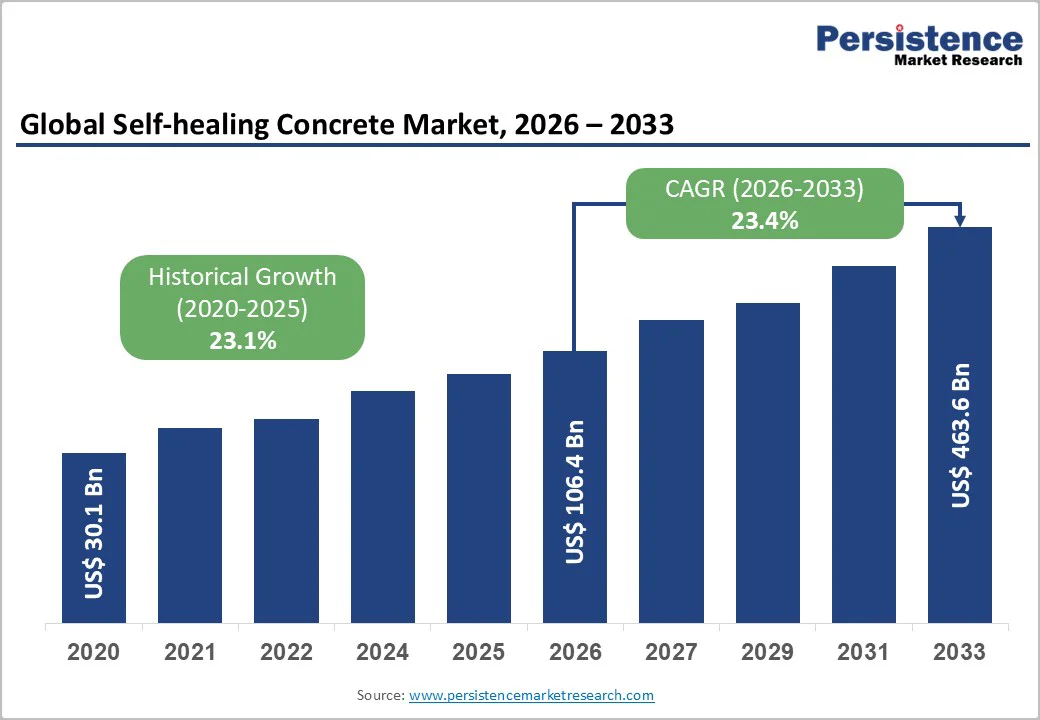
The global self-healing concrete market size is likely to be valued at US$106.4 billion in 2026, and is expected to reach US$463.6 billion by 2033, growing at a CAGR of 23.4% during the forecast period from 2026 to 2033, driven by escalating demand for durable, sustainable construction materials amid rapid urbanization, infrastructure investments, and eco-friendly building mandates.
Bio-based, capsule-embedded, microbial, and vascular technologies that autonomously repair cracks, cut maintenance costs by up to 50%, and extend structural life will drive market growth. These innovations boost the adoption across residential, commercial, and industrial projects, enhancing durability in demanding environments. Despite higher initial costs, self-healing concrete is emerging as a key enabler of green construction, supporting net-zero targets and smart city development.
Key Industry Highlights:
- Leading Region: Europe, anticipated to hold 35% market share in 2026, driven by stringent EU sustainability directives and advanced R&D in the U.K. and Germany.
- Fastest-growing Region: Asia Pacific, fueled by massive infrastructure projects, urbanization in China and India, and government green building incentives.
- Dominant Form: Capsule-based, capturing about 42% of the market, due to its efficient, triggered healing mechanism for micro-cracks.
- Leading Application: Industrial, accounting for over 40% of revenue, as it supports heavy-duty structures in manufacturing and energy sectors.
| Key Insights | Details |
|---|---|
|
Self-healing Concrete Market Size (2026E) |
US$106.4 Bn |
|
Market Value Forecast (2033F) |
US$463.6 Bn |
|
Projected Growth (CAGR 2026 to 2033) |
23.4% |
|
Historical Market Growth (CAGR 2020 to 2025) |
23.1% |
Market Factors - Growth, Barriers, and Opportunity Analysis
Enhanced Durability, Extended Lifespan & Structural Integrity
Enhanced durability, extended lifespan, and stronger structural integrity are central advantages driving the adoption of self-healing concrete. This material is engineered to autonomously repair micro-cracks before they expand into larger structural issues, significantly reducing long-term degradation. When cracks are sealed early, moisture, chlorides, and oxygen are prevented from entering the concrete matrix, which minimizes corrosion of reinforcement bars, one of the main causes of structural failure in conventional concrete. As a result, buildings, bridges, tunnels, marine structures, and pavements maintain their load-bearing capacity for longer periods even under harsh environmental conditions.
Self-healing mechanisms, whether based on encapsulated agents, mineral precipitation, or microbial activity, restore cohesiveness within the concrete, improving resistance to fatigue, freeze–thaw cycles, and chemical attack. This enhanced resilience ensures that infrastructure can withstand heavy traffic loads, thermal fluctuations, and vibration stress with minimal performance loss. The continuous self-repair action extends the operational lifespan of structures, reducing the need for frequent interventions or reconstruction.
Technical and Performance Limitations
Technical and performance limitations remain significant barriers to the broader adoption of self-healing concrete, despite its long-term advantages. One major challenge is that most self-healing mechanisms are effective only for micro-cracks. When cracks widen beyond a certain threshold due to heavy loads, impact, or structural stress, the healing agents often cannot fill or bond the larger gaps, limiting their usefulness in severe damage scenarios. Integrating capsules, bacteria, or polymer-based agents can influence the concrete’s density, workability, and compressive strength if not precisely proportioned, making mix design more complex than conventional concrete.
Environmental dependency further complicates performance reliability. Many healing processes require specific moisture levels, temperature ranges, or pH conditions to activate effectively. In dry, extremely cold, or highly corrosive environments, the healing reactions may slow down or fail, reducing durability benefits. Long-term consistency also remains uncertain, as repeated cycles of cracking and healing may deplete the active agents embedded in the concrete.
Advancements in Material Science & Scalable Production
Advancements in material science and scalable production methods are creating strong growth opportunities for the self-healing concrete market. Continuous research is improving the efficiency, reliability, and responsiveness of healing mechanisms, making the technology more practical for real-world construction. New formulations using mineral-based agents, bio-inspired compounds, or intrinsic healing materials are helping concrete repair itself more quickly and under a wider range of environmental conditions. These innovations reduce dependency on complex additives and improve compatibility with the existing construction practices.
Another important development is the move toward scalable, cost-effective manufacturing. Earlier self-healing systems relied on expensive microcapsules or delicate bacterial cultures, which made large-scale production difficult. Simplified mix designs, more durable healing agents, and automated mixing technologies are enabling bulk manufacturing without compromising structural performance. The integration of nano-materials, smart polymers, and robust encapsulation techniques also ensures that healing agents remain stable throughout transportation, batching, and casting.
Category-wise Analysis
Form Insights
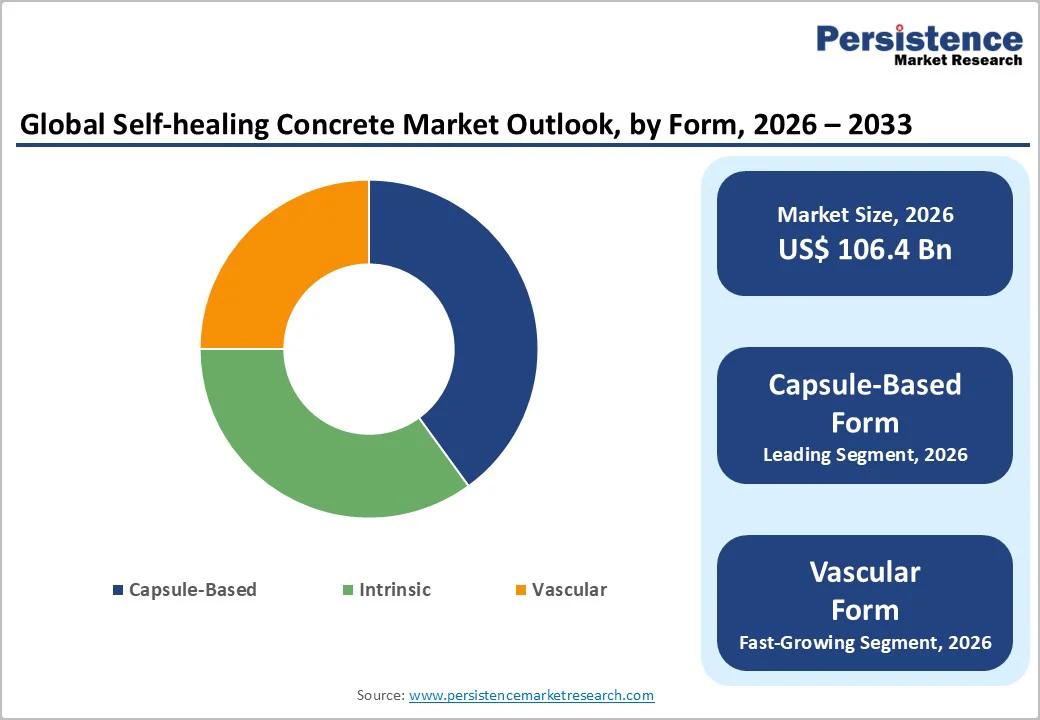
Capsule-based is projected to lead the market with over 42% share in 2026, due to its reliable and controlled healing mechanism. These capsules, filled with adhesives or mineral agents, rupture when cracks form, instantly releasing the healing material to seal the damaged area. This approach ensures consistent performance without depending heavily on environmental conditions. Its ease of integration into conventional concrete mixes also supports widespread adoption across infrastructure and commercial projects. For example, a highway bridge deck reinforced with microcapsule-embedded concrete can automatically repair early micro-cracks caused by heavy traffic, reducing long-term maintenance needs and extending service life.
Vascular is the fastest-growing, driven by its ability to repeatedly heal cracks through a built-in network of hollow channels. These channels function such as artificial veins, carrying healing agents that flow into newly formed cracks whenever damage occurs. This continuous supply enables multiple healing cycles, making it ideal for structures exposed to repeated stress or dynamic loads. For example, an industrial warehouse floor equipped with vascular self-healing systems can automatically repair recurring micro-cracks caused by constant forklift movement, significantly improving durability and reducing repair downtime.
Application Insights
The industrial segment is estimated to dominate at 40% of the market share in 2026, driven by the high demand for durable, low-maintenance materials in factories, warehouses, power plants, and heavy-duty facilities. These environments experience constant vibration, machinery loads, and chemical exposure, making crack formation frequent and costly to manage. Self-healing concrete helps extend structural life by autonomously repairing damage, reducing downtime and maintenance expenses. For example, a manufacturing plant floor exposed to continuous equipment movement can benefit from self-healing concrete that seals micro-cracks automatically, ensuring smoother operations and minimizing the need for frequent resurfacing or repairs.
The residential segment is the fastest-growing segment, supported by rising urbanization, demand for long-lasting housing, and the push for sustainable building materials. Homeowners and developers are increasingly adopting advanced concretes that reduce maintenance needs and enhance structural safety. Self-healing concrete helps prevent issues such as wall cracking, moisture seepage, and foundation deterioration, improving overall building quality. For example, in multi-storey apartment complexes, wall and slab micro-cracks formed due to temperature changes can automatically seal themselves, reducing repair costs and increasing durability. This reliability makes self-healing concrete an attractive choice for modern residential construction.
Regional Insights
North America Self-Healing Concrete Market Trends
North America is experiencing sustained growth as the region focuses on enhancing infrastructure durability, reducing long-term maintenance costs, and advancing sustainable construction practices. Aging bridges, highways, and water management systems across the U.S. and Canada are driving interest in materials that reduce maintenance needs and extend service life. Self-healing concrete aligns well with these goals by automatically repairing micro-cracks, helping prevent corrosion and structural deterioration. The adoption is also supported by increasing emphasis on resilience, particularly in areas exposed to freeze–thaw cycles, heavy traffic loads, or coastal conditions.
Technological progress within the region, such as refined capsule systems, improved vascular networks, and more reliable intrinsic healing formulations, is improving performance consistency and making integration easier for contractors. Research institutions and public agencies are conducting pilot projects to validate long-term benefits, which is gradually building confidence in the technology. For example, researchers at Worcester Polytechnic Institute (WPI), USA, developed an innovative self-healing concrete that uses an enzyme derived from red blood cells. When micro-cracks appear, the enzyme reacts with atmospheric CO2 to form calcium carbonate, automatically sealing the cracks. Although higher initial costs remain a barrier, owners of critical assets, such as transportation authorities and industrial operators, are increasingly evaluating life-cycle savings rather than upfront expenses.
Europe Self-Healing Concrete Market Trends
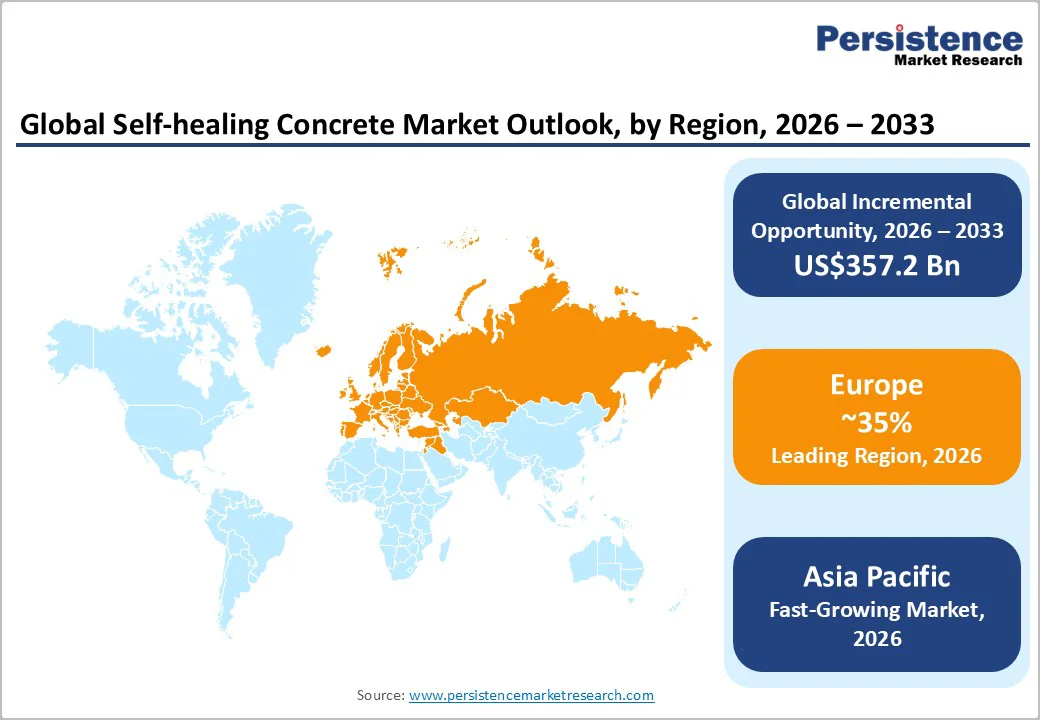
Europe is projected to dominate the market, with approximately a 35% share in 2026, advancing rapidly as the region prioritizes sustainable construction, strict durability standards, and reduced maintenance costs for aging infrastructure. Many European countries face centuries-old buildings, tunnels, and bridges that require long-term, low-disruption repair strategies. For example, Basilisk, a company based in the Netherlands, offers microbial and capsule-based self-healing concrete solutions, now being trialed in European infrastructure projects to extend service life and reduce maintenance frequency. Self-healing concrete aligns with this need by autonomously sealing micro-cracks, improving structural resilience, and lowering lifecycle emissions. Strong regulatory pressure to adopt greener materials supported by the EU climate directives and circular economy goals is further accelerating interest in innovative concrete technologies.
European research institutions and government-funded pilot programs are actively testing self-healing materials in transportation, marine, and urban infrastructure. Cold climates in Northern Europe and coastal conditions in Western Europe also drive demand for materials that withstand freeze–thaw cycles and chloride exposure. Cities focused on smart infrastructure and carbon-neutral initiatives are integrating self-healing concrete into modern construction plans.
Asia Pacific Self-Healing Concrete Market Trends
Asia Pacific is likely to be the fastest-growing market, driven by large-scale urbanization, rising infrastructure investments, and a growing focus on long-term structural durability. Countries such as China, India, Japan, and South Korea are heavily investing in highways, metro networks, bridges, smart cities, and industrial facilities projects, where reducing maintenance costs and extending service life are high priorities. Self-healing concrete fits these needs by autonomously repairing micro-cracks, minimizing water seepage, and improving resistance to corrosion, making it valuable for densely populated and high-traffic areas.
Climate conditions across the region, ranging from heavy monsoons to seismic activity and coastal exposure, also strengthen the demand for materials that enhance structural resilience. Ongoing academic and industry-led research in the region is refining bio-based and capsule-based healing systems, enabling more versatile formulations suitable for local construction practices.
For example, researchers at the Pacific Northwest National Laboratory (PNNL) developed a self-healing cement using shape-memory polymers that expand when heated to automatically close cracks, significantly improving durability and extending structural lifespan. This innovation is aimed at both commercial and infrastructure applications, helping reduce maintenance costs and enhance structural safety. Rising sustainability goals and government interest in low-carbon building materials are further encouraging early adoption.
Competitive Landscape
The global self-healing concrete market is highly competitive, shaped by continuous innovation, expanding research activity, and the growing interest of construction material manufacturers. Competition centers on developing more efficient, cost-effective, and scalable healing technologies that can be integrated into large infrastructure and commercial projects. Companies and research groups are focusing on improving the reliability of healing mechanisms such as capsules, vascular networks, and intrinsic materials to deliver consistent performance under diverse environmental and load conditions. This has led to active experimentation with bio-based agents, mineral fillers, smart polymers, and advanced encapsulation techniques.
Efforts are increasingly focused on lowering production costs and simplifying on-site mixing. Manufacturers are developing formulations compatible with standard batching equipment to facilitate easy adoption by contractors. Collaboration among universities, infrastructure developers, and material producers is growing, with real-world pilot projects playing a vital role in proving long-term performance and strengthening market credibility.
Key Industry Developments
- In April 2023, Hycrete Inc. launched Hycrete Endure Cure, a water-based concrete curing agent that improves the durability of concrete by reducing absorption and providing enhanced protection against corrosion.
Companies Covered in Self-Healing Concrete Market
- Basilisk
- BASF
- Cemex S.A.B DE C.V.
- GCP Applied Technologies Inc.
- Hycrete Inc. (Broadview Technologies Inc.)
- Kryton International Inc.
- Oscrete (Christeyns UK Ltd.)
- Penetron, RPM International Inc.
- Sika AG.
- Others
Frequently Asked Questions
The global self-healing concrete market is projected to reach US$106.4 billion in 2026.
Rapid urbanization and expansion of cities demand large-scale infrastructure roads, bridges, tunnels, and high-rise buildings, which call for long-lasting, low-maintenance materials.
The self-healing concrete market is poised for a 23.4% CAGR from 2026 to 2033.
As governments and industries push toward net-zero targets, self-healing concrete offers a major opportunity to reduce lifecycle emissions by minimizing repairs, material wastage, and CO₂-intensive reconstruction.
Leading players include BASF, Sika AG, Cemex S.A.B. de C.V., Basilisk, and Kryton International Inc.


