




- Hardware & Software IT Services
- Cloud Orchestration Market
Cloud Orchestration Market Size, Share, and Growth Forecast, 2025 - 2032
Cloud Orchestration Market By Solution (Configuration (IaC), Managed Support, Others), Deployment Mode (Private Cloud, Public Cloud, Others), Enterprise Type, and Regional Analysis for 2025 - 2032

Cloud Orchestration Market Size and Trends Analysis
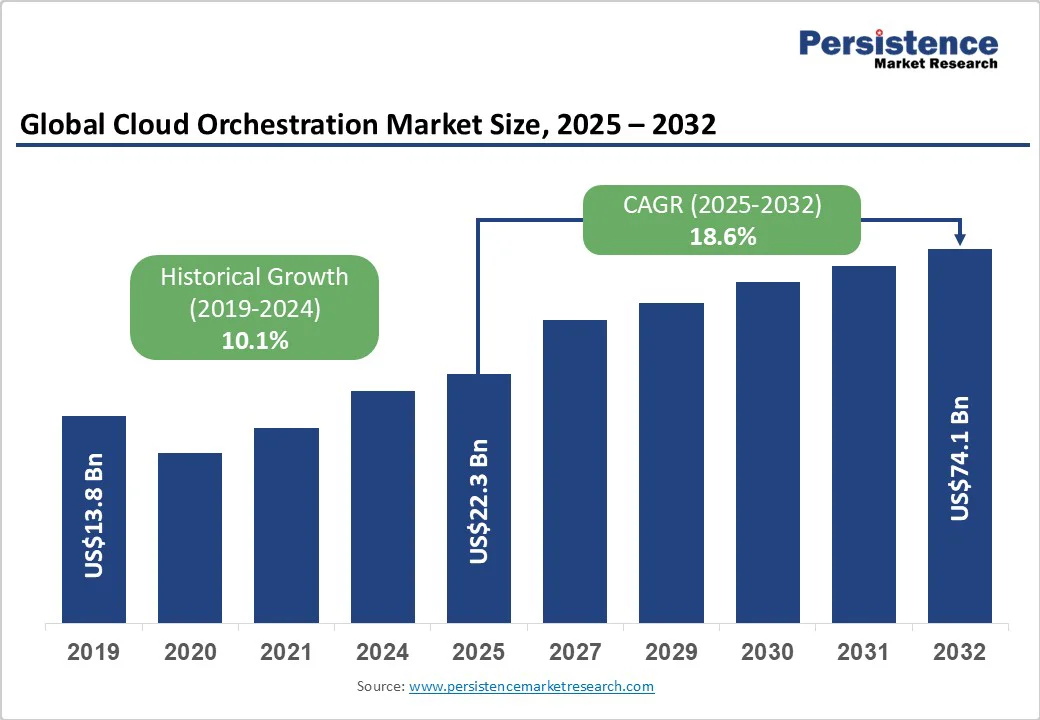
The global cloud orchestration market is expected to reach US$22.3 billion in 2025. It is expected to reach US$74.1 billion by 2032, growing at a CAGR of 18.6% during the forecast period from 2025 to 2032, driven by enterprise urgency to automate lifecycle operations across multi-cloud and hybrid infrastructures, reduce time-to-deploy, and increase operational resilience.
Key growth vectors include platform engineering adoption, integration of AI into orchestration flows, and rising orchestration demand from telco and mobile edge computing projects.
Key Industry Highlights
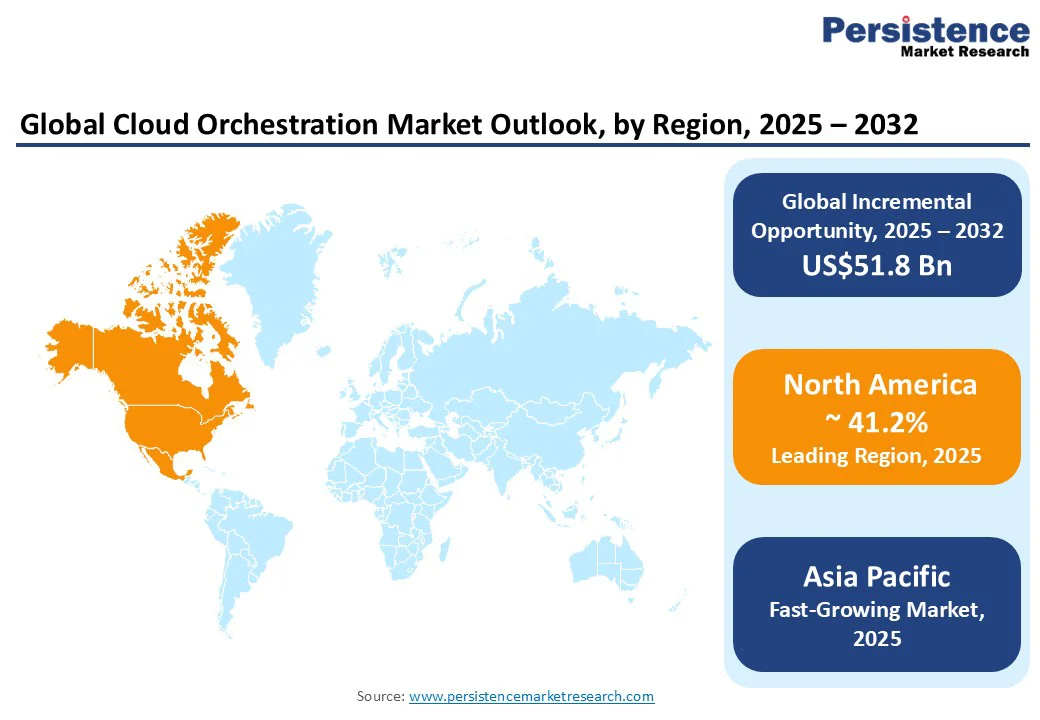
- Leading Region: North America dominates the global cloud orchestration market, accounting for around 41.2% of total revenue in 2025, driven by hyperscaler ecosystems, advanced DevOps practices, and strong enterprise cloud adoption.
- Fastest-growing Region: Asia Pacific is the fastest-growing region, due to rapid industrial digitalization, telecom modernization, and cloud-native SME growth.
- Investment Plans: Global investments are focused on AI-enabled orchestration, sovereign-cloud development, and hybrid cloud integration, with leading vendors such as AWS, Google Cloud, and Microsoft expanding managed orchestration services and R&D in policy automation.
- Dominant Solution: Configuration solutions lead the market with the largest share in the solution segment, accounting for approximately 36.3% of total revenue, supported by demand for infrastructure-as-code and compliance automation.
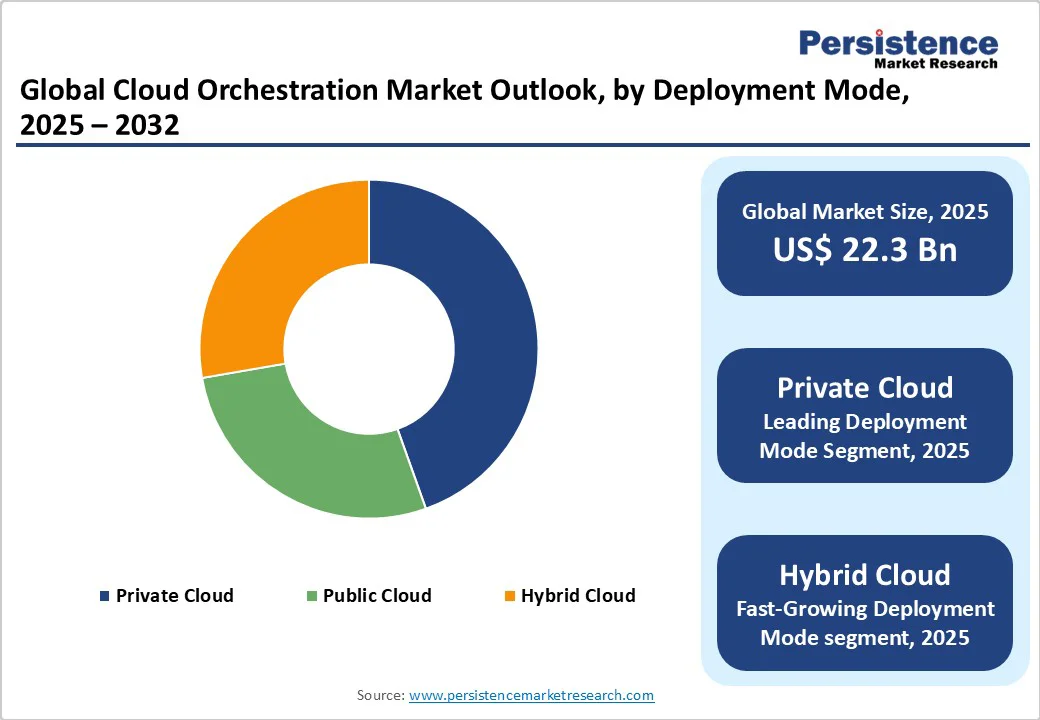
- Leading Deployment Mode: Private cloud deployments are the leading deployment mode, accounting for nearly 44.9% of the market share in 2025, reflecting enterprise preference for data security, governance, and predictable operational control.
| Key Insights | Details |
|---|---|
|
Cloud Orchestration Market Size (2025E) |
US$22.3 Bn |
|
Market Value Forecast (2032F) |
US$74.1 Bn |
|
Projected Growth (CAGR 2025 to 2032) |
18.6% |
|
Historical Market Growth (CAGR 2019 to 2024) |
10.1% |
Market Factors - Growth, Barriers, and Opportunity Analysis
Growth Analysis - Rapid Multi-Cloud and Hybrid Adoption Creating a Direct Need for Orchestration
Enterprises continue to distribute workloads across public clouds, private data centers, and edge locations, creating operational complexity that cannot be managed manually at scale. Centralized orchestration becomes essential for consistent provisioning, cost governance, workload placement, and policy enforcement.
The growing multi-cloud footprint is driving demand for orchestration platforms that unify lifecycle management and provide a single control plane for cross-environment automation. Organizations that adopt orchestration report reduced provisioning time, lower configuration drift, and improved governance. Collectively, these operational returns make orchestration a strategic capital allocation for CIOs seeking predictable, auditable cloud operations.
Institutionalization of Platform Engineering and Infrastructure as Code
Infrastructure as code (IaC) and platform engineering have moved from pilot projects to mainstream enterprise practices. Orchestration products that integrate with IaC tools and GitOps workflows form the core of modern platform stacks. This integration guarantees reproducible deployments, enforces standards, and enables faster developer delivery. Vendors increasingly embed policy-as-code and guardrails into deployment pipelines, enabling teams to scale automation without compromising compliance. The maturation of these practices shifts orchestration from a niche operations tool to a central platform capability that supports developer velocity, reduces configuration errors, and shortens mean time to repair in production environments.
Edge and Telco Transformations, and Regulated-Industry Requirements
Edge computing, telco cloud modernization, and industry-specific regulatory demands create distributed, constrained environments that require coordinated orchestration. Orchestration solutions that support remote cluster management, constrained-resource scheduling, and locality-aware policies are becoming mission-critical for telecom providers, manufacturing sites, and regulated industries. These environments require automated deployment, observability, and policy enforcement while preserving local controls. The confluence of edge expansion and stringent compliance requirements creates long-term structural demand for orchestration solutions that span the cloud-to-edge continuum while ensuring auditability and data residency.
Barrier Analysis - Integration Complexity and Existing Technology Debt
Many enterprises maintain significant legacy systems and heterogeneous stacks. Integrating orchestration tools with legacy management systems, proprietary middleware, and bespoke scripting requires substantial engineering effort. Integration projects raise initial costs and extend timelines, reducing near-term returns on investment and slowing adoption, particularly in conservative verticals such as heavy manufacturing and government. Professional services fees and internal labor to adapt legacy systems can account for a significant portion of first-year implementation costs, creating a clear structural barrier to rapid market penetration.
Security, Compliance, and Data Sovereignty Overhead
Orchestration controls provisioning across compute, network, and identity layers, increasing the governance burden. Regulatory regimes, data privacy laws, sector-specific rules, and government procurement requirements necessitate additional design, auditing, and operational controls. These compliance demands increase time-to-production and raise the total cost of ownership for orchestration projects in regulated sectors. Security concerns also slow adoption in organizations that lack maturity in continuous security testing and monitoring. The need for built-in audit trails and certification-compliant offerings is an operational cost that reduces the pace and breadth of adoption in specific industries.
Opportunity Analysis - Managed Orchestration Services for SMEs and Mid-Market Firms
Large enterprises build internal platform teams; small and mid-market firms frequently lack the resources to operate orchestration at scale. Managed orchestration offerings can convert one-off implementation work into higher-margin recurring revenue and address a large untapped addressable market. By packaging orchestration with observability, backup, and compliance templates, providers can reduce time-to-value and lower technical barriers for SMEs. Conservative market sizing places this service opportunity in the multi-billion-dollar range over the forecast period, particularly in regions where managed cloud adoption already shows high penetration.
AI-Augmented Orchestration as a Premium Feature Tier
Embedding AI into orchestration workflows, predictive scaling, anomaly detection, cost optimization, and automated healing creates a clear premium product tier. Organizations that adopt AI-driven automation report measurable reductions in downtime and operational costs. This opens lucrative monetization avenues by tying premium features to demonstrable operational improvements. Productizing AI features with robust human-in-the-loop controls balances automation benefits with governance and risk mitigation, and can be marketed as a differentiated offering to large enterprises seeking both efficiency and resiliency.
Category-wise Analysis
Solution Insights
Configuration solutions, including infrastructure as code (IaC), template-based deployment, and policy-as-code frameworks, accounted for the largest revenue share in 2025 at 36.3%. Enterprises use these to standardize and automate infrastructure provisioning across diverse environments. Platforms such as Terraform (HashiCorp), AWS CloudFormation, and Red Hat Ansible Automation Platform dominate this space. They enable repeatable, compliant, and auditable deployments integrated into CI/CD pipelines, enhancing governance and operational predictability. As organizations prioritize DevSecOps maturity and seek to reduce configuration drift, configuration orchestration has become the core layer of digital infrastructure management worldwide.
Managed orchestration and portable workload services represent the fastest-growing segment. This growth stems from organizations seeking simplified operations, predictable costs, and cloud portability. Providers such as Rackspace Technology, IBM Cloud Satellite, and Google Anthos offer turnkey orchestration with cross-cloud compatibility, appealing to mid-market enterprises and SMEs. Telcos and edge-computing operators increasingly adopt these services to automate distributed deployments and ensure low-latency operations. The ability to shift workloads seamlessly between public and private clouds provides strong resilience and cost optimization, driving market adoption across emerging economies.
Deployment Mode Insights
Private cloud deployments maintain the largest market share, accounting for approximately 44.9% of total revenue in 2025, driven by data residency, compliance, and control requirements. Sectors such as banking, defense, and healthcare prefer on-prem orchestration for governance and data security. Vendors such as VMware vRealize Orchestrator, OpenStack Heat, and Nutanix Cloud Manager lead private deployment adoption. These platforms enable organizations to manage virtualized workloads securely within controlled environments. Enterprises with strict regulatory frameworks, such as financial institutions, depend on private orchestration to achieve compliance certifications (e.g., ISO 27001, SOC 2) and maintain consistent performance under mission-critical workloads.
Hybrid orchestration is the fastest-growing model, as organizations increasingly combine on-prem control with public-cloud scalability. Platforms like Azure Arc, Google Anthos, and AWS Outposts exemplify hybrid orchestration architectures that unify management, monitoring, and security policies across distributed environments. These solutions enable enterprises to deploy applications across public, private, and edge resources while maintaining centralized control. Use cases include automated disaster recovery, burstable computing, and data residency enforcement, all of which demand orchestration tools capable of seamless policy enforcement and unified lifecycle management across multiple infrastructures.
Regional Insights
North America Cloud Orchestration Market Trends - Hyperscaler-Led Innovation and AI-Driven Orchestration Growth
North America holds the dominant position in the cloud orchestration market, accounting for around 41.2% of global revenue in 2025. The region benefits from its concentration of hyperscalers, enterprise cloud adopters, and leading platform vendors, which collectively drive rapid product innovation and procurement growth. The United States leads the regional landscape, with major enterprises, cloud-native technology firms, and public institutions accelerating orchestration investments. Advanced platform engineering practices, robust DevOps ecosystems, and widespread integration with hyperscaler marketplaces are primary enablers of demand. Public-sector modernization programs and federal cloud certification frameworks further support adoption by ensuring high compliance and security standards.
The competitive landscape is characterized by intense rivalry among hyperscalers such as Amazon Web Services, Microsoft Azure, and Google Cloud, as well as specialist orchestration providers such as VMware and Red Hat. These companies focus on embedding AI-driven operational insights and hybrid management capabilities into their portfolios. Recent developments include Google Cloud’s 2025 introduction of Duet AI for Operations, which enhances orchestration visibility and automation, and AWS’s expansion of the Service Catalog AppRegistry to strengthen configuration governance. Investment priorities in the region are centered on AI-enabled orchestration, unified policy management, and the expansion of managed services across both enterprise and public-sector verticals.
Europe Cloud Orchestration Market Trends-Sovereign - Cloud Expansion and Compliance-Centric Adoption
Europe demonstrates a mature, yet compliance-driven adoption pattern, reflecting its emphasis on data sovereignty and regulated infrastructure. The region contributes a substantial share to global revenues, led by Western European economies that prioritize governance and control. Germany and the United Kingdom remain the strongest adopters, driven by manufacturing digitization and BFSI modernization, while France and Spain exhibit increasing demand within telecom and public-sector transformations. The focus on data residency and procurement standards has made sovereign-cloud orchestration central to enterprise and government strategies.
The European regulatory landscape, particularly under GDPR and national data protection laws, heavily shapes orchestration choices. Vendors such as OVHcloud, Atos, and Deutsche Telekom are spearheading sovereign orchestration models tailored to local compliance standards. Regional system integrators and managed service providers capture enterprise demand by offering localized compliance guarantees and round-the-clock support. In early 2025, Atos and Orange announced a sovereign orchestration collaboration for critical infrastructure, while VMware partnered with Deutsche Telekom to launch multi-tenant orchestration platforms for EU-certified environments. Investment in sovereign-cloud initiatives, telco cloud pilots, and hybrid multi-cloud interoperability is expected to sustain Europe’s strategic edge in the coming years.
Asia Pacific Cloud Orchestration Market Trends - Industrial Digitalization and Hybrid Multi-Cloud Acceleration
Asia Pacific represents the fastest-growing region in the cloud orchestration market, fueled by large-scale industrial digitalization, telecommunications modernization, and public-sector transformation. China and Japan dominate in spending and innovation capacity, supported by strong domestic cloud platforms and government initiatives. India, South Korea, and Southeast Asian economies are emerging as vibrant hubs of SME and startup activity, leveraging orchestration to enhance scalability and reduce operational overheads. The region’s acceleration is linked to Industry 4.0 programs, rapid adoption of edge computing, and expanding hybrid multi-cloud deployments across the manufacturing, logistics, and telecom sectors.
Regulatory diversity in the Asia Pacific drives mixed deployment patterns that blend public, private, and hybrid models. Governments in China and India impose strict data localization and cybersecurity laws, compelling enterprises to adopt localized orchestration solutions. Vendors are responding with partnerships that bridge compliance and scalability; for instance, Alibaba Cloud launched its Distributed Cloud Container Orchestration service in 2025, tailored for regulated industries, while Microsoft Azure expanded its Arc-enabled Kubernetes offerings in India and Japan. Growing collaboration between global hyperscalers and local integrators is fostering greater adoption of managed orchestration platforms. As cloud-native ecosystems evolve, the Asia Pacific market is projected to lead global growth through 2032, with the manufacturing and telecom sectors at the forefront of demand.
Competitive Landscape
The global cloud orchestration market is moderately consolidated, with hyperscalers and major platform vendors capturing most revenue, while specialists and MSPs serve niche segments. Large vendors compete through integration breadth, developer experience, and compliance, whereas specialist vendors emphasize portability and multi-cluster management.
Market leaders focus on AI-driven operations, platform integration, and managed services to boost ARR. Key differentiators include interoperability with IaC and GitOps, compliance certifications, and unified subscriptions for orchestration, observability, and cost optimization.
Key Industry Developments
- In April 2025, Tufin released its TOS R25-1 orchestration suite for cloud and network security policy automation across hybrid/multi-cloud networks. The update expanded device coverage (including Arista, Zscaler, Meraki, Azure NSG, AWS Security Groups) and improved policy-automation visibility across environments.
- In April 2025, Camunda Services GmbH integrated agent-driven orchestration capabilities into its process orchestration platform, enabling AI agents to dynamically control sub-processes, mapping to demand for automation and orchestration in complex cloud-native environments.
Companies Covered in Cloud Orchestration Market
- Amazon Web Services (AWS)
- Microsoft Corporation
- Google Cloud Platform (GCP)
- IBM Corporation
- Oracle Corporation
- VMware, Inc.
- Cisco Systems, Inc.
- Red Hat, Inc. (IBM Subsidiary)
- Hewlett Packard Enterprise (HPE)
- BMC Software, Inc.
- ServiceNow, Inc.
- Dell Technologies, Inc.
- Broadcom Inc. (CA Technologies)
- Micro Focus International plc
- Flexera Software LLC
- CloudBolt Software, Inc.
- Morpheus Data, LLC
- Scalr Inc.
- Puppet, Inc.
- HashiCorp, Inc.
Frequently Asked Questions
The cloud orchestration market is valued at US$22.3 billion in 2025, driven by rising enterprise adoption of hybrid and multi-cloud environments.
By 2032, the cloud orchestration market is expected to reach US$74.1 Billion.
Key trends include AI-driven automation, multi-cloud interoperability, policy-as-code adoption, sovereign cloud development, and the rise of managed orchestration services catering to SMEs and telco edge applications.
Configuration solutions dominate the market under the solution segment due to their integration with CI/CD pipelines and compliance automation features. In deployment mode, private cloud orchestration holds the largest share, especially among regulated enterprises.
The cloud orchestration market is projected to grow at a CAGR of 18.6% between 2025 and 2032, supported by expanding demand for automated cloud operations, compliance management, and hybrid-cloud deployments.
Key players include Amazon Web Services (AWS), Microsoft Corporation, Google Cloud Platform (GCP), IBM Corporation, and VMware, Inc.


