




- Telecommunications
- Cloud Based Payroll Software Market
Cloud Based Payroll Software Market Size, Share, and Growth Forecast, 2026 - 2033
Cloud Based Payroll Software Market by Offering (Software/Platform, Services), Organization Size (Large Enterprises, Small and Medium-sized Enterprises), Industry (BFSI, Manufacturing, IT & Telecom, Healthcare, Retail & E-commerce, Government & Public Sector, Hospitality & Travel, Others) and Regional Analysis for 2026 - 2033

Cloud Based Payroll Software Market Size and Trends
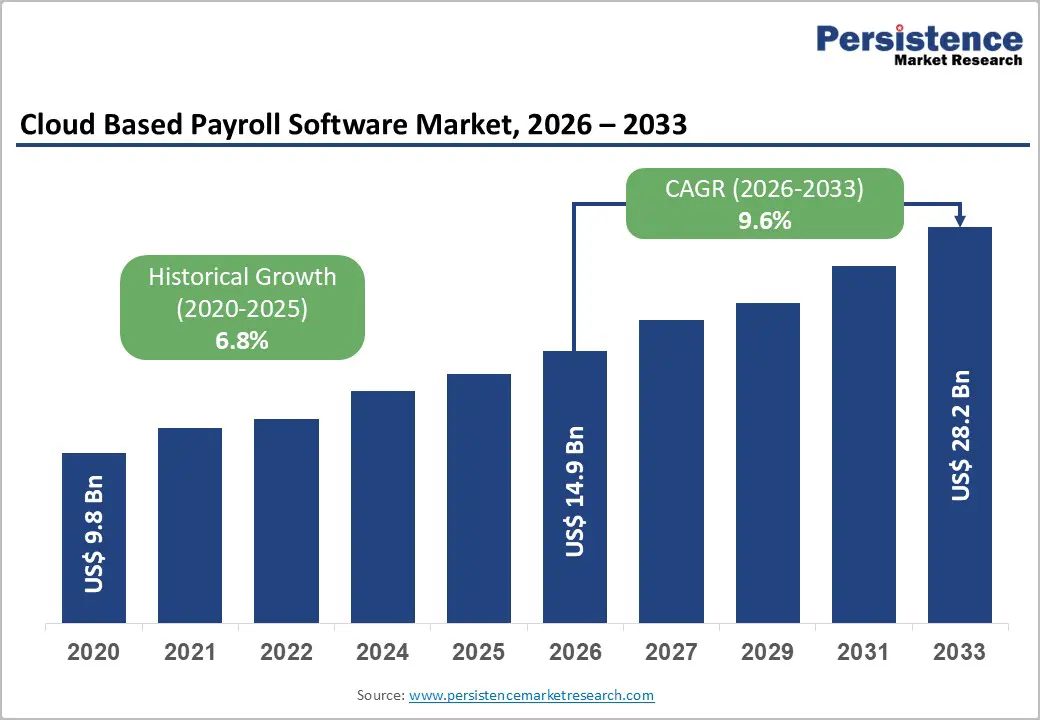
The global cloud based payroll software market size is projected to rise from US$14.9 Bn in 2026 to US$28.2 Bn by 2033. It is anticipated to witness a CAGR of 9.6% during the forecast period from 2026 to 2033, driven by employers’ need to automate complex payroll and tax workflows across multiple jurisdictions while improving compliance and employee experience.
Rapid digitization of HR functions, the shift to SaaS-based HR platforms, and stricter e-filing and payroll compliance mandates in major markets such as the U.S. and Europe are accelerating the adoption of cloud-native payroll systems among both large enterprises and SMEs. Integration capabilities with HRIS, ERP, and accounting platforms, combined with measurable reductions in administrative overhead, are making cloud-based payroll a strategic investment.
Key Industry Highlights:
- Leading Offering: Software/Platform dominates with over 67% market share in 2026, valued at more than US$ 10 Bn, driven by demand for automated, scalable, and AI-enabled payroll solutions. Services are the fastest-growing, catering to deployment, customization, and ongoing maintenance needs.
- Leading Organization Size: Large Enterprises hold over 59% market share in 2026, valued at more than US$ 8.8 Bn, due to complex payroll requirements across multiple geographies. SMEs are the fastest-growing segment, adopting affordable, easy-to-deploy cloud payroll solutions with self-service capabilities.
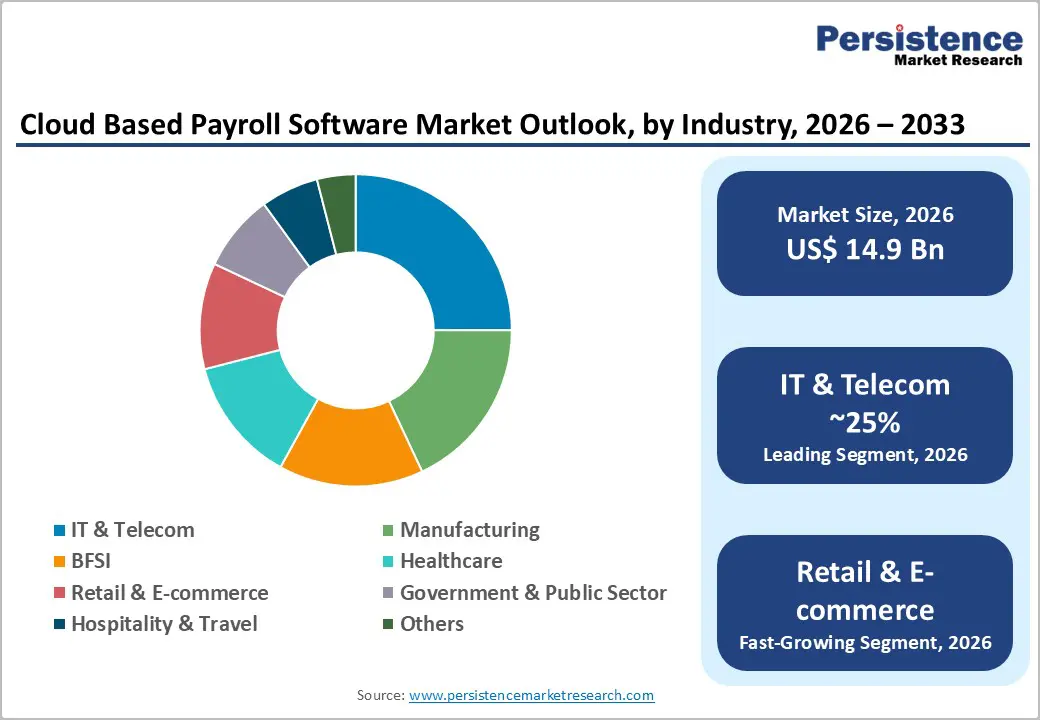
- Leading Industry: IT & Telecom command the largest share at over 25% in 2026, valued at more than US$ 3.7 Bn, driven by distributed workforces, complex pay structures, and multi-region compliance. Retail & E-commerce is expanding rapidly at a CAGR of 12.6%, due to seasonal staffing fluctuations and high employee turnover.
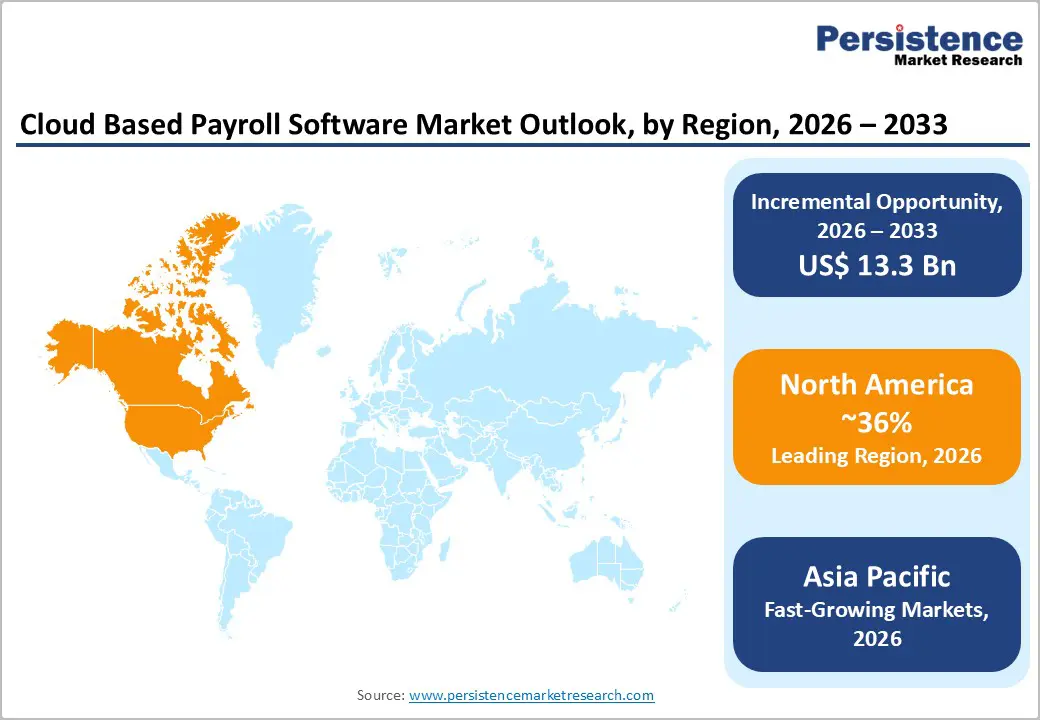
- Leading Region: North America leads with over 36% share in 2026, valued at US$ 5.4 Bn, driven by complex compliance requirements, multi-jurisdictional payroll regulations, and widespread adoption of automated cloud payroll solutions. Asia Pacific is the fastest-growing region with a CAGR of 13.8%, fueled by workforce formalization, government digitalization initiatives, and regional customization for MNCs.
| Key Insights | Details |
|---|---|
| Cloud Based Payroll Software Market Size (2026E) | US$14.9 Bn |
| Market Value Forecast (2033F) | US$28.2 Bn |
| Projected Growth (CAGR 2026 to 2033) | 9.6% |
| Historical Market Growth (CAGR 2020 to 2025) | 6.8% |
Market Dynamics
Driver
Intensifying Payroll Compliance and E-Filing Mandates
Stricter payroll tax, reporting, and data privacy rules in markets such as the U.S., Canada, and EU are a powerful catalyst for cloud-native payroll adoption. In the U.S., ongoing IRS modernization and regulations on digital content and cloud transactions are tightening requirements for electronic filing and accurate classification of cloud-based services, pushing more employers to adopt compliant, automated payroll solutions. States like California, Colorado, and Virginia now treat payroll data as protected personal information, requiring encryption, strict retention policies, and vendor risk assessments that cloud payroll vendors are purpose-built to handle. Similar obligations under GDPR and national data protection rules in Europe further reinforce the need for centralized, secure, and always up-to-date payroll platforms, driving sustained market expansion.
Employee Self-Service and Mobile Accessibility
The adoption of employee self-service (ESS) portals and mobile-accessible payroll solutions is driving significant market growth. These features empower employees to access payslips, submit tax forms, and manage benefits independently, reducing HR administrative workload. Mobile accessibility ensures real-time updates, faster approvals, and seamless communication, particularly for remote and hybrid workforces. Organizations leveraging ESS report enhanced employee satisfaction and engagement. According to a study, automation through self-service portals reduces payroll processing errors by up to 20-25%, while improving overall operational efficiency and cost savings. This is increasingly influencing cloud payroll adoption across SMEs and large enterprises.
Restraint
Data Security, Privacy, and Sovereignty Concerns
Despite strong encryption and compliance capabilities, many organizations still hesitate to move sensitive payroll data to multi-tenant cloud environments due to fear of breaches and regulatory penalties. Privacy laws such as GDPR, CCPA, and India’s DPDP Act impose strict rules on cross-border data flows, consent, and retention, and violations lead to fines of up to 4% of global annual turnover in the case of GDPR, which makes some enterprises cautious. Public-sector entities and highly regulated industries often face data localization or sovereignty requirements that complicate use of global cloud infrastructure, limiting uptake in certain jurisdictions. These concerns slow decision cycles and can keep a portion of potential demand tied to on-premise or hybrid architectures.
Integration Complexity and Legacy System Dependence
Many organizations operate fragmented HR, time-and-attendance, and accounting stacks, making integration of new cloud payroll platforms time-consuming and costly. Legacy ERP or homegrown payroll systems are deeply embedded into finance workflows, and migration requires data cleansing, mapping, and process redesign that some enterprises are reluctant to undertake, especially in regions with limited IT skills. Where integrations with HRIS, ERP, and benefits platforms are not seamless, organizations risk payroll discrepancies and duplicate data entry during transition phases, which erode trust in new systems. This complexity, combined with perceived switching costs, delays or scales back adoption plans, particularly for mid-sized firms with constrained IT resources.
Opportunity
AI-Driven Payroll Analytics and Employee Experience
Vendors are increasingly differentiating cloud-based payroll suites by embedding AI and advanced analytics to provide predictive insights on labor costs, overtime, and compliance risks. In the broader SaaS HR tools space, automation is estimated to reduce administrative overhead by 30-50% and accelerate recruitment cycles by 25-35%, demonstrating the tangible benefits of smart workflows for HR leaders. Applying similar AI-driven capabilities to payroll such as anomaly detection for fraudulent claims, predictive cash-flow planning for payroll runs, and personalized pay insights for employees creates new value propositions and flexible pricing models. As enterprises pursue unified platforms for payroll, time, and talent management, integrated AI features unlock premium tiers and cross-sell opportunities for vendors serving both large enterprises and SMEs.
Expansion through Payroll-as-a-Service (PaaS) and SME-Focused Affordable Solutions
With small and medium-sized enterprises (SMEs) increasingly seeking cost-effective, scalable, and easy-to-implement payroll solutions, vendors leverage Payroll-as-a-Service (PaaS) to offer subscription-based models that reduce upfront costs and IT complexity. This approach enables faster deployment, automated compliance, and seamless integration with HR systems, making cloud payroll accessible to smaller organizations. By targeting SMEs with tailored, affordable solutions, providers capture a large untapped market segment while building long-term customer relationships and recurring revenue streams. This strategy also aligns with the digital transformation in HR operations across emerging economies.
Category-wise Analysis
Offering Analysis
Software/Platform dominates the market, capturing more than 67% market share in 2026 with a value exceeding US$ 10 Bn, due to organizations’ need for automated, scalable, and integrated payroll solutions that streamline employee management, ensure compliance, and reduce manual errors. They provide real-time access, seamless updates, and multi-location support, making payroll operations more efficient and cost-effective. The adoption of AI and analytics tools within these platforms also helps in predictive payroll planning and error detection.
Services are expected to grow at a significant rate due to organizations’ demand for expert guidance during deployment, customization according to specific HR policies, and ongoing maintenance support. Smaller enterprises and companies moving from legacy systems prefer managed services to reduce operational complexity and ensure smooth adoption of cloud payroll systems.
Organization Size Analysis
Large Enterprises hold over 59% market share in 2026, with a value exceeding US$ 8.8 Bn. These organizations demand robust, secure, and compliant payroll solutions that handle thousands of employees across multiple geographies. Their payroll requirements include integration with ERP, tax compliance, benefits management, and analytics dashboards. The complexity of their workforce structures drives the adoption of advanced cloud-based systems to improve accuracy and operational efficiency.
Small and Medium-sized Enterprises (SMEs) are expected to grow rapidly due to the increasing need for affordable, easy-to-deploy payroll software that reduces administrative burden. SMEs prioritize time-saving, user-friendly platforms that offer automated salary processing, statutory compliance, and employee self-service portals, enabling them to focus on core business activities. The flexibility of cloud deployment makes it particularly attractive for SMEs with limited IT infrastructure.
Industry Analysis
IT & Telecom command the largest market share at over 25% in 2026, with a value exceeding US$ 3.7 Bn, driven by the industry’s highly distributed workforce, complex pay structures, and need for compliance across regions. Cloud payroll systems provide IT & Telecom companies with real-time reporting, integration with HR and attendance systems, and scalability for rapid workforce growth, addressing critical operational needs efficiently.
Retail & E-commerce is expected to grow at a CAGR of 12.6% due to the need for dynamic payroll management in response to seasonal staffing fluctuations, high employee turnover, and multi-location operations. It allows retailers to automate wage calculations, manage part-time and full-time staff, and comply with labor regulations, which significantly reduces errors and administrative workload.
Regional Insights
North America Cloud Based Payroll Software Market Trends
North America holds over 36% share in 2026, reaching US$ 5.4 Bn value, led by the United States, where over 160 million workers generate massive payroll volumes annually. The region’s complex compliance landscape, including over 10,000 tax jurisdictions identified by the American Payroll Association (APA) drives adoption of automated, cloud-based payroll solutions. Leading vendors compete intensely, integrating AI and analytics for smarter payroll management. In Canada, regulatory mandates from the Canada Revenue Agency (CRA), requiring electronic payroll remittances for employers exceeding CAD 50,000, are accelerating cloud adoption among mid-market businesses.
Asia Pacific Cloud Based Payroll Software Market Trends
Asia Pacific is expected to grow at a significant rate with a CAGR of 13.8%, fueled by rapid economic expansion, workforce formalization, and government digitalization initiatives. In India, adoption surged following GST implementation and EPFO digitization, requiring integrated payroll and compliance workflows. Australia’s STP Phase 2 mandates expanded payroll reporting, while Japan’s Society 5.0 reforms are modernizing HR and payroll systems. ASEAN nations including Singapore, Malaysia, and Indonesia are seeing strong uptake among MNCs establishing shared service centers. Cloud payroll software providers are targeting regional customization to address language, compliance, and cultural requirements.
Europe Cloud Based Payroll Software Market Trends
Europe is expected to hold more than 23% share by 2026, with Germany, the United Kingdom, France, and the Netherlands as primary demand centers. Regulatory frameworks such as GDPR, the EU Pay Transparency Directive, and country-specific social security rules compel the modernization of legacy payroll systems. The UK’s HMRC RTI reporting mandates timely payroll submissions, while Germany’s Kurzarbeit short-time work schemes highlight the need for agile, compliant systems. Vendors like Alight Solutions, along with global players ADP and Workday, are expanding through localization and strategic acquisitions to address multi-country payroll requirements across the continent. European enterprises are embracing AI-enabled payroll analytics and real-time reporting, allowing better decision-making and workforce optimization.
Competitive Landscape
The cloud based payroll software market exhibits a moderately consolidated structure, with a handful of established players controlling a significant portion of enterprise market revenues, while a growing cohort of venture-backed challengers compete aggressively in the mid-market and SME segments. Market leaders differentiate through comprehensive compliance coverage across jurisdictions, deep integration with ERP and HCM ecosystems, and expanding AI-driven analytics capabilities. Emerging players are disrupting traditional models through global employer-of-record (EOR) services, API-first architectures, and competitive PEPM pricing.
Key Industry Developments
- In January 2026, ADP introduced ADP Assist AI agents, leveraging its global data platform to automate HR and payroll tasks, provide personalized policy guidance, detect payroll variances, and deliver data-driven workforce insights. These agents streamline processes, reduce manual workload, and enable smarter, persona-based decision-making while maintaining compliance and security standards.
- In June 2025, CloudPay launched a fully cloud-based payroll solution for midsize businesses, offering fast, easy-to-use deployment with fixed-fee packages and single-country setup. The solution ensures global compliance, seamless integration with HCM systems, and scalable operations for businesses expanding into new countries or entities.
Companies Covered in Cloud Based Payroll Software Market
- ADP Inc
- Workday, Inc.
- Paychex, Inc.
- Dayforce, Inc.
- UKG Inc.
- Paycom Payroll LLC
- Paylocity
- Gusto
- Rippling
- Deel
- Papaya Global
- Alight Solutions
- Oracle Corporation
- Zoho Corporation Pvt. Ltd.
- Others
Frequently Asked Questions
The global market is projected to be valued at US$14.9 Bn in 2026.
The need for automated, accurate, and scalable payroll solutions that reduce manual errors, ensure compliance, and support remote and global workforce management efficiently are key driver of the market.
The market is expected to witness a CAGR of 9.6% from 2026 to 2033.
AI-driven analytics, global payroll expansion, integration with HR and ERP systems, and demand from SMEs for cost-effective solutions are creating strong growth opportunities.
ADP Inc, Workday, Inc., Paychex, Inc., Dayforce, Inc., UKG Inc., Paycom Payroll LLC, Paylocity, Gusto are among the leading key players.


