




- Specialty & Fine Chemicals
- Calcium Stearate Market
Calcium Stearate Market Size, Share, and Growth Forecast, 2026 - 2033
Calcium Stearate Market by Product Form (Powder, Flakes, Granules, Liquid), Application (Plastics, Polymers & Rubber, Personal Care & Cosmetics, Food & Beverages, Pharmaceuticals, Electronics & Electrical, Paints & Coatings), End-User (Automotive, Construction, Consumer Goods, Medical, Electronics, Packaging), and Regional Analysis for 2026 - 2033

Calcium Stearate Market Share and Trends Analysis
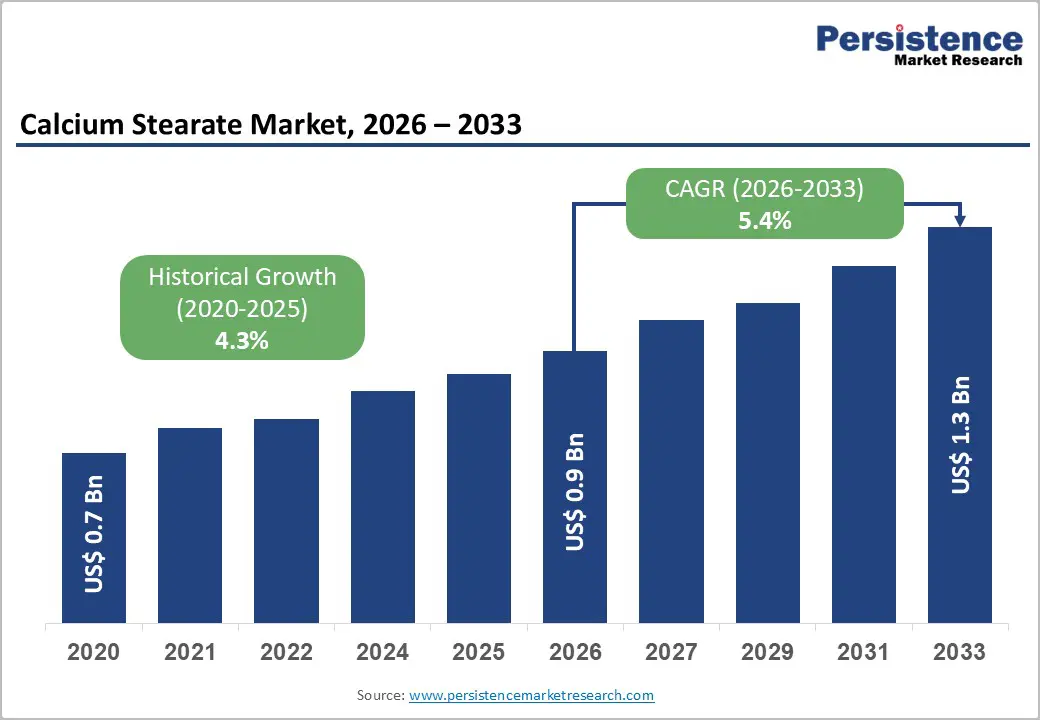
The global calcium stearate market size is likely to be valued at US$ 0.9 billion in 2026, and is projected to reach US$ 1.3 billion by 2033, growing at a CAGR of 5.4% during the forecast period 2026−2033. This expansion is driven by rising demand for the compound across diverse sectors, including plastics, personal care, pharmaceuticals, and food and beverages.
Key growth factors include increasing consumption in polymer and rubber manufacturing, broader adoption in personal care formulations, and expanding applications in food and beverage products. Technological innovations, rapid urbanization, and the global shift toward sustainable and eco-friendly materials have further accelerated market development. Growth is also being fueled by the compound’s versatility, reliability, and adaptability to evolving industry requirements. As manufacturing standards continue to advance and sustainability remains a priority, calcium stearate is well positioned to meet the performance and regulatory needs of a wide range of industrial applications.
Key Industry Highlights
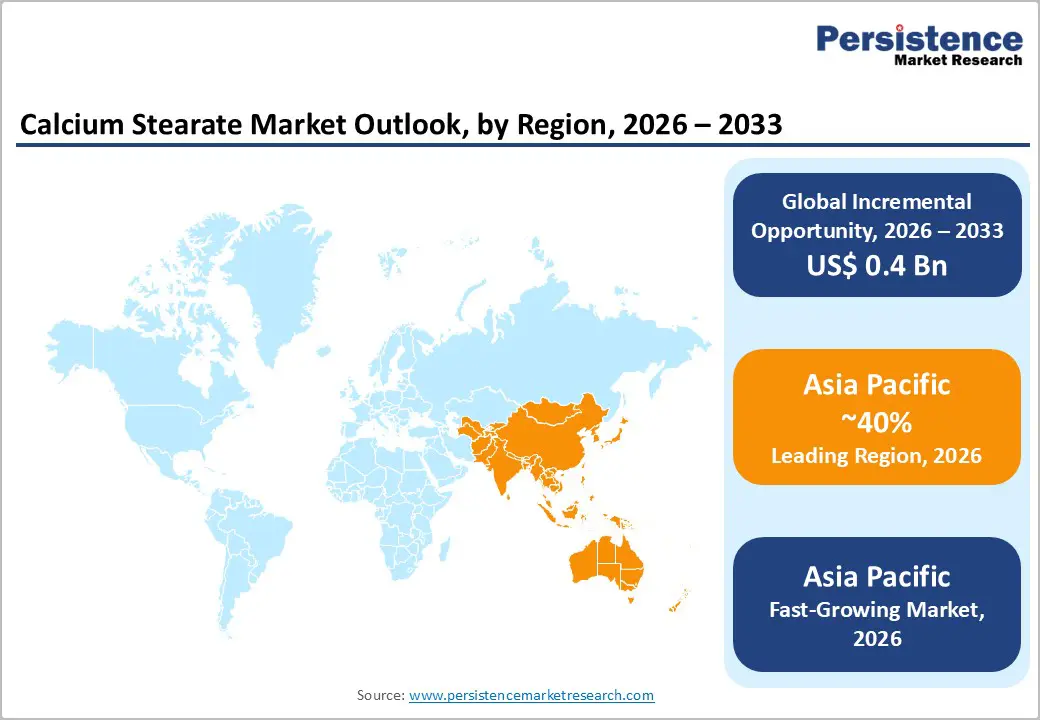
- Dominant Region: Asia Pacific is predicted to hold a 40% market share in 2026, powered by its dominance in plastics, automotive, and construction industries.
- Fastest-growing Market: Asia Pacific is forecasted to be the fastest-growing market from 2026 to 2033, fueled by automation in the automotive, electronics, and packaging industries.
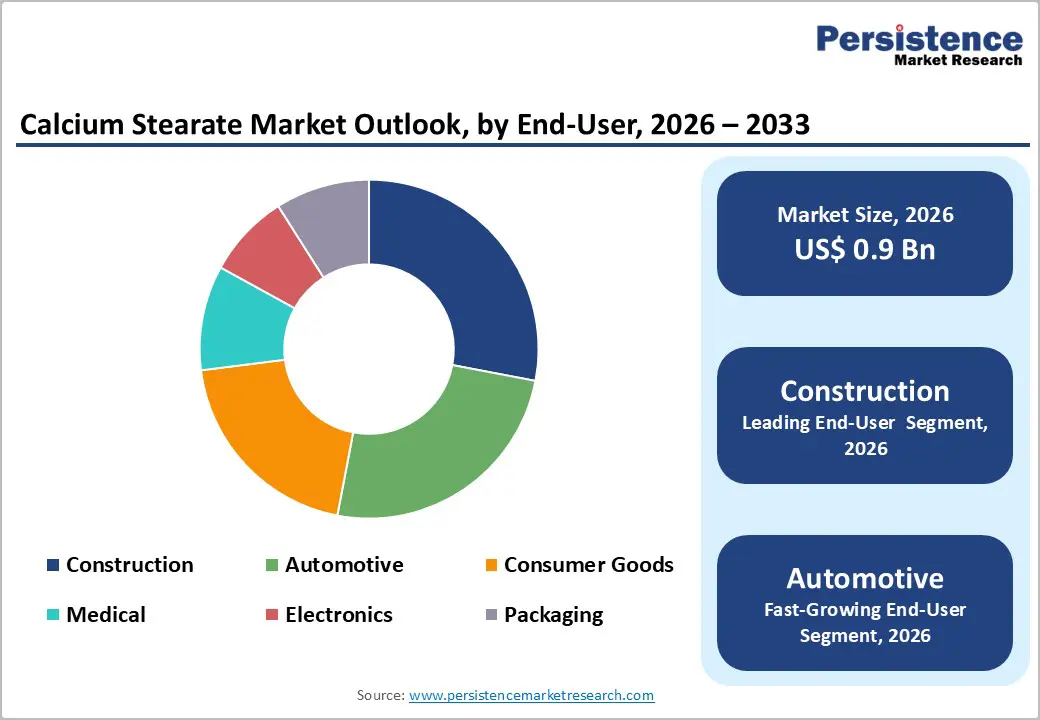
- Leading End-User: The construction industry is likely to lead with over 28% market share in 2026, supported by a soaring demand for durable building materials and infrastructure development in the Asia Pacific and the Middle East.
- Fastest-growing End-User: The automotive sector is projected to grow the fastest through 2033, driven by the increased use of polymeric materials and high demand for lightweight components.
| Key Insights | Details |
|---|---|
|
Calcium Stearate Market Size (2026E) |
US$ 0.9 Bn |
|
Market Value Forecast (2033F) |
US$ 1.3 Bn |
|
Projected Growth (CAGR 2026 to 2033) |
5.4% |
|
Historical Market Growth (CAGR 2020 to 2025) |
4.3% |
Market Factors - Growth, Barriers, and Opportunity Analysis
Rising Demand in Plastics and Rubber Industries
The growing demand in the plastics and rubber industries has significantly driven the expansion of the calcium stearate market, as this compound has been essential for enhancing manufacturing efficiency and end-product performance. Within the plastics sector, calcium stearate has served as both a lubricant and a processing aid during polymer production, particularly in extrusion and molding processes. By reducing friction between molten plastics and machinery surfaces, it has promoted smoother material flow, minimized equipment wear, and prevented sticking. These benefits have not only improved production consistency and energy efficiency but also elevated the surface finish and visual quality of plastic products, which has been valuable for markets such as packaging, automotive, and consumer goods.
In rubber manufacturing, calcium stearate has served as an effective mold release agent, facilitating the clean removal of shaped products without surface defects or material distortion. Additionally, it has improved the dispersion of reinforcing agents, such as carbon black and other fillers, thereby strengthening the uniformity and mechanical durability of rubber components, particularly in demanding applications such as tires, seals, and hoses. As industrial activity in sectors such as automotive and construction has continued to expand, the requirement for high-performance, long-lasting rubber materials has increased. This trend will further elevate the importance of advanced processing additives such as calcium stearate in maintaining quality, efficiency, and cost competitiveness across modern manufacturing operations.
Substitution by Alternative Stearates
The substitution of alternative stearates has presented a notable challenge to the growth of the calcium stearate market, as compounds such as zinc stearate and magnesium stearate have offered similar advantages in manufacturing operations. These alternatives have provided comparable lubrication, stabilization, and processing properties, making them appealing options for industries such as plastics and rubber. Many manufacturers have adopted these substitutes to optimize production costs, particularly when alternatives are more affordable or readily accessible than calcium stearate. Because the transition between different stearates requires minimal process modification given their comparable performance characteristics, the market expansion of calcium stearate has remained constrained in several application areas.
The perceptible shift toward substitution has also reflected the evolving preferences of end-users who have emphasized product performance, sustainability, and compliance. In many cases, industries have selected alternative stearates for their ability to meet stricter environmental regulations, comply with higher safety standards, and improve compatibility with advanced material formulations. As cost efficiency and regulatory compliance have become stronger priorities across global manufacturing, the preference for specialized and eco-friendly stearate options is expected to intensify. This trend will likely continue to reduce market dependence on calcium stearate, prompting producers to explore innovation-driven strategies to reinforce its competitive position.
Adoption of Bio-Based and Sustainable Variants
The shift toward bio-based and sustainable variants has created a valuable growth opportunity for the calcium stearate market, as industries have increasingly prioritized environmentally responsible solutions. Heightened awareness of ecological impact and stringent regulations governing chemical products have driven companies to adopt renewable and biodegradable alternatives. Bio-based calcium stearate, derived from renewable plant-based sources, has offered a sustainable substitute that minimizes the environmental footprint of conventional production methods. This aligns closely with the global movement toward sustainability across sectors such as plastics, personal care, and pharmaceuticals, where organizations have sought to balance performance with environmental stewardship.
Rising consumer preference for eco-friendly products has further influenced both industry practices and regulatory standards, encouraging faster adoption of bio-based calcium stearate. In markets such as personal care, cosmetics, and food processing, the use of natural and biodegradable ingredients has increasingly served as a key differentiator, strengthening brand reputation and market competitiveness. Companies that have transitioned to bio-based formulations have not only achieved compliance with evolving environmental regulations but have also enhanced consumer trust and brand loyalty. As this trend continues, businesses embracing sustainable innovation are expected to capture emerging growth opportunities and position themselves as leaders in environmentally conscious manufacturing.
Category-wise Analysis
Product Form Insights
The powder form is projected to remain the dominant segment, accounting for approximately 65% of the calcium stearate market revenue share in 2026, due to its outstanding dispersion capabilities in plastics and rubber production. This form has been widely preferred for its cost-effectiveness, uniform particle size, and high compatibility with large-scale manufacturing processes. Industries such as packaging, construction, and automotive have relied on powder calcium stearate to achieve superior processing efficiency, minimize production defects, and maintain product uniformity. These advantages have been particularly significant for continuous operations where consistency and material performance directly influence productivity and overall manufacturing quality.
The granule segment is expected to grow the fastest between 2026 and 2033, supported by accelerating adoption in automated pharmaceutical production lines and electronics manufacturing. Granular calcium stearate has gained traction owing to its ease of handling, low dust emissions, and stable performance in high-precision automated systems. In the pharmaceutical sector, its use has enhanced operational efficiency by reducing contamination risks and simplifying material feeding processes. Similarly, in the electronics industry, the growing emphasis on automation and precision engineering has stimulated stronger demand for granule formulations. This trend is anticipated to reinforce the segment’s growth trajectory and establish granules as a key material form in industries that value precision, cleanliness, and process reliability.
Application Insights
The plastics segment is projected to capture approximately 32% of the revenue share in 2026, underscoring the essential role calcium stearate has played as a stabilizer and lubricant in polyvinyl chloride (PVC) processing. This compound has enhanced material flow, minimized friction, and contributed to smoother and more efficient plastic manufacturing operations. As the global demand for plastic materials continues to increase, driven by industries such as packaging, automotive, and consumer goods, calcium stearate has remained a vital additive for ensuring defect-free production and consistent product quality. Owing to these proven benefits, this segment is expected to maintain a strong market position through 2026, supported by ongoing innovations in polymer processing and performance optimization.
The personal care and cosmetics segment is projected to grow the fastest between 2026 and 2033, driven by the expanding use of calcium stearate as an excipient in pharmaceutical tablets and an anti-caking agent in cosmetic powders. This expansion has been driven by the increasing number of products approved by the United States Food and Drug Administration (FDA) and the growing global population of elderly consumers, which has elevated demand for nutritional supplements and skincare products. As these industries continue to evolve, the requirement for safe, effective, and consistent stabilizers such as calcium stearate is anticipated to rise substantially. This trajectory positions calcium stearate as a strategic material supporting quality assurance and product performance in both pharmaceutical and personal care applications.
End-User Insights
The construction industry is projected to dominate the calcium stearate market share at about 28% in 2026, driven by the rising need for durable and high-performance building materials. Calcium stearate has served a crucial role in concrete formulations as both a stabilizer and a water repellent, improving the durability, resistance, and overall longevity of structural components. Its ability to enhance material performance under varying climatic conditions has made it an indispensable additive in modern construction materials. The continued expansion of infrastructure projects across Asia Pacific and the Middle East, supported by urbanization and large-scale industrial development, is expected to reinforce the construction segment’s leading position through the forecast period.
The automotive sector is forecasted to be the fastest-growing segment during the 2026-2033 period, propelled by the increasing incorporation of polymer-based and composite materials in vehicle design and production. As manufacturers have sought lighter, stronger, and more energy-efficient materials for interiors, coatings, and functional components, calcium stearate has emerged as a critical additive that optimizes processing, enhances surface finish, and improves thermal stability. Growing trends in sustainability, electric vehicle (EV) manufacturing, and material innovation have further amplified the use of high-performance additives. Consequently, the adoption of calcium stearate within the automotive industry is set to accelerate, supporting both efficiency and product quality in next-generation mobility solutions.
Regional Insights
North America Calcium Stearate Market Trends
North America is likely to maintain a strong position in the calcium stearate market, supported by a mature industrial ecosystem and well-established demand across key sectors such as plastics, rubber, and construction. The region’s manufacturing base has heavily relied on calcium stearate for its multifunctional benefits as a lubricant, stabilizer, and water-repellent agent, particularly in polymer processing and cement formulations. This demand has been reinforced by ongoing innovation in packaging, steady automotive production, and the continuous development of consumer goods that require high-performance additives to ensure efficiency, durability, and product longevity. The United States remains the dominant market within the region, bolstered by strict regulatory oversight from agencies such as the FDA and the Environmental Protection Agency (EPA). These agencies have promoted the use of food-grade and pharmaceutical-grade calcium stearate in excipient formulations and anti-caking applications, ensuring stringent standards for safety and quality compliance.
Construction activity, supported by extensive infrastructure investment programs, will continue to fuel the use of calcium stearate in concrete, plaster, and other building materials, improving moisture resistance and extending structural durability. At the same time, the pharmaceutical and food processing sectors have contributed steadily to market growth through consistent use of the compound in tablet production and processed food formulations due to its recognized safety profile. Competitive dynamics within North America feature established producers focusing on capacity expansions, efficiency improvements, and the development of specialized emulsions for coatings and adhesives. Moreover, supportive regulatory frameworks have encouraged domestic sourcing and sustainability-led compliance, shortening supply chains while helping manufacturers mitigate challenges such as raw material cost fluctuations and supply volatility.
Europe Calcium Stearate Market Trends
Europe is expected to occupy a prominent position in this market, underpinned by a strong industrial infrastructure across automotive, construction, and plastics sectors. The region’s well-developed manufacturing ecosystem has prioritized sustainable and environmentally friendly products, which has fueled demand for high-purity, non-toxic variants of calcium stearate. Industries have increasingly relied on this compound to enhance material performance and ensure regulatory compliance in advanced construction materials, automotive components, and personal care formulations. Leading countries such as Germany, France, Italy, Spain, and the United Kingdom have driven this activity, supported by rigorous standards under the Registration, Evaluation, Authorisation and Restriction of Chemicals (REACH) framework. These regulations have reinforced the preference for premium-grade additives that balance efficacy with ecological responsibility.
The rubber and plastics sectors have continued to provide steady demand through production of hoses, tires, and protective coatings, where calcium stearate has improved durability amid rising energy costs. Construction initiatives across the region have further utilized the compound to boost cement strength and water resistance in infrastructure projects, contributing to long-term structural reliability. In the competitive landscape, major producers have invested in local warehousing, particularly following Brexit, and capacity enhancements to address supply disruptions. Regulatory requirements have encouraged domestic manufacturing and stringent quality assurance, thereby building resilience to economic fluctuations and positioning Europe for sustained market leadership in high-value applications.
Asia Pacific Calcium Stearate Market Trends
By 2026, the Asia Pacific is foreseen to lead the calcium stearate market share at an estimated 40%, backed by its commanding presence in core manufacturing sectors such as plastics, automotive, and construction. Countries such as China and India have anchored this dominance through expansive industrial capabilities that position them as global centers for plastics production, vehicle assembly, and infrastructure expansion. Manufacturers in these nations have relied on calcium stearate as a stabilizer and lubricant in polymer, rubber, and concrete processing, which has elevated material quality, processing speed, and end-product reliability. This strategic integration has solidified the region’s market leadership amid accelerating economic and industrial momentum.
The Asia Pacific market is also projected to register the fastest growth between 2026 and 2033, supported by transformative trends across multiple industries. Automation advancements in automotive assembly, electronics fabrication, and packaging operations have heightened the need for premium additives such as calcium stearate, which optimize efficiency and ensure superior performance. An expanding middle class, rapid urbanization, and rising disposable incomes have stimulated demand for consumer goods, particularly for flexible packaging solutions, thereby widening adoption of calcium stearate. Organizations targeting this dynamic region should prioritize supply chain resilience and innovation in high-performance formulations to capitalize on these opportunities and sustain competitive advantages.
Competitive Landscape
The global calcium stearate market remains moderately consolidated, with leading companies capturing a substantial share of total revenue through proven operational strengths. Key players such as Baerlocher GmbH, Dover Chemical Corporation, and Peter Greven GmbH & Co. KG have maintained dominance via advanced manufacturing infrastructure, extensive distribution channels, and comprehensive product portfolios. These organizations have invested heavily in research & development (R&D) capabilities, international production sites, and long-term customer partnerships, thereby solidifying their competitive advantages. Such strategic positioning has enabled them to meet diverse industry requirements while anticipating future shifts in material science and processing technologies.
Mid-sized and emerging enterprises have complemented this landscape by specializing in niche formulations and targeted regional expansion. These firms have focused on developing sustainable, cost-optimized variants, along with innovative delivery systems and customized solutions, for sectors such as pharmaceuticals and electronics. Through collaborations with local distributors and manufacturers, they have penetrated underserved markets, enhancing product availability in high-growth areas. Forward-thinking companies will benefit from balancing scale with specialization, pursuing joint ventures or technology licensing to accelerate innovation and capture emerging opportunities in bio-based and precision-engineered additives.
Key Industry Developments
- In August 2025, Baerlocher GmbH launched a new eco-friendly calcium stearate formulation aimed at improving sustainability in the plastics industry, responding to growing demand for greener additives.
Companies Covered in Calcium Stearate Market
- Baerlocher GmbH
- Dover Chemical Corporation
- Peter Greven GmbH & Co. KG
- Valtris Specialty Chemicals.
- FACI Corporate S.p.A.
- Global Calcium
- Shandong Repolyfine Additives Co., Ltd.
Frequently Asked Questions
The global calcium stearate market is projected to reach US$ 0.9 billion in 2026.
The market is driven by the widespread use of calcium stearate as a stabilizer, lubricant, and processing aid across industries such as plastics, automotive, construction, and pharmaceuticals.
The market is poised to witness a CAGR of 5.4% from 2026 to 2033.
Key market opportunities include the growing demand for bio-based variants, increasing adoption in sustainable products, and expanding applications in personal care, pharmaceuticals, and packaging.
Key players in the market include Baerlocher GmbH, Dover Chemical Corporation, and Peter Greven GmbH & Co. KG.


