




- Automotive Components & Materials
- Automotive Rubber-Molded Components Market
Automotive Rubber-Molded Components Market Size, Share, and Growth Forecast 2026 - 2033
Automotive Rubber-Molded Components Market by Material Type (Ethylene Propylene Diene Monomer, Natural Rubber, Styrene-Butadiene Rubber, Others), by Component Type (Seals, Gaskets, Hoses, Weather Strips, Others), by Vehicle Type (Passenger Cars, Commercial Vehicles), and Regional Analysis for 2026 - 2033

Automotive Rubber-Molded Components Market Size and Trends Analysis
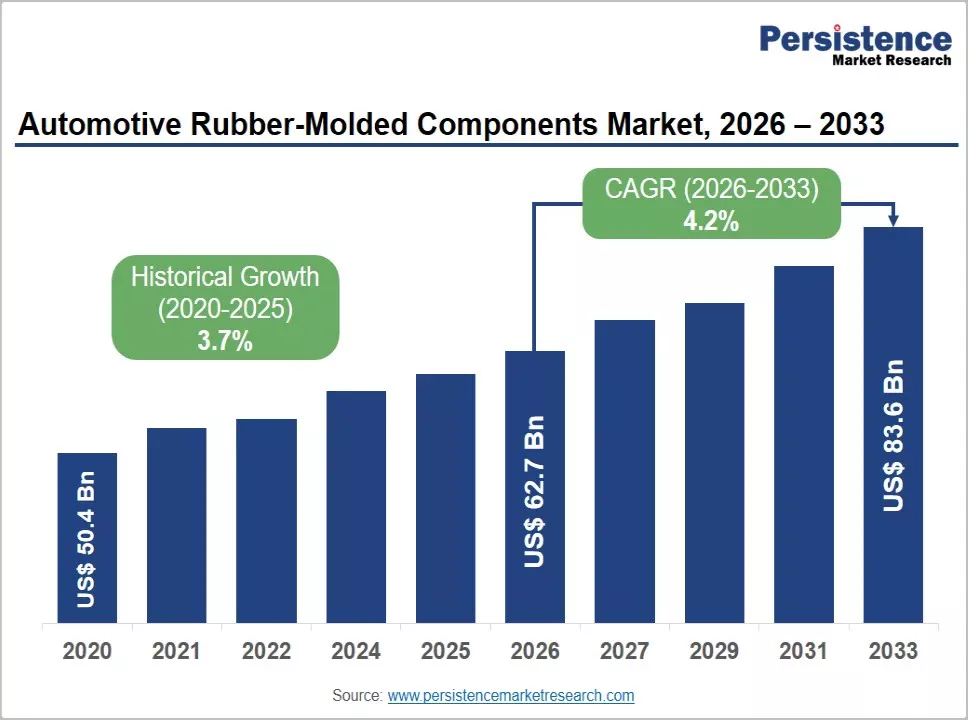
The global automotive rubber-molded components market is expected to be valued at US$ 62.70 Billion in 2026 and is projected to reach US$ 83.63 Billion by 2033, growing at a CAGR of 4.2% between 2026 and 2033.
Market growth is primarily driven by automotive electrification, stricter noise, vibration, and harshness (NVH) requirements, and OEM platform consolidation. Rubber-molded seals, hoses, and weather strips are increasingly designed to support both mechanical protection and cabin acoustic performance, particularly across electric vehicle platforms.
The International Organization of Motor Vehicle Manufacturers (OICA) reported global vehicle production recovering to around 85 million units in 2023, sustaining first-fit and replacement demand for automotive rubber-molded components. Increasing electrification requirements, particularly for thermal-management sealing in battery modules, are also raising rubber content per vehicle and supporting steady market expansion.
Key Industry Highlights
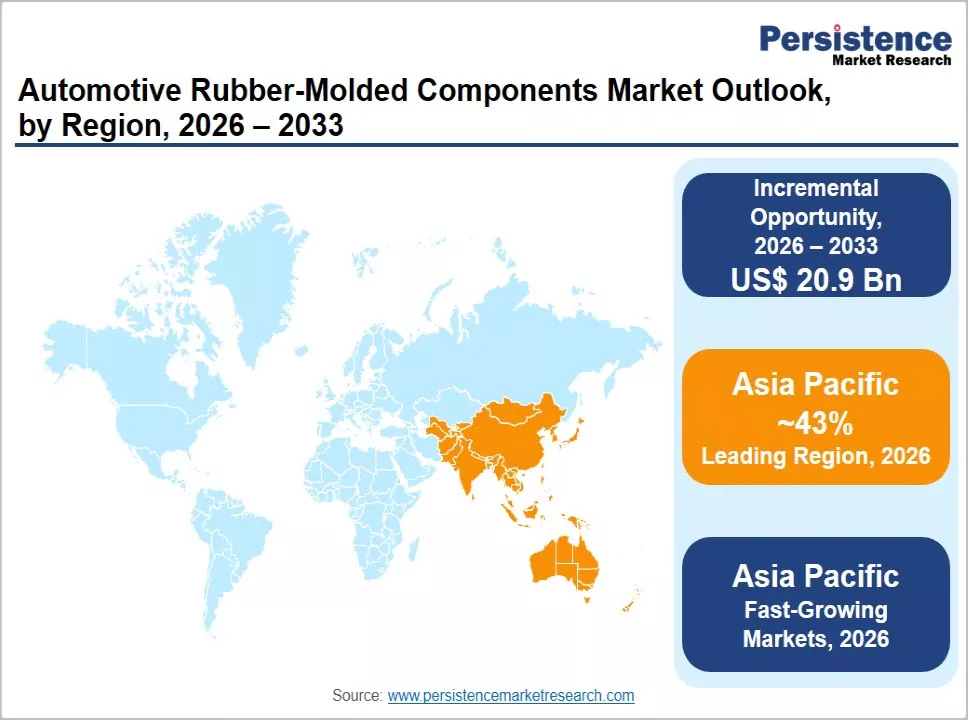
- Leading Region: Asia Pacific is likely to lead the global market with around 43% share in 2026, supported by high vehicle production volumes, rapid EV adoption, and a well-established automotive manufacturing base.
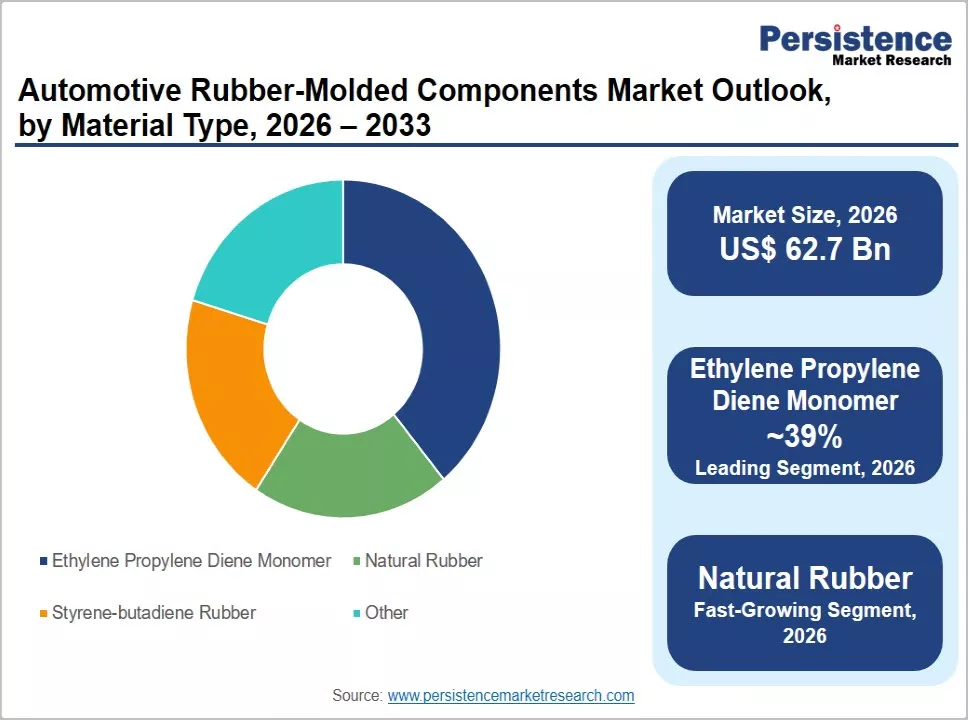
- Leading Segment: Ethylene propylene diene monomer is the leading material segment, holding around 39% share of the market in 2026, supported by its widespread use in automotive sealing applications and compatibility with demanding temperature, weather, and thermal-management requirements. Platform-specific OEM compound approvals also support continued EPDM adoption across existing and new vehicle programs.
- Fastest-growing Segment: Natural rubber is the fastest-growing material segment, driven by increasing OEM sustainability initiatives and demand for renewable-content materials. Carbon-accounting requirements, including ISO 14064 frameworks, are encouraging Tier-1 suppliers to evaluate natural rubber compounds for anti-vibration mounts and chassis isolation systems, supporting demand across Southeast Asian natural rubber supply chains.
- Key Market Opportunity: Rising demand for battery thermal management systems represents a significant market opportunity, as expanding EV adoption is increasing demand for cooling circuit hoses, inter-module seals, battery tray gaskets, and other specialized molded rubber components. The transition toward higher-voltage battery architectures, including 800-volt systems, is expected to further support demand for thermally resilient sealing solutions.
Market Dynamics
Drivers - EV Platform Expansion and Elevated Per-Vehicle Rubber Content
The expansion of electric vehicle platforms is increasing demand for specialized rubber-molded components and raising rubber content per vehicle. Battery pack assemblies use silicone and Ethylene Propylene Diene Monomer (EPDM) seals to limit moisture ingress and support thermal management within high-voltage compartments. Tesla, Inc. documented in its 2023 vehicle service architecture disclosures that each Model Y battery enclosure incorporates multiple co-extruded EPDM gaskets rated to withstand coolant temperatures above 120°C. As global EV sales surpassed 14 million units in 2023, according to the International Energy Agency (IEA), OEM procurement of thermally resilient rubber-molded sealing systems increased. Tier-1 suppliers with validated compounds and precision injection-molding capabilities are therefore gaining greater access to EV first-fit programs.
Tightening NVH Standards and Acoustic Requirements
Noise, vibration, and harshness (NVH) performance is gaining importance as automakers transition toward battery-electric architectures, where lower powertrain noise increases the prominence of other vehicle sounds. The European Union's Euro 7 emissions regulation, finalised in 2023, introduced additional pass-by noise requirements, supporting OEM investment in acoustic weather strips, anti-vibration rubber mounts, and refined door-seal profiles. Sumitomo Riko Co., Ltd. expanded its anti-vibration rubber product line in 2024 to target EV sub-frame isolation, highlighting the impact of NVH requirements on molded rubber component demand. Higher-performance compounds used in these applications also support a shift toward higher-value product categories.
Restraints - Raw Material Price Volatility and Supply Chain Fragility
Raw material price volatility remains a key constraint for automotive rubber-molded component manufacturers. Natural rubber prices are influenced by weather cycles, disease pressures affecting Hevea brasiliensis plantations across Southeast Asia, and currency fluctuations in producing countries. The Association of Natural Rubber Producing Countries (ANRPC) recorded a 17% intra-year price swing for RSS3-grade rubber in 2022, placing pressure on margins for compounding and molding operations without long-term supply agreements. Synthetic alternatives such as Styrene-Butadiene Rubber (SBR) rely on petrochemical feedstocks exposed to crude oil price volatility, creating cost pressures across the material portfolio.
Substitution Pressure from Engineered Thermoplastics
Lightweight thermoplastic elastomers (TPEs) and thermoplastic vulcanisates (TPVs) are gaining adoption in selected automotive applications traditionally served by molded rubber, particularly under-hood hoses and grommets. BASF SE's Elastollan TPU grades, repositioned for automotive underhood applications between 2022 and 2024, reflect increasing competition from engineered polymers. TPE conversion reduces component weight by an estimated 15 to 25%, supporting OEM lightweighting objectives and creating substitution pressure across specific rubber component categories.
Opportunities - Thermal Management Expansion in Battery Electric Vehicles
The expansion of battery thermal management systems is creating additional demand for molded rubber components beyond conventional powertrain sealing. Cooling circuit hoses, inter-module seals, and battery tray gaskets require compounds that tolerate glycol-water coolants and continuous operating temperatures associated with high-voltage battery systems. Continental AG launched a dedicated e-mobility sealing systems product line in 2023, targeting thermal runaway containment and coolant-circuit integrity in 800-volt battery architectures. Suppliers that qualify compounds to SAE International J2593 thermal cycling standards can strengthen their participation in specialized EV sealing applications and expand their addressable product portfolios.
Aftermarket Growth in High-Vehicle-Age Markets
The average age of registered light vehicles in the U.S. reached 12.6 years in 2024, according to S&P Global Mobility, sustaining aftermarket replacement demand for seals, hoses, and weather strips affected by age and thermal cycling. This opportunity is particularly relevant in Latin America and the Middle East, where vehicle fleets frequently have average ages exceeding 15 years and import-duty structures favor locally assembled aftermarket parts. Distributors and molded rubber component specialists that develop region-specific product catalogs for popular older platforms, such as Toyota Hilux and Ford Ranger derivatives, can capture replacement demand beyond original-equipment production cycles.
Category-wise Analysis
Which Material Type Leads the Automotive Rubber-Molded Components Market?
Ethylene propylene diene monomer (EPDM) is the leading material type, accounting for 39.0% of the automotive rubber-molded components market in 2026. EPDM leads due to its strong resistance to ozone, UV exposure, heat, and weathering, making it widely used in door seals, trunk weather strips, and radiator hose assemblies where long-term durability supports OEM quality and warranty requirements. Tier-1 suppliers such as Magna International Inc. specify EPDM co-extrusion profiles for vehicle closure systems across multiple platform architectures, reinforcing the material's established position in automotive applications. Its compatibility with continuous-vulcanization processing also supports high-volume production and consistent manufacturing efficiency across automotive supply chains.
Natural rubber is the fastest-growing material type, driven by increasing demand for high-damping anti-vibration mounts in commercial and electric vehicles. Bridgestone Corporation's vibration control subsidiary introduced bio-sourced natural rubber anti-vibration components in 2023 in response to sustainability procurement initiatives, reflecting growing OEM interest in renewable-content materials and supply chains aligned with ISO 14064 carbon reporting frameworks.
Component Type Insights
Seals are the leading component type, accounting for 35.0% of the market share in 2026. Seals maintain their leading position due to their extensive use across vehicle systems, including crankshaft end-seals, transmission output-shaft seals, and high-voltage battery enclosure perimeter gaskets. These applications require precisely molded interfaces to prevent fluid leakage, contamination ingress, and loss of electrical enclosure integrity. NOK Corporation, a global sealing specialist, supplies powertrain seals to more than 40 OEM platforms across Japan, Europe, and North America, highlighting the broad and recurring demand base supporting the segment.
Hoses are the fastest-growing component category, driven by the expansion of battery thermal-management systems in electric vehicles. Gates Corporation commercialized reinforced EPDM coolant hoses rated for 800-volt EV architectures in 2024, targeting the increasing thermal-management content of next-generation battery platforms. The shift toward advanced cooling circuits is increasing demand for specialized hoses with higher temperature, pressure, and coolant-resistance requirements.
Vehicle Type Insights
Passenger cars are the leading vehicle type, holding around 65.0% of the market in 2026. The segment leads due to high global production volumes and the extensive use of rubber-molded components across each vehicle. A typical mid-size sedan incorporates over 150 individual rubber-molded parts spanning door seals, engine mounts, brake system components, and interior grommets. Volkswagen AG's MEB electric platform, deployed across ID. series models since 2020, standardizes high-specification sealing and weather-stripping components across multiple manufacturing plants, supporting recurring, high-volume procurement from qualified Tier-1 molding suppliers.
Commercial vehicles are the fastest-growing vehicle type segment, driven by fleet electrification initiatives and expanding last-mile logistics infrastructure. The European Commission's amended Heavy-Duty Vehicles CO2 Regulation, adopted in 2024, requires 90% of new urban buses to be zero-emission by 2030, supporting demand for EV-specific thermal-management, sealing, and vibration-control components in commercial vehicle powertrain architectures.
Regional Analysis
North America Automotive Rubber-Molded Components Market Insights
North America is projected to account for about 22.0% of the global automotive rubber-molded components market in 2026. Regional demand is supported by high-volume light-truck and SUV production in the U.S. and Mexico, where body-on-frame architectures require extensive sealing, weatherproofing, and vibration-isolation components. The Inflation Reduction Act's domestic content provisions are also encouraging nearshore sourcing and manufacturing investment, supporting additional rubber-molded component capacity across the region through 2033.
U.S. Automotive Rubber-Molded Components Market Insights
The U.S. accounts for 76.0% of North American market revenue. Strong consumer demand for light trucks, pickup trucks, and SUVs, which represented around 80% of retail vehicle sales in 2023 according to Ward's Automotive data, supports high per-vehicle demand for seals, mounts, hoses, grommets, and other rubber-molded components. Continued EV launches by General Motors Company and Ford Motor Company are also increasing demand for higher-performance sealing compounds, thermal-management hoses, and battery-related rubber components.
Europe Automotive Rubber-Molded Components Market Insights
Europe is anticipated to account for around 18.0% of the global automotive rubber-molded components market in 2026. Regional demand is influenced by increasingly stringent vehicle emissions and noise requirements, with Euro 7 supporting greater adoption of acoustic sealing, vibration-control, and weather-sealing components. German and French premium OEMs are also expanding EV production to meet fleet CO2 targets under EU Regulation 2019/631, increasing the use of specialized rubber-molded components across electric vehicle platforms.
Germany Automotive Rubber-Molded Components Market Insights
Germany accounts for an estimated 36.0% of European market revenue. BMW AG and Mercedes-Benz Group AG are expanding domestic EV production and increasing the use of precision-molded rubber components for battery enclosure sealing, thermal management, acoustic control, and vibration isolation. Germany's established Tier-1 supplier ecosystem, including Freudenberg & Co. KG and Continental AG, supports domestic component production and strengthens the country's role within Europe's automotive rubber supply chain.
U.K. Automotive Rubber-Molded Components Market Insights
The U.K. is projected to hold a substantial share of the European automotive rubber-molded components market in 2026. Jaguar Land Rover Limited's commitment to fully electric vehicle production by 2030, reaffirmed under its Reimagine strategy, is increasing demand for specialized sealing, thermal-management, and vibration-control components. Post-Brexit supply-chain adjustments are also increasing the relevance of suppliers with manufacturing and distribution capabilities across both the U.K. and EU markets.
France Automotive Rubber-Molded Components Market Insights
France is anticipated to hold a considerable share of the European automotive rubber-molded components market in 2026. Stellantis N.V. and Renault Group operate major vehicle manufacturing facilities in the country and are expanding EV production with support from the French Government's 2023 Green Industry Law and related incentives for domestic automotive manufacturing. These initiatives are supporting first-fit demand for molded rubber seals, thermal-management components, weather strips, and anti-vibration products used across local vehicle production.
Asia Pacific Automotive Rubber-Molded Components Market Insights
Asia Pacific is expected to lead the global automotive rubber-molded components market with around 43% share in 2026. Regional growth is supported by China's expanding NEV production, Japan's established Tier-1 supplier ecosystem, and India's increasing vehicle manufacturing volumes. The region's extensive automotive production base and integrated component supply chains also support demand for rubber-molded components across passenger vehicles, commercial vehicles, and electric vehicle platforms.
China Automotive Rubber-Molded Components Market Insights
China accounts for an estimated 40.0% of Asia Pacific market revenue. China's New Energy Vehicle (NEV) penetration exceeded 35% of new passenger-car sales in 2023, according to the China Association of Automobile Manufacturers (CAAM), increasing demand for EPDM battery enclosure seals, thermal-management hoses, weatherproofing components, and other EV-specific rubber products. Continued NEV production growth and high vehicle manufacturing volumes reinforce China's position as the largest national market in the regional automotive rubber-molded components industry.
Japan Automotive Rubber-Molded Components Market Insights
Japan is anticipated to hold a significant share of the Asia Pacific market in 2026. The country's established Tier-1 supplier ecosystem, including Toyoda Gosei Co., Ltd. and NOK Corporation, supports high-quality molded rubber production for domestic OEMs and export markets. Toyota Motor Corporation's electrification roadmap, targeting 3.5 million annual BEV sales by 2030, is expected to increase demand for EV-oriented sealing, thermal-management, and vibration-control components across the Japanese automotive supply chain.
India Automotive Rubber-Molded Components Market Insights
India is projected to hold a notable share of the Asia Pacific automotive rubber-molded components market in 2026. Vehicle production surpassed 5.8 million units in FY2024, according to the Society of Indian Automobile Manufacturers (SIAM), reinforcing India's position as the world's third-largest automotive market by volume. The Production Linked Incentive (PLI) scheme for automotive components, administered by India's Ministry of Heavy Industries, is attracting investment in domestic rubber-component manufacturing and supporting expansion of the local supplier base through the forecast period.
Competitive Landscape
The global automotive rubber-molded components market is moderately consolidated, with global specialists such as Continental AG, Freudenberg & Co. KG, Trelleborg AB, and Sumitomo Riko Co., Ltd. commanding material share through proprietary compound development, long-term OEM platform nominations, and global manufacturing footprints. Competitive advantage accrues to suppliers that achieve IATF 16949 quality certification across multiple plant locations and can demonstrate compound validation to OEM-specific thermal and chemical exposure standards, a qualification process that typically spans 18–24 months and functions as an effective barrier to entry. Regional challengers in China and India compete aggressively on price for commodity seals and gaskets, but premium segment positions in EV thermal management and NVH sealing remain concentrated among established multinationals with validated compound libraries.
Key Industry Developments
- July 2026: Continental agreed to sell its ContiTech group sector to Lone Star Funds for €4.0 billion, transferring its global rubber and thermoplastic products business and enabling Continental to focus on its core tire operations.
- August 2026: Sumitomo Riko began mass production of automotive hoses for Maruti Suzuki’s Brezza, using a multilayer resin structure that reduces fuel permeation and complies with India’s upcoming BS6 Phase 3 emissions regulations.
- September 2026: Freudenberg announced the creation of Freudenberg Aftermarket, effective January 2027, consolidating global automotive aftermarket activities to expand product access, strengthen technical support, accelerate new product introductions, and improve customer service.
Companies Covered in Automotive Rubber-Molded Components Market
- Continental AG
- Sumitomo Riko Co. Ltd.
- Freudenberg & Co. KG
- Trelleborg AB
- Hutchinson SA
- Cooper Standard Holdings Inc.
- Toyoda Gosei Co. Ltd.
- NOK Corporation
- Dana Incorporated
- SKF Group
- Tenneco Inc.
- ALP Group
- Henniges Automotive Holdings Inc.
- Datwyler Group
- Gates Corporation
- Magna International Inc.
- Parker Hannifin Corporation
- Yokohama Rubber Co. Ltd.
- Vibracoustic SE
- ElringKlinger AG
Frequently Asked Questions
The global market is expected to be valued at US$ 62.70 Billion in 2026 and is projected to reach US$ 83.63 Billion by 2033, expanding at a CAGR of 4.2%.
Rising battery electric vehicle production, which requires thermally resilient EPDM sealing systems, and tightening acoustic standards, including the European Union's Euro 7 regulation, that increase weather-strip and anti-vibration component specifications per vehicle are key factors driving the market.
Asia Pacific is likely to dominate the market with around 43% share in 2026, supported by China's NEV penetration exceeding 35% of new-car sales and India's PLI-scheme-driven capacity expansion.
The most significant opportunity lies in EV battery thermal management systems, specifically cooling-circuit hoses and battery tray sealing components compatible with 800-volt architectures, where fewer than a dozen suppliers globally hold validated OEM compound approvals.
Leading companies in the global market include Continental AG, Freudenberg & Co. KG, Trelleborg AB, Sumitomo Riko Co., Ltd., NOK Corporation, and Gates Corporation.


