ID: PMRREP5294| 226 Pages | 11 Dec 2025 | Format: PDF, Excel, PPT* | Healthcare

The global medical case management services market size is valued at US$ 4.9 billion in 2025 and is projected to reach US$ 6.7 billion by 2032, growing at a CAGR of 4.7% between 2025 and 2032.
Medical case management services integrate client-focused support with healthcare systems, psychosocial resources, reimbursement pathways, and ongoing treatment coordination.
Rising healthcare expenditures, alongside growing efforts to control medical costs while improving care quality, are strengthening the need for structured case management.
| Key Insights | Details |
|---|---|
| Global Medical Case Management Services Market Size (2025E) | US$ 4.9 Billion |
| Market Value Forecast (2032F) | US$ 6.7 Billion |
| Projected Growth (CAGR 2025 to 2032) | 4.7% |
| Historical Market Growth (CAGR 2019 to 2024) | 3.9% |
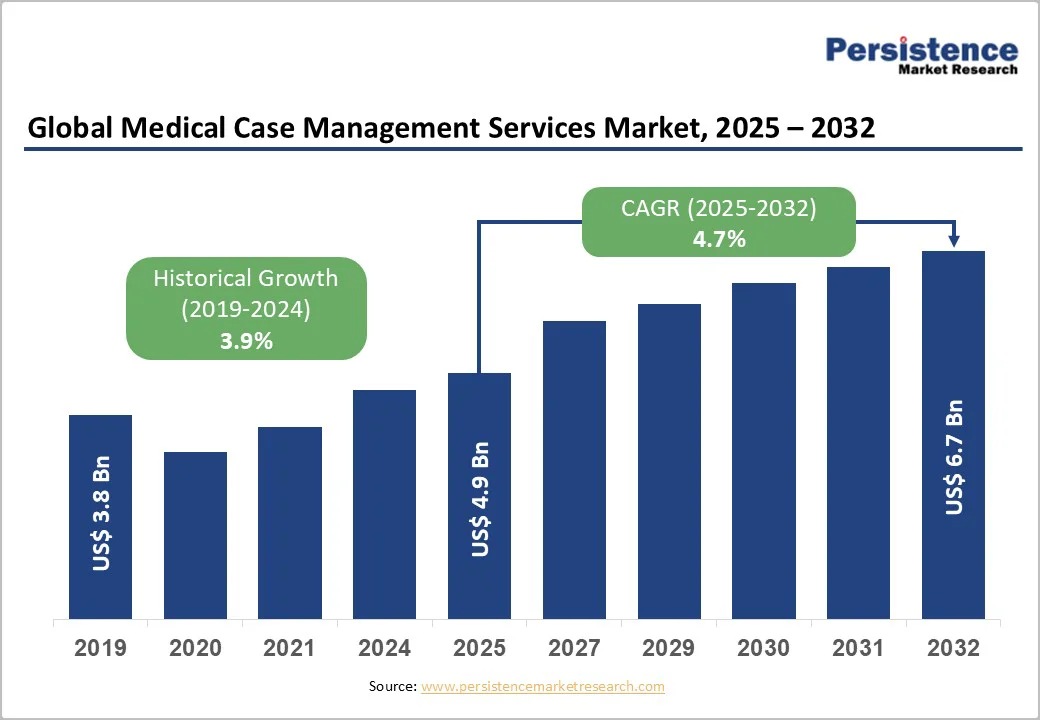
The medical case management services market continues to grow as the healthcare industry seeks reliable technologies to support modern, coordinated patient care. With global population expansion placing increasing pressure on healthcare systems, the risk of medical errors and unintended drug reactions is rising.
In this context, case managers play a critical role by ensuring accurate access to patient histories, drug interactions, and post-surgical precautions, thereby improving safety and continuity of care.
Technological advancements designed to enhance patient outcomes are further accelerating market adoption, particularly as digital platforms improve communication and care navigation. The increasing prevalence of chronic diseases-including heart disease, cancer, stroke, and obesity-continues to drive the need for long-term, structured management across care settings.
Additionally, expanding employment benefits in developed countries is strengthening the demand for coordinated case management to ensure timely and appropriate treatment for workplace injuries. Growing emphasis on value-based care also serves as a new driver, encouraging providers to adopt case management solutions that reduce costs while improving outcomes.
Several structural barriers continue to hinder the expansion of the medical case management services market. Limited awareness remains a major challenge, particularly in developing countries where most vendors have minimal presence, resulting in low understanding of the value of coordinated care services.
The shortage of trained case management professionals further constrains growth, with nearly 50% of case managers currently managing more than 100 cases per month, leading to workload strain and reduced service quality. High service costs also act as a significant bottleneck, especially in price-sensitive markets.
Additionally, the low proportion of insured populations in many developing regions weakens demand, as uninsured individuals are less likely to seek structured case management. Variability in digital infrastructure poses another restraint, slowing the adoption of web-based and technology-enabled platforms despite their growing prominence. These limitations collectively temper market expansion despite rising global healthcare needs.
Growing digital transformation across healthcare is creating strong opportunities for expanding medical case management services, especially as providers increasingly adopt AI-enabled triage, remote monitoring, and data-driven care navigation tools.
Rising investment in telehealth and virtual consultation platforms is further opening avenues for integrating real-time case oversight into routine care. The accelerating shift toward value-based care models offers another major opportunity, as hospitals and insurers seek coordinated solutions that reduce readmissions and improve outcomes.
In developing regions, expanding health insurance penetration and government initiatives to strengthen primary care systems are expected to generate new demand for structured case management.
There is also significant potential in workplace health programs, where employers are adopting coordinated care services to manage occupational injuries and chronic health risks more efficiently. Additionally, the growing focus on patient experience and personalized care is encouraging broader adoption of technology-supported case management solutions.
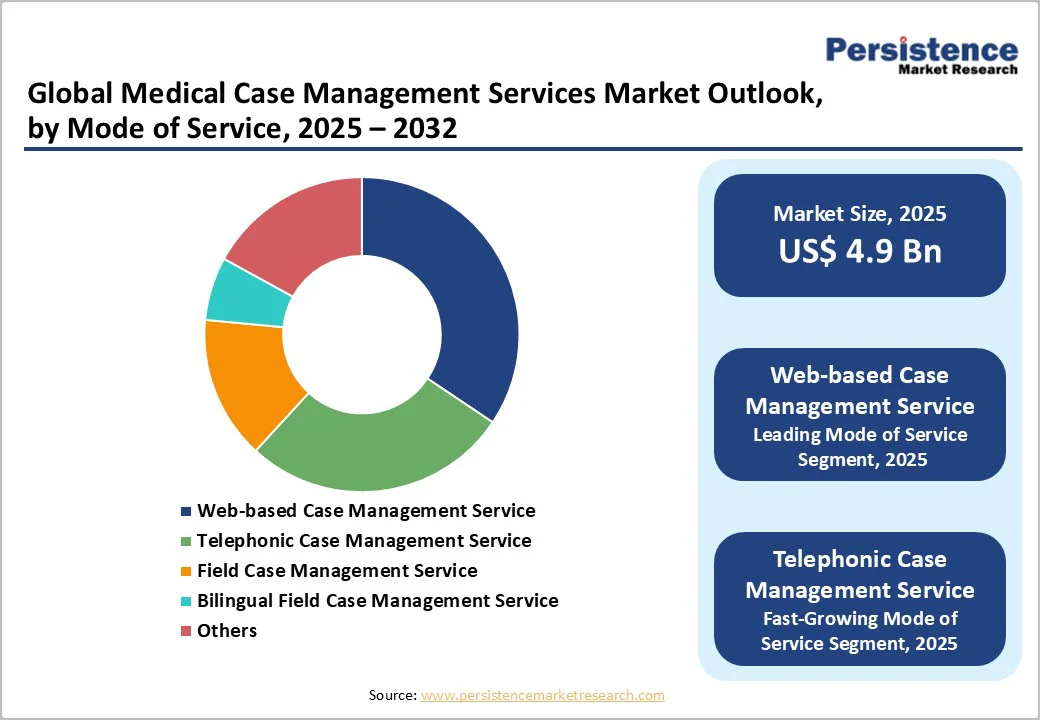
Web-based case management services are expected to hold a leading 42.8% share of the global medical case management services market by 2025. Their dominance is driven by the widespread adoption of digital platforms that streamline communication among patients, providers, and insurers. These systems enable real-time access to medical records, faster case triaging, and improved continuity of care.
Growing preference for remote care management, coupled with rising healthcare digitalization and workflow automation, further strengthens their market position. Additionally, web-based solutions offer scalability, cost efficiency, and flexible implementation models, making them highly suitable for both large and mid-sized healthcare systems.
Long-term disability is projected to dominate the global medical case management services market in 2025, capturing nearly 39.1% of the total share. This segment benefits from the growing prevalence of chronic diseases that require sustained, structured, and multidisciplinary care support.
Patients with long-term disabilities often depend on continuous monitoring, rehabilitation planning, and coordinated interventions, which increases reliance on professional case management.
Longer recovery periods, complex treatment pathways, and the need for insurance navigation further reinforce demand. As disability-related healthcare costs rise worldwide, structured case management becomes essential to ensure improved outcomes and reduced unnecessary medical utilization.
Hospitals are projected to dominate in 2025, capturing nearly 68.2% of the total share. Their leadership stems from high patient volumes, complex case profiles, and a greater requirement for integrated clinical oversight. Hospitals serve as primary hubs for acute care, specialty treatments, diagnostics, and rehabilitation planning, making them central to case coordination.
Increasing adoption of digital care pathways, multidisciplinary teams, and value-based care initiatives further drives demand for structured case management. Additionally, hospitals face strong pressure to reduce readmissions and enhance continuity of care, reinforcing their dependence on comprehensive case management services.
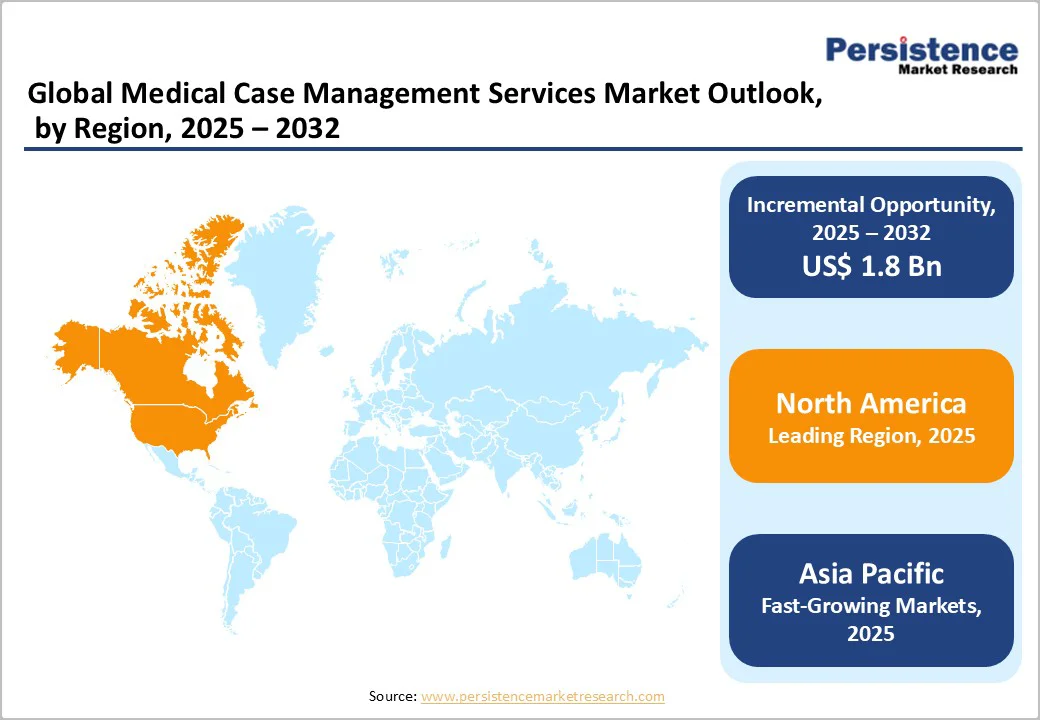
By 2025, North America is projected to capture nearly 41.6% of the global medical case management services market, supported by strong insurance penetration that continues to elevate demand for coordinated care solutions. The region’s high chronic disease burden further reinforces the need for continuous case management, while its advanced healthcare infrastructure enables more integrated and efficient service delivery.
Strengthening this momentum, in April 2025, Deacon Health launched a tech-enabled care coordination platform for specialty care patients with chronic conditions. The platform focuses on value-based outcomes, improved clinician workflows, cost reduction, enhanced patient engagement, and streamlined navigation to lower medical loss ratios. Together, these factors position North America as a leading hub for medical case management innovation and adoption.
By 2025, Europe is projected to hold nearly 29.4% of the global medical case management services market, supported by universal healthcare systems that naturally enable more structured and consistent case management adoption. The region’s rapidly growing elderly population is further increasing the need for complex, long-term care coordination across multiple specialties and care settings.
Additionally, governments across Europe are intensifying efforts to reduce hospital readmissions, prompting greater emphasis on proactive patient monitoring, timely interventions, and seamless transitions between acute and post-acute care. Together, these dynamics are positioning Europe as a strong and steadily expanding market for medical case management services, with structural efficiencies and demographic trends reinforcing sustained demand.
Asia Pacific medical case management services market is expanding rapidly and is projected to grow at a CAGR of 5.9% over the forecast period. This momentum is reinforced by fast-paced healthcare digitalization, which is significantly improving the adoption of coordinated care solutions across the region.
A notable example is the May 2025 launch of MeshApp’s digital platform in India, offering doctors and pharmaceutical representatives discounted insurance, medico-legal support, workflow management tools, peer networking, and passive income opportunities-ultimately enhancing professional efficiency and access to essential resources.
Alongside these digital advancements, expanding private insurance coverage in emerging markets is increasing demand for structured case management. Rising chronic diseases are further driving the need for long-term, coordinated oversight, while the region’s growing medical tourism sector is creating greater requirements for cross-border care navigation. Together, these trends are accelerating Asia Pacific’s strong market trajectory.
The competitive landscape is becoming increasingly technology-driven, with leading players focusing on AI-enabled platforms that streamline case management, automate administrative workflows, and enhance clinical decision support. Vendors are integrating advanced planning tools, predictive analytics, and interoperable solutions that connect seamlessly with multiple EHR systems.
Innovation is centered on improving regulatory compliance, strengthening data privacy, and optimizing cross-functional workflows across clinical, surgical, and safety operations. Market competition is intensifying as companies expand capabilities across both care delivery and post-marketing surveillance.
The global medical case management services market is projected to be valued at US$ 4.9 billion in 2025.
Rising chronic diseases, healthcare digitalization, and growing demand for coordinated, cost-efficient care are driving market growth.
The global medical case management services market is poised to witness a CAGR of 4.7% between 2025 and 2032.
AI-enabled platforms, expanding insurance coverage, and value-based care initiatives create significant growth opportunities.
Major players in the global are GENEX Services Inc., Europ Assistance - Global Corporate Solutions, Medical Case Management Group, EK Health Services Inc., EagleOne and others.
| Report Attribute | Details |
|---|---|
| Historical Data/Actuals | 2019 - 2024 |
| Forecast Period | 2025 - 2032 |
| Market Analysis | Value: US$ Mn |
| Geographical Coverage |
|
| Segmental Coverage |
|
| Competitive Analysis |
|
| Report Highlights |
|
By Mode of Service
By Severity Of Case
By End-user
By Region
Delivery Timelines
For more information on this report and its delivery timelines please get in touch with our sales team.
About Author