




- Medical Devices
- Pancreatic and Biliary Stents Market
Pancreatic and Biliary Stents Market Size, Trends, Share, Growth, and Regional Forecast, 2026 to 2033
Pancreatic and Biliary Stents Market by Product (Plastic Stents, and Metal Stents), Application (Benign Biliary Structures, Bilio-Pancreatic Leakages, Pancreatic Cancer, and Others) End-user (Hospitals, Specialty Clinics, and Ambulatory Surgery Centers), and Regional Analysis from 2026 to 2033

Pancreatic and Biliary Stents Market Share and Trends Analysis
The global pancreatic and biliary stents market size is estimated to grow from US$ 760.9 million in 2026 to US$ 1,249.9 million by 2033, growing at a CAGR of 5.7% during the forecast period from 2026 to 2033.
Global demand for pancreatic and biliary stents is rising rapidly, driven by the increasing prevalence of pancreatic cancer, biliary strictures, gallstone-related obstruction, and chronic pancreatitis.
The rise in adoption of minimally invasive endoscopic retrograde cholangiopancreatography-guided. ERCP-guided interventions, along with rising awareness of early diagnosis for pancreatic biliary diseases, are accelerating market expansion.
Key Industry Highlights:
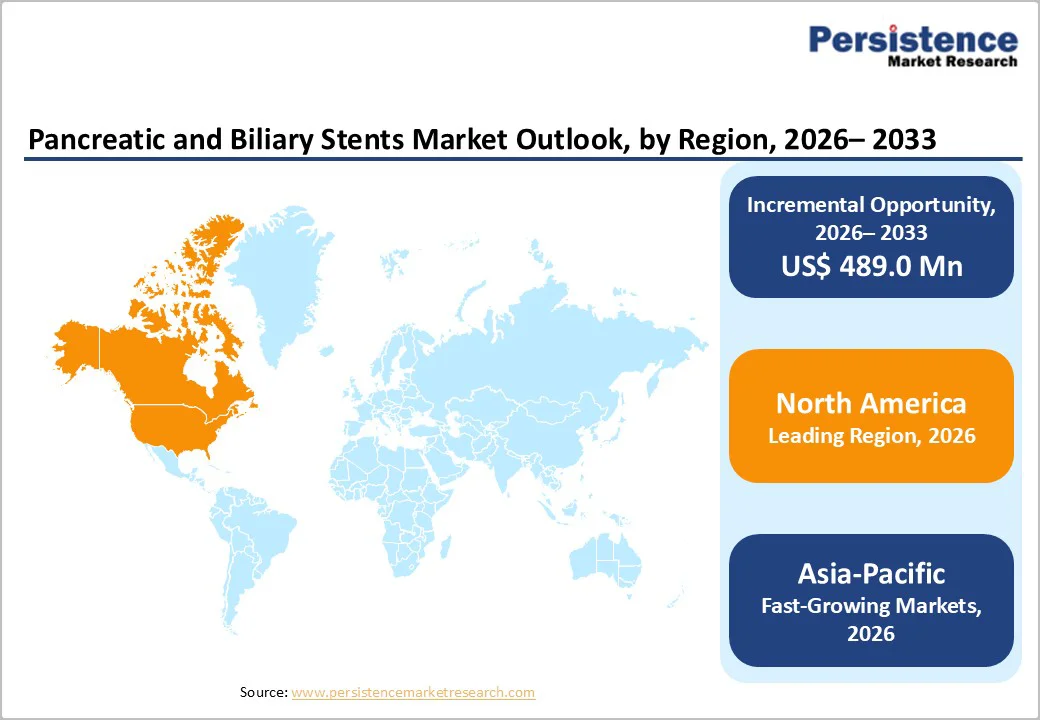
- Leading Region: North America holds the largest share at 45.8%, supported by high ERCP procedure volumes, advanced endoscopy infrastructure, rapid adoption of next-generation SEMS, and strong reimbursement frameworks.
- Fastest-Growing Region: Asia Pacific is expanding at the fastest pace, driven by rising pancreaticobiliary disease burden, improved hospital infrastructure, a growing endoscopist workforce, and greater availability of cost-efficient stent solutions.
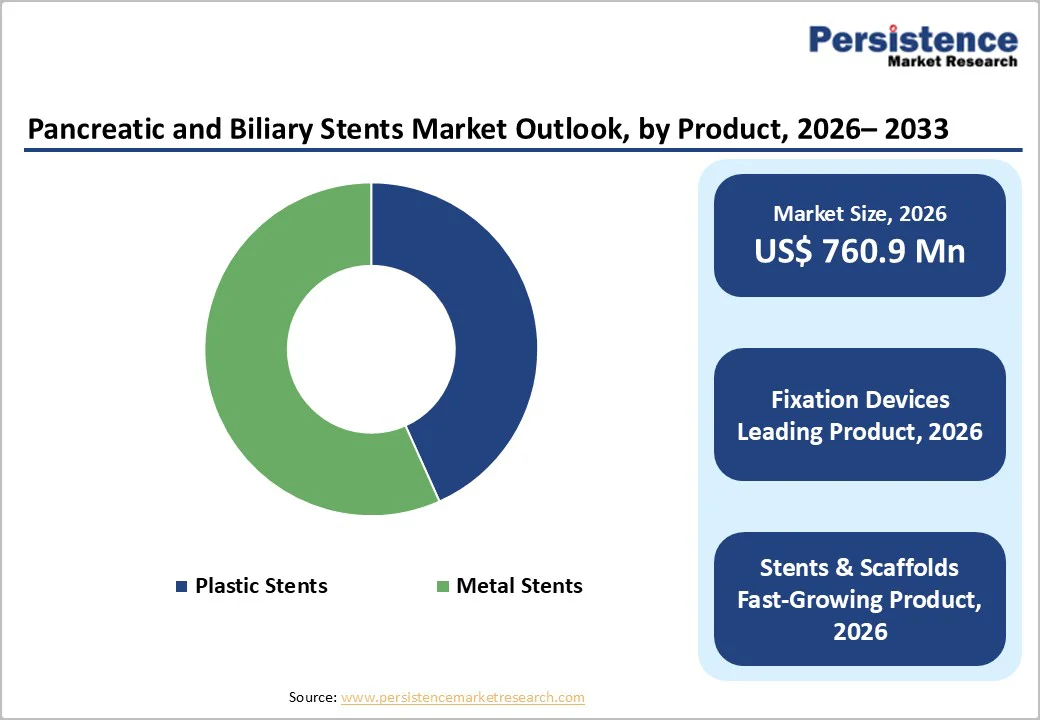
- Leading Product Segment: Metal stents dominate the market due to their superior patency, lower occlusion rates, and strong clinical preference for managing malignant biliary obstruction.
- Fastest-Growing Product Segment: Plastic stents are expanding the fastest, driven by rising use in benign strictures, lower upfront costs, and increasing adoption in short-term drainage procedures.
- Leading Surgery Segment: Pancreatic cancer leads globally because malignant biliary obstruction requires frequent stent placement to improve drainage, relieve jaundice, and enable cancer treatment.
- Fastest-Growing Surgery Segment: Benign biliary strictures are scaling rapidly as minimally invasive ERCP management becomes more common for post-surgical injuries, inflammatory strictures, and recurrent obstruction.
| Key Insights | Details |
|---|---|
| Pancreatic and Biliary Stents Market Size (2026E) | US$ 760.9 Mn |
| Market Value Forecast (2033F) | US$ 1,249.9 Mn |
| Projected Growth (CAGR 2026 to 2033) | 5.7% |
| Historical Market Growth (CAGR 2020 to 2025) | 4.3% |

Market Dynamics
Driver - Rising Prevalence of Pancreatic and Biliary Disorders and Growing Adoption of Minimally Invasive ERCP Procedures
The increasing global burden of pancreatic cancer, biliary obstruction, gallstone disease, and chronic pancreatitis is significantly driving the need for effective and long-term drainage solutions. For instance, in 2025, according to the National Cancer Institute, the rate of new pancreatic cancer cases is estimated to reach 13.8 per 100,000 men and women annually, while the lifetime risk of developing pancreatic cancer stands at approximately 1.6% for both genders.
As these conditions frequently lead to ductal narrowing or obstruction, stent placement has become a critical component of patient management. The expanding patient pool, coupled with growing awareness and improved diagnostic capabilities, continues to drive consistent demand for both plastic and metal stents across clinical settings.
The rapid shift toward minimally invasive ERCP-guided interventions is accelerating the adoption of advanced stenting technologies. Endoscopic drainage offers shorter recovery times, reduced complication rates, and lower hospitalization costs compared to open surgical procedures, making it the preferred treatment pathway worldwide.
As hospitals and specialty centers increasingly upgrade their endoscopy suites, the use of next-generation SEMS, fully covered designs, and improved delivery systems is rising, further driving market growth.
Restraints - Risk of Stent-Related Complications, High Procedure Costs, and Regulatory Challenges
Complications such as stent migration, occlusion, infection, or tissue ingrowth remain major clinical concerns that limit long-term reliability and may necessitate repeat procedures. These risks are particularly significant in patients with complex strictures or prolonged stent placement, increasing overall treatment burden.
Such challenges also drive the need for enhanced stent designs with improved coatings, anti-migration features, and longer patency, placing additional pressure on manufacturers to innovate continuously.
Moreover, the high cost of advanced metal stents, ERCP equipment, and specialized endoscopy infrastructure restricts adoption in low- and middle-income regions. Stringent regulatory requirements, including rigorous performance validation, safety testing, and post-market surveillance, compound these economic barriers.
Compliance with evolving global standards increases development timelines and operational costs, creating additional hurdles for both established companies and new entrants in the pancreatic and biliary stents market.
Opportunity - Rising Adoption of Advanced Stent Technologies and Innovative Endoscopic Solutions
The expanding use of fully covered self-expanding metal stents (SEMS) for benign biliary strictures is creating significant opportunities in the market. Regulatory approvals and growing clinical confidence in these stents are encouraging wider adoption, particularly for patients requiring temporary but reliable drainage.
Additionally, the shift toward single-use ERCP accessories, including disposable stent kits and guidewire-compatible systems, is gaining momentum due to heightened focus on infection control and improved procedural safety, especially in high-volume endoscopy centers.
Furthermore, the integration of advanced imaging and smart navigation technologies is further boosting market opportunities. Innovations such as fluoroscopic improvements, 3D navigation, and AI-assisted endoscopy enable higher procedural precision, reduced complications, and better clinical outcomes.
These technological advancements also enable manufacturers to differentiate their products, capturing market share by offering more reliable, efficient, and user-friendly stenting solutions.
Category-wise Analysis
By Product Insights
The metal stents segment is projected to dominate the global pancreatic and biliary stents market in 2026, accounting for a 56.7% revenue share. The segment’s strong performance is driven primarily by the superior clinical advantages of self-expanding metal stents (SEMS), which offer longer patency, greater radial force, and significantly lower risk of occlusion compared to traditional plastic stents.
Their durability makes them the preferred option for managing malignant biliary obstruction, where long-term drainage and reduced reintervention rates are critical. Growing adoption of fully and partially covered SEMS, advancements in anti-migration designs, and improved radiopacity for precise placement are further boosting usage.
Increasing preference for minimally invasive ERCP procedures, along with rising availability of advanced delivery systems and favorable reimbursement policies for metal stent placement, is propelling market growth.
By Application Insights
The pancreatic cancer segment is projected to dominate the global pancreatic and biliary stents market in 2026, accounting for 43.9% of revenue, due to the high incidence of malignant biliary obstruction associated with advanced pancreatic tumors. These patients often require timely stent placement to relieve jaundice, improve biliary drainage, and enable eligibility for chemotherapy or surgical interventions.
The increasing use of self-expanding metal stents (SEMS) owing to their longer patency, lower occlusion rates, and superior performance compared with plastic stents further drives segment leadership.
Rising adoption of minimally invasive ERCP procedures, expanded use of fully covered SEMS in malignant strictures, and improvements in endoscopic imaging are also contributing to higher utilization rates. Additionally, the growing global burden of pancreatic cancer, particularly among aging populations, has led to an increased demand for reliable, long-term stenting solutions.
By End-user Insights
The hospitals segment is projected to dominate the global pancreatic and biliary stents market in 2026, accounting for a revenue share 53.6%. This is driven by the high volume of ERCP procedures performed in multi-specialty and tertiary care hospitals, where advanced endoscopy suites and skilled gastroenterologists are readily available.
Hospitals also serve as primary centers for managing complex pancreaticobiliary disorders, including malignant strictures, obstructive jaundice, acute pancreatitis, and post-surgical complications, which require timely stent placement and continuous monitoring.
Additionally, hospitals have faster access to premium SEMS, fully covered stents, radiopaque polymer stents, and integrated delivery systems, ensuring better patient outcomes and reduced reintervention rates. Strong reimbursement support, presence of multidisciplinary care teams, and higher adoption of imaging-guided endoscopic technologies boost market growth.
Region-wise Insights
North America Pancreatic and Biliary Stents Market Trends
The North America market is expected to dominate globally with a value share of 45.8% in the 2026, with the U.S. leading the region due to its highly advanced endoscopy ecosystem, strong adoption of ERCP-guided interventions, and the widespread availability of next-generation metal and polymer stents.
High incidence of pancreatic cancer, biliary obstruction, and gallstone-associated complications, combined with a large aging population, continues to drive procedural volumes across hospitals and specialized GI centers.
The U.S. benefits from rapid integration of innovative stent technologies, including fully covered SEMS, anti-migration platforms, drug-eluting designs, high-radiopacity materials, and enhanced hydrophilic-coated delivery systems.
Strong reimbursement structures, extensive training programs for gastroenterologists, and the presence of leading manufacturers such as Boston Scientific, Cook Medical, CONMED, and Medtronic further accelerate market growth. Additionally, the region is witnessing rising demand for single-use ERCP accessories, infection-control-compliant devices, and outpatient endoscopy services, enabling higher procedural throughput and improved clinical outcomes.
Europe Pancreatic and Biliary Stents Market Trends
The European market is expected to grow steadily, driven by the rising burden of pancreatic cancer, biliary obstruction, gallstone-related complications, and chronic pancreatitis across major countries such as Germany, the U.K., France, Italy, and Spain.
Strong penetration of advanced endoscopy services, a well-established ERCP infrastructure, and early adoption of premium stent technologies, such as fully covered SEMS, anti-migration designs, and high-radiopacity polymer stents, further boost market growth.
The region also benefits from robust clinical guidelines issued by European GI societies, which encourage timely stent placement for both malignant and benign strictures.
Growing demand for minimally invasive GI interventions, supported by high physician awareness and expanding day-care endoscopy centers, is fueling the adoption of next-generation stents with improved patency and reduced complication rates. In addition, Europe’s strong regulatory focus on safety and performance is pushing manufacturers to invest in advanced biocompatible materials, improved delivery systems, and infection-control-compliant stent kits.
Asia Pacific Pancreatic and Biliary Stents Market Trends
The Asia Pacific market is expected to register a relatively higher CAGR of around 7.7% between 2026 and 2033, driven by a rapidly expanding patient pool for pancreatitis, biliary strictures, gallstone-related complications, and rising cancer incidence across China, India, and Southeast Asia.
Growing adoption of ERCP and minimally invasive endoscopic procedures, supported by improved hospital infrastructure, is accelerating demand for advanced polymer and metal stents.
Increasing investments in GI endoscopy training programs, rising availability of skilled endoscopists, and faster uptake of fully covered SEMS are also shaping market expansion.
Local manufacturers in China, South Korea, and India are strengthening their competitive pricing and accelerating the penetration of cost-efficient stent systems, making the region highly attractive to global companies. Government initiatives to improve access to tertiary care, rising medical tourism for GI procedures, and increasing insurance coverage for endoscopic interventions further drive market growth in the region.
Competitive Landscape
The global pancreatic and biliary stents market is highly competitive, with leading players such as Boston Cook, Boston Scientific Corporation, CONMED Corporation, Olympus Corporation, and Medtronic leveraging strong endoscopy portfolios, broad GI distribution networks, and continuous innovation in minimally invasive ERCP-based interventions.
Market participants are focusing on self-expanding metal stents (SEMS), fully/partially covered designs, anti-migration technologies, and longer-patency polymer stents to enhance drainage efficiency, reduce restenosis, and minimize reintervention rates.
Companies are increasingly advancing radiopaque coatings, drug-eluting platforms, improved guidewire compatibility, hydrophilic coatings, and enhanced stent delivery systems to support complex pancreaticobiliary strictures.
Additionally, manufacturers are investing in single-use ERCP accessories, integrated endoscopic imaging improvements, infection-control compliant materials, and cost-effective stent kits to expand adoption across hospitals, high-volume endoscopy centers, and emerging markets.
Key Industry Developments
- In October 2025, Boston Scientific Corporation announced that it received 510(k) clearance from the U.S. Food and Drug Administration and CE Mark approval to market its Advanix™ Biliary Plastic Stents. These stents are indicated for the treatment of biliary strictures, including biliary stone disease, benign biliary strictures, and suspected or confirmed malignancies of the biliary system. The product is now available in Europe and other international markets.
Companies Covered in Pancreatic and Biliary Stents Market
- Cook
- Boston Scientific Corporation
- CONMED Corporation
- Olympus Corporation
- Medtronic
- TAEWOONG
- ENDO-FLEX GmbH
- ELLA - CS, s.r.o.
- BD
- Allium
- Cliniva Healthcare
- Shaili Endoscopy
- Medorah Meditek Pvt. Ltd.
- Others
Frequently Asked Questions
The global pancreatic and biliary stents market is projected to be valued at US$ 760.9 Mn in 2026.
Increasing prevalence of pancreaticobiliary diseases and the growing shift toward minimally invasive endoscopic interventions are driving the global pancreatic and biliary stents market.
The global pancreatic and biliary stents market is poised to witness a CAGR of 5.7% between 2026 and 2033.
Rising adoption of minimally invasive endoscopic procedures and increasing incidence of pancreaticobiliary disorders are creating opportunities in the market.
Cook, Boston Scientific Corporation, CONMED Corporation, Olympus Corporation, and Medtronic are some of the key players in the pancreatic and biliary stents market.


