




- Beauty & Personal Care
- Night Creams Market
Night Creams Market Size, Share, and Growth Forecast 2026 - 2033
Night Creams Market by Product Type (Moisturizing Creams, Anti-aging Creams, Brightening Creams, Others), Price Segment (Economy, Premium), Distribution Channel (Supermarkets and Hypermarkets, Retail Pharmacies, Convenience Stores, Online Stores), Regional Analysis, 2026 - 2033

Night Creams Market Size and Trend Analysis
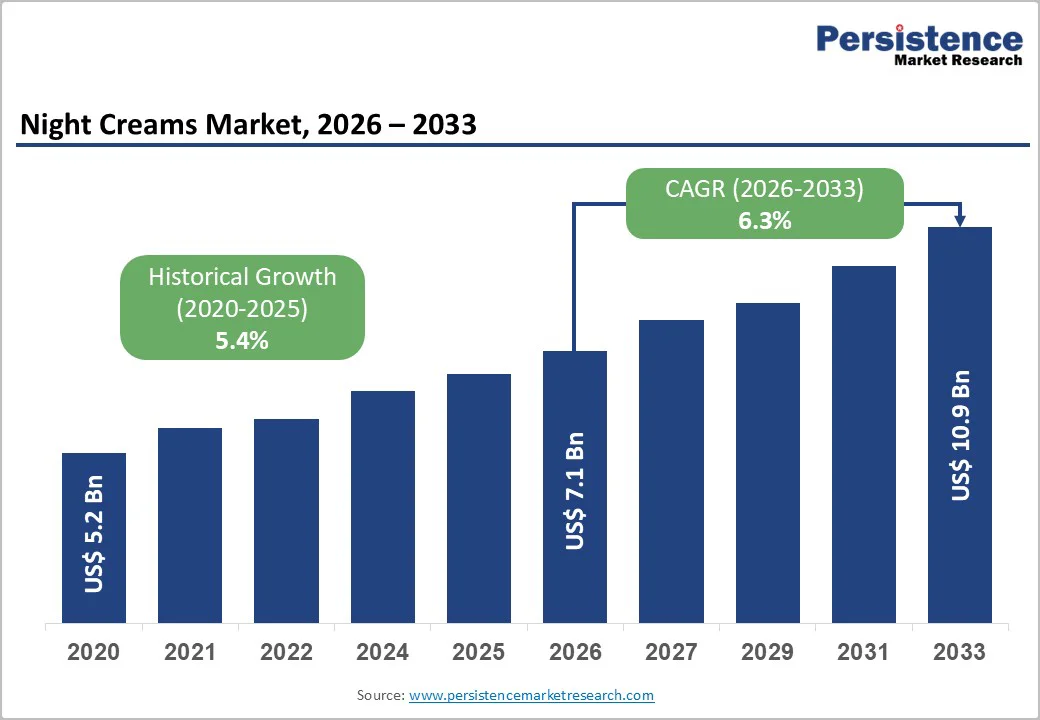
The global night creams market size is likely to be valued at US$ 7.1 billion in 2026 and is expected to reach US$ 10.9 billion by 2033, growing at a CAGR of 6.3% during the forecast period from 2026 to 2033.
The market expansion is primarily driven by heightened consumer consciousness regarding the benefits of targeted nighttime skincare regimens, combined with rising global disposable incomes that enable consumers to invest in premium formulations. The surge in social media influence and beauty content creators actively promoting night cream products has substantially accelerated consumer awareness, with 25% of TikTok users purchasing beauty products after viewing relevant content, while 67% report being influenced by such platforms.
Key Industry Highlights:
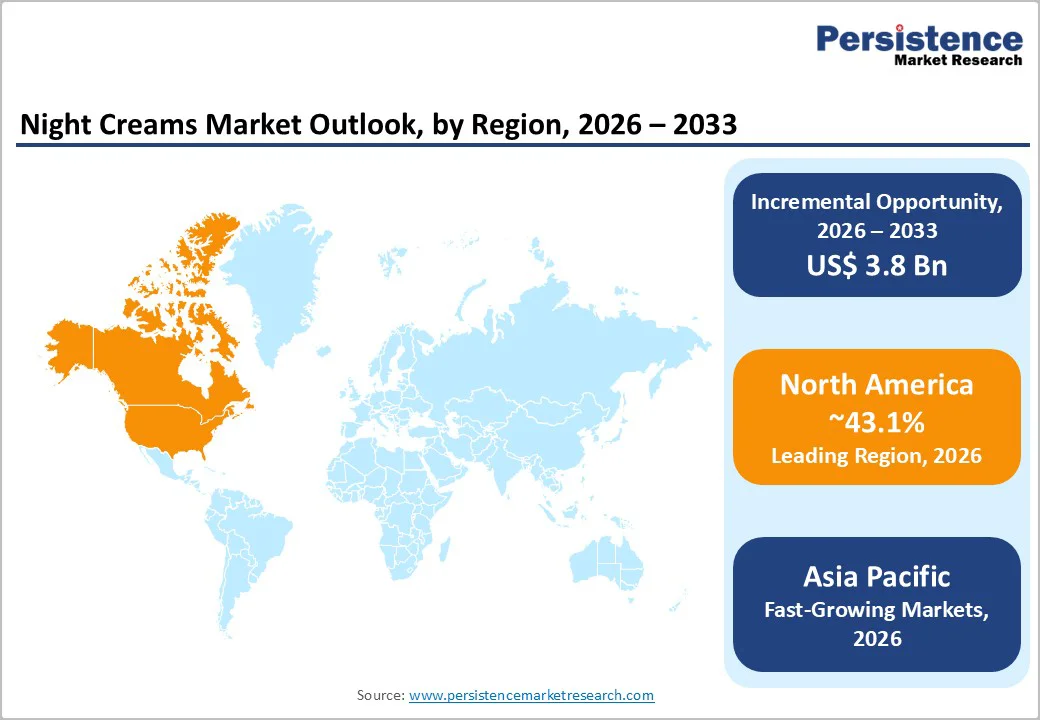
- Leading Region: North America leads with 43.1% of global market share, driven by high consumer awareness, premium product adoption, and established retail and e-commerce infrastructure.
- Fastest-Growing Region: Asia Pacific holds 33.5% share, fueled by rising disposable incomes, urbanization, e-commerce growth, and expanding male grooming adoption.
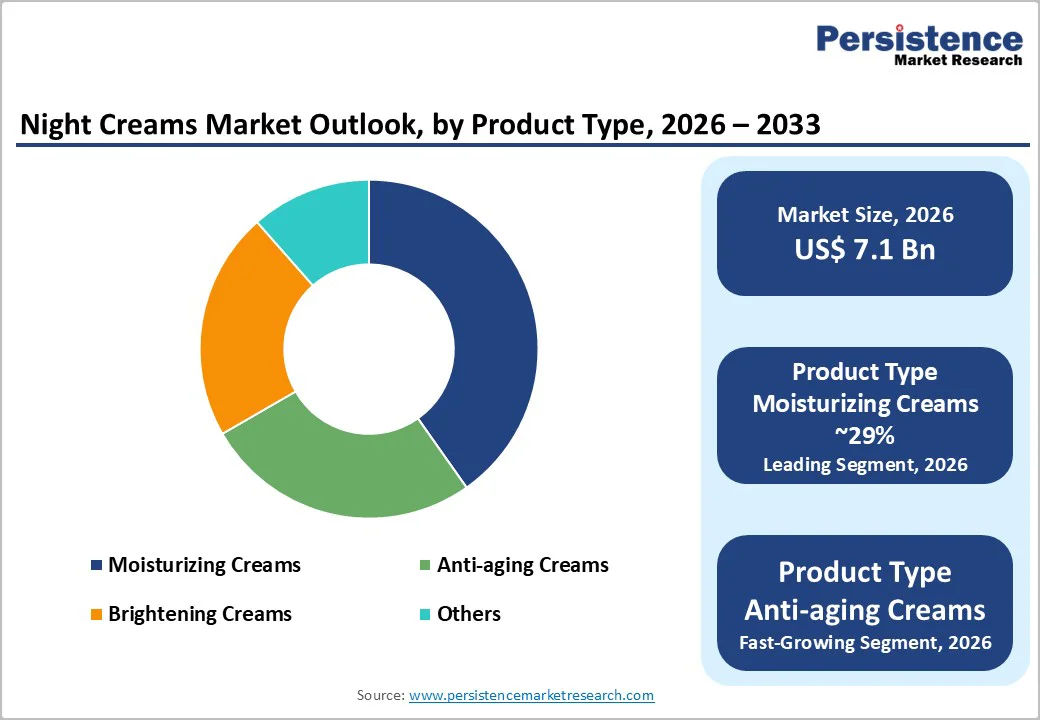
- Dominant Product Segment: Moisturizing creams maintain market leadership with approximately 29% share due to universal hydration needs and broad consumer appeal.
- Fastest-Growing Product Segment: Premium night creams are growing fastest, supported by advanced actives, proprietary delivery systems, and luxury positioning.
- Key Market Opportunity: Male grooming and AI-driven personalized skincare present significant growth potential, with 52% of U.S. men using facial care and 68% penetration among Gen Z men.
| Key Insights | Details |
|---|---|
|
Night Creams Market Size (2026E) |
US$ 7.1 Billion |
|
Market Value Forecast (2033F) |
US$ 10.9 Billion |
|
Projected Growth CAGR (2026-2033) |
6.3% |
|
Historical Market Growth (2020-2025) |
5.4% |
Market Dynamics
Market Growth Drivers
Increasing Consumer Awareness of Skin Regeneration During Sleep
Growing consumer understanding that skin repairs itself faster during sleep is significantly boosting the adoption of night creams. Social media, dermatology-led discussions, and beauty blogs have played a major role in spreading awareness about cell turnover and overnight hydration needs. As people learn more about how ingredients like retinol, niacinamide, peptides, and vitamin C work best during nighttime, night creams are positioned as a necessary part of a healthy skincare routine rather than just an optional product.
This shift is especially prominent among the 25–40 age group, who are more inclined toward prevention-based skincare. Millennials and Gen Z users increasingly view night creams as self-care and wellness essentials, emphasizing stress recovery, barrier repair, and long-term youth preservation. The rising demand for products that promote relaxation, deep nourishment, and visible morning skin improvement continues to strengthen market expansion.
Rising Influence of Social Media and Beauty Influencers
Social media is one of the strongest forces driving night cream consumption, particularly among younger demographics. TikTok, Instagram, and YouTube creators regularly review products, showcase night routines, and share time-lapse results, making skincare discovery highly interactive and visual. Viral trends, relatable testimonials, and side-by-side comparisons influence purchase behavior more effectively than traditional advertisements. In 2024, beauty was the most-purchased category through TikTok Shops, demonstrating the power of digital content in shaping consumer decisions.
Live shopping events and influencer-led product demonstrations are rapidly replacing showroom trials and in-store sampling. Gen Z especially relies on real-user reviews and peer-recommendations when selecting night creams. This dynamic environment has enabled both global brands and smaller indie labels to scale quickly, enhancing competition and accelerating market growth.
Market Restraints
High Price of Premium and Specialized Formulations
Premium night creams containing retinoids, peptides, ceramides, fermented actives, and advanced encapsulation technologies fall into a high-cost category, often priced between US$50–100 or more. These formulations appeal strongly to high-income consumers in North America, Europe, and parts of East Asia; however, they create a clear accessibility gap for mid- and low-income groups. The cost of biotech-derived ingredients, patented delivery systems, and dermaceutical-grade manufacturing elevates pricing strategies, but also limits scalability in price-sensitive markets.
Affordability remains a key concern in developing regions like Southeast Asia, India, and Latin America, where skincare spending is growing but still value-driven. The widening price disparity between drugstore and luxury night creams restricts penetration and reduces adoption in mass consumer segments. While premium products ensure high margins for brands, the price barrier continues to prevent broader reach, slowing long-term market expansion.
Market Saturation and Increased Product Complexity
The market is increasingly crowded, with numerous brands offering similar anti-aging, brightening, and hydration night creams across different price tiers. This has led to consumer fatigue and confusion, especially as overlapping claims and unclear ingredient communication blur differentiation between products. With sleeping masks, overnight serums, moisturizers, and repair balms entering the same night-care category, consumers struggle to determine which option best fits their needs, often resulting in trial-and-error purchases rather than brand loyalty.
Saturation has also intensified promotional competition, forcing brands to invest heavily in marketing, influencer collaborations, and product education to retain visibility. Constant new product launches encourage experimentation rather than repeat purchases, increasing churn rates and compressing pricing in mid-tier categories. As a result, acquisition costs rise while long-term retention weakens, posing a challenge for both established and emerging brands.
Market Opportunities
Surge in Clean, Natural, and Sustainable Beauty Formulations
The global shift toward clean beauty is reshaping demand for night creams, with growing consumer preference for natural actives, minimal synthetic chemicals, and sustainable ingredient sourcing. Shoppers are increasingly rejecting parabens, mineral oils, synthetic fragrances and harsh preservatives, instead favouring products with botanical actives like bakuchiol, aloe vera, green tea and plant oils that offer gentle anti-aging and repair benefits. This transition is especially strong among millennials and Gen Z, who display high awareness of ingredient safety and environmental responsibility, fueling premium adoption and brand loyalty.
Sustainability-driven packaging is further strengthening the trend. Brands using recyclable glass jars, biodegradable polymer containers and refill-based systems are differentiating themselves in a competitive market. Natural retinoid alternatives infused in night creams are projected to expand at a strong pace, particularly in North America and Europe where eco-regulations are strict and conscious consumption is rising, making this a highly scalable opportunity.
Expansion of Male Grooming and Personalized Skincare Solutions
Male grooming acceptance is rapidly increasing, positioning men as a high-value emerging customer segment for night cream brands. Usage of facial skincare among U.S. men has grown substantially, driven by rising awareness of hydration, aging prevention and post-shave repair. Younger consumers, especially Gen Z, are adopting structured regimes and actively seeking products for oil control, barrier strengthening and texture smoothing, signalling strong demand for targeted, male-focused formulations. Influencers and grooming culture are accelerating behavioural acceptance, unlocking further category expansion.
Parallel growth in personalized skincare is amplifying this opportunity. AI-enabled diagnosis tools, digital skin assessments and subscription-based recommendations allow brands to deliver tailored night cream routines with higher conversion and repeat usage. Solutions like L’Oréal’s Beauty Genius exemplify how smart personalization improves accuracy, engagement and premium product uptake. This trend is particularly scalable in Asia Pacific, supported by digital adoption and rising disposable incomes.
Category-wise Analysis
Product Type Insights
Moisturizing night creams hold the leading share of approximately 29% in the global market, supported by demand across all age groups and skin categories. Hydration remains the core driver of skin repair during sleep, making moisturizing creams the default choice for beginners and the baseline product even within advanced skincare routines. Their affordability, accessibility, and skin compatibility have strengthened long-term adoption, with hydrating ingredients like ceramides, glycerin, and hyaluronic acid enhancing night-time moisture retention.
Premium formulations are further elevating segment value through ingredients such as peptides, botanical extracts, niacinamide, and clean-label hydration blends. These upgraded variants command higher prices while maintaining strong consumer preference especially in North America and Europe where investment in quality skincare is rising. The segment is expected to retain dominance as hydration continues to be positioned as the most essential step of nocturnal skin repair.
Price Segment Insights
Premium night creams now represent the fastest-growing segment, accounting for nearly 62% of global market value. High-performance formulations backed by clinically validated actives, brand exclusivity, and dermatology-grade positioning have driven repeat purchases and elevated consumer loyalty. Prestige brands like Estée Lauder, L'Oréal, and Shiseido continue expanding their advanced R&D pipelines, justifying pricing through claims of enhanced repair, anti-aging efficiency, and ingredient purity.
Lower-priced economy products retain notable volume share in emerging markets, but increased competition and private label expansion are compressing margins. Regional contrasts are clearly defined: premium dominates in North America and Western Europe, while economy price tiers remain stronger in the Asia Pacific, requiring brands to navigate pricing, accessibility, and formulation strategies more selectively across markets.
Distribution Channel Insights
Supermarkets and hypermarkets lead the global distribution landscape with 24% share, anchored by physical availability, a broad brand mix, and consistent consumer footfall. Promotional pricing, shelf-scale visibility, and convenience of multi-product purchasing continue to attract mainstream buyers, particularly in middle-income demographics. This channel remains essential for retail-driven brand discovery and routine replenishment cycles.
E-commerce represents the fastest-growing route, expanding at nearly 8% CAGR, driven by digital-native consumers, subscription models, and algorithmic personalization. Direct-to-consumer platforms are boosting margins and enabling brands to capture first-party data for tailored marketing and product development. Omnichannel integration is now critical, with a balanced ecosystem of online stores, specialty pharmacies, beauty boutiques, and retail chains required to capture diversified consumer shopping behaviours.
Regional Insights
North America Night Creams Market Trends
North America stands as the dominant regional market, holding 43.1% of the global share, driven by strong consumer spending capacity, rapid technology adoption, and widespread shift toward premium, smart, and hybrid mattress systems. Rising awareness of sleep health, frequent product replacement cycles, and the presence of recognized brands further enhance the region’s leadership. Urban consumers increasingly prioritize orthopedic and memory-foam mattresses, while online retail and mattress-in-a-box formats continue to reshape the purchase experience. With well-developed distribution networks and favorable policies promoting wellness products, the region maintains a strong commercial and residential demand base.
North America benefits from innovations in cooling foams, eco-friendly textiles, and pressure-relief technologies, supported by ongoing R&D investments. Hospitality refurbishment cycles, growth in rental housing, and rising cases of insomnia and back-related issues continue to accelerate market penetration. The U.S. contributes a major revenue share, while Canada demonstrates noticeable growth in modular and luxury mattress categories.
Europe Night Creams Market Trends
Europe maintains a steady expansion at a CAGR of 7.5%, supported by high-quality bedding standards, consumer inclination toward eco-certified and recyclable materials, and continuous hotel renovation activities across Germany, the U.K., France, Spain, and the Nordics. The region exhibits strong penetration of latex and hybrid mattresses, driven by environmental consciousness and preference for long-lasting products with orthopedic benefits. Regulatory focus on indoor comfort and sustainability has prompted manufacturers to adopt low-VOC foams, natural fibers, and circular production models.
Rising prevalence of sleep disorders, increasing geriatric population, and emphasis on body pressure-distribution systems further push demand across healthcare and household settings. Premium and customized mattresses gain traction, while retail chains and digital storefronts improve product reach. With maturing consumer awareness and preference for durability over low-cost alternatives, Europe remains a vital, steadily progressing market with prominent growth visibility.
Asia Pacific Night Creams Market Trends
Asia Pacific emerges as the fastest-growing market with a 33.5% share, driven by rapid urbanization, a surge in middle-class income, and increasing awareness of ergonomic sleep solutions. Consumers in China, India, Japan, and Southeast Asia are transitioning from traditional cotton-based sleeping systems toward foam, latex, and spring-based mattresses. Expanding retail presence, online brand visibility, and availability of cost-effective to premium price points have significantly widened adoption. Moreover, rising hospitality infrastructure, home ownership, and furnishing upgrades in metropolitan clusters materially support sales volumes.
The region’s growth is amplified by health-conscious spending and preference for anti-allergen, breathable mattress materials suited for humid climates. E-commerce platforms, discount-driven promotional campaigns, and influencer marketing have accelerated first-time purchases and product replacement cycles. Manufacturing competitiveness, improving distribution networks, and increasing export capabilities also position Asia Pacific as a long-term growth hub in the global landscape.
Competitive Landscape
The global night creams market is moderately consolidated, with leading players controlling a significant share through extensive brand portfolios across luxury, prestige, and mass-market tiers. Market dominance is supported by strong research and development, proprietary ingredient technologies, advanced manufacturing capabilities, and premium positioning.
Emerging and indie brands compete through differentiation strategies, emphasizing clean formulations, sustainable packaging, direct-to-consumer channels, and authentic social media engagement. Growth opportunities exist in underserved price segments and regions, while innovation in advanced delivery systems, AI-driven personalization, and subscription models enhances consumer engagement, loyalty, and lifetime value, creating a dynamic and competitive marketplace.
Key Market Developments:
- In June 2025, L'Oréal Group unveiled its most comprehensive innovation portfolio at VivaTech 2025, introducing L'Oréal Longevity Integrative Science™, combining artificial intelligence and skin expertise to advance preventive skincare from corrective care, alongside Lancôme RÉNERGIE NANO-RESURFACER 400, a nanochip-powered at-home skincare device enhancing topical ingredient penetration and clinical efficacy.
- In January 2024, L'Oréal Paris introduced a comprehensive line of natural night creams across multiple markets to address rapidly expanding demand for eco-friendly, sustainably-sourced skincare solutions among environmentally-conscious consumer segments prioritizing clean beauty and reduced chemical exposure.
- In December 2024, the FDA Cosmetics Direct Portal underwent significant enhancements, enabling brands to streamline facility registration and product listing management under MoCRA compliance requirements, introducing new discontinuation and relisting features, facilitating improved inventory management and product portfolio optimization for cosmetics manufacturers and distributors.
Companies Covered in Night Creams Market
- L'Oréal S.A.
- Unilever plc
- The Estée Lauder Companies, Inc.
- Procter & Gamble Co.
- Beiersdorf AG
- Shiseido Company, Ltd.
- Johnson & Johnson Services, Inc.
- Amorepacific Group Inc.
- Kao Corporation
- Coty Inc.
- Avon Products, Inc.
- LVMH Moët Hennessy Louis Vuitton
- Chanel
- Natura & Co.
- Revlon Inc.
- CeraVe
- Neutrogena
- SK-II
- Lancôme
- Olay
Frequently Asked Questions
The global night creams market is projected to reach US$ 10.9 billion by 2033, growing from US$ 7.1 billion in 2026 at a CAGR of 6.3%, driven by rising consumer awareness, disposable incomes, and adoption of advanced formulations.
Key drivers include awareness of skin regeneration during sleep, social media influence, premium product adoption, active ingredient innovation, wellness positioning, and growth in male grooming.
Moisturizing creams lead with 29% market share due to universal hydration needs, broad demographic appeal, affordability, and role as an entry-point skincare product.
North America leads with 43.1% share, driven by premium product adoption, high consumer awareness, and strong retail and e-commerce infrastructure.
Male grooming and AI-powered personalized skincare represent the main opportunity, with 52% of U.S. men and 68% of Gen Z men actively using facial care.


