




- Medical Devices
- Night Contact Lens Market
Night Contact Lens Market Size, Share, Growth, and Regional Forecast, 2026 - 2033
Night Contact Lens Market by Indication (Myopia, Astigmatism, Hyperopia, Presbyopia), End-user (Hospitals, Ophthalmology Clinics, Vision Care Centers), and Regional Analysis from 2026 - 2033

Night Contact Lens Market Share and Trends Analysis
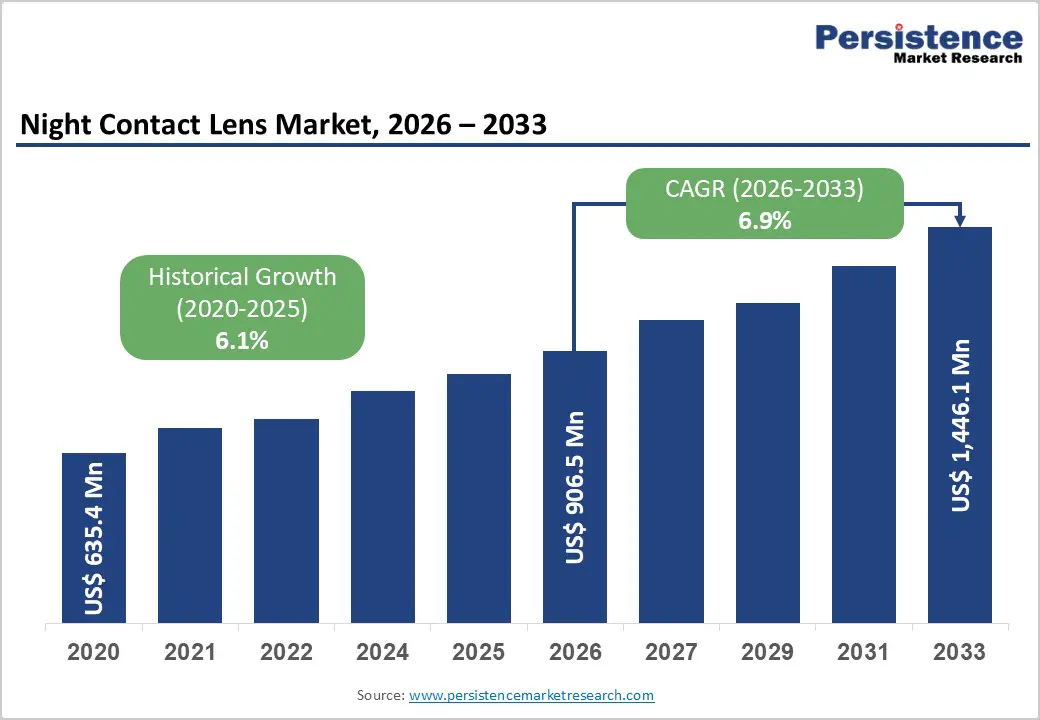
The global night contact lens market size is likely to be valued at US$ 906.5 million in 2026 and US$1,446.1 million by 2033 growing at a CAGR of 6.9% during the forecast period from 2026 to 2033.
The global market is gaining strong momentum, driven by the rapidly increasing prevalence of myopia among children and young adults and the growing need for effective, non-surgical vision correction solutions. Night contact lenses, primarily based on orthokeratology, are designed to temporarily reshape the cornea during sleep, enabling clear daytime vision while also supporting myopia control. Rising awareness among parents and eye care professionals, combined with expanding clinical validation, is accelerating adoption worldwide. Studies indicate that orthokeratology lenses can significantly slow axial eye growth compared with conventional single-vision corrections, positioning them as a clinically supported intervention for long-term myopia management. With global projections indicating a substantial rise in myopia cases by mid-century, demand for safe, evidence-based optical solutions, such as night contact lenses, is expected to grow steadily across both developed and emerging markets.
Key Industry Highlights
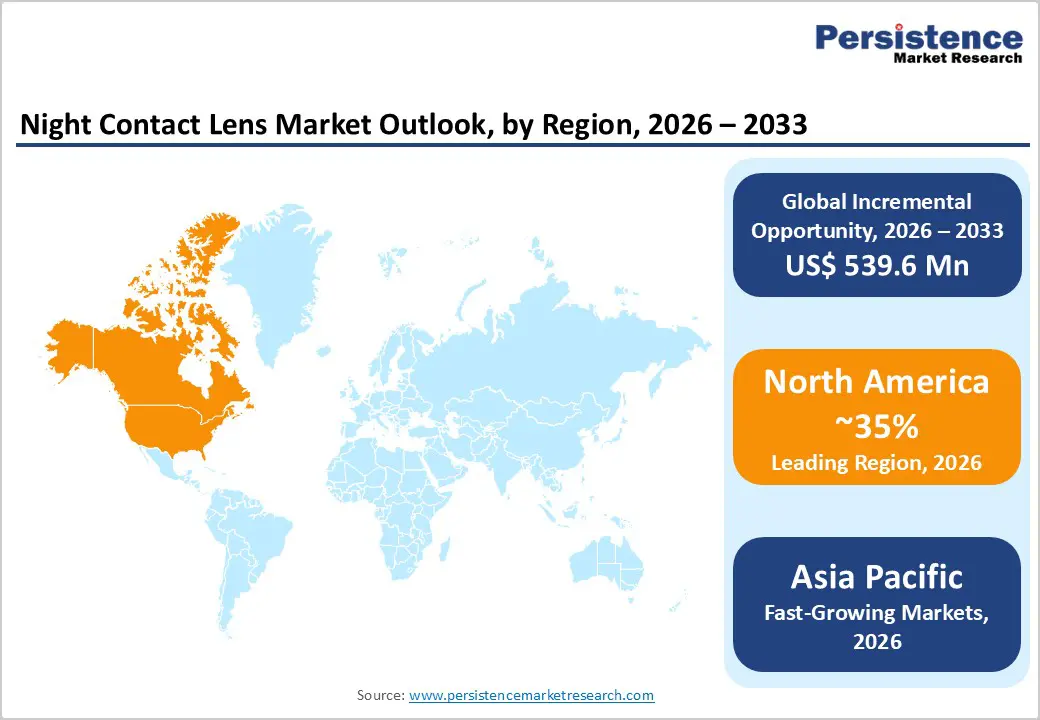
- Leading Region: North America leads the night contact ens Market due to rising myopia management adoption, increasing FDA approvals, specialist clinics' expansion, and higher awareness of ortho-k benefits.
- Fastest Growing Region: Asia Pacific is the fastest-growing region, due to high myopia prevalence, early pediatric screening programs, strong clinician adoption, and growing parental awareness.
- Dominant Segment: Myopia dominates the market, supported by increasing childhood myopia incidence, clinical validation of orthokeratology, and rising demand for non-surgical vision correction.
- Fastest-Growing Segment: Pediatric myopia management is the fastest-growing segment, propelled by early intervention strategies, school screening programs, and long-term focus on slowing myopia progression.
| Key Insights | Details |
|---|---|
|
Night Contact Lens Market Size (2026E) |
US$ 906.5 Mn |
|
Market Value Forecast (2033F) |
US$ 1,446.1 Mn |
|
Projected Growth (CAGR 2026 to 2033) |
6.9% |
|
Historical Market Growth (CAGR 2020 to 2025) |
6.1% |
Market Dynamics
Driver - Better Alternative than Laser Vision Correction (LASIK)
Orthokeratology (ortho-k) lenses are increasingly viewed as a safer and more flexible alternative to laser vision correction procedures such as LASIK. While refractive surgery offers long-term vision correction, it is irreversible and associated with potential complications including chronic dry eye, glare, halos, under- or over-correction, and postoperative infections. These risks, combined with age-, corneal thickness-, and ocular stability-related eligibility limitations, make surgical correction unsuitable for many patients. In contrast, ortho-k lenses provide a non-invasive and reversible approach to vision correction, delivering clear daytime vision without permanent alteration of the cornea. Initially developed for pediatric myopia management, FDA-approved ortho-k lenses have since gained wider acceptance among adults seeking surgery-free vision correction.
Recent advancements in ortho-k lens design have further strengthened their clinical appeal. Innovations such as improved reverse-geometry designs, enhanced oxygen-permeable materials, and customized peripheral alignment zones have improved comfort, predictability, and myopia control outcomes. Emerging designs continue to refine peripheral refraction management, which plays a key role in slowing axial eye growth. From a cost perspective, ortho-k lenses are generally more affordable than laser procedures and avoid the financial and medical risks associated with potential repeat surgeries. Their suitability for active lifestyles, including sports and outdoor activities, further enhances patient preference. Together, these advantages are driving increased adoption of ortho-k lenses, supporting the sustained growth of the global night contact lens market.
Restraints - Risk of Complications and Strict Hygiene Requirements
Night contact lenses, particularly orthokeratology designs, face adoption barriers due to the risk of complications associated with overnight lens wear and the need for strict hygiene compliance. The clinical literature indicates that sleeping in contact lenses increases the risk of complications such as microbial keratitis, corneal staining, lens binding, and hypoxia-related corneal stress. Although large-scale population studies suggest that complication rates for orthokeratology are comparable to those of other contact lens modalities when properly managed, the perceived risk remains a concern for both patients and practitioners.
Successful ortho-k use requires meticulous daily lens cleaning, strict replacement schedules, and consistent follow-up visits to monitor corneal health and lens fit. These requirements can be challenging for pediatric users and caregivers, especially in regions with limited access to trained eye care specialists. Inconsistent hygiene practices or missed follow-ups may increase the risk of adverse events, discouraging risk-averse clinicians from recommending night lenses broadly. As a result, despite strong clinical benefits, the need for disciplined patient behavior and specialist oversight continues to restrain wider market penetration in certain geographies.
Opportunity - Expanding Myopia Control Programs and Younger-Age Interventions
A major growth opportunity for the night contact lens market lies in integrating orthokeratology into structured myopia control programs, particularly those targeting children at an early age. Clinical evidence increasingly supports proactive intervention once myopia progression is detected, rather than relying solely on corrective eyewear. Orthokeratology has demonstrated consistent effectiveness in slowing axial eye growth over several years, especially when initiated in younger children. This positions night lenses as a core component of comprehensive myopia management strategies that also include lifestyle guidance, outdoor activity promotion, and regular monitoring.
Government-led initiatives are further accelerating this opportunity. For example, China’s National Myopia Prevention and Control Program promotes early vision screening in schools, limits screen time, and encourages evidence-based myopia management interventions, creating a favorable environment for the clinical adoption of orthokeratology. Similarly, Singapore’s National Myopia Prevention Programme (NMPP) focuses on early detection, parental education, and promoting outdoor activity, while supporting advanced optical solutions through clinical channels. As healthcare systems and clinics align with these public health efforts, providers offering scalable myopia control protocols, including night contact lenses, are well-positioned to capture sustained demand from the growing pediatric myopia population.
Category-wise Analysis
By Indication Insights
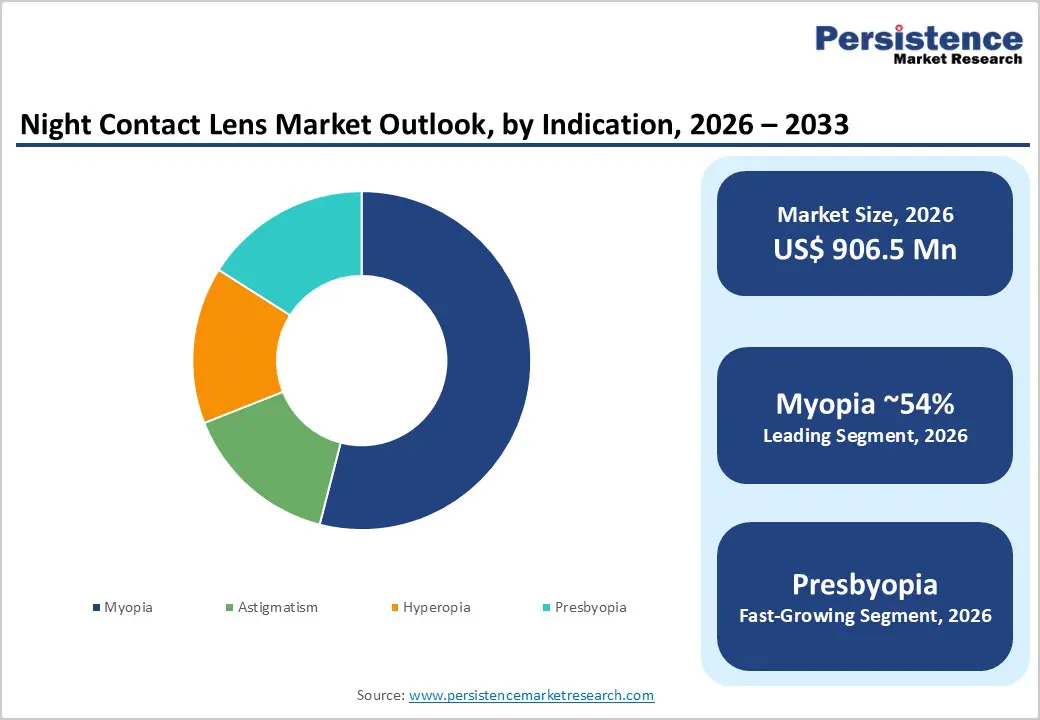
Myopia represents the largest indication segment in the global night contact lens market, accounting for approximately 54% of total market share in 2025. This dominance is closely linked to the rising incidence of myopia during childhood and adolescence, particularly in urban populations. Increased engagement in near-vision activities such as prolonged screen use, digital learning, reading, and gaming has been strongly associated with early-onset myopia. Children exposed to sustained close work for extended periods have a notably higher risk of developing progressive refractive errors, underscoring the need for early corrective intervention.
Night contact lenses, especially orthokeratology designs, are widely prescribed for myopia due to their dual benefit of temporary vision correction and myopia progression control. Growing awareness among parents and eye care professionals regarding long-term complications of untreated myopia has further strengthened adoption. As myopia prevalence continues to rise globally, particularly in pediatric and young adult populations, demand for clinically validated, non-surgical myopia management solutions is expected to sustain the leadership of this segment.
By End-user Insights
Ophthalmology clinics accounted for approximately 48% of the global night contact lens market in 2025, reflecting their central role in diagnosing, treating, and managing refractive disorders. These clinics serve as specialized centers for advanced eye care, providing access to experienced ophthalmologists and optometrists, as well as the diagnostic infrastructure needed for precision lens fitting and follow-up monitoring. The ability to conduct detailed corneal assessments, axial length measurements, and customized lens adjustments makes ophthalmology clinics the preferred setting for orthokeratology treatment.
In addition, the continuous expansion of outpatient and specialty eye care services has increased patient inflow, particularly for pediatric myopia management and complex refractive conditions. Ophthalmology clinics also play a critical role in clinical research, training, and the adoption of advanced vision care technologies, which support early uptake of innovative contact lens solutions. This combination of clinical expertise, patient volume, and technology adoption continues to drive strong demand for night contact lenses within ophthalmology clinic settings.
Regional Insights
North America Night Contact Lens Market Trends
North America, led by the U.S., accounts for around 35% of the global night contact lens market in 2025, underpinned by high awareness of myopia control, strong optometry and ophthalmology infrastructure, and early adoption of orthokeratology. Studies in North American populations show that overnight orthokeratology can meaningfully slow myopia progression in children aged 2–5 years, with safety profiles similar to those of other overnight lens modalities when evidence-based hygiene protocols are followed. Professional organizations and academic centers increasingly highlight orthokeratology as a viable myopia management option, contributing to growing demand among parents seeking alternatives to refractive surgery for their children.
Regulatory oversight by agencies such as the U.S. Food and Drug Administration (FDA) ensures that night contact lenses meet stringent safety and efficacy requirements, while established contact lens brands continue to invest in education for eye-care practitioners. The region also benefits from a strong innovative ecosystem, including specialty lens laboratories, digital topography technologies, and myopia management clinics that integrate orthokeratology with lifestyle interventions and other optical approaches. As awareness of the long-term cost burden of high myopia increases, North America is expected to remain a key reference market for premium night contact lens solutions.
Europe Night Contact Lens Market Trends
Europe night contact lens market is witnessing steady growth, supported by rising awareness of myopia management and the increasing prevalence of refractive errors across age groups. Growing preference for non-surgical vision correction, particularly among children and young adults, is driving the adoption of orthokeratology lenses. Advancements in lens materials and customized designs have improved comfort, safety, and clinical outcomes, encouraging wider acceptance among eye care professionals. The expansion of specialized optometry and ophthalmology clinics across Europe is further strengthening market penetration.
Country-level trends highlight strong momentum in key markets. In the UK, increasing daily screen exposure has heightened concerns around eye strain and progressive myopia, boosting demand for night lenses as a preventive solution. France is seeing growth driven by rising awareness of retinal disorders and sustained healthcare investment, which support access to advanced vision care. Meanwhile, Germany’s mature healthcare infrastructure, aging population, and strong clinical adoption of advanced refractive technologies are accelerating the uptake of orthokeratology lenses in routine clinical practice.
Asia Pacific Night Contact Lens Market Trends
Asia Pacific is poised to be the fastest-growing region in the night contact lens market, driven by extremely high myopia prevalence and early onset in countries such as China, Japan, South Korea, Singapore, and other ASEAN nations. In some East Asian urban populations, studies report myopia rates of 80–90% among school-leavers, with high myopia affecting 10–20%, creating intense demand for effective progression control strategies. Orthokeratology has gained strong traction in China, Japan, and Taiwan, where specialized clinics and academic centers actively research and deploy night lenses as part of comprehensive myopia management programs.
Manufacturing advantages in China, Taiwan, and South Korea support local production of gas-permeable materials and custom lens designs, helping to reduce costs and broaden availability across regional markets. Regulatory authorities in several Asia Pacific countries have approved multiple orthokeratology brands, and professional societies actively disseminate clinical guidelines on safe fitting and follow-up. As governments increasingly frame myopia as a public health priority and parents seek non-surgical options for children, the Asia Pacific is expected to exhibit the highest CAGR for night contact lenses during the forecast period.
Competitive Landscape
The night contact lens market is moderately fragmented, featuring a mix of global contact lens manufacturers, regional specialty laboratories, and technology-focused players that concentrate on orthokeratology and custom rigid gas-permeable designs. Leading companies compete on lens material oxygen permeability, design sophistication for myopia and astigmatism correction, safety profiles, and practitioner support, including topography-based fitting software and clinical education. Strategies for growth include geographic expansion into high-myopia regions, collaboration with pediatric ophthalmology clinics, and investment in long-term clinical research to further validate efficacy and safety. Emerging business models focus on integrated myopia management programs, subscription-based lens replacement, and data-driven follow-up systems that enhance adherence and outcomes for pediatric wearers.
Key Industry Developments:
- In September 2023, AccuLens launched the NewVision SC orthokeratology lens, an FDA-cleared corneo-scleral design made from Contamac Infinite material. The lens features a larger diameter to improve comfort and allow for flexible wear time.
- In September 2022, Johnson & Johnson Vision announced the launch of an expanded portfolio of Acuvue Abiliti overnight lenses, along with the introduction of a new intraocular lens.
- In September 2021, specialist contact lens company Scotlens partnered with Avizor to introduce a new “unboxing experience” for ortho-K night lenses, designed to raise public awareness and spark interest in the treatment option.
Companies Covered in Night Contact Lens Market
- Cooper Vision
- Euclid Systems
- Johnson & Johnson Vision Care, Inc.
- Bausch & Lomb
- Truform Optics
- Art Optical Contact Lens, Inc.
- Menicon Co., Ltd./ Alpha
- Brighten Optix
- Eyebright Medical Technology Beijing Co Ltd
- Lucid
- Optact International Ltd.
- Taiwan Macro Vision Corporation
- E & E optics
- GP Specialists
- Others
Frequently Asked Questions
The global night contact lens market is projected to be valued at US$ 906.5 Mn in 2026.
Rising childhood myopia prevalence, growing awareness of non-surgical vision correction, and increasing clinical acceptance of orthokeratology therapies.
The global night contact lens market is poised to witness a CAGR of 6.9% between 2026 and 2033.
Expansion in pediatric myopia management programs, emerging market penetration, technological lens design advancements, and broader practitioner training initiatives.
North America is the leading region in the global night contact lens market.


