




- Clothing, Footwear, & Accessories
- Women Casual Shoes Market
Women Casual Shoes Market Size, Share, and Growth Forecast, 2026 - 2033
Women Casual Shoes Market by Product Type (Sneakers, Loafers, Ballet Flats, Sandals), Material (Leather, Textile, Synthetic), Distribution Channel (Online Retail, Offline Retail), and Regional Analysis for 2026-2033

Women Casual Shoes Market Share and Trends Analysis
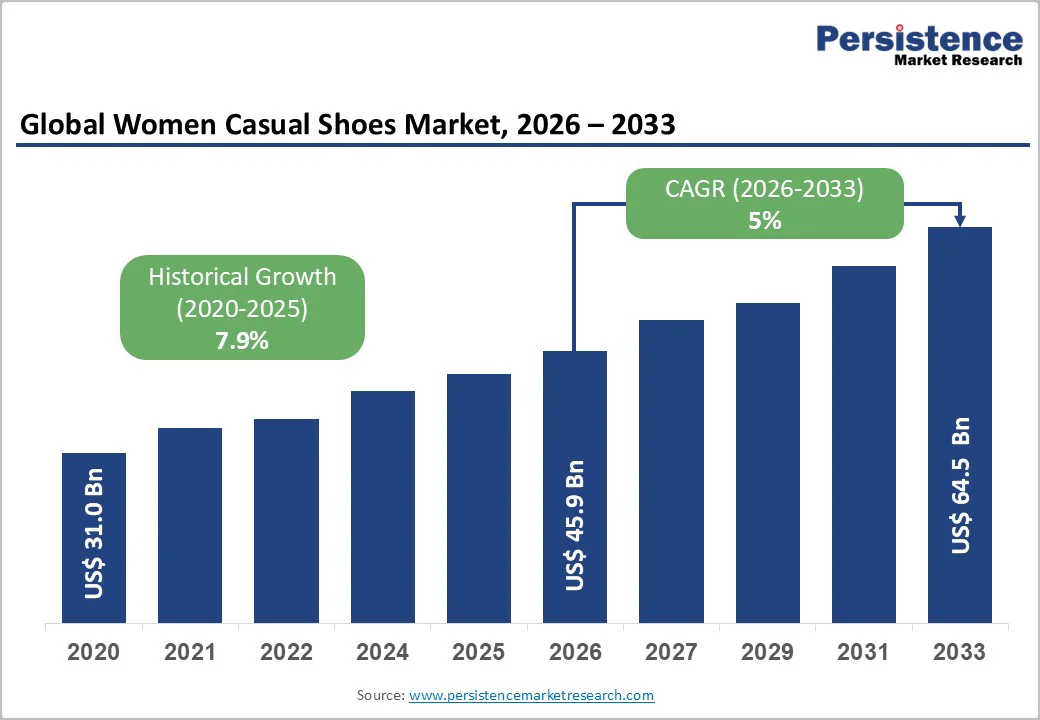
The global women casual shoes market size is likely to be valued at US$ 45.9 billion in 2026, and is estimated to reach US$ 64.5 billion by 2033, growing at a CAGR of 5% during the forecast period 2026-2033. Rising fashion consciousness and higher disposable incomes are now core structural drivers of the women’s casual footwear market, especially across urban and younger consumer cohorts. As women seek shoes that adapt to hybrid work patterns, flexible lifestyles, and diverse social occasions, demand is shifting toward multi-purpose designs that balance all-day comfort with contemporary aesthetics, encouraging brands to upgrade silhouettes, cushioning, and material mixes. At the same time, rapid online retail expansion and influencer-led digital content are boosting product visibility, shortening decision cycles, and lifting conversion rates across value and premium tiers.
Key Industry Highlights
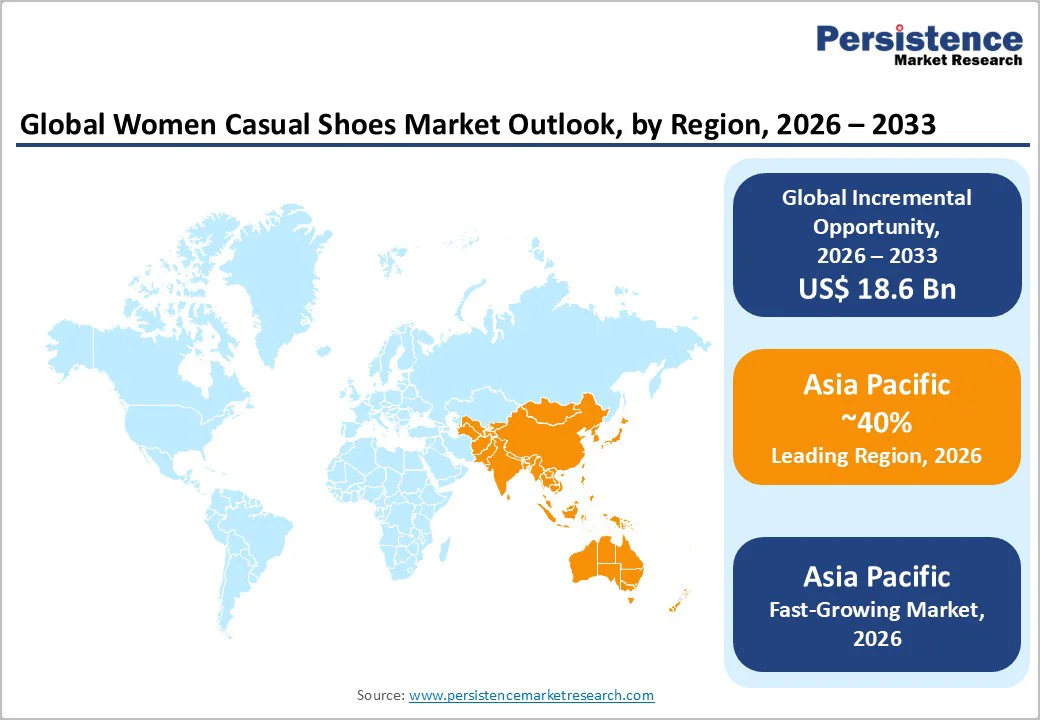
- Dominant Region: Asia Pacific is slated to dominate with an approximate 40% market share in 2026, supported by rising disposable incomes and an expanding middle class.
- Fastest-growing Regional Market: Asia Pacific is set to be the fastest-growing market through 2033, due to the proliferation of e-commerce platforms and growing adoption of fashionable footwear.
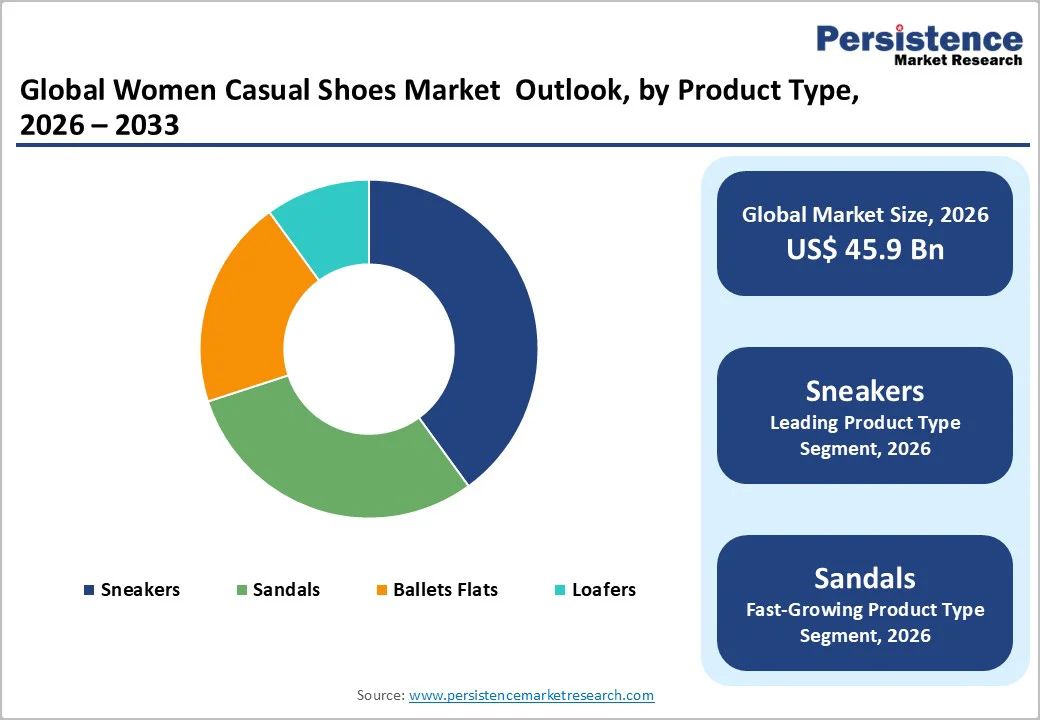
- Leading & Fastest-growing Product Type: Sneakers are likely to account for roughly 40% of the 2026 market revenue share, driven largely by the athleisure movement.
- Fastest-growing Product Type: Sandals are expected to grow the fastest from 2026 to 2033, driven by their breathable, comfortable design that makes them especially suitable for tropical climates.
- Dominant Material Type: Synthetic materials are expected to dominate, with an estimated 40% revenue share in 2026, as they offer design flexibility and consistent quality.
| Key Insights | Details |
|---|---|
| Women Casual Shoes Market Size (2026E) | US$ 45.9 Bn |
| Market Value Forecast (2033F) | US$ 64.5 Bn |
| Projected Growth (CAGR 2026 to 2033) | 5% |
| Historical Market Growth (CAGR 2020 to 2025) | 7.9% |
Market Factors – Growth, Barriers, and Opportunity Analysis
Digital Commerce and Omnichannel Retail Expansion
Digital commerce and omnichannel retail now act as fundamental engines for the women’s casual footwear market. Rapid expansion in e-commerce has widened access to branded and private-label goods, especially in regions such as Asia Pacific and Latin America. Leading retailers currently integrate online marketplaces with direct-to-consumer (D2C) websites to create a seamless experience. This strategic alignment improves product discovery and personalization for the shopper. Consequently, these integrated networks boost conversion rates significantly. Brands that leverage social commerce also see tangible improvements in customer engagement. This unified approach transforms how consumers interact with fashion categories.
Advanced technology has also steadily increases the volume of shoes sold through virtual channels. Innovations such as AI drive precise recommendations, while virtual try-on tools reduce hesitation. Flexible logistics and return options further encourage purchasing decisions. These developments cause internet platforms to grow faster than traditional brick-and-mortar stores. The relaxed style category gains the most from this shift because buyers find these items easier to size and exchange remotely. Higher sell-through numbers and quicker inventory replenishment cycles result from this ease of purchase.
Price Sensitivity and Margin Pressure in Mass Segments
Price sensitivity poses a key structural hurdle in the mass-market segment of women’s casual footwear, especially across developing economies. Consumers in these areas focus on low costs, which curbs opportunities for elevated pricing strategies. This preference hampers the transition to higher-value offerings. Retailers must navigate tight budgets that dominate purchasing decisions. Such dynamics demand careful pricing adjustments to retain market share. Forward-thinking brands explore value-added features to justify modest premiums without alienating core buyers.
Rising expenses challenge manufacturers in leather, textiles, synthetic materials, logistics, and labor sectors. Brands struggle to transfer these cost hikes fully to shoppers amid fierce rivalry in narrow price ranges. Local and unorganized competitors erode pricing authority, prompting ongoing promotions and price cuts. These tactics erode gross margins and limit funds for advancements in product design, marketing efforts, and eco-friendly practices. Strategic cost controls paired with targeted differentiation can help restore balance. Leaders who optimize supply chains gain a competitive edge in sustaining profitability.
Shifting Consumer Preferences and Technological Advancements
The women’s casual footwear market offers varied expansion prospects driven by shifting buyer preferences and swift technological advances. Sustainable sourcing and eco-friendly production gain strong traction as shoppers seek shoes crafted from materials such as recycled plastics, vegan leathers, and organic fabrics. These choices appeal to those who value reduced environmental harm. Brands that prioritize green practices position themselves ahead of rivals. Consultative strategies recommend early adoption of certified suppliers to meet rising demand. This focus not only captures premium segments but also enhances brand reputation over time.
Commitment to environmental innovation provides a distinct advantage for forward-looking companies. Investments in bio-based inputs, efficient production methods, and open supply chain details lower ecological impact while strengthening customer confidence. Such steps cultivate enduring relationships with eco-aware consumers. Meanwhile, smart technologies like built-in health sensors, gait analysis tools, and app-connected customization deliver unique benefits. These features elevate basic shoes into functional assets. Leaders who blend sustainability with tech integration unlock superior growth potential in a competitive landscape.
Category-wise Analysis
Product Type Insights
Sneakers are anticipated to be the leading segment with an approximate 40% of the women casual shoes market revenue share in 2026, primarily due to the growth of the athleisure movement, which seamlessly merges athletic style with everyday fashion. Their built-in versatility allows women to wear them in a range of settings from work and travel to social activities, which has dramatically broadened their appeal and elevated their market penetration globally. Frequent brand innovations reinforce this consumer preference, companies continuously introduce advanced cushioning systems, lightweight and breathable materials, and updated designs that emphasize both performance and visual appeal.
Sandals are likely to be the fastest-growing segment from 2026 to 2033. The demand for sandals is driven by their breathability and comfort, making them ideal for summer months and tropical climates. Brands have diversified their offerings by incorporating trendy designs and comfort features such as adjustable straps and arch support, broadening their appeal to a wider audience. The rise in travel and leisure activities has further bolstered the demand for sandals, as consumers seek footwear that combines style with practicality.
Material Insights
Synthetic materials are expected to dominate, with an estimated 40% share of market revenue in 2026, primarily because they offer strong cost-efficiency, design flexibility, and consistent quality. Synthetic casual footwear is especially common in mass and mid?market price tiers, where buyers place a higher value on style variety and affordability than on the tactile qualities of natural leather. In addition, synthetics work well with fast?fashion product cycles and injection-molded or automated manufacturing processes, which support efficient scaling and help brands manage margins more effectively.
Textile is forecasted to be the fastest-growing material between 2026 and 2033. Textile materials such as canvas and denim are widely favored in the casual footwear segment because they offer an attractive balance of versatility and comfort. They support a broad palette of colors, prints, and patterns, which makes textile-based shoes especially appealing to fashion-conscious consumers who seek frequent style updates. Their lightweight construction also makes textile shoes well-suited for everyday wear, commuting, and informal social occasions.
Distribution Channel Insights
At about 70%, offline retail is poised to lead the revenue share in 2026, as it delivers a tactile, in-person shopping experience that many consumers still value. This channel spans department stores, branded outlets, and independent shoe retailers, all of which allow shoppers to try on footwear, assess fit and comfort directly, and receive assistance from sales staff. The physical experience particularly appeals to consumers who prioritize personalized service, immediate product access, and assurance on sizing.
Online retail is anticipated to be the fastest-growing segment during the 2026-2033 forecast period. Online retail has experienced strong growth as consumers increasingly prioritize convenience, multiple choices, and time savings. Shoppers can now browse, compare, and purchase footwear from anywhere, at any time, which has fundamentally reshaped buying habits and reduced dependence on physical store visits. This shift is especially pronounced among younger, digitally savvy consumers, who are more comfortable transacting via mobile apps and e-commerce platforms.
Regional Insights
Asia Pacific Women Casual Shoes Market Trends
Asia Pacific leads as the largest and fastest-expanding regional market for women’s casual footwear, expected to hold about 40% of the global market share in 2026. Rising household incomes fuel this dominance alongside a swelling middle class and steady economic gains in nations such as China, India, Indonesia, and Vietnam. More women join professional roles and urban centers, which elevates demand for style essentials such as sneakers, sandals, and flats. These items shift from optional buys to daily necessities. Consultants advise brands to target this demographic shift with accessible, versatile designs to capture sustained volume.
Younger shoppers actively follow worldwide trends via social platforms, which speeds adoption of fresh looks and global labels. This enthusiasm also spurs needs for budget-friendly options that match fleeting fashions. Parallel progress in highways, shopping outlets, organized retail, and online platforms enhances reach into smaller cities and nascent areas. Such infrastructure upgrades bridge gaps for branded goods, making them more accessible for consumers. Strategic players invest here to build loyalty among tech-savvy youth. This regional momentum promises robust returns for adaptable entrants.
Europe Women Casual Shoes Market Trends
Europe, with its strong fashion heritage and mature retail infrastructure, is likely to capture a considerable portion of the women casual shoes market share in 2026. The market here is defined by a clear emphasis on quality, design, and brand reputation. Consumers in this region increasingly seek products that balance style, comfort, and durability, while also reflecting growing concerns about environmental impact and ethical sourcing. As a result, demand is steadily shifting toward casual footwear made with sustainable materials, transparent supply chains.
Market growth in Europe is expected to remain moderate but stable, supported by ongoing product innovation, premiumization, and the integration of omnichannel retail models that link physical boutiques with advanced e-commerce platforms. Brands that successfully combine fashion-forward design, comfort features, and sustainability credentials are especially well-positioned to capture share in this region. As modern retail formats and online channels expand in these regions, and consumers become more brand? and trend-conscious, they create substantial growth potential for companies that tailor product design, pricing, and marketing strategies to local preferences.
North America Women Casual Shoes Market Trends
North America stands out as a dynamic hub for women’s casual footwear, where buyers consistently seek products that blend style with advanced features. The region’s fashion-driven consumers frequently refresh their wardrobes, embracing new shapes, designer collaborations, and comfort-focused technologies. This appetite for novelty drives rapid turnover in sneakers, flats, and casual sandals. A mature retail landscape, spanning specialty stores, department outlets, and digital-first brands, ensures wide availability and swift access to the latest collections. Brands that align with evolving trends and invest in innovation capture greater market share.
Consumer priorities in North America increasingly center on both personal well-being and environmental responsibility. Shoppers favor shoes that deliver real comfort, such as enhanced cushioning, arch support, and ergonomic construction. At the same time, they demand lower-impact materials and transparent production methods. Brands that successfully merge aesthetic appeal, physical comfort, and authentic sustainability credentials gain a distinct advantage. This convergence of style, function, and ethics is shaping the future of the regional market.
Competitive Landscape
The global women casual shoes market landscape displays a distinct hierarchy where massive scale coexists with local fragmentation. Dominant entities such as Nike, Inc., Adidas AG, Puma SE, and Skechers U.S.A., Inc. secure a commanding 55% to 60% market share. These corporations wield their extensive product lines and powerful brand equity to define industry standards. Furthermore, their far-reaching distribution networks grant them superior access to diverse customer bases in both mature and developing nations. Analysts observe that this structural advantage allows market leaders to shape purchasing habits significantly while creating high barriers for smaller rivals.
Leading companies strengthen their positions through substantial spending on promotional campaigns and celebrity alliances. These strategic moves enhance brand recall and solidify consumer connections. Incumbents typically rely on their heritage of style and quality to retain loyalty among core demographics. In contrast, emerging challengers disrupt the status quo by focusing on unique innovations and specific market niches. This fierce contest drives a continuous cycle of product evolution involving novel materials and cutting-edge technologies. Success in this environment requires a relentless focus on differentiation and value creation to capture buyer interest.
Key Industry Developments
- In November 2025, the Air Jordan 1 Triple Stack SE updated Michael Jordan’s debut low-top sneaker with a bold triple-layered rubber midsole and outsole, creating a nearly 3-inch platform for added height and visual impact.
Women’s-exclusive colorways such as Team Red/Pale Ivory/Sanded Gold and Psychic Blue/Psychic Blue/White/Sail feature unique details such as a hand-drawn Nike Air Swoosh tongue and corduroy material, set for spring 2026 release. - In November 2025, Alegria highlighted its top Holiday 2025 dress shoes from the Journey Back to Me collection. The recommendations featured American Podiatric Medical Association-accepted styles such as Lisah in Jam Patent, Talya in Champagne Mist (ballet flat), and Keli in Stellar Silver (slip-on) for festive comfort and style.
- In August 2025, Nordstrom's "Make Room for Shoes" campaign spotlighted Adidas with exclusive colorways on iconic silhouettes such as Samba, Gazelle, Spezial, and München, five for women and two for men. This month-long partnership honored the brand's heritage while driving footwear sales growth.
Companies Covered in Women Casual Shoes Market
- Nike, Inc.
- Adidas AG
- Puma SE
- Skechers U.S.A., Inc.
- Wolverine World Wide, Inc.
- Clarks (C&J Clark International)
- Ecco Sko A/S
- Belle International
- Kering
- LVMH
- Deckers Brands (UGG)
- Bata Corporation
- Relaxo Footwears Ltd.
- Liberty Shoes
- New Balance Athletics, Inc.
Frequently Asked Questions
The global women casual shoes market is projected to reach US$ 45.9 billion in 2026.
Rising fashion consciousness, higher female workforce participation, and a sustained shift toward comfort-focused, athleisure-inspired everyday footwear are driving the market.
The market is poised to witness a CAGR of 5% from 2026 to 2033.
Key opportunities include scaling sustainable and eco‑designed casual footwear lines and leveraging digital commerce, D2C models.
Nike, Inc., Adidas AG, Puma SE, Skechers U.S.A., Inc. are some of the key players in the market.


