




- Clothing, Footwear, & Accessories
- Women Sandals Market
Women Sandals Market Size, Share and Growth Forecast, 2026-2033
Women Sandals Market by Product Type (Flats, Heeled, Wedges, Others), Material Type (Leather, Synthetic, Rubber, Textile, EVA foam, Others), Demographic Segmentation (Teen girls, Young women, Working professionals, Others), and Regional Analysis for 2026-2033

Women Sandals Market Share and Trends Analysis
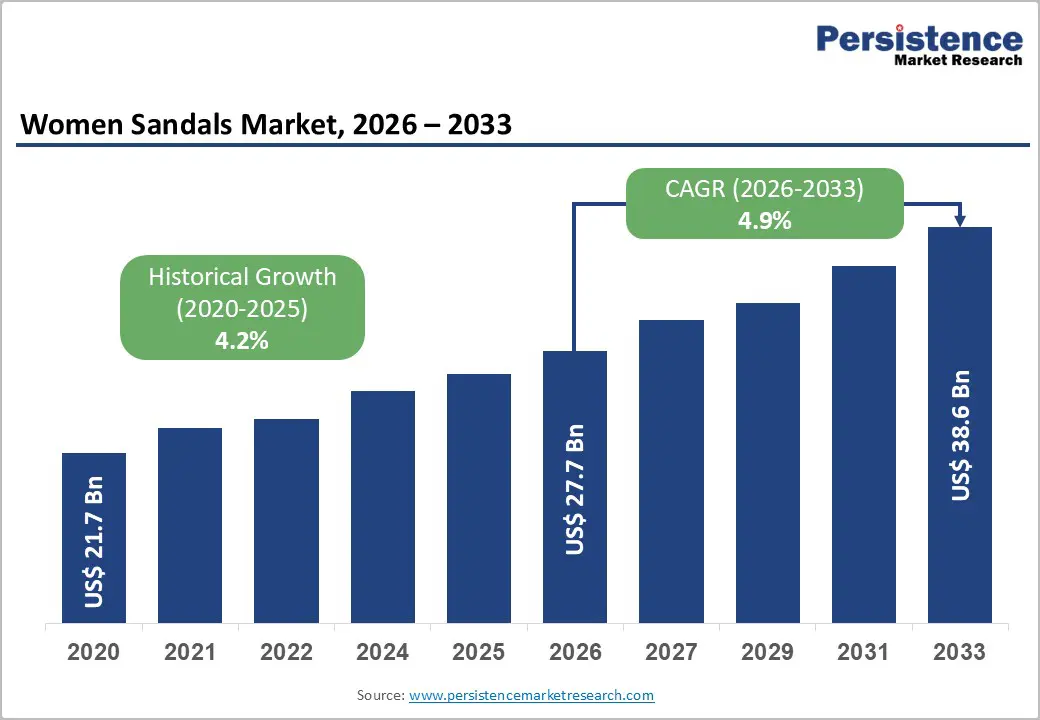
The global women sandals market size is likely to be valued at US$27.7 billion in 2026 and is projected to reach US$38.6 billion by 2033, growing at a CAGR of 4.9% during the forecast period 2026–2033, driven by rising demand for fashion-forward yet comfort-oriented footwear, increasing female workforce participation, and the growing influence of social media fashion cycles and celebrity-led footwear trends.
According to international trade data from UN Comtrade and consumer trend insights from OECD lifestyle expenditure reports, footwear spending among women has steadily increased across urban economies. The growth is further supported by innovation in sustainable materials, especially bio-based and EVA foam sandals, aligning with environmental regulations in Europe and North America.
Key Industry Highlights:
- Product Type Segmentation: Flat sandals are set to lead the women sandals market with around 34% share in 2026, while orthopedic sandals are likely to grow the fastest through 2033, driven by rising foot health awareness and aging population trends.
- Material Type Segmentation: Synthetic materials are expected to dominate with around 42% share in 2026, while bio-based materials are projected to grow the fastest through 2033, supported by sustainability regulations and eco-conscious consumer demand.
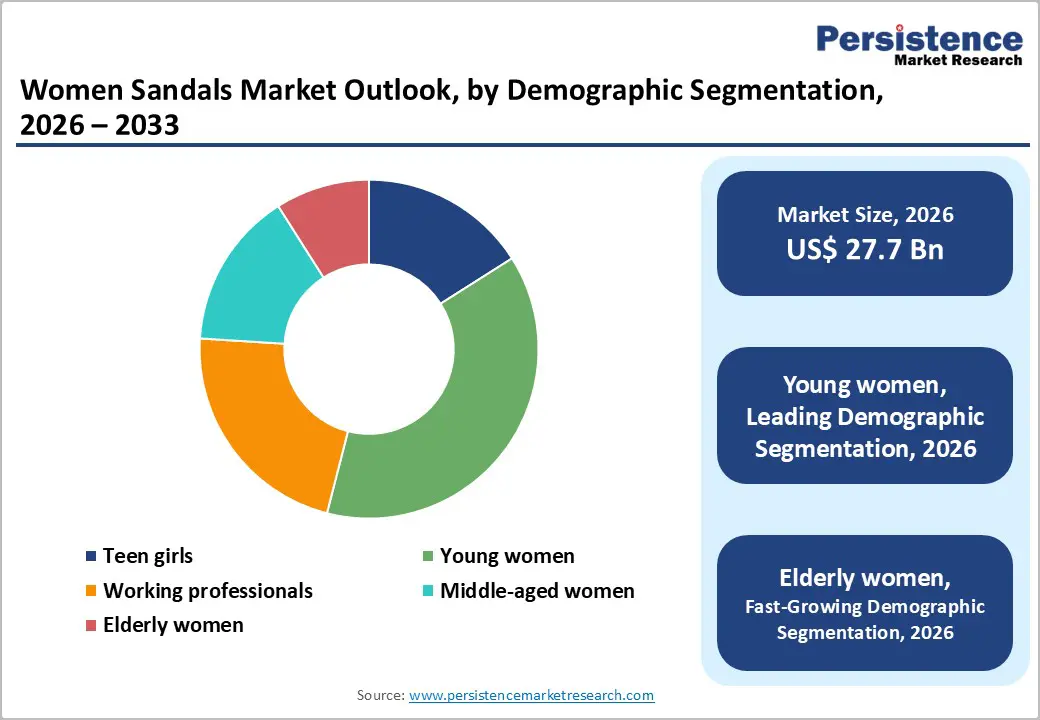
- Demographic Segmentation: Young women are set to lead with a dominant 38% share in 2026, while elderly women are expected to grow the fastest through 2033, driven by increasing demand for comfort-oriented and orthopedic sandal designs.
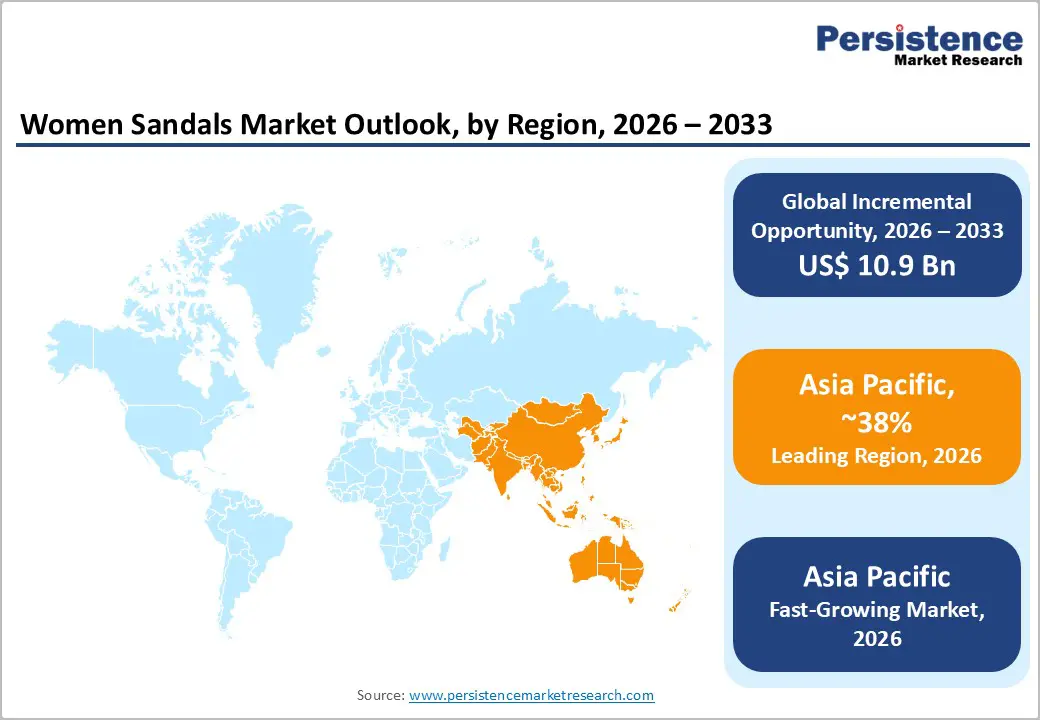
- Regional Leadership: Asia Pacific is poised to dominate with an estimated 38% share in 2026 and is likely to grow at a CAGR of 5.2% through 2033, supported by urbanization, rising disposable incomes, and strong footwear manufacturing ecosystems in China and India.
- Structural Market Shift: Eco-friendly materials such as bio-based polymers, cork, and recycled EVA foam are expected to account for 15–20% of premium sandal production by 2033, as sustainability becomes a core competitive differentiator and regulatory compliance factor.
DRO Analysis
Driver - Rising Female Workforce Participation and Lifestyle Shifts
A major growth driver for the women sandals market is the increasing participation of women in the global workforce, which is reshaping footwear consumption patterns toward functional yet stylish designs. According to the International Labour Organization (ILO), global female labor force participation has remained above 45% in recent years, with higher rates in urban economies such as North America and Asia Pacific.
This shift has increased demand for versatile footwear such as flat sandals, wedge sandals, and strappy sandals, which combine comfort with professional aesthetics. The World Bank highlights that rising disposable income among working women in emerging economies such as India and Indonesia is directly linked to higher spending on lifestyle products, including footwear.
As a result, manufacturers are prioritizing ergonomic designs and lightweight materials, boosting innovation in EVA foam sandals and hybrid constructions. This structural shift is significantly expanding the mid-premium segment of the market, particularly in urban retail and online channels.
Restraint - Raw Material Price Volatility and Supply Chain Disruptions
The market faces notable constraints due to volatility in raw material prices, particularly leather, rubber, and synthetic polymers. According to the OECD commodity price index, global leather and petrochemical-based material prices have experienced fluctuations due to energy costs and supply chain instability.
This volatility directly impacts manufacturing margins, especially for small and medium footwear producers. Additionally, disruptions in global logistics networks, as reported by World Trade Organization (WTO) supply chain assessments, have increased lead times and freight costs, affecting inventory cycles.
These challenges reduce pricing flexibility in highly competitive markets, forcing manufacturers to either absorb costs or pass them to consumers, thereby limiting demand elasticity in price-sensitive regions such as Latin America and parts of Asia.
Opportunity - Expansion of Sustainable and Bio-Based Footwear Materials
A significant opportunity in the women sandals market lies in the rapid shift toward sustainable footwear production. The growing environmental awareness and regulatory pressure in Europe under the EU Green Deal framework are pushing brands to adopt bio-based materials, cork-based sandals, and recycled EVA foam.
The sustainable footwear segment is expected to represent a rapidly expanding niche within the global footwear industry, with increasing consumer willingness to pay a premium for eco-friendly products. Industry estimates from sustainability-focused organizations such as the Ellen MacArthur Foundation indicate that circular fashion adoption could influence over 20% of footwear production in developed markets by the early 2030s.
This creates strong opportunities for innovation-led companies to capture environmentally conscious consumers, particularly in premium urban markets, while also reducing long-term regulatory compliance risks.
Category-wise Analysis
Product Type Insights
The flat sandals segment is likely to remain the leading category in the women sandals market, accounting for an estimated 34% share in 2026. This dominance is expected to be supported by strong mass-market adoption across working professionals, students, and urban consumers who continue to prefer lightweight and versatile footwear. The ongoing normalization of hybrid work and lifestyle patterns is likely to sustain demand for footwear that can transition across formal and casual settings.
Orthopedic sandals are likely to emerge as the fastest-growing product type during 2026–2033. This growth is expected to be driven by increasing awareness of preventive foot health and rising willingness among consumers to invest in comfort-oriented footwear solutions. Developed markets such as Japan and Germany are likely to contribute significantly, supported by aging population structures and healthcare-led footwear recommendations. In addition, it is expected that footwear brands will increasingly integrate ergonomic and biomechanical design inputs, further accelerating adoption in this category.
Material Type Insights
Synthetic materials are likely to continue leading the market, with an estimated 42% share in 2026, driven by cost-efficiency, large-scale manufacturability, and strong compatibility with fast-fashion production cycles. This dominance is expected to remain particularly strong across Asia Pacific manufacturing hubs, where high-volume production supports global supply chains. The ability of synthetic materials to quickly adapt to changing fashion trends is also likely to reinforce their role as a core input material across mass-market footwear.
Bio-based materials are expected to be the fastest-growing segment, from 2026–2033. This growth is likely to be supported by tightening sustainability regulations and increasing consumer preference for environmentally responsible products. Policy frameworks such as the EU Green Deal, along with corporate decarbonization commitments, are expected to accelerate the shift toward recycled EVA, cork-based composites, and plant-derived materials. In addition, it is likely that leading footwear brands will expand investments in sustainable material innovation to align with long-term ESG goals.
Demographic Segmentation Insights
Young women aged between 18 and 32 years are expected to lead the market, holding an estimated 38% share in 2026. This leadership is likely to be driven by strong fashion orientation, rapid trend adoption, and the strong influence of digital and social media platforms on purchasing behavior. Categories such as platform sandals, strappy sandals, and slide sandals are expected to see particularly strong demand from this group. In addition, rising urbanization and growing online retail penetration are likely to further reinforce consumption patterns among this demographic.
Elderly women are projected to be the fastest-growing demographic segment from 2026 to 2033. This growth is likely to be supported by increasing global aging trends, particularly across Europe and East Asia, where healthcare systems are placing greater emphasis on mobility support and preventive orthopedic care. Increased awareness of chronic foot conditions such as plantar fasciitis and arthritis is also driving the adoption of comfort-focused sandals.
Regional Insights
North America Women Sandals Market Trends
North America is expected to account for an estimated 24% share of the global women's sandals market in 2026, supported by high disposable incomes, strong brand penetration, and advanced omnichannel retail ecosystems. The region continues to show a strong preference for premium, comfort-driven, and sustainable sandals, with the growing influence of direct-to-consumer footwear platforms. Demand is also being reinforced by lifestyle shifts toward casualization of footwear and increasing adoption of eco-certified materials across mainstream retail channels.
U.S. Women Sandals Market Trends
The U.S., with an estimated 46% regional share, is likely to remain the primary growth engine. In 2025, several U.S.-based footwear retailers expanded their “carbon-labeled footwear” product lines, reflecting growing ESG transparency expectations among consumers. The year 2026 is also seeing accelerated expansion of digitally native sandal brands focusing on customization and rapid design-to-market cycles, particularly across urban retail hubs.
Canada Women Sandals Market Trends
Canada, accounting for an estimated 12% regional share, is witnessing steady expansion driven by rising demand for durable and season-adapted sandals suited to variable climate conditions. In 2025, Canadian retail chains increasingly introduced curated sustainable footwear sections in partnership with ethical sourcing programs, strengthening consumer awareness around material traceability and low-impact production practices.
Europe Women Sandals Market Trends
Europe is expected to hold an estimated 22% share of the global women sandals market in 2026, driven by strong regulatory frameworks, high sustainability adoption, and demand for premium design-led footwear. The region is increasingly shaped by circular economy principles, where recyclable materials and extended product lifecycle strategies are becoming standard industry practice. Consumer preference is also shifting toward ethically produced sandals, particularly in urban fashion markets.
Germany Women Sandals Market Trends
Germany, with an estimated 24% regional share, is likely to lead in technical and comfort-focused sandal innovation. In 2025, several German footwear manufacturers scaled up automated production systems, integrating recyclable material sorting, improving production efficiency, and ensuring sustainability compliance. This is further supported by rising domestic demand for orthopedic and ergonomically engineered sandals across aging population segments.
France Women Sandals Market Trends
France, holding an estimated 18% regional share, continues to be driven by high-end fashion and design-centric consumption. In 2026, French retail groups are increasingly emphasizing “eco-luxury” sandal collections, with stronger integration of biodegradable packaging and traceable sourcing frameworks. This aligns with growing consumer demand for sustainability without compromising aesthetic appeal in premium footwear categories.
Asia Pacific Women Sandals Market Trends
Asia Pacific is expected to dominate the women sandals market with an estimated 38% global share in 2026, supported by rapid urbanization, expanding middle-class populations, and strong footwear manufacturing ecosystems. The region is also experiencing accelerated digital commerce adoption, which is significantly improving product accessibility across tier-2 and tier-3 cities. Increasing female workforce participation and fashion consciousness are further strengthening long-term demand fundamentals.
China Women Sandals Market Trends
China, accounting for an estimated 48% regional share, remains the largest production and consumption hub. In 2025, several manufacturing clusters in coastal China expanded smart factory integration in footwear production, improving efficiency and reducing lead times for fast-fashion sandal categories. The market is also witnessing strong growth in mid-premium segments driven by domestic lifestyle branding and online retail expansion.
India Women Sandals Market Trends
India, with an estimated 20% regional share, is emerging as a high-growth consumer and manufacturing market. In 2026, the expansion of domestic footwear clusters under government-supported manufacturing incentives has strengthened local production capacity for affordable sandal categories. The rising adoption of organized retail and e-commerce platforms is accelerating demand for fashion-forward and comfort-oriented sandals among urban female consumers.
Competitive Landscape
The global women sandals market is moderately fragmented, with leading players such as Nike, Adidas, Puma, Skechers, Crocs, Birkenstock, and Bata collectively holding a strong share of branded revenue. These companies compete primarily on brand strength, comfort innovation, and sustainable material integration, while leveraging extensive retail and e-commerce networks to maintain global reach. Continuous investments in design upgrades and eco-friendly sandal lines are helping them retain consumer loyalty across the key markets.
Alongside global leaders, players such as Steve Madden, ALDO, Clarks, ECCO, and Relaxo Footwears are strengthening positions through regional dominance, fast product refresh cycles, and value-focused offerings. Competition is intensifying as digital-first brands expand through online channels, reducing entry barriers. The market is expected to gradually consolidate as larger firms acquire niche, sustainable, and comfort-focused footwear brands to expand portfolio depth and geographic presence.
Key Industry Developments:
- In 2026, Nordstrom marked its 125th anniversary with exclusive partnerships across luxury and athletic brands, including Manolo Blahnik, Chanel, Nike, Adidas, and Birkenstock. The initiative highlights the growing convergence of luxury fashion and comfort footwear, strengthening premium demand for women’s sandals through limited-edition capsule collections and experiential retail.
- In May 2025, Skechers was taken private in a landmark US$9.4 billion deal by 3G Capital, making it one of the largest footwear acquisitions in industry history. The move reflects rising consolidation in the global footwear market, enabling long-term restructuring and a stronger focus on lifestyle and comfort segments, including women’s sandals.
Companies Covered in Women Sandals Market
- Nike Inc.
- Adidas AG
- Puma SE
- Crocs Inc.
- Skechers USA Inc.
- Birkenstock
- Bata Corporation
- Steve Madden Ltd.
- Clarks
- Havaianas
- ECCO
- Woodland
- Relaxo Footwears
- ALDO Group
- Deichmann SE


