




- Metalworking & Fabrication
- Wire Stripping Machine Market
Wire Stripping Machine Market Size, Share, and Growth Forecast, 2026 – 2033
Wire Stripping Machine Market by Product Type (Automatic Wire Stripping Machines, Others), Application (Electrical and Electronics, Automotive, Telecommunications, Renewable Energy, Construction), and Regional Analysis for 2026 – 2033

Wire Stripping Machine Market Size and Trends Analysis
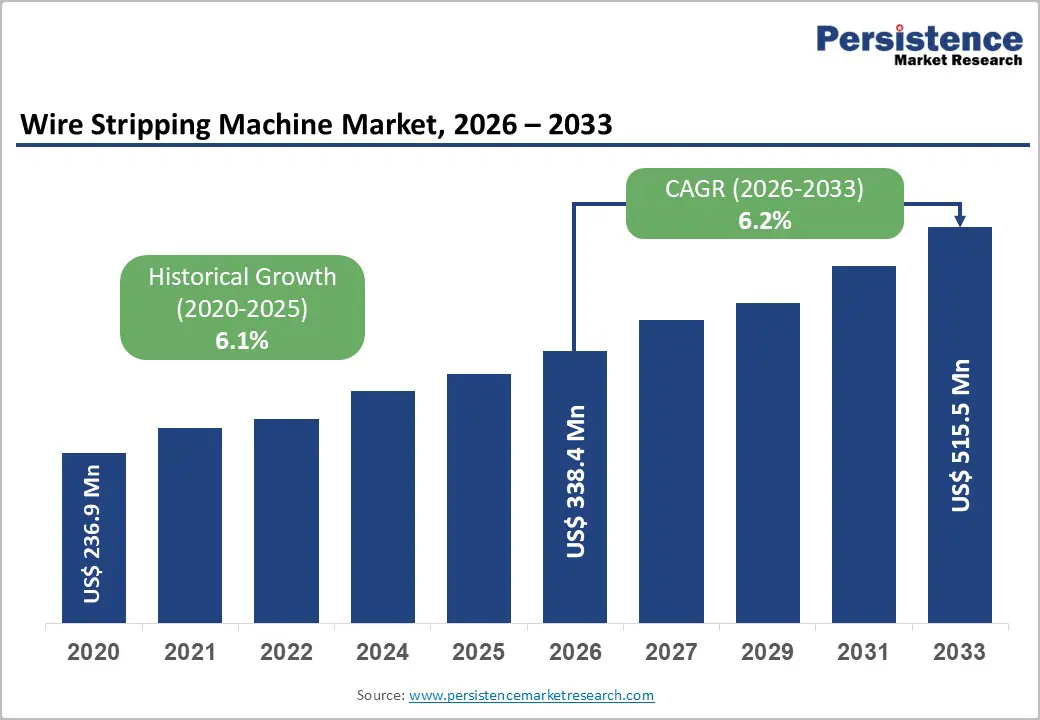
The global wire stripping machine market size is likely to be valued at US$338.4 million in 2026 and is expected to reach US$515.5 million by 2033, growing at a CAGR of 6.2% during the forecast period from 2026 to 2033, driven by rising demand in automation-intensive industries such as automotive, electronics manufacturing, and renewable energy, where precise and efficient wire processing is essential.
The adoption of advanced wire-stripping technologies for cable preparation, recycling, and assembly is increasing productivity while reducing labor costs. The expansion of telecommunications infrastructure, including 5G networks and fiber-optic deployments, supports market growth, alongside trends in electrification and industrial automation that require high-precision wire handling equipment. Modernization of manufacturing facilities is driving the replacement of legacy systems with fully and semi-automated machines to meet efficiency, safety, and quality requirements.
Key Industry Highlights:
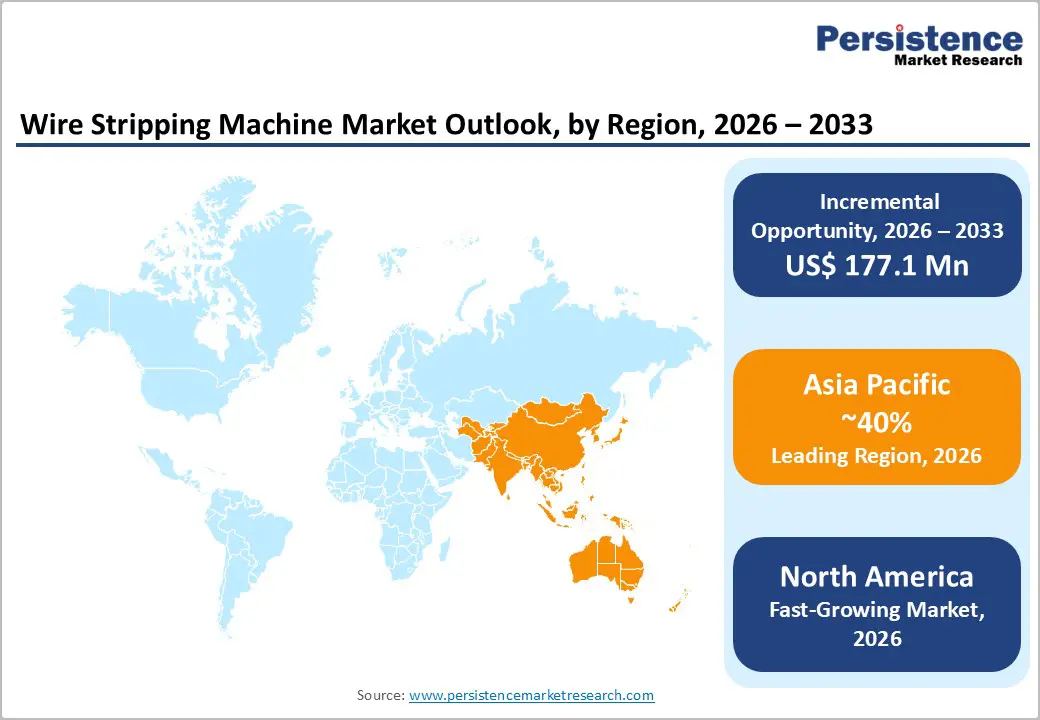
- Leading Region: Asia Pacific is anticipated to be the leading region, accounting for a market share of 40% in 2026, driven by industrialization, electronics, and automotive expansion, infrastructure development, and regulatory support for green initiatives.
- Fastest-growing Region: North America is likely to be the fastest-growing region, supported by advanced manufacturing, automotive, and electronics sectors, R&D investment, and strong regulatory support for innovation and automation.
- Leading Product Type: Automatic wire-stripping machines are projected to account for 50% of revenue in 2026, driven by their efficiency, precision, and ability to reduce labor costs in high-volume production environments such as automotive and electronics manufacturing.
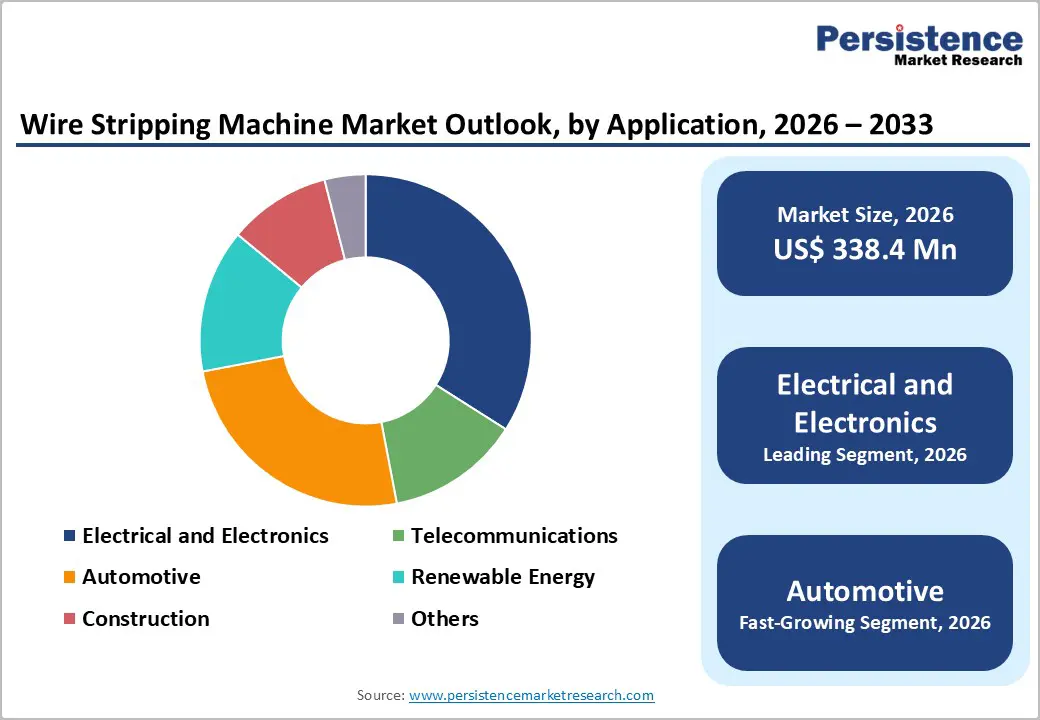
- Leading Application: Electrical and electronics are projected to be the leading application type, accounting for over 45% of revenue in 2026, supported by high demand for consumer devices and component assembly.
| Global Market Attributes | Key Insights |
|---|---|
| Wire Stripping Machine Market Size (2026E) | US$338.4 Mn |
| Market Value Forecast (2033F) | US$515.5 Mn |
| Projected Growth (CAGR 2026 to 2033) | 6.2% |
| Historical Market Growth (CAGR 2020 to 2025) | 6.1% |
Market Factors – Growth, Barriers, and Opportunity Analysis
Industrial Automation and Manufacturing Efficiency
Manufacturers increasingly adopt automated solutions to enhance operational efficiency, precision, and output. In industries such as automotive, electronics, telecommunications, and renewable energy, the need for accurate and consistent wire processing has become critical. Fully automatic and semi-automatic wire-stripping machines reduce manual intervention, minimize human error, and maintain consistent quality, which is essential in high-volume production environments.
Automation allows manufacturers to achieve faster cycle times, higher throughput, and lower production costs, particularly in assembly lines for complex wiring harnesses, circuit boards, and cable assemblies. Smart machines equipped with IoT capabilities and programmable controls enable predictive maintenance, remote monitoring, and integration with broader production management systems.
Manufacturing efficiency is another critical factor driving demand for wire stripping machines. Modern production facilities prioritize minimizing labor costs, reducing waste, and optimizing workflows, all of which are supported by automated wire-processing equipment. Semi-automatic and fully automatic machines can handle diverse wire types, diameters, and insulation materials with minimal adjustment, thereby improving flexibility and operational speed.
In the automotive sector, precise wire stripping ensures reliability in complex wiring harnesses for electric and conventional vehicles, reducing defects and assembly rework. In electronics manufacturing, high-precision stripping of fine-gauge wires is essential for component connectivity and product performance.
Supply Chain Constraints and Raw Material Volatility
The manufacturing of these machines relies on precision components, advanced electronics, motors, sensors, and high-grade steel or aluminum for machine frames. Disruptions in the supply chain, including geopolitical tensions, shipping delays, or logistics bottlenecks, can delay production and delivery schedules, thereby impairing manufacturers' ability to meet customer demand. Most wire-stripping machines require the integration of electronic control systems, programmable logic controllers (PLCs), and specialized tooling, often sourced from multiple regions. Shortages or delays in these critical components can lead to increased lead times, production slowdowns, and higher operational costs. Smaller suppliers or regional manufacturers are particularly vulnerable to such disruptions, which can undermine their market competitiveness.
Raw material volatility is another important restraint impacting the wire stripping machine market. Fluctuating metal prices, such as those for steel, aluminum, copper, and other alloys used in machine frames, wiring, and cutting components, directly affect manufacturing costs. High volatility increases production expenses, which can be passed on to customers, potentially reducing demand, especially in price-sensitive regions or among small and medium-sized enterprises.
The cost and availability of electronic components, sensors, and precision motors, often affected by semiconductor shortages or material scarcity, add uncertainty. Raw material price fluctuations may also delay new product launches or upgrades, as manufacturers struggle to stabilize costs while maintaining quality.
Renewable Energy and Sustainability Initiatives
Solar power plants, wind farms, energy storage systems, and grid modernization projects require extensive use of electrical cables and wiring assemblies, all of which demand precise and reliable wire stripping solutions. As governments and private investors increase spending on renewable infrastructure to meet decarbonization targets, demand for efficient cable-preparation equipment continues to rise.
Automatic and semi-automatic wire stripping machines enable high-speed, accurate processing of power cables used in solar panels, wind turbines, and power distribution networks. These machines help manufacturers and installers meet strict quality and safety standards while improving productivity.
Sustainability initiatives enhance market opportunities by encouraging the adoption of efficient, low-waste manufacturing processes. Modern wire stripping machines support sustainability goals by reducing material waste, minimizing insulation damage, and enabling precise separation of conductive materials for recycling. This is particularly important in cable recycling and end-of-life energy infrastructure, where efficient wire stripping improves metal recovery rates and reduces environmental impact.
Manufacturers are increasingly focusing on energy-efficient machines and durable designs that align with green manufacturing standards. The push toward circular economy practices is increasing demand for wire-stripping machines in recycling facilities that process copper and aluminum cables from renewable energy systems, electric vehicles, and industrial equipment.
Category-wise Analysis
Product Type Insights
Automatic wire stripping machines are expected to lead, accounting for approximately 50% of revenue in 2026, driven by their superior efficiency in high-volume and precision-driven manufacturing environments. These machines are widely adopted in automotive, electrical, and electronics manufacturing, where consistent quality, speed, and minimal error rates are critical. Their ability to process complex wire types, varied insulation materials, and multiple diameters with minimal human intervention makes them essential in automated production lines.
Industry-wide shifts toward smart factories support their dominance, as automatic machines integrate seamlessly with robotic assembly lines and digital control systems. For example, their extensive use in automotive wiring harness production, where automatic wire stripping ensures uniform stripping length and insulation accuracy, directly impacts vehicle safety and performance.
Semi-automatic wire stripping machines are likely to represent the fastest-growing segment in 2026, supported by their balance between automation and cost efficiency, making them highly suitable for mid-scale production environments. These machines appeal strongly to manufacturers seeking improved productivity without the high capital investment required for fully automated systems. Growing demand from small and medium-sized enterprises in electronics assembly, appliance manufacturing, and cable processing is accelerating adoption.
Semi-automatic machines offer flexibility in handling different wire specifications while maintaining acceptable precision and speed. For example, electronics component manufacturers that require frequent wire-type changeovers, where semi-automatic machines allow operators to quickly adjust settings while maintaining consistent output quality.
Application Insights
The electrical and electronics segment is projected to lead the market, accounting for approximately 45% of revenue in 2026, supported by sustained demand from consumer electronics, industrial electronics, and component assembly. Precise wire stripping is essential in this segment to ensure reliable electrical connections, minimize signal loss, and maintain product durability. The widespread use of complex wiring in devices such as consumer appliances, control panels, circuit boards, and power supplies has increased reliance on advanced wire stripping equipment. Automation in electronics manufacturing reinforces this segment’s leadership, as manufacturers focus on improving consistency, speed, and reducing defects. For instance, wire stripping machines are used in printed circuit board assembly lines to ensure precise insulation removal, which is essential for high-quality soldering and long-term device reliability.
The automotive segment is likely to be the fastest-growing application, driven by increasing vehicle electrification and the growing complexity of wiring systems. Modern vehicles, especially electric and hybrid models, rely on complex and highly precise wiring harnesses to manage power distribution, battery systems, and electronic controls. This has driven strong demand for advanced wire-stripping solutions capable of handling high production volumes while maintaining strict quality standards.
For example, in electric vehicle manufacturing, precise wire stripping is crucial to ensure the safety, reliability, and performance of batteries and charging systems. As automakers increasingly adopt automation and electrification, wire-stripping machines play a vital role in improving assembly efficiency and reducing defects.
Regional Insights
North America Wire Stripping Machine Market Trends
North America is likely to be the fastest-growing region, driven by strong adoption of industrial automation, advanced manufacturing practices, and strict quality standards across key end-use industries. Automotive, electronics, aerospace, and industrial equipment manufacturers increasingly rely on automated and semi-automated wire stripping machines to ensure precision, repeatability, and production efficiency. The region benefits from a well-established manufacturing infrastructure, skilled workforce, and high investment in smart factory technologies. Replacement of legacy equipment with digitally controlled and IoT-enabled wire processing systems is a notable trend, driven by the need to reduce downtime and improve operational visibility.
Manufacturers are increasingly adopting equipment that reduces material waste, improves energy efficiency, and supports recycling operations, particularly in cable and metal recovery applications. Regulatory focus on workplace safety and environmental compliance is driving demand for automated solutions that reduce manual handling and operational risks.
The integration of wire-stripping machines into fully automated production lines is also increasing, enabling seamless coordination with cutting, crimping, and harness assembly systems. For example, The Eraser Company, based in the United States, provides a broad range of wire and cable processing machines to North American manufacturers, supporting industries that require precise stripping performance, customization, and consistent quality in both high-volume and specialized production environments.
Europe Wire Stripping Machine Market Trends
Europe is likely to be a significant market for wire stripping machines in 2026, due to strong industrial automation, high regulatory standards, and emphasis on sustainability, positioning the region as a mature and technologically advanced market in the landscape. European manufacturers are increasingly adopting automated and intelligent wire stripping solutions to enhance production accuracy, minimize downtime, and meet stringent quality and environmental standards such as CE, REACH, and RoHS, which require high levels of engineering consistency and traceability.
For example, Schleuniger, a Switzerland-based wire processing technology provider, is widely used in the automotive and industrial sectors for its precise stripping capabilities, digital controls, and modular solutions that align with European manufacturers’ quality and sustainability objectives.
Manufacturers are increasingly seeking equipment that not only performs precise insulation removal but also supports remote diagnostics, predictive maintenance, and data connectivity to enterprise resource planning (ERP) systems, enabling real-time oversight of production lines. This trend reflects the region’s strategic focus on digital transformation and smart factory deployments, particularly in automotive and high-end electronics manufacturing hubs in Germany and the U.K. The increasing complexity of wire harness assemblies, particularly in electric and hybrid vehicles, is driving demand for machines capable of handling diverse wire gauges and materials while maintaining high throughput.
Asia Pacific Wire Stripping Machine Market Trends
The Asia-Pacific region is expected to be the leading region, accounting for 40% in 2026, driven by the large electronics, automotive, and infrastructure sectors, which depend on efficient, precise wire-processing equipment. As manufacturers increase investments in smart factory technologies and production line automation, the use of automatic and semi-automatic wire stripping machines has become more widespread across high-volume industrial hubs.
For example, Kingsing Machinery, a China-based supplier of wire and cable processing machines, whose products are widely used in APAC manufacturing plants to support high-speed stripping operations and improve production efficiency by aligning with regional automation goals.
Asia Pacific wire stripping machine market is seeing an increasing focus on sustainability and recycling infrastructure, which opens new application avenues beyond traditional manufacturing. As countries in the region experience rapid economic growth and urbanization, the volume of end-of-life cables and scrap wiring has risen, prompting investment in eco-efficient cable and wire recycling systems that rely on specialized stripping machines to improve material recovery.
This trend is particularly evident in China and India, where recycling centers and material recovery facilities are scaling up operations to reduce waste and recover valuable metals such as copper and aluminum. The shift toward multi-functional machines capable of handling both production and recycling tasks is also gaining traction, as companies seek versatile equipment to support diverse operational needs.
Competitive Landscape
The global wire stripping machine market is moderately fragmented, characterized by a mix of established multinational companies and numerous regional manufacturers competing across product segments and geographies. While leading firms such as Schleuniger and Komax account for a significant share of revenue due to their extensive product portfolios and well-established networks, many smaller and mid-sized companies also contribute to the competitive landscape.
Established players are distinguished by advanced automation, high-precision solutions, and robust service infrastructure, particularly in high-demand industries like automotive, electronics, and industrial manufacturing.
Key market leaders include Schleuniger, Komax, Eraser, Kodera, MK Electronics, Artos Engineering, Carpenter Mfg, Machine Makers, Arno Fuchs, Metzner, Maple Legend Inc., Daumak, Kingsing Machinery, Wingud, and Junquan. The competitive environment is dynamic and innovation-driven, with companies focusing on continuous product development, enhanced automation, smart connectivity, and strategic expansion into emerging markets. Product differentiation, such as IoT-enabled machines, modular designs for diverse wire types, and high-speed precision models, has become a central strategy for maintaining and expanding market share.
Key Industry Developments:
- In December 2025, leading wire processing equipment manufacturers Komax and Schleuniger unveiled advanced automation upgrades incorporating Adaptive Incision Control technology in their automatic and semi-automatic wire stripping machines. This innovative system dynamically adjusts the blade incision depth in real time by continuously comparing the defined maximum notch depth with the actual cut on the wire. By compensating for wire diameter variations and detecting wire ends that exceed allowable limits, the technology greatly enhances stripping precision, minimizes material waste, and improves overall production quality.
Companies Covered in Wire Stripping Machine Market
- Schleuniger
- Komax
- Eraser
- Kodera
- MK Electronics
- Artos Engineering
- Carpenter Mfg
- Machine Makers
- Metzner
- Maple Legend Inc.
- Daumak
- Kingsing Machinery
- Wingud
- Junquan
Frequently Asked Questions
The global wire stripping machine market is projected to reach US$338.4 million in 2026.
The wire stripping machine market is driven by rising industrial automation, growing demand from automotive and electronics manufacturing, and the need for efficient, precise, and high-volume wire processing.
The wire stripping machine market is expected to grow at a CAGR of 6.2% from 2026 to 2033.
Expanding electric vehicle and renewable energy projects, increasing adoption of automated and smart wire processing technologies, and growing demand for efficient cable recycling solutions.
Schleuniger, Komax, Eraser, Kodera, MK Electronics, Artos Engineering, Carpenter Mfg, and Machine Makers are the leading players.


