




- Automotive Components & Materials
- X-By-Wire Systems Market
X-By-Wire Systems Market Size, Share and Growth Forecast, 2026 - 2033
X-By-Wire Systems Market by System Type (Throttle-by-Wire, Brake-by-Wire, Steer-by-Wire, Shift-by-Wire, Park-by-Wire), Vehicle Type (Passenger Vehicles, Others), Propulsion Type (Internal Combustion Engine, Others), and Regional Analysis for 2026 - 2033

X-By-Wire Systems Market Share and Trends Analysis
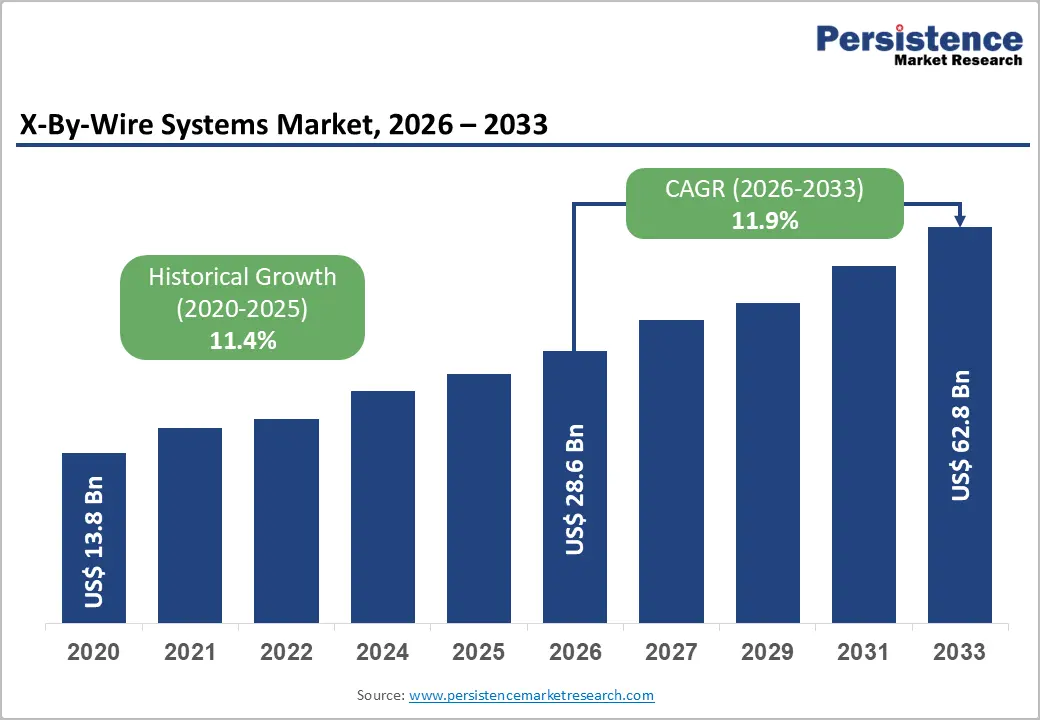
The global X-By-Wire systems market size is likely to be valued at US$28.6 billion in 2026 and is projected to reach US$62.8 billion by 2033, growing at a CAGR of 11.9% during the forecast period 2026 - 2033, driven by the rapid electrification of vehicle fleets, rising deployment of Advanced Driver Assistance Systems (ADAS), and the push toward higher fuel efficiency and lower emissions across passenger and commercial vehicles.
Expanding adoption of electronic control systems over mechanical linkages for throttle, brake, steering, shift, and parking functions is accelerating demand for integrated X-by-wire platforms that support autonomous driving, mobility-as-a-service, and connected vehicle architectures.
Key Industry Highlights:
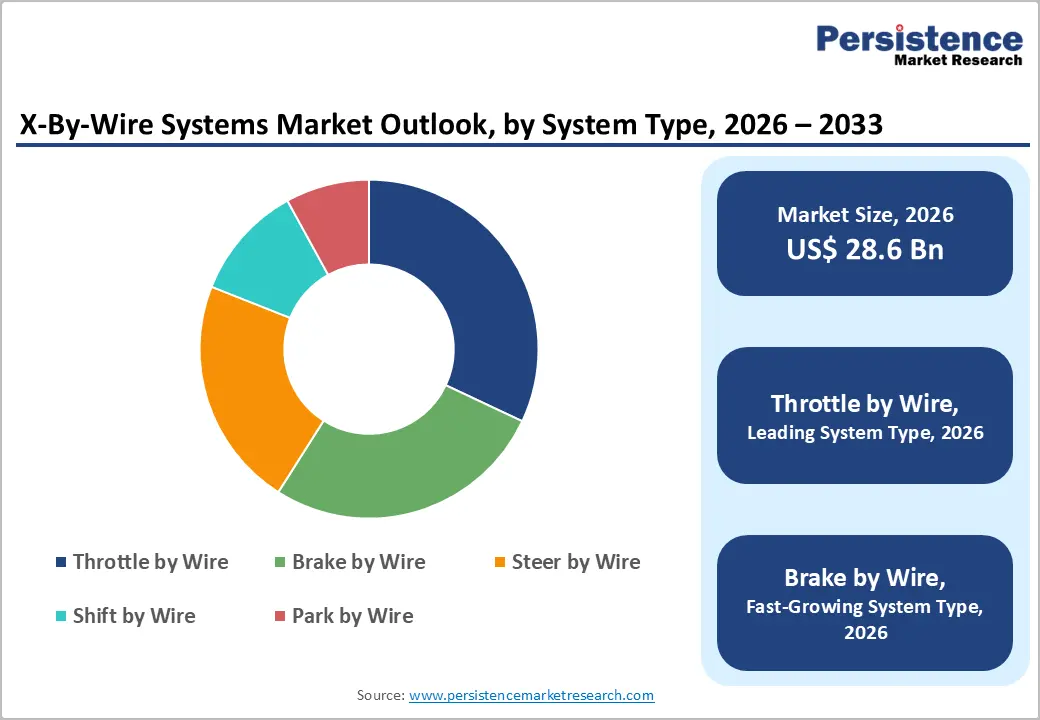
- Dominant Module Types: Throttle-by-wire is set to command around 35% of the revenue share in 2026, while brake-by-wire and steer-by-wire are expected to be the fastest-growing modules, driven by ADAS, regenerative braking, and autonomous-driving architectures.
- Leading Vehicle Segments: Passenger vehicles are expected to lead with approximately 67% of the vehicle-type revenue share, while commercial vehicles are projected to grow the fastest, reflecting the expansion of electrified and connected fleets.
- Dominant Propulsion Type: Internal Combustion Engine (ICE)-linked X-by-wire content is projected to hold around 49% of the propulsion-type revenue share in 2026, while Battery Electric Vehicles (BEVs) are expected to be the fastest-growing segment, reflecting the global push toward EV adoption.
- Dominant Geographic Markets: North America is anticipated to lead in absolute value, accounting for approximately 32% of the global X-by-wire systems market share in 2026, while Asia Pacific is slated to represent the fastest-growing regional segment, driven by X-by-wire and ADAS-linked deployments.
- Competitive Landscape: The global X-by-wire systems market is characterized by a medium-concentration structure, with leading players such as Bosch, Continental, ZF, and Aptiv collectively holding a majority share.
DRO Analysis
Driver - Electrification and Safety Mandates Powering X-by-Wire Transformation
The global shift toward BEVs and HEVs is a primary growth lever for X-by-wire systems. Between 2023 and 2025, global EV sales rose from over 17 million to around 20.7 million units, reflecting strong double-digit growth and accelerating the transition toward electrified mobility. Electric and hybrid drivetrains align seamlessly with brake-by-wire and steer-by-wire architectures, integrating with regenerative braking and centralized electronic control units (ECUs). This enables weight reduction, improved packaging, and optimized energy efficiency. As automakers scale electrified platforms, X-by-wire systems are becoming essential to next-generation vehicle design.
Simultaneously, tightening safety regulations and rising ADAS adoption are reinforcing this momentum. Mandatory and quasi-mandatory frameworks across North America, Europe, and key Asian markets are pushing OEMs to integrate advanced electronic control systems. Safety programs such as Euro NCAP increasingly prioritize features such as Electronic Stability Control (ESC), brake-by-wire, and drive-by-wire steering, directly influencing vehicle design and ratings.
In parallel, the National Highway Traffic Safety Administration (NHTSA) is encouraging adoption of advanced braking and steering technologies. These regulatory forces are reshaping vehicle architectures and unlocking substantial long-term demand for X-by-wire systems.
Restraint - Safety-Critical Complexity and Lack of Standardization Limiting Adoption
X-by-wire systems replace mechanical linkages with electronic actuators and sensors, introducing potential single-point failure modes that require redundant architectures, fail-safe protocols, and ASIL-D-grade safety design. This significantly increases system complexity, validation costs, and development timelines, especially for steer-by-wire and drive-by-wire platforms. Concerns around latency, software faults, and sensor drift in safety-critical functions persist. In 2025, investigations and recalls reviewed by the National Highway Traffic Safety Administration reinforced risks linked to electronic control failures, slowing adoption in cost-sensitive and emerging markets.
The absence of standardized protocols and interface harmonization further constrains market growth. Diverse regional and OEM-specific standards for communication protocols, CAN-based interfaces, and sensor-actuator configurations create interoperability challenges. In 2025-2026, efforts by the UNECE World Forum for Harmonization of Vehicle Regulations to align software and cybersecurity frameworks highlighted ongoing gaps across regions. This fragmentation increases integration costs, delays time-to-market, and limits scalable deployment, particularly in commercial and off-road vehicle segments.
Opportunity - Structural Tailwinds Creating High-Value Growth Opportunities in X-by-Wire
The X by wire systems market offers strong opportunities because it sits at the intersection of vehicle electrification, autonomous driving, and advanced safety regulation, all of which are undergoing long-term structural shifts rather than short-term cycles. The move toward Level 2+ ADAS and autonomous platforms increases the need for drive-by-wire, steer-by-wire, and brake-by-wire actuation, since these architectures deliver the high bandwidth, low latency control loops required for safe, software-defined driving stacks. As a result, X by wire penetration in new vehicle platforms is projected to rise from roughly 20-30% today to over 50% by 2033, turning once optional electronic modules into core building blocks of the modern vehicle architecture.
Beyond passenger cars, the electrification and lightweighting of commercial trucks, construction and mining equipment, and agricultural vehicles create a parallel growth axis. Brake-by-wire and shift-by-wire systems help hybrid and electric commercial fleets optimize energy recovery, transmission efficiency, and cabin ergonomics, while reducing fuel consumption, maintenance costs, and CO2 emissions. When combined with tightening emission rules, urban zero-emission zones, and fleet modernization mandates, these dynamics support a multibillion-dollar incremental opportunity for X by wire content, especially in high-margin commercial and off-highway segments, making the market attractive for both established suppliers and technology-focused entrants.
Category-wise Analysis
System Type Insights
The throttle-by-wire segment is estimated to be the largest within the X-by-wire systems market, accounting for approximately 35% of total system type revenue in 2026. Its dominance is expected to stem from its role in electronic throttle control units, which replace traditional throttle cables and support precise air fuel metering, smoother torque response, and alignment with emission norms such as Euro 6/7 and China 6. OEMs are projected to deploy throttle-by-wire in ICE vehicles, hybrids, and BEVs, integrating it with torque map strategies and ADAS-based adaptive cruise control, reinforcing its position as a core platform in the broader portfolio.
Among system types, brake by wire is estimated to be the fastest growing segment, with mid-teens to high-teens growth rates. In 2025, ZF Friedrichshafen introduced an integrated steer-by-wire and drive-by-wire platform for a next-generation premium EV, intended to enable column-free cockpits and ADAS-integrated trajectory control. In 2026, a major European commercial truck OEM is estimated to be deploying brake-by-wire on its battery electric long-haul tractor to improve regenerative braking efficiency and reduce hydraulic complexity, signaling a shift toward system-level architecture rather than niche features.
Vehicle Type Insights
The passenger vehicle segment is estimated to be the leading vehicle type in the X-by-wire systems market, capturing about 67% of global revenue in 2026. Its strength is expected to reflect the ongoing rollout of ADAS-enabled, electric, and connected passenger cars in North America, Europe, and China, where throttle by wire, brake by wire, and shift by wire are increasingly standard in mid to high-tier trims. OEMs are projected to leverage X by wire to enhance drive mode customization, comfort-oriented suspension tuning, and man-machine interface flexibility, consolidating passenger vehicles as the primary volume engine for the market.
Commercial vehicles are estimated to be the fastest-growing vehicle type segment, with growth projected at a higher CAGR than passenger vehicles. In 2025, Daimler Truck AG is expected to expand brake-by-wire and shift-by-wire systems into its eActros 600 battery electric truck, optimizing energy recovery and drivability for long-haul fleets. In 2026, XL Fleet is anticipated to integrate X by wire control layers into medium-duty commercial EV conversions for U.S. delivery fleets, enabling smoother pedal mapping and integrated ADAS support, indicating that commercial platforms are likely to become a key growth vector for X by wire adoption.
Propulsion Type
Within propulsion type, internal combustion engine-powered vehicles are estimated to remain the leading segment by installed base volume, holding a majority share of X by wire content in 2026. This is expected to reflect the large existing ICE fleet and the gradual adoption of throttle-by-wire, brake-by-wire, and shift-by-wire, often added to meet emission and safety standards without a full powertrain redesign. Retrofitting drive-by-wire and electronic braking into legacy ICE architectures is projected to sustain mid-single-digit growth in ICE-linked X-by-wire content through at least 2030, anchoring a substantial share of the revenue base.
Battery electric vehicles (BEVs) are projected to be the fastest-growing propulsion segment. The increasing integration of drive-by-wire, steer-by-wire, and brake-by-wire systems with vehicle control units and ADAS domain controllers is positioning X-by-wire technologies as a fundamental enabler of BEV architectures. By 2026, Lucid Motors is expected to gradually introduce X-by-wire steering and braking systems across its luxury EV sedan lineup, highlighting enhanced cabin flexibility and ADAS-integrated redundancy. This trend indicates that BEVs are set to become the primary design foundation for next-generation X-by-wire platforms.
Regional Insights
North America X-By-Wire Systems Market Trends
North America is projected to account for approximately 32% of global X-by-wire systems revenue in 2026, making it the largest regional market in absolute terms. This leadership is driven by strong adoption of battery electric and hybrid vehicles, a first-mover advantage in autonomous driving technologies, and stringent U.S. safety and emissions regulations that support ADAS-integrated X-by-wire architectures. Increasing investments in smart mobility infrastructure and software-defined vehicles are expected to sustain high single-digit growth in drive-by-wire, brake-by-wire, and steer-by-wire systems through 2033.
U.S. X-By-Wire Systems Market Trends
The U.S. is expected to account for roughly 68% of the region’s X-by-wire revenue in 2026, supported by ADAS-focused regulatory momentum from the National Highway Traffic Safety Administration, California’s zero-emission vehicle mandates, and strong EV platforms from Tesla, General Motors, and Ford Motor Company. The country’s innovation hubs, centered around Silicon Valley, Detroit, and Austin, are driving collaboration among OEMs, Tier 1 suppliers, and chipmakers, accelerating the deployment of Level 2+ and Level 3-ready X-by-wire systems for passenger and light commercial EVs.
Canada X-By-Wire Systems Market Trends
Canada is projected to account for around 10% of North America’s X-by-wire revenue in 2026, with growth driven by cross-border supply chain integration, electric truck pilot programs, and national EV incentive schemes that support the adoption of connected and electrified fleets. Urban delivery and transit bus OEMs in Canada are increasingly implementing X-by-wire braking and shift management systems to align with national emissions reduction goals and to participate in U.S.-linked smart mobility initiatives.
Europe X-By-Wire Systems Market Trends
Europe is projected to account for approximately 28% of global X-by-wire systems revenue in 2026, ranking as the second-largest regional market. This position is supported by a well-established base in ADAS and vehicle electrification, EU-wide CO2 reduction targets, and standardized safety frameworks such as Euro NCAP, all of which are accelerating the adoption of throttle-by-wire, brake-by-wire, and shift-by-wire technologies across both conventional ICE and plug-in hybrid platforms. Additionally, stringent functional safety regulations and type approval requirements are expected to drive consistent growth in X-by-wire system adoption rates through 2033.
Germany X-By-Wire Systems Market Trends
Germany is expected to account for roughly 40% of the region’s X-by-wire market value in 2026, driven by premium OEMs and leading German Tier 1 suppliers advancing steer-by-wire and drive-by-wire architectures for Level 3-ready and software-defined vehicles. The country’s strong R&D focus on high-reliability, steering-free cockpit concepts, and ADAS-integrated drive-by-wire systems is positioning it as a central technology hub for autonomous-oriented X-by-wire innovation.
Meanwhile, France, the U.K., and Spain together are projected to contribute around 25% of Europe’s X-by-wire revenue. Growth across these markets is supported by urban-centric EV deployments, electrification of public transit, and national vehicle safety upgrade initiatives. OEMs in France and the U.K. are increasingly incorporating X-by-wire braking and throttle systems into light commercial EVs designed for city logistics, while Spain is gaining prominence as a regional assembly base for X-by-wire-enabled sedans and hybrid vehicles serving both domestic and export demand.
Asia Pacific X-By-Wire Systems Market Trends
Asia Pacific is projected to account for approximately 30% of global X-by-wire systems revenue in 2026, and is expected to be the fastest-growing regional market through 2033. This growth is driven by strong EV policy support, government-backed ADAS mandates, and the rapid expansion of urban EV fleets across China, Japan, India, and key ASEAN economies. Cost-efficient component manufacturing, government-led EV incentive programs, and the development of localized X-by-wire production hubs are anticipated to drive mid-teens growth in ECUs, sensors, and actuators associated with drive-by-wire, brake-by-wire, and steer-by-wire platforms.
China X-By-Wire Systems Market Trends
China is expected to account for nearly 50% of the region’s X-by-wire market value in 2026, supported by strong domestic EV mandates, new energy vehicle (NEV) policy backing, and large-scale deployment of ADAS-enabled passenger and commercial electric vehicles. Chinese OEMs and Tier 1 suppliers are increasingly implementing integrated X-by-wire platforms across urban shuttles, ride-hailing EVs, and battery electric buses, strengthening the country’s position as both a major demand hub and a key testing ground for next-generation technologies.
Together, Japan and India are projected to contribute around 30% of Asia Pacific’s X-by-wire revenue in 2026. Japan continues to focus on high-reliability steer-by-wire and brake-by-wire systems for premium and hybrid vehicles, while India is emerging as a high-volume market for commercial vehicle X-by-wire applications. In India, fleet operators and three-wheeler OEMs are increasingly adopting X-by-wire braking and shift solutions for electric last-mile and intra-city logistics vehicles, supported by both central and state-level EV incentives as well as expanding charging infrastructure.
Competitive Landscape
The global X-by-wire systems market is considered moderately consolidated, with major suppliers such as Bosch, Continental AG, ZF Friedrichshafen, and Aptiv together accounting for more than half of the total global revenue. These companies benefit from long-standing OEM relationships, strong functional safety capabilities, and integrated hardware-software platforms supporting ADAS, electrification, and autonomous driving. Significant investments in steer-by-wire, drive-by-wire, and brake-by-wire R&D are helping them secure high-value EV and autonomous vehicle programs, while ongoing technology-driven acquisitions are expected to further consolidate the market.
Regional and specialized players such as Nexteer Automotive, Hitachi Astemo, Mando Corporation, and Brembo also focus on niche segments, including steer-by-wire systems, electro-hydraulic braking, and electronic shift technologies, often aligning with specific OEMs or regional markets. Entry barriers remain high due to stringent functional safety certification requirements and ASIL-D level software validation. However, increasing digitalization is enabling software-centric firms to participate through OTA-enabled control software and cloud-integrated ADAS platforms. These players are gaining traction in premium EVs, autonomous shuttles, and electrified commercial vehicles, with strategic integration partnerships with OEMs and Tier 1 suppliers serving as the primary pathway into the X-by-wire ecosystem.
Key Industry Developments:
- In April 2026, Bosch Limited announced its plan to acquire 100% stake in Bosch Chassis Systems India for up to INR 9,068.68 crore (US$1.09 billion), strengthening its vehicle motion and safety portfolio. This move enables deeper integration of braking and control technologies such as ABS and ESP, reinforcing Bosch’s position in X-by-wire and active safety systems.
- In March 2026, Li Auto introduced a combined steer-by-wire and brake-by-wire architecture, advancing fully electronic vehicle control systems for next-generation EV platforms. This development highlights the shift toward integrated by-wire systems, supporting autonomous driving capabilities and reducing reliance on mechanical linkages.
Companies Covered in X-By-Wire Systems Market
- Bayer AG
- Syngenta Group
- BASF SE
- Corteva Agriscience
- FMC Corporation
- Sumitomo Chemical Co., Ltd.
- UPL Limited
- ADAMA Ltd.
- Nufarm Limited
- American Vanguard Corporation
- Nissan Chemical Corporation
- PI Industries
- Rallis India Limited
- Isagro S.p.A.
Frequently Asked Questions
The X by wire systems market is projected to reach US$28.6 billion in 2026.
The X-by-wire systems market is driven by rising vehicle electrification, advanced safety regulations, and the adoption of ADAS and autonomous-driving features across vehicle segments.
The X by wire market is expected to grow at a CAGR of 11.9% from 2026 to 2033.
Key opportunities lie in the expanding adoption of X-by-wire systems across BEVs, commercial vehicles, and off-highway equipment, as well as the increasing integration of steer-by-wire and brake-by-wire technologies in ADAS-enabled and autonomous vehicle platforms.
Key market participants include Bosch, Continental AG, ZF Friedrichshafen, Aptiv, Nexteer Automotive, Hitachi Astemo, Mando Corporation, and Brembo.


