




- Semiconductor Materials & Components
- Vector Network Analyzer Market
Vector Network Analyzer Market Size, Share, and Growth Forecast, 2026 - 2033
Vector Network Analyzer Market By Product Type (1 GHz to 5 GHz, 6 GHz to 10 GHz, 11 GHz to 15 GHz, Above 15 GHz), Application (Electronics & Telecommunication, Aerospace & Defense, Automotive, Others), and Regional Analysis for 2026 - 2033

Vector Network Analyzer Market Size and Trends Analysis
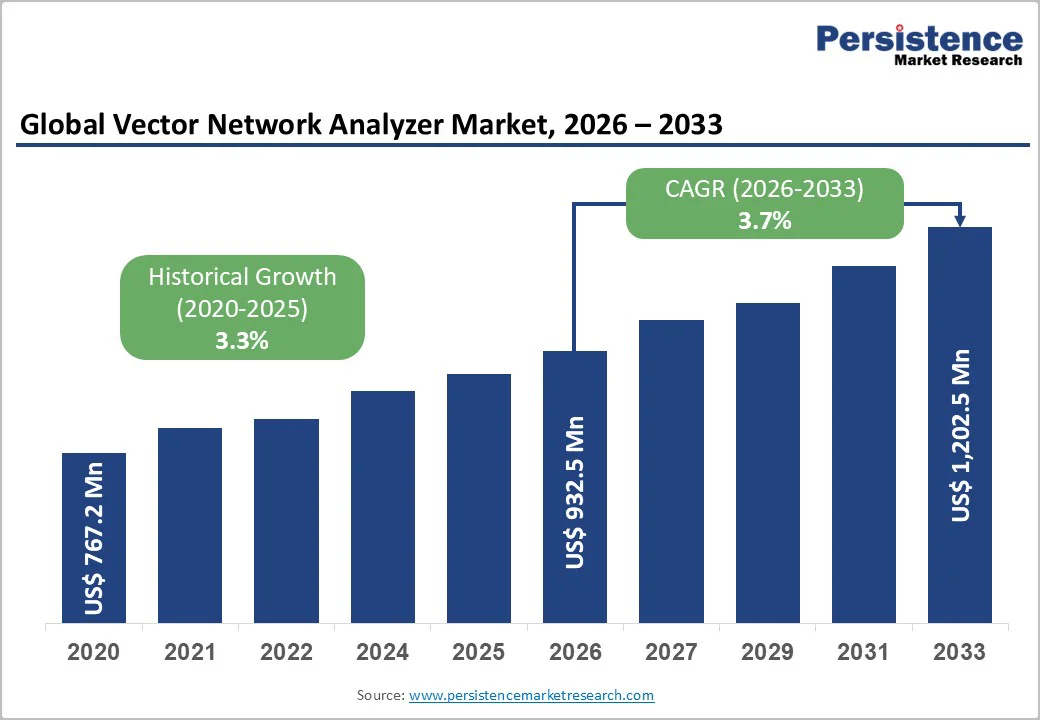
The global vector network analyzer market size is likely to be valued at US$932.5 million in 2026. It is expected to reach US$1,202.5 million by 2033, growing at a CAGR of 3.7% from 2026 to 2033, driven by the increasing prevalence of 5G testing requirements, rising demand for RF component characterization in electronics & telecommunications, and advancements in high-frequency measurement technologies.
Demand for precise S-parameter analysis in aerospace and defense is driving strong adoption of vector network analyzers. Market growth is further supported by advancements in 6–10 GHz and above 15 GHz models that offer compact, high-resolution performance, alongside rising use in automotive radar development, especially in the Asia Pacific.
Key Industry Highlights:
- Leading Region: North America, to command a 38% market share in 2026, driven by advanced RF research, high prevalence of 5G deployments, and strong R&D activities in the U.S.
- Fastest-growing Region: Asia Pacific, fueled by increasing electronics manufacturing, rising awareness of test equipment, and growing investments in telecom in China and India.
- Dominant Product Type: 1 GHz to 5 GHz, to hold approximately 35% of the market share in 2026, as it covers widely used frequency bands for Wi-Fi, LTE, and standard communication systems.
- Leading Application: Electronics & telecommunication, to account for over 50% of market revenue in 2026, driven by component validation.
- Key Market Driver: Rapid 5G rollout and demand for precise RF characterization are accelerating the adoption of vector network analyzers in telecom and automotive.
- Market Opportunity: Expansion in millimeter Wave testing and AI-enhanced analyzers creates strong opportunities for high-frequency variants.
| Key Insights | Details |
|---|---|
|
Vector Network Analyzer Market Size (2026E) |
US$932.5 Mn |
|
Market Value Forecast (2033F) |
US$1,202.5 Mn |
|
Projected Growth (CAGR 2026 to 2033) |
3.7% |
|
Historical Market Growth (CAGR 2020 to 2025) |
3.3% |
Market Factors - Growth, Barriers, and Opportunity Analysis
Rising Prevalence of 5G Testing Requirements and Demand for RF Component Characterization
The rising prevalence of 5G testing requirements globally is a primary driver of the vector network analyzer market. The deployment of 5G technology involves high-frequency signals, including millimeter-wave bands, which require precise testing and validation of RF components, antennas, filters, and transmission lines. Accurate characterization of these components is critical to ensure signal integrity, minimal interference, and optimal performance in next-generation communication systems. VNAs provide the high-resolution measurements necessary to evaluate insertion loss, return loss, phase response, and impedance characteristics across wide frequency ranges.
As telecom operators, equipment manufacturers, and research institutions expand 5G infrastructure, there is a growing need for reliable and efficient measurement tools. VNAs are used not only in laboratories but also in production lines for quality assurance, ensuring that components meet stringent performance standards. The adoption of small cells, beamforming antennas, and advanced MIMO technology further increases the demand for precise RF characterization.
High Development and Calibration Costs
The high costs associated with the development and calibration of vector network analyzers pose a significant restraint on market growth. Developing advanced VNAs capable of high-frequency operation, such as millimeter-wave testing above 15 GHz, requires substantial investment in research and development. Engineers must design highly precise RF circuits, integrate advanced signal-processing capabilities, and ensure low-noise, high-stability performance across wide frequency ranges. The use of premium components, specialized materials, and high-speed data acquisition systems further increases production expenses.
Calibration is another critical cost factor. VNAs require precise calibration to ensure measurement accuracy, which involves complex procedures using reference standards, calibration kits, and specialized test fixtures. Regular recalibration is essential to maintain traceability, especially for high-frequency and multi-port analyzers used in telecommunications, aerospace, and defense applications. The process often demands skilled technicians, advanced software, and laboratory-grade environmental conditions to prevent errors caused by temperature fluctuations or signal interference.
Advancements in Millimeter Wave Testing and AI-enhanced Analyzers
Advancements in millimeter wave testing and AI-enhanced analyzers present significant growth opportunities for the vector network analyzer market. The rollout of 5G and early developments toward 6G networks have increased demand for millimeter-wave testing, which enables the characterization of extremely high-frequency signals and the precise evaluation of antennas, filters, and other RF components. Modern VNAs capable of operating above 15 GHz provide high-resolution measurements essential for applications such as millimeter-wave radar, satellite communications, and next-generation wireless systems. These advancements allow engineers to accurately assess signal integrity, insertion loss, return loss, and phase characteristics in complex high-frequency circuits.
Integration of artificial intelligence into VNAs is enhancing usability, accuracy, and efficiency. AI-driven analyzers can automate calibration, detect anomalies, and optimize measurement setups in real time, reducing human error and minimizing test cycles. Machine learning algorithms also enable predictive maintenance of instruments and improve data analysis by identifying patterns and deviations in high-volume test scenarios.
Category-wise Analysis
Product Type Insights
1 GHz to 5 GHz is anticipated to dominate the market, accounting for approximately 35% of the share in 2026, driven by broad applicability, affordability, and baseline testing, making it preferred for telecom. 1 GHz to 5 GHz analyzers provide fundamental S-parameters, ensuring reliability. For example, Keysight Technologies offers network analyzers in the 1–5 GHz range, widely used by telecom companies and universities for validating antennas, RF circuits, and basic wireless devices, delivering accurate results at a cost-effective entry-level price. Its versatility and entry-level cost make it preferred for users.
Above 15 GHz is likely to be the fastest-growing segment, fueled by 5G millimeter-wave deployment and expanding radar applications. High-frequency operation provides superior resolution, enabling precise characterization of antennas and components. Innovations in waveguide technology and measurement techniques further enhance performance, accelerating adoption across North America and Europe. For example, telecom and aerospace firms use Rohde & Schwarz millimeter-wave analyzers above 15 GHz to test 5G base station antennas and automotive radar sensors, ensuring high-precision measurements for next-generation wireless and autonomous vehicle systems.
Application Insights
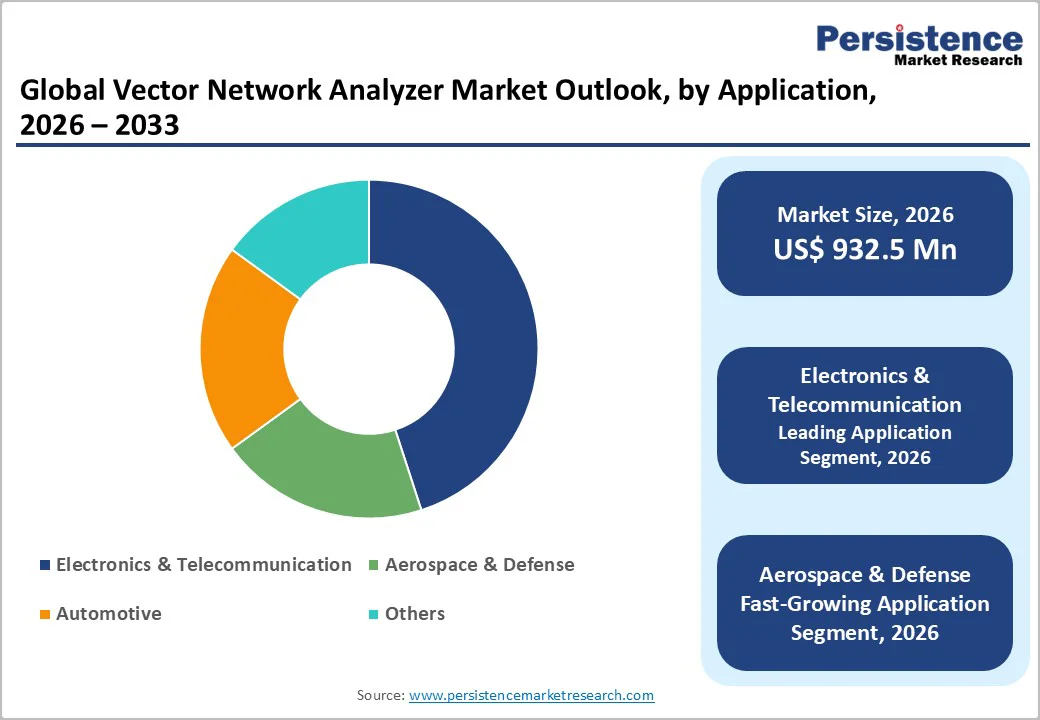
The electronics & telecommunication segment is anticipated to lead the market, holding approximately 50% of the share in 2026, driven by extensive use in component testing, antenna characterization, and high-frequency circuit validation. Laboratories, research centers, and manufacturing units rely on VNAs to ensure performance, reliability, and compliance. Growing demand for 5G, IoT devices, and wireless communication systems further reinforces its market dominance. For example, telecom companies and electronics labs use Keysight Technologies VNAs to test 5G modules, smartphone RF circuits, and IoT devices, ensuring accurate signal measurements and compliance with global wireless standards.
Aerospace & defense is the fastest-growing segment, fueled by increasing radar applications, advanced avionics, and secure communication system requirements. VNAs provide precise, reliable measurements essential for designing and testing antennas, filters, and RF components. Their accuracy, adaptability, and the ability to support complex defense and aerospace systems accelerate adoption across both military and commercial aviation sectors. For example, companies such as Rohde & Schwarz supply high-frequency VNAs to aerospace firms for testing radar systems, satellite communication antennas, and avionics modules, ensuring mission-critical reliability and performance.
Regional Insights
North America Vector Network Analyzer Market Trends
North America is projected to account for nearly 38% of the global vector network analyzer market in 2026, driven by strong adoption across telecommunications, aerospace, defense, and electronics industries. The rapid deployment of 5G infrastructure and growing research toward 6G networks have increased the demand for advanced RF and microwave testing equipment. VNAs are critical for precise measurement of antennas, filters, and high-frequency components, ensuring performance, compliance, and reliability in next-generation wireless systems.
The automotive sector is another major contributor, with VNAs used to test radar, LiDAR, and vehicle connectivity systems for electric and autonomous vehicles. Aerospace and defense industries rely on VNAs for satellite communication, radar systems, and secure RF communications, where high accuracy and reliability are essential. Technological innovations, such as modular analyzers, multi-port systems, and software-driven measurement platforms, have improved usability, reduced test times, and allowed integration with automated test setups. Compact and portable VNAs are increasingly adopted in labs and field testing environments to support flexible deployment.
Europe Vector Network Analyzer Market Trends
Europe has grown steadily due to the region’s strong focus on advanced electronics, telecommunications, and industrial innovation. Key drivers include the expansion of 5G networks, the development of automotive radar systems, and increasing demand for high-performance semiconductor devices. VNAs are essential for testing RF components, antennas, and high-frequency circuits to ensure reliability, efficiency, and compliance with industry standards.
Countries such as Germany, France, the U.K., and Italy have witnessed significant adoption in automotive, aerospace, defense, and research sectors. Automotive manufacturers rely on VNAs for testing radar sensors, in-vehicle connectivity modules, and electric vehicle components, while aerospace and defense industries use them for satellite communication systems and secure communication networks. Industrial automation and IoT applications require precise characterization of components, further supporting market growth. European buyers increasingly prefer modular, multi-port, and high-frequency analyzers that offer flexibility, real-time data analysis, and reduced testing times. Energy efficiency, compact design, and software-enabled functionalities are also shaping purchasing decisions.
Asia Pacific Vector Network Analyzer Market Trends
Asia Pacific is likely to be the fastest-growing market for vector network analyzers, driven by the region’s expanding electronics, telecommunications, and semiconductor industries. Increasing adoption of 5G and early developments toward 6G networks have significantly boosted the demand for advanced RF testing solutions, as manufacturers and service providers require highly accurate and high-frequency measurement tools to ensure performance, reliability, and compliance. Countries such as China, Japan, South Korea, and India are leading this surge, supported by government initiatives to modernize infrastructure and expand research in wireless communications.
Growth is further fueled by rising production of consumer electronics, automotive electronics, and IoT devices, all of which demand precise characterization of components, circuits, and antennas. The market also benefits from growing investments in research laboratories, university R&D programs, and testing centers that increasingly rely on compact and high-performance VNAs for innovation and quality assurance. Technological enhancements, including modular designs, software-defined measurements, and real-time data analysis, have improved usability and reduced testing time, making VNAs more accessible to a wider range of applications.

Competitive Landscape
The global vector network analyzer market is competitive, led by giants such as Keysight Technologies, Rohde & Schwarz, Anritsu, Tektronix, Copper Mountain Technologies, and National Instruments. These leaders maintain dominance through extensive portfolios, R&D, and reliability, supported by millimeter-wave, 5G/6G testing, and cloud-connected platforms.
Mid-tier and emerging vendors compete with compact USB VNAs, modular PXI systems, cost-effective benchtops, and tailored RF solutions for smaller labs and academia. Focus areas include frequency extension, real-time calibration, and software-defined measurement. Collaborations with telecom, semiconductor, defense, and automotive sectors enhance specialized capabilities for radar, satellite, 5G, EV components, and antenna design.
Key Industry Developments
- In September 2025, Keysight introduced two frequency extender modules (up to 170 GHz and 250 GHz) and a precision calibration kit, allowing PNA/PNA-X VNAs to deliver fully calibrated broadband S-parameter measurements from ~10 MHz to 250 GHz for next-gen semiconductors, sub-THz wireless, and high-speed interconnect testing.
- In 2024, Anritsu expanded its VNA offerings by introducing compact, portable VNA models designed for field testing in telecommunications and aerospace applications, improving flexibility for remote or on-site RF testing environments.
Companies Covered in Vector Network Analyzer Market
- Keysight Technologies
- Anritsu Corporation
- Rohde & Schwarz
- National Instruments
- Microchip Technology
- Axiom Test Equipment
- Tektronix
- B&K Precision
Frequently Asked Questions
The global vector network analyzer market is projected to reach US$932.5 million in 2026.
The rising prevalence of 5G testing requirements and demand for RF component characterization are the key drivers.
The vector network analyzer market is poised to witness a CAGR of 3.7% from 2026 to 2033.
Advancements in mmWave testing and AI-enhanced analyzers are the key opportunities.
Keysight Technologies, Anritsu Corporation, Rohde & Schwarz, National Instruments, and Microchip Technology are the key players.


