




- Food Packaging
- Tray Sealing Machines Market
Tray Sealing Machines Market Size, Share, and Growth Forecast 2026 - 2033
Tray Sealing Machines Market by Technology (Automation, Semi‑Automation, Manual), by Application (Meat, Poultry, Bakery & Confectionary, Ready Meals), Operating Speed (up to 3 CPM, 4 to 8 CPM, 9 to 12 CPM, above 12 CPM), and Regional Analysis, 2026 ‑ 2033

Tray Sealing Machines Market Size and Trend Analysis
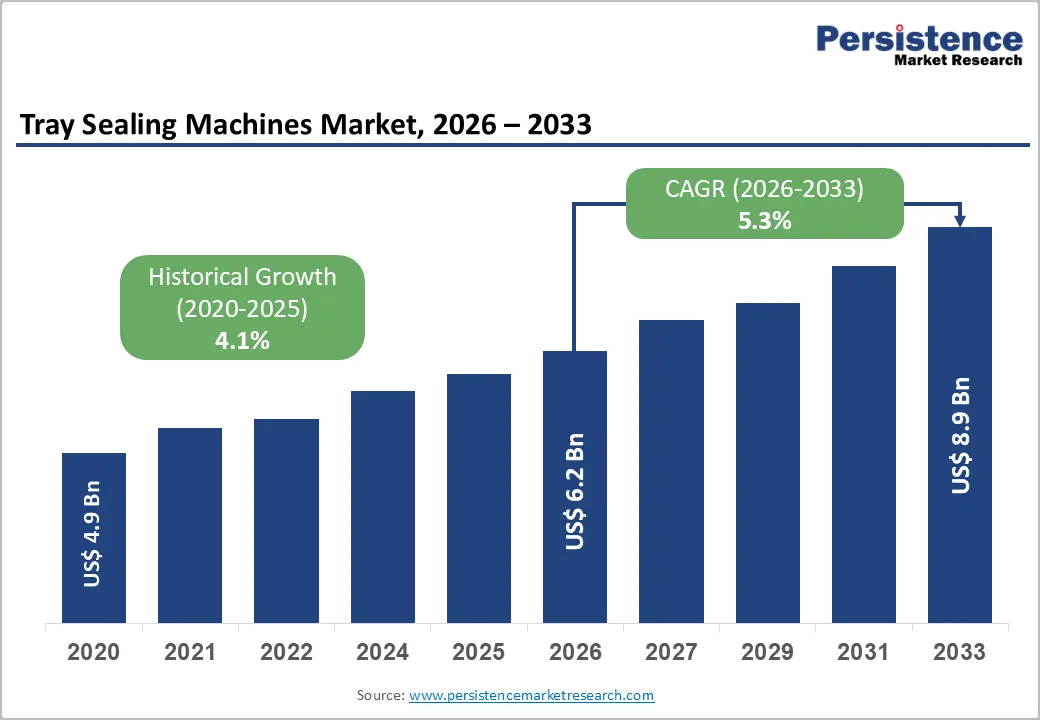
The global tray sealing machines market size is likely to be valued at US$ 6.2 billion in 2026 and is expected to reach US$ 8.9 billion by 2033, growing at a CAGR of 5.3% during the forecast period from 2026 to 2033. Demand growth is primarily driven by the expansion of convenience and ready-to-eat food categories, coupled with stringent food safety and shelf-life regulations that favor hermetically sealed trays in meat, poultry, and ready meal applications.
Key Market Highlights
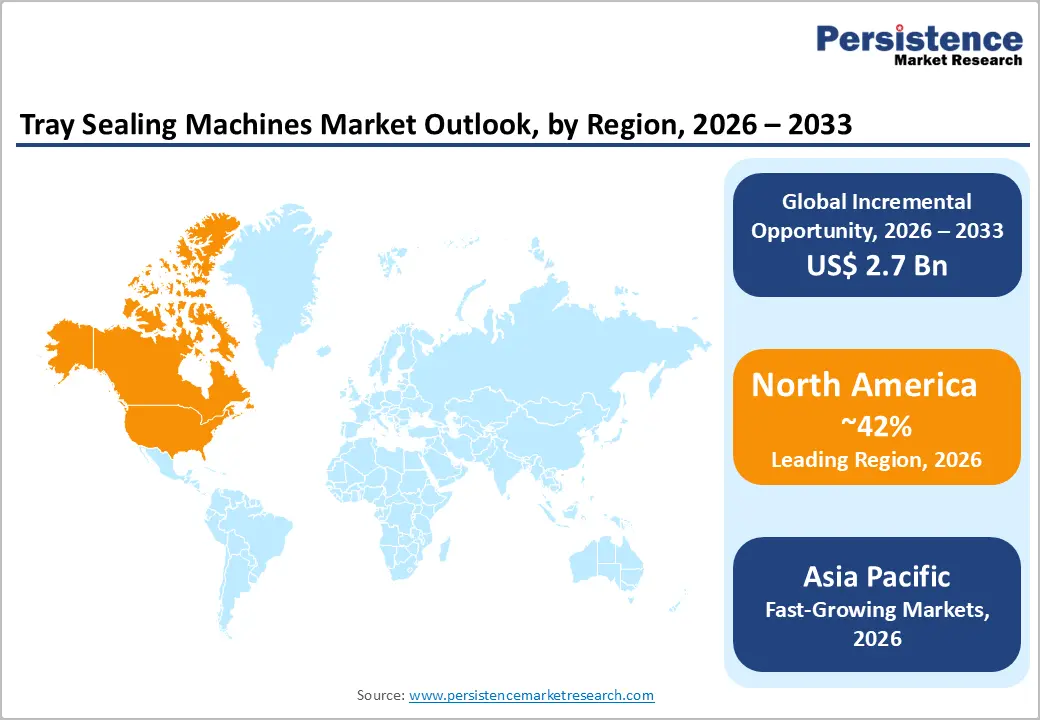
- Leading Region: North America is the largest revenue base for the Tray Sealing Machines Market, supported by stringent food safety regulations, advanced retail infrastructure, and high adoption of automated packaging lines among meat and ready-meal processors.
- Fastest-Growing Region: Asia Pacific is expected to be the fastest-growing region through 2033, driven by expanding processed food consumption, growth of modern retail and cold chain in China, India, and ASEAN, and localization strategies of leading equipment manufacturers.
- Leading Segment: The Automation technology segment dominates the market, reflecting strong demand for high-speed, integrated tray-sealing systems that enhance hygiene, reduce labor dependency, and support SKU proliferation in the protein and ready meal categories.
- Fastest-Growing Segment: Within applications, the Meat segment holds the largest share, leveraging modified atmosphere and vacuum-skin packaging capabilities of tray sealers to achieve extended shelf life, superior product presentation, and compliance with retailer quality standards.
- Key Opportunity lies in sustainable and paper-based tray solutions, where machine suppliers that can validate reliable sealing with recyclable or hybrid materials are poised to win long-term specifications from retailers and brand owners globally.
| Key Insights | Details |
|---|---|
|
Tray Sealing Machines Market Size (2026E) |
US$ 6.2 Billion |
|
Market Value Forecast (2033F) |
US$ 8.9 Billion |
|
Projected Growth CAGR (2026-2033) |
5.3% |
|
Historical Market Growth (2020-2025) |
4.1% |
Market Dynamics
Drivers - Growing Consumer Preference for Protein-Rich Ready Meals and Case-Ready Meat Driving Tray Sealing Adoption Globally
One of the strongest growth drivers for the tray sealing machines market is the steady rise in demand for convenience foods and protein-rich packaged products. Consumers increasingly prefer chilled and ambient-stable ready meals, meat, and poultry products that offer longer shelf life, better hygiene, and visual appeal. Supermarkets and foodservice operators are expanding their private-label portfolios of case-ready meat and portioned poultry, which rely heavily on tray-sealing technology.
Compared to traditional over-wrap packaging, tray sealing enables shelf-life extension of up to two to three times through modified-atmosphere packaging while maintaining freshness and product appearance. Regulatory bodies in North America and Europe are also placing stronger emphasis on microbiological safety, tamper evidence, and packaging integrity in fresh food categories. Tray sealing machines meet these requirements through consistent seal quality, gas flushing, and in-line inspection systems, making them essential for large-scale protein processing facilities.
Rising Automation Needs and Labor Cost Pressures Accelerating Investment in Fully Automated Tray Sealing Systems
Food and beverage processors worldwide are increasingly focused on automation to address skilled labor shortages and rising wage costs, making automated tray sealing machines highly attractive. End-of-line packaging automation helps manufacturers improve efficiency while reducing dependency on manual labor. Leading equipment suppliers such as MULTIVAC, Proseal, and G. Mondini offer advanced tray sealing systems that integrate denesting, filling, sealing, and case packing into a single automated line.
These solutions help processors increase throughput, reduce per-unit packaging costs, and improve Overall Equipment Effectiveness (OEE). The transition from manual or low-speed machines to high-speed automated systems is further supported by Industry 4.0 initiatives. Features such as intelligent sensors, recipe storage, rapid tool changeovers, predictive maintenance, and real-time monitoring allow producers to improve line balancing, reduce downtime, and gain better operational visibility, strengthening adoption across food processing plants.
Restraints - High Initial Capital Investment and Complex Line Integration Limiting Adoption Among Small and Mid-Sized Food Processors
Despite their strong operational benefits, tray sealing machines, especially fully automated, high-capacity systems, require significant upfront investment. This high capital expenditure can be a major barrier for small and medium-sized food processors, particularly in emerging markets where budget constraints are common. Many SMEs continue to rely on manual sealing or basic lidding solutions, as the payback period for advanced tray sealing equipment may extend beyond three to five years.
In addition to machine costs, integration into existing production lines can be complex and expensive. Retrofitting tray sealers often requires custom tooling, modifications to the conveyor system, software upgrades, and synchronization of control systems. These additional requirements increase project timelines and overall investment risk. As a result, some processors delay adoption decisions or opt for lower-capacity solutions, thereby slowing overall market penetration despite the long-term efficiency and food-safety advantages offered by modern tray-sealing technology.
Evolving Sustainability Regulations and New Packaging Materials Creating Technical and Compliance Challenges for Tray Sealing Operations
Another key restraint affecting the tray sealing machines market is the rapidly changing regulatory landscape around packaging sustainability. Governments, especially in the European Union and parts of North America, are introducing stricter regulations on single-use plastics, recyclability, and compostability. As a result, food manufacturers are shifting toward mono-material plastics, paper-based trays, fiber solutions, and thinner bio-based lidding films.
While environmentally beneficial, these materials often require precise sealing temperatures, pressures, and dwell times, increasing operational complexity. Tray sealing machines must be capable of handling diverse substrates without compromising seal integrity or shelf life. Companies that are slow to adapt tooling, sealing profiles, or validation processes risk higher reject rates, seal failures, and non-compliance with retailer standards. These challenges increase testing costs and uncertainty, causing some processors to delay capital investments in new tray sealing equipment.
Opportunities - Increasing Adoption of Recyclable and Paper-Based Tray Formats Creating New Demand for Advanced Sealing Technologies
A significant growth opportunity lies in the rapid adoption of sustainable, recyclable, and fiber-based tray formats across the global food packaging industry. Retailers and brands are actively promoting paper-based or hybrid trays with thin plastic liners that can be separated for recycling, supporting circular economy and extended producer responsibility goals. These new formats are driving demand for tray sealing machine upgrades, retrofits, and replacements that can reliably seal non-traditional materials.
Equipment suppliers that demonstrate strong sealing performance, easy material changeovers, and validated shelf-life results for sustainable trays are gaining competitive advantage. This trend is especially strong in premium ready meals, fresh produce, and protein packaging segments across Europe, and is gradually expanding in North America and Asia Pacific. Vendors that align machine capabilities with evolving sustainability requirements are well positioned to secure long-term contracts and specification wins.
Rapid Expansion of Ready Meals and Centralized Kitchens in Asia Pacific Unlocking Greenfield Equipment Opportunities
Asia Pacific presents a major growth opportunity due to rapid urbanization, rising disposable incomes, and the expansion of dual-income households. Countries such as China, India, and ASEAN nations are witnessing strong demand for chilled and frozen ready meals, convenience foods, and delivery-oriented central kitchen operations. Large foodservice chains, cloud kitchens, and organized retailers are investing in centralized production facilities and cold-chain logistics, where tray sealing machines play a critical role.
These machines enable standardized portioning, tamper evidence, leak-proof packaging, and efficient transportation of single- and multi-compartment meal trays. As online grocery, quick-commerce, and food delivery platforms expand, operators increasingly require high-speed automated tray sealing lines with flexible tooling. This creates attractive greenfield opportunities for both global and regional equipment manufacturers in Asia Pacific.
Category-wise Analysis
Technology Insights
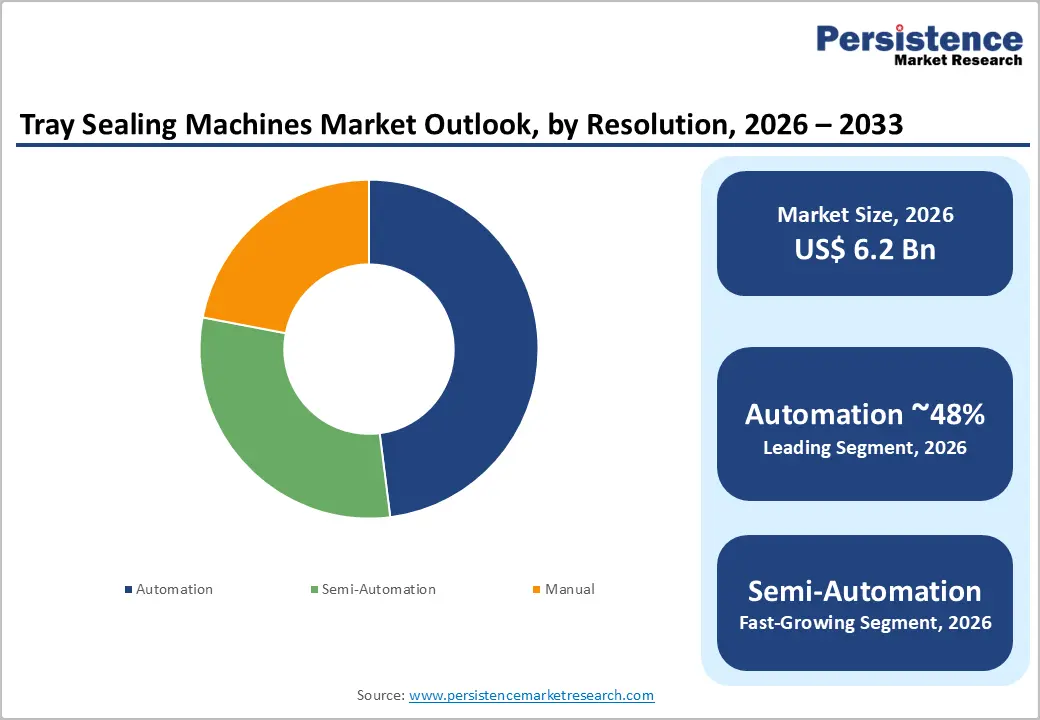
Based on technology, automated tray sealing machines account for approximately 48% of global market revenue, reflecting strong adoption across high-volume meat, poultry, and ready-meal processing operations. These facilities prioritize speed, hygiene, consistency, and compliance with strict food safety standards. Leading manufacturers such as MULTIVAC, Proseal, and G. Mondini focus on fully automated systems that integrate filling, conveying, sealing, and in-line inspection to minimize human contact and reduce contamination risks.
Automated tray sealers achieve significantly higher cycles per minute compared to manual or semi-automatic machines, improving throughput and productivity. Advanced features such as servo-controlled motion, recipe memory, intelligent sensors, and rapid changeover tooling support shorter production runs and frequent SKU changes. This flexibility is critical in modern retail environments, where product variety is increasing. Together, these benefits underpin the dominance of automated technology in the tray sealing machines market.
Application Insights
Among end-use applications, the meat segment is expected to remain the largest, accounting for around 34% of overall tray sealing machine demand, followed closely by poultry and ready meals. Case-ready red meat and poultry products are increasingly packaged using modified-atmosphere tray sealing to extend shelf life, reduce purge, and enhance visual presentation. Retailers in North America and Europe are standardizing these packaging formats across chilled food sections, driving consistent demand for tray sealing equipment.
Tray sealers enable processors to deliver leak-proof, tamper-evident packaging that meets strict hygiene and labeling requirements while withstanding complex cold-chain logistics. In addition, these machines support precise portion control and provide ample space for branding, nutritional information, and traceability labels. As meat processors continue upgrading to automated, inspection-enabled lines, demand for medium- to high-speed tray sealing machines is expected to remain strong.
Operating Speed Analysis
Based on operating speed, tray sealing machines operating at 9 to 12 cycles per minute (CPM) and above 12 CPM together account for more than 52% of installed global capacity. This reflects the growing focus among industrial food processors on maximizing throughput and line efficiency. High-speed tray sealers are widely used in large meat, poultry, and ready-meal plants that process thousands of packs per hour. In these environments, consistent seal quality, minimal downtime, and fast changeovers directly impact profitability and service levels to major retail customers.
Equipment suppliers have responded by developing robust, servo-driven platforms capable of multi-lane operation and rapid tooling changes. These machines can handle a wide range of tray sizes and depths without sacrificing speed, allowing processors to manage product variety efficiently. This flexibility reinforces the dominance of high-speed tray sealing systems.
Regional Insights
North America Tray Sealing Machines Market Trends
North America remains one of the most advanced markets for tray sealing machines, supported by strict FDA and USDA regulations governing food safety, labeling, and packaging integrity. Large meat, poultry, and ready-to-eat food processors in the United States have widely adopted automated tray sealers with gas flushing and vacuum-skin packaging capabilities. These technologies help deliver extended shelf life, leak-proof seals, and consistent product appearance across national retail chains.
The region also benefits from a strong innovation ecosystem, with leading manufacturers introducing IoT-enabled controls, intelligent monitoring systems, and AI-driven process optimization to improve OEE and reduce waste. Growth in meal kits, chilled ready meals, and e-commerce grocery services further strengthens demand for tamper-evident tray packaging. As distribution networks become more complex, investment in reliable mid- to high-speed tray sealing machinery continues to rise.
Europe Tray Sealing Machines Market Trends
Europe represents a mature yet highly dynamic market, strongly influenced by sustainability regulations and retailer commitments to reduce plastic waste. Countries such as Germany, the U.K., France, and Spain are leading the shift toward recyclable mono-material and paper-based tray formats. This transition requires tray sealing machines with precise control over sealing temperature, pressure, and dwell time to ensure consistent performance across new materials.
European Union regulations on single-use plastics and extended producer responsibility have accelerated collaboration between machine manufacturers, film suppliers, and food processors. These partnerships focus on validating new tray-lidding combinations at commercial scale. Combined with strong consumer demand for premium chilled ready meals and high-quality fresh protein, these factors support continued investment in advanced tray sealing machines featuring hygienic design, energy-efficient drives, and flexible format capabilities across the region.
Asia Pacific Tray Sealing Machines Market Trends
Asia Pacific is the fastest-growing regional market for tray sealing machines, driven by rapid urbanization, rising incomes, and expanding consumption of packaged food products. Countries such as China, Japan, South Korea, India, and ASEAN nations are witnessing strong growth in packaged meat, poultry, bakery, and ready-meal segments. Japan and South Korea already show high penetration of advanced tray sealing technology, particularly in bento meals and premium food packaging.
China and India are rapidly expanding modern retail formats and cold-chain infrastructure. Manufacturing cost advantages and growing local equipment capabilities are encouraging global suppliers to localize production, service, and application engineering in the region. Central kitchens, quick-service restaurant commissaries, and organized meat processors increasingly prefer automated or semi-automated tray sealers to ensure consistent quality, food safety, and scalability for online grocery and delivery platforms.
Competitive Landscape
The tray sealing machines market shows a moderately consolidated structure at the top, with global leaders such as MULTIVAC, Proseal, G. Mondini, Sealpac, and ILPRA holding a significant combined market share. These Tier-1 players differentiate themselves through broad product portfolios ranging from manual to fully automated systems, strong global service networks, and continuous investment in research and development. Their focus areas include AI-enabled controls, sustainability-ready tooling, hygienic machine design, and high-speed platforms.
At the same time, numerous mid-tier and regional manufacturers compete by offering customized solutions, application-specific machines for meat, bakery, or ready meals, and flexible financing or retrofit options. This competitive mix creates a dynamic market environment that encourages innovation, pricing flexibility, and customer-centric business models, ultimately supporting steady technological advancement across the tray sealing machines industry.
Key Market Developments
- In February, 2024: MULTIVAC strengthened its position in automated tray sealing by acquiring a majority stake in Italianpack S.p.A., broadening its tray sealer portfolio, especially in low- and medium-price segments for global food packaging equipment.
- In March, 2024: MULTIVAC launched AI-powered automated tray sealing systems that enhance process optimization and provide real-time monitoring capabilities, significantly improving efficiency, adaptability, and throughput on high-volume food packaging lines.
- In June, 2025: Proseal unveiled the XTP Automatic Tray Sealer featuring advanced airless sealing and electric actuators, designed to boost efficiency, versatility, and throughput for medium- to large-scale food production facilities.
Companies Covered in Tray Sealing Machines Market
- MULTIVAC, Inc.
- Proseal America Inc.
- ProMach, Inc.
- AptarGroup, Inc.
- John Bean Technologies Corporation
- Omori Machinery Co., Ltd
- Robert Reiser & Co., Inc.
- Sealpac GmbH
- Webomatic Maschinenfabrik GmbH
- ILPRA S.p.A.
- ORICS Industries, Inc.
- ISHIDA CO., LTD.
- Global Mondini
- Reepack SRL
- Rotopack srl
- ULMA Packaging
- Heat Seal Co.
- Packaging Automation Ltd.
- Y‑FANG SEALING MACHINE LTD.
- Mecapack
- SIA SCANDIVAC
Frequently Asked Questions
The Tray Sealing Machines Market is projected to grow from about US$ 6.2 Billion in 2026 to approximately US$ 8.9 Billion by 2033, reflecting a forecast CAGR of around 5.3% during 2026‑2033.
Key demand drivers include rising consumption of convenience foods and case‑ready meat, stringent food safety regulations, and a strong shift toward automated packaging lines that enhance hygiene, shelf life, and labor efficiency in food processing facilities.
The Meat segment holds the largest share, supported by widespread use of modified atmosphere and vacuum‑skin packs that require reliable tray sealing to ensure extended shelf life, leak‑proof performance, and premium product presentation at retail.
North America represent the largest installed base and spending on tray sealing machinery, underpinned by stringent regulatory frameworks, advanced grocery retail networks, and high adoption of automated packaging solutions.
A major opportunity lies in developing tray sealing solutions compatible with recyclable, mono‑material, and paper‑based trays, enabling food brands and retailers to meet ambitious sustainability goals while maintaining shelf life and packaging performance.


