




- Technology
- Smart Retail Market
Smart Retail Market Size, Share, and Growth Forecast 2026 - 2033
Smart Retail Market Size by Solution type (Hardware and Software), by Application (Visual Marketing, Smart Label, Smart Payment System, Intelligent System and Others), and Retailer Size (Small Retailers, Mid-sized Retailers and Large Retailers) and Regional Analysis for 2026 – 2033

Smart Retail Market Trends and Analysis
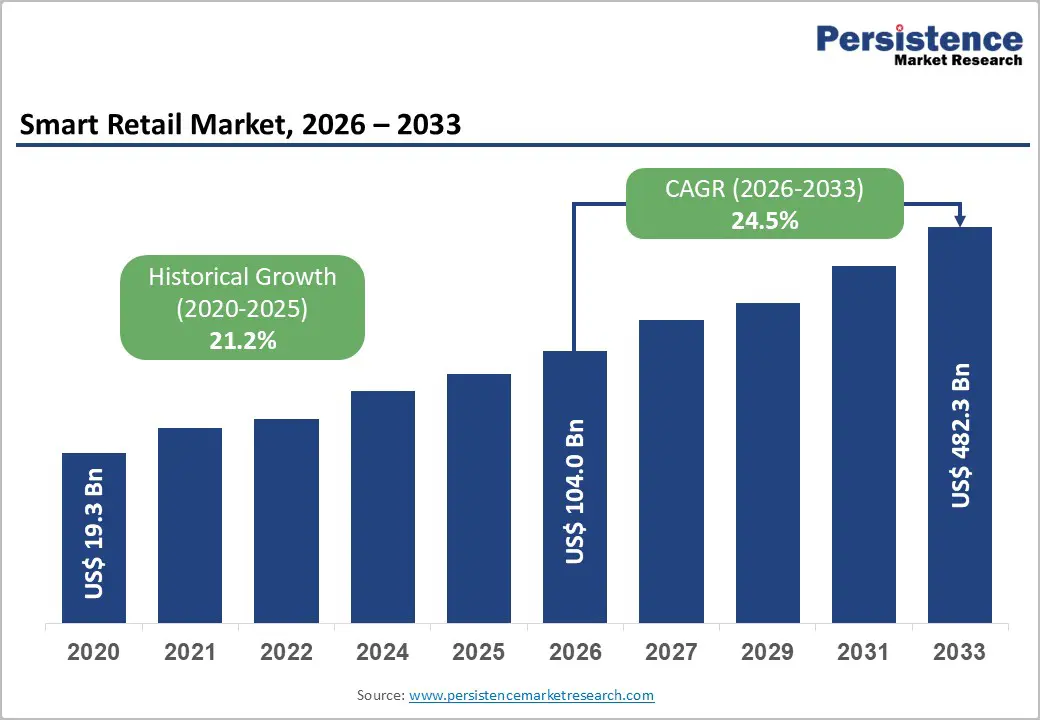
The global Smart Retail Market size was valued at US$ 104.0 Billion in 2026 and is projected to reach US$ 482.3 Billion by 2033, growing at a CAGR of 24.5% between 2026 and 2033. The market is experiencing rapid expansion driven by widespread adoption of Artificial Intelligence (AI), Internet of Things (IoT), and advanced analytics technologies that enable retailers to optimize inventory management, personalize customer experiences, and automate store operations across physical and digital retail environments.
Key Market Highlights
- Leading Region: North America, specifically the United States, dominates the global smart retail market with approximately 35% of worldwide revenue share, driven by early technology adoption, substantial retail investments in AI, IoT, and automation, and leadership from retail giants Amazon, Walmart, and Target establishing innovation benchmarks.
- Fastest Growing Region: Asia-Pacific exhibits the fastest market growth trajectory at 30% CAGR through 2033, propelled by rapid urbanization, expanding digital infrastructure, tech-savvy populations, and government digitalization initiatives in China, India, and Southeast Asia regions.
- Dominant Segment: Hardware solutions command approximately 55% of smart retail market revenue driven by widespread deployment of IoT sensors, smart displays, RFID systems, and edge computing devices forming foundational infrastructure for intelligent retail operations globally.
- Fastest Growing Segment: Software and Services segments expand fastest at 28% CAGR, reflecting accelerating demand for AI analytics platforms, cloud-based retail management systems, managed services, and subscription-based technology solutions reducing upfront capital requirements for retailers.
- Key Market Opportunity: Augmented Reality (AR) and Extended Reality (XR) shopping experiences represent the highest-potential growth opportunity through 2033, enabling immersive product visualization, virtual try-ons, and interactive shopping environments.
| Key Insights | Details |
|---|---|
| Smart Retail Market Size (2026E) | US$ 104.0 Bn |
| Market Value Forecast (2033F) | US$ 482.3 Bn |
| Projected Growth (CAGR 2026 to 2033) | 24.5% |
| Historical Market Growth (CAGR 2020 to 2025) | 21.2% |
Market Dynamics
Market Growth Drivers
Rising Adoption of Artificial Intelligence and Machine Learning in Retail Operations
The integration of Artificial Intelligence (AI) and Machine Learning (ML) technologies into retail operations represents the most significant growth driver for the smart retail market. AI-powered systems enable retailers to analyze vast amounts of customer data, predict purchasing behavior, optimize inventory levels, and deliver hyper-personalized shopping experiences at scale. Walmart has filed over 3,000 AI-related patents in recent years, with a 20% increase in the last three years, demonstrating the company's aggressive investment in AI-driven automation including augmented reality applications, virtual try-ons, and automated stock management systems. Similarly, Amazon operates with more than 9,000 AI-related patents, with 50% filed in the last three years, leveraging machine learning algorithms for customer personalization, autonomous checkout systems, and supply chain optimization.
Expansion of Omnichannel Retail Strategies and Digital Transformation Initiatives
The convergence of physical retail stores and digital e-commerce platforms has created unprecedented demand for integrated smart retail solutions that unify customer experiences across multiple touchpoints. North American retailers are aggressively adopting omnichannel strategies that combine brick-and-mortar operations with mobile applications, social commerce, and seamless digital-physical integration, requiring sophisticated smart retail technology infrastructure. According to market analysis, 66% of global consumers prefer using self-checkout options, emphasizing the critical importance of frictionless, technology-enabled shopping experiences. Retailers including Target have generated double-digit digital sales growth after implementing Store Companion AI applications that provide real-time on-shelf availability and tailored product recommendations through mobile channels.
Market Restraints
High Implementation Costs and Complex Integration with Legacy Systems
The substantial upfront capital requirements and technical complexity associated with deploying comprehensive smart retail solutions present significant barriers to market adoption, particularly for small and mid-sized retailers lacking advanced technological infrastructure. Implementation costs for smart retail systems encompass hardware acquisition (sensors, cameras, RFID tags, interactive kiosks) ranging from $25,000 to $250,000+ for software development, network infrastructure investments, and ongoing system integration expenses. Retailers must navigate the challenge of integrating advanced IoT and AI solutions with outdated legacy systems and disparate data architectures, requiring specialized IT expertise and substantial resources. The complexity of achieving seamless interoperability between point-of-sale systems, inventory management platforms, e-commerce backends, and real-time analytics solutions often demands complete system overhauls, extending deployment timelines to 12-24 months or longer.
Data Security, Privacy Concerns, and Regulatory Compliance Challenges
As retailers accumulate vast amounts of customer data through IoT devices and analytics platforms, protecting sensitive information has become a critical challenge impacting smart retail adoption rates and investment momentum. The average data breach cost in the retail industry rose significantly from $2.96 million in 2023 to $3.48 million in 2024, according to IBM's 2024 Report, creating substantial financial and reputational risks for retailers implementing smart retail technologies. European retailers face heightened compliance pressures under GDPR (General Data Protection Regulation) and emerging regulatory frameworks including the EU AI Act, requiring transparent data handling practices, robust encryption mechanisms, and rigorous audit capabilities that increase operational complexity and ongoing compliance costs.
Market Opportunities
Rapid Expansion of Unmanned Retail Stores and Autonomous Shopping Formats
The emerging segment of unmanned retail environments and autonomous shopping formats represents one of the fastest-growing opportunities in the smart retail market, particularly in Asia-Pacific regions where China's unmanned-cabinet sector is projected to reach 2 trillion yuan in turnover by 2026 and serve 250 million consumers. Amazon Go stores have pioneered checkout-free shopping experiences utilizing deep learning, computer vision, and sensor fusion technologies that automatically detect product selections and charge customers upon exit, eliminating traditional checkout processes and reducing checkout times to under three seconds. Sam's Club has deployed exit technology equipped with AI and computer vision across all locations, significantly reducing customer wait times and improving membership through frictionless transactions. Alibaba and Cloudpick have developed turnkey AI-store solutions that are being exported globally, enabling retailers to rapidly deploy autonomous retail environments with minimal upfront infrastructure investment.
Integration of Augmented Reality and Extended Reality Technologies for Immersive Shopping Experiences
Augmented Reality (AR) and Virtual Reality (VR) technologies are rapidly becoming mainstream retail tools that enable immersive product visualization, virtual try-ons, and interactive shopping experiences that drive customer engagement and reduce product return rates. Walmart's AR-based "Shop with Friends" feature allows customers to share fashion choices and receive feedback, while AR try-on applications enable virtual clothing fittings and furniture visualization in home environments, reducing purchase hesitation and return rates by 15-25%. Nike and IKEA have launched sophisticated AR applications allowing customers to preview shoes in physical environments and visualize furniture in actual room settings, significantly enhancing purchase confidence and customer satisfaction. The AR/VR retail segment is expected to grow at 28-32% CAGR through 2033, supported by improving hardware capabilities, declining hardware costs, and expanding consumer familiarity with immersive technologies.
Category-wise Insights
Solution Type Analysis
The Hardware solution segment commanded approximately 55% of the global smart retail market revenue in 2026, driven by substantial retail investments in IoT sensors, smart displays, RFID tags, electronic shelf labels (ESLs), interactive kiosks, and edge computing devices that form the foundational infrastructure for intelligent retail operations. Smart shelves equipped with weight sensors, RFID readers, and camera-enabled devices enable real-time inventory tracking, automated replenishment alerts, and dynamic pricing capabilities that reduce stockouts by 25-30% while minimizing excess inventory carrying costs. Electronic Shelf Labels (ESLs) allow retailers to dynamically modify prices without manual label replacements, enabling responsive pricing strategies aligned with demand fluctuations, promotional campaigns, and competitive dynamics. Walmart implemented RFID-based inventory tracking across merchandise assortments to enhance supply chain visibility, while Tally robots deployed by BJ's Wholesale Club autonomously scan store aisles for inventory accuracy and shelf compliance.
Application Type Analysis
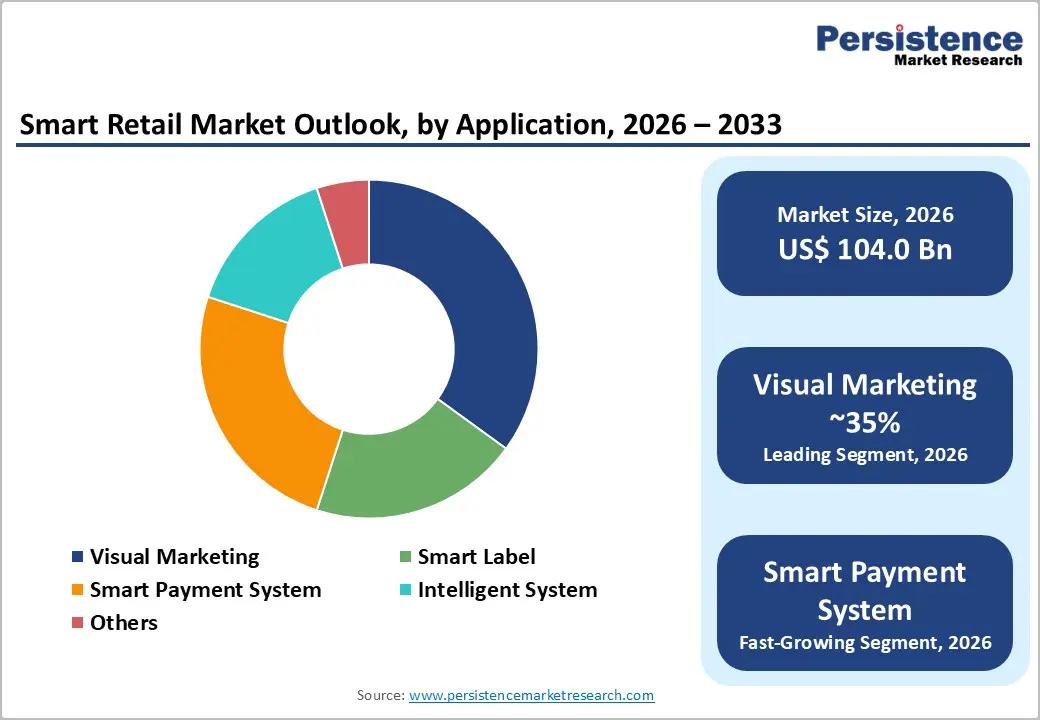
Visual Marketing applications represent the largest application segment within the smart retail market, commanding approximately 35% of total market revenue driven by widespread adoption of digital signage, dynamic price displays, interactive store displays, and personalized promotional content systems. Digital signage enables retailers to engage customers through eye-catching visual content, showcase promotions aligned with customer preferences, and deliver dynamic product information that enhances in-store engagement and drives impulse purchases. Retailers are increasingly deploying smart displays connected to real-time analytics platforms that automatically adjust promotional messaging, pricing, and product highlighting based on foot traffic patterns, customer demographics, and shopping behavior. The integration of visual marketing with AI-powered systems enables retailers to test content variations, measure customer attention metrics, and optimize display layouts through A/B testing and machine learning algorithms that continuously improve marketing effectiveness.
Retailer Size Analysis
Large Retailers representing supermarkets, hypermarkets, department store chains, and big-box retailers command approximately 65% of the smart retail market revenue, driven by substantial capital budgets, sophisticated IT infrastructure, and customer scale supporting rapid adoption of advanced AI, IoT, and automation technologies. Walmart, Amazon, Target, Alibaba, and other mega-retailers have emerged as innovation leaders, investing billions in smart retail capabilities including computer vision checkout, inventory automation, predictive analytics, and omnichannel integration that create competitive advantages through superior operational efficiency and personalized customer experiences. Large retailers benefit from economies of scale in hardware deployment and software development, spreading infrastructure investments across thousands of store locations while achieving rapid technology adoption and generating meaningful return on investment.
Regional Insights
North America
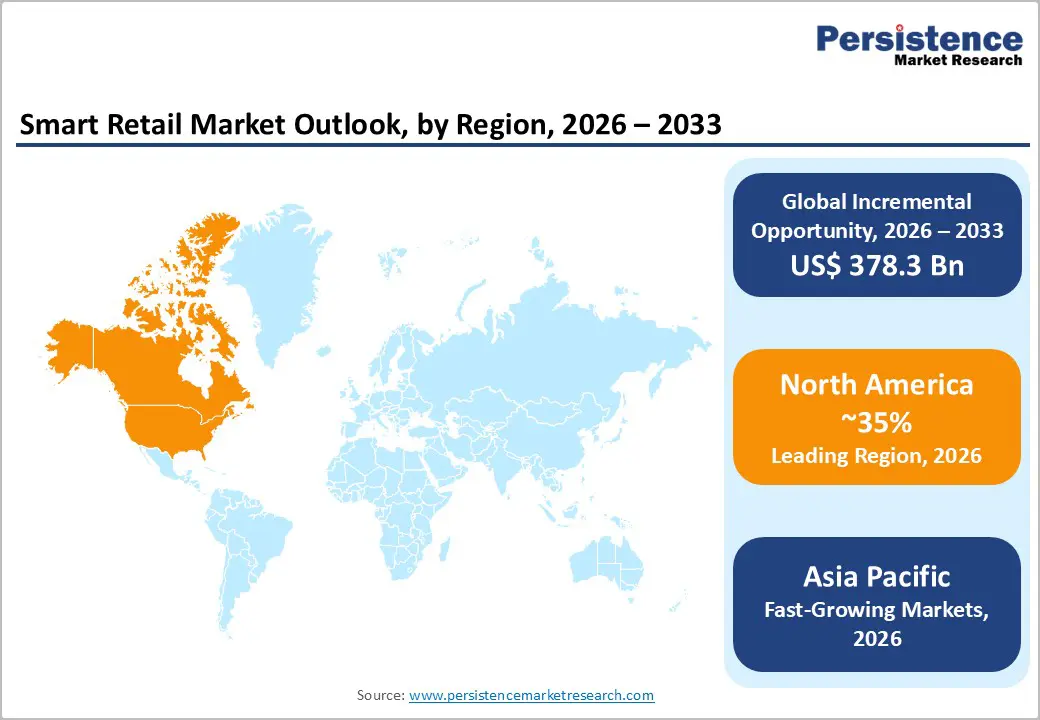
North America, led by the United States, dominates the global smart retail market with approximately 35% of worldwide revenue share, supported by advanced digital infrastructure, sophisticated retail ecosystem, substantial technology investments, and early adoption of AI, IoT, and automation technologies. U.S. retailers including Walmart, Amazon, Target, Best Buy, and Lowe's have established themselves as innovation leaders, investing aggressively in smart retail capabilities including computer vision checkout, inventory automation, personalized mobile experiences, and omnichannel integration that set global benchmarks for operational excellence.
North America is anticipated to maintain market leadership through 2033, supported by continued technology investment, strong consumer demand for convenience, and regulatory frameworks encouraging digital transformation initiatives. However, growth rates in North America (17-18% CAGR) are moderating relative to Asia-Pacific, reflecting the higher baseline of technology adoption already achieved by large North American retailers.
Europe
Europe represents the second-largest regional market for smart retail, commanding approximately 22% of global market revenue, with particularly strong adoption in Germany, United Kingdom, France, and Spain, where retailers are integrating advanced technologies while navigating AI Act compliance, data privacy regulations, and sustainability mandates. European retailers are demonstrating particularly strong interest in RFID technology, self-service kiosks, computer vision systems, and electronic shelf labels, supported by regulatory frameworks emphasizing transparency, data protection, and environmental sustainability.
Europe's smart retail market is expected to expand at 18% CAGR through 2033, supported by digital transformation initiatives, regulatory compliance investments, and consumer demand for seamless omnichannel experiences. The region's emphasis on GDPR compliance, data privacy, and sustainability is driving differentiated smart retail solutions emphasizing security, transparency, and environmental accountability.
Asia Pacific
Asia-Pacific emerges as the fastest-growing regional market, expanding at 30% CAGR through 2033, driven by rapid urbanization, expanding digital infrastructure, tech-savvy consumer populations, and aggressive government digitalization initiatives across China, Japan, India, Singapore, South Korea, and ASEAN nations. China dominates the regional market with 63% of the population living in urban areas as of 2023, according to the World Bank, creating massive addressable markets for smart retail technologies. China's unmanned retail segment is projected to achieve 2 trillion-yuan turnover by 2026, with Alibaba and Cloudpick exporting turnkey AI-store solutions globally, while government support for 5G infrastructure (with 5G subscriptions exceeding 1 billion marks in December 2023) enables high-speed, low-latency IoT deployments across retail networks.
Japan, despite mature retail markets, continues investing in smart retail technologies, growing at 27% CAGR driven by labor cost pressures, aging populations requiring automation, and advanced technological capabilities. Asia-Pacific's extraordinary growth trajectory reflects the convergence of expanding urban populations, rising disposable incomes, technology-savvy consumers, favorable government policies, and competitive pressures from e-commerce giants forcing traditional retailers to embrace digital transformation and smart retail capabilities rapidly.
Competitive Landscape
Market Structure Analysis
The smart retail market exhibits a moderately consolidated competitive structure characterized by large technology enterprises and retail platform companies controlling approximately 52% of aggregate market revenue, while emerging specialized technology vendors, system integrators, and retail-focused startups capture growing market share in niche segments and regional markets.
Tier 1 competitors including Amazon.com, Inc., Alibaba Group, Google, IBM, Cisco Systems, Honeywell International, and Intel Corporation leverage extensive technology portfolios, cloud infrastructure capabilities, machine learning expertise, and established retail relationships to deliver comprehensive smart retail platforms and solutions. These technology giants are pursuing vertical integration strategies, acquiring specialized smart retail vendors, investing in internal R&D capabilities, and developing proprietary solutions tailored to retailer needs. acquiring emerging competitors to strengthen capability portfolios and market positioning.
Key Market Developments
- In May 2025, Amazon opened its fourth robotic fulfilment centre in Virginia, a 3.1-million-sq-ft site that cuts order cycle time 25% and lowers peak-season unit service cost 25%.
- In April 2025, Axis Communications’ Partner Summit 2025 showcased IoT-enabled video analytics tailored for retail, reinforcing its Latin America go-to-market.
- In April 2025, Flagship, Vypr, and Markmi raised a combined USD 9 million to scale visual-merchandising SaaS, shopper-insight platforms, and AI markdown solutions.
Companies Covered in Smart Retail Market
- Intel Corporation
- IBM
- Google LLC
- Microsoft Corporation
- Amazon Inc.
- Ingenico Group
- Huawei Technologies Co., Ltd.
- Cisco Systems
- Zebra Technologies Corp.
- Unitech Electronics Co., LTD.
- IEI Integration Corp.
- Samsung Electronics
- Verifone Systems
- NCR Corporation
- Motorola Mobility LLC.
- Honeywell International Inc.
Frequently Asked Questions
The Global Smart Retail Market is projected to reach US$ 482.3 Billion by 2033, expanding from US$ 104.0 Billion in 2026 at a CAGR of 24.5%, driven by accelerating adoption of AI, IoT, automation, and omnichannel retail strategies across global retail ecosystems transforming customer experiences and operational efficiency
The market is primarily driven by widespread adoption of Artificial Intelligence and Machine Learning technologies enabling hyper-personalized customer experiences and automated operations; rapid expansion of omnichannel retail strategies integrating physical and digital touchpoints; rising consumer demand for frictionless contactless payments and self-checkout experiences; and government digitalization initiatives supporting technology infrastructure investments in emerging markets, particularly Asia-Pacific regions experiencing explosive smart retail expansion.
Visual Marketing applications command approximately 35% of smart retail market revenue through digital signage, dynamic pricing, and personalized promotional content systems, while Smart Payment Systems represent the second-largest segment at 25% market share, encompassing contactless payments, mobile wallets, and autonomous checkout technologies increasingly preferred by consumers and retailers seeking operational efficiency.
North America, dominated by the United States, maintains regional market leadership with approximately 35% of global revenue share, supported by advanced digital infrastructure and technology investments by retail giants including Amazon, Walmart, and Targe.
Amazon.com, Inc., Alibaba Group, Google, IBM, and Cisco Systems are the leading companies driving innovation in the Smart Retail Market.


