




- Metalworking & Fabrication
- Sand Blasting Machine Market
Sand Blasting Machine Market Size, Share, and Growth Forecast, 2026 – 2033
Sand Blasting Machine Market by Product Type (Stationary Sand Blasting Machines, Portable Sand Blasting Machines, Others), Application (Automotive, Construction, Marine, Oil and Gas, Petrochemical), and Regional Analysis for 2026 – 2033

Sand Blasting Machine Market Size and Trends Analysis
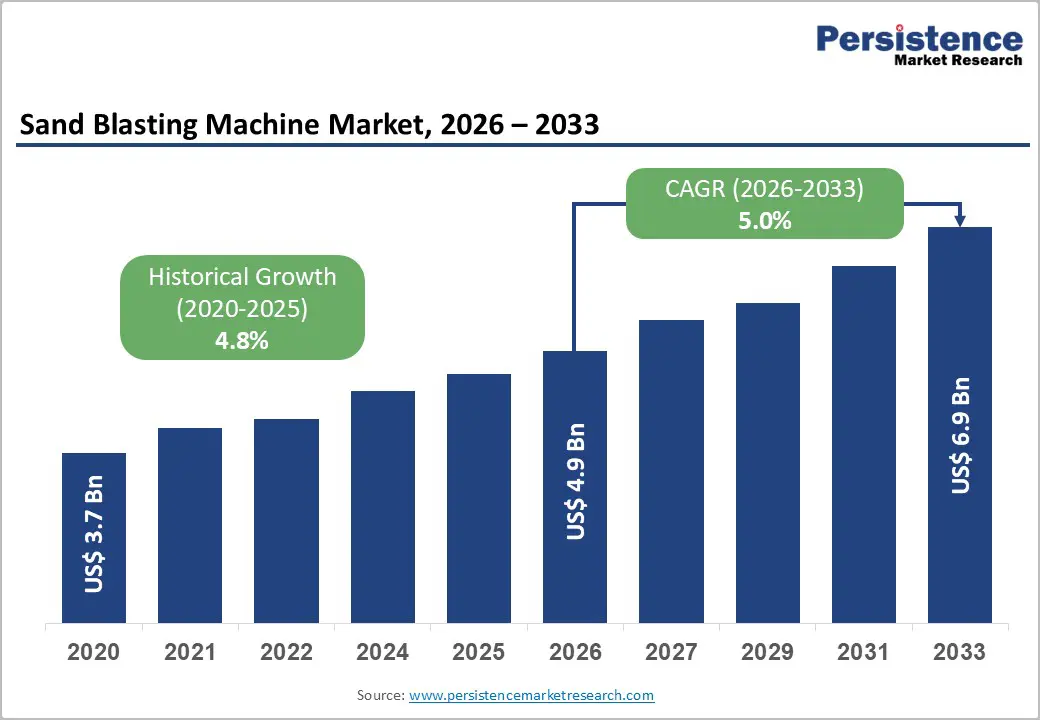
The global sand blasting machine market size is likely to be valued at US$4.9 billion in 2026 and is expected to reach US$6.9 billion by 2033, growing at a CAGR of 5.0% during the forecast period from 2026 to 2033, driven by the rising need for surface preparation, corrosion control, and coating removal across industrial applications.
Expanding infrastructure development, automotive manufacturing, shipbuilding, and maintenance activities continue to fuel demand, particularly in emerging economies experiencing rapid industrialization.
Increased investments in oil & gas, petrochemical, and power generation projects support market expansion, as sand blasting remains a critical process for equipment maintenance and asset life extension. The market faces challenges from stringent environmental and occupational safety regulations regarding dust emissions and abrasive materials. Ongoing advancements in automated systems, dust-free blasting technologies, and alternative abrasives are helping sustain steady growth.
Key Industry Highlights:
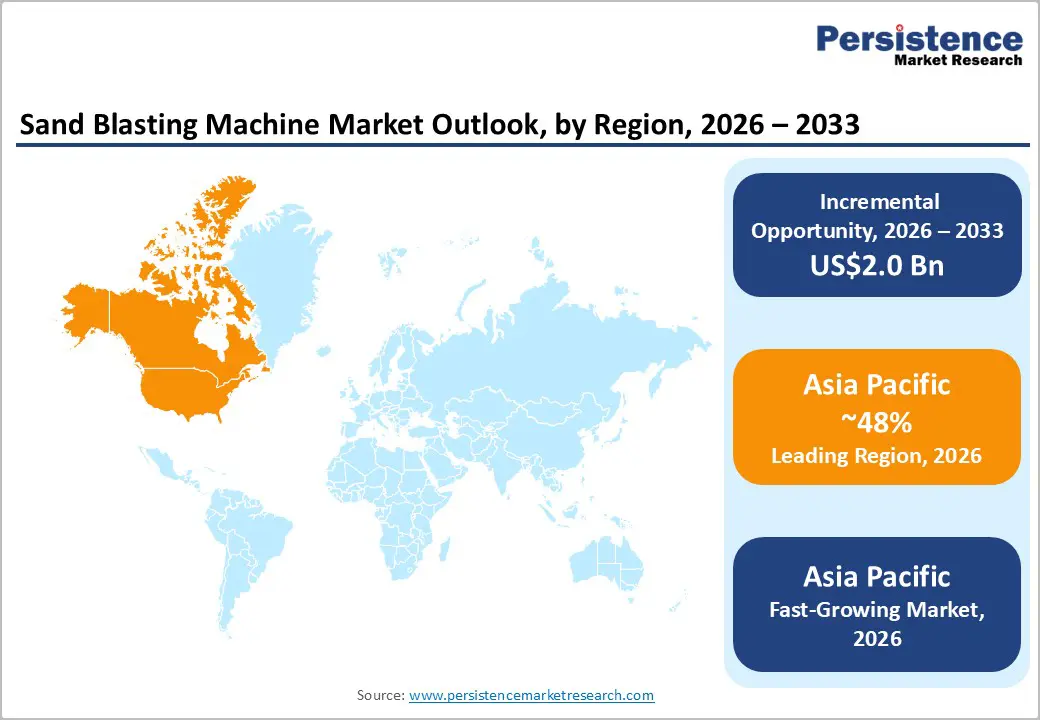
- Leading Region: Asia Pacific is anticipated to be the leading region, accounting for a market share of 48% in 2026, driven by strong manufacturing bases in China, Japan, India, and ASEAN countries, rapid industrialization, infrastructure expansion, and rising adoption of advanced surface preparation technologies.
- Fastest-growing Region: Asia Pacific is likely to be the fastest-growing region, supported by strong manufacturing activity, large infrastructure projects, and rising demand from automotive, marine, and energy sectors, which continue to accelerate the adoption of sand blasting machines.
- Leading Product Type: The portable sand blasting segment is projected to represent the leading product type in 2026, accounting for 42% of the revenue share, driven by its flexibility, ease of transport, and wide adoption in construction and marine on-site operations.
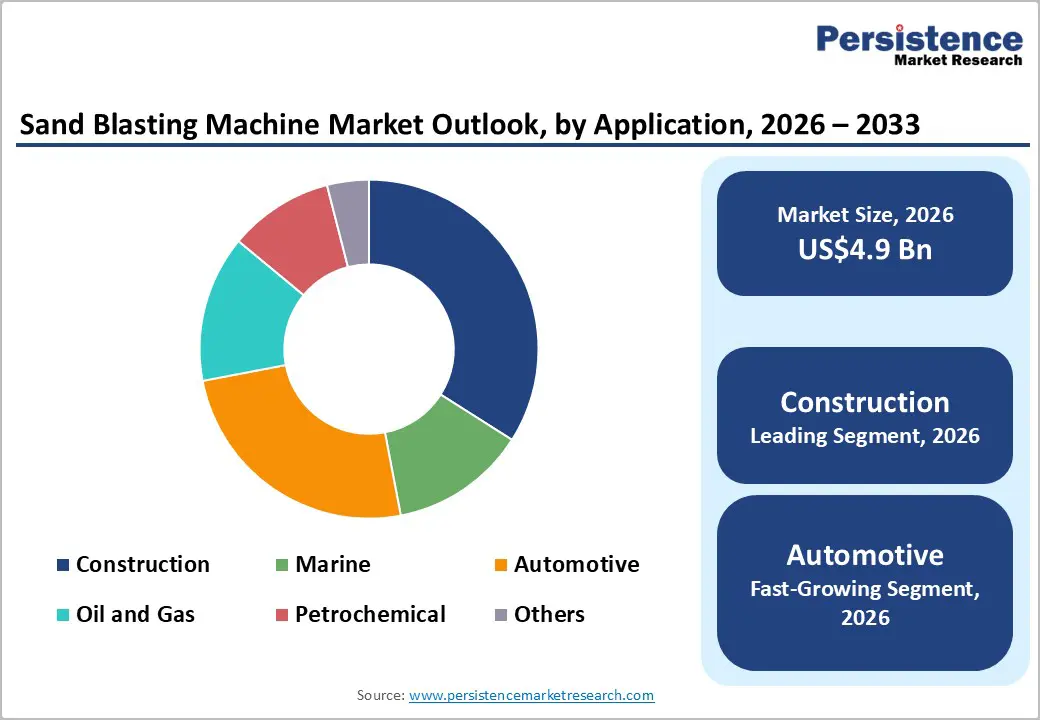
- Leading Application: The construction segment is anticipated to be the leading application type, accounting for over 38% of the revenue share in 2026, supported by extensive use in infrastructure development, building renovation, and surface preparation activities.
| Key Insights | Details |
|---|---|
| Sand Blasting Machine Market Size (2026E) | US$ 4.9 Bn |
| Market Value Forecast (2033F) | US$ 6.9 Bn |
| Projected Growth (CAGR 2026 to 2033) | 5.0% |
| Historical Market Growth (CAGR 2020 to 2025) | 4.8% |
Market Factors – Growth, Barriers, and Opportunity Analysis
Growth Analysis - Infrastructure Development and Growth in Construction
Large-scale construction projects require effective surface preparation solutions. Sand blasting machines are widely used for cleaning steel structures, removing rust from beams, preparing concrete surfaces, and improving coating adhesion in bridges, tunnels, highways, and commercial buildings. Growing urbanization and government-led infrastructure spending across Asia Pacific, the Middle East, and parts of Africa are significantly increasing demand. Renovation and rehabilitation of aging infrastructure in developed regions also contribute to steady equipment adoption across construction-related applications.
The construction sector’s emphasis on durability, safety, and long asset life strengthens demand for sand blasting machines. Surface preparation plays a critical role in preventing corrosion and ensuring structural integrity, particularly in harsh environments. Sand blasting improves bonding of protective coatings, paints, and sealants, making it an essential process in modern construction workflows. Rising investments in smart cities, industrial parks, and public utilities continue to generate sustained demand.
As construction activities become more mechanized and quality-driven, sand blasting machines remain indispensable tools for contractors and infrastructure developers worldwide.
Technological Advancements and Efficiency Gains
Technological advancements are significantly driving growth in the market by improving operational efficiency, safety, and consistency. Modern systems incorporate automation, programmable controls, and precision nozzles that enhance blasting accuracy while reducing material wastage.
Developments such as dust-free blasting, abrasive recycling systems, and enclosed blasting chambers improve productivity and compliance with safety norms. These innovations are increasingly adopted across automotive, marine, and industrial manufacturing sectors, where consistent surface quality and faster turnaround times are essential for maintaining production efficiency.
Efficiency gains achieved through advanced sand blasting technologies help end users reduce labor dependency and operational costs. Automated and robotic blasting systems minimize manual intervention and improve repeatability, particularly in high-volume production environments. Improved energy efficiency and optimized abrasive flow reduce overall operating expenses, making advanced machines more attractive despite higher initial investment. As industries focus on lean manufacturing and process optimization, the demand for technologically advanced sand blasting machines continues to increase across both developed and emerging markets.
Barrier Analysis - Health Risks and Skilled Labor Shortages
Exposure to airborne dust, especially silica particles, can lead to serious respiratory diseases, prompting strict workplace safety regulations. Employers must invest in protective equipment, ventilation systems, and enclosed blasting environments, increasing operational complexity and costs. These health concerns discourage adoption in smaller facilities that lack resources to implement advanced safety measures, thereby limiting market penetration in cost-sensitive regions.
Frequent inspections and compliance audits raise operating expenses for end-users. Growing awareness of occupational health risks is also pushing industries to explore alternative surface preparation methods, slightly reducing reliance on conventional sand blasting techniques.
The sand blasting machine market faces challenges related to shortages of skilled and trained operators. Effective operation of blasting equipment requires technical expertise to ensure surface quality, equipment longevity, and worker safety. Many regions experience a declining availability of skilled labor due to workforce aging and limited training programs. This shortage can lead to inefficiencies, downtime, and safety risks, restraining market growth, particularly in labor-intensive industries and small-scale operations. Training costs and longer onboarding periods add to the financial burden for employers.
Environmental Regulations on Dust Emissions
Stringent environmental regulations governing dust emissions and abrasive disposal significantly restrain the market. Regulatory authorities across North America, Europe, and parts of Asia have imposed strict limits on airborne particulate emissions to protect environmental and worker health. Compliance often requires the adoption of dust collection systems, enclosed blasting units, and approved abrasives, increasing both capital investment and operating costs for end users.
Restrictions on the use of traditional silica sand in several regions have impacted market dynamics. Companies are required to shift toward alternative abrasives and cleaner technologies, which may not always be cost-effective for small and mid-sized users. Failure to comply can result in penalties or operational shutdowns, discouraging adoption in highly regulated markets. These regulatory pressures can slow market expansion, particularly among contractors and smaller industrial facilities with limited budgets.
Opportunity Analysis - Shift to Eco-Friendly and Automated Technologies
Increasing environmental awareness and regulatory enforcement are encouraging industries to adopt dust-free blasting, wet blasting, and recyclable abrasive systems. These technologies significantly reduce airborne emissions and environmental impact while improving workplace safety. Manufacturers offering sustainable solutions can capitalize on rising demand from regulated markets seeking compliance-friendly equipment. Eco-friendly blasting solutions help companies meet corporate sustainability goals and reduce long-term liability risks.
Automation enhances this opportunity by reducing labor dependency and improving process consistency. Automated and robotic sand blasting systems limit human exposure to hazardous environments while delivering higher precision and productivity. Integration with digital monitoring and control systems enables better process optimization and reduced waste. Advanced automation also improves repeatability in high-volume industrial applications, particularly in automotive and manufacturing sectors.
Expansion in Oil & Gas and Petrochemical Maintenance
Aging infrastructure, such as pipelines, storage tanks, refineries, and offshore platforms, requires frequent surface preparation for corrosion control and protective coating application. Sand blasting remains one of the most effective methods for maintaining these assets and ensuring operational safety in harsh environments.
Regular blasting helps prevent equipment failure and unplanned shutdowns, which are costly in energy operations. The ability of sand blasting machines to handle heavy-duty cleaning under extreme conditions makes them essential tools in oil & gas and petrochemical maintenance activities.
Growing energy demand and capacity expansion projects across regions such as the Middle East, Asia Pacific, and North America are increasing maintenance spending. Asset life extension programs and stricter safety standards drive demand for reliable surface preparation equipment. Many operators are prioritizing preventive maintenance to reduce long-term operational risks and downtime. Oil & gas and petrochemical operators emphasize efficiency and compliance, sand blasting machines are widely used for corrosion removal and surface preparation of critical equipment.
Category-wise Analysis
Product Type Insights
Portable sand blasting machines are expected to lead, accounting for approximately 42% of revenue in 2026, driven by their flexibility, mobility, and suitability for on-site operations. These machines are widely preferred in construction, marine maintenance, and infrastructure repair projects where equipment must be transported easily across job sites.
Their compact design, quick setup, and ability to operate in confined or outdoor environments make them a practical choice for contractors and service providers. For example, portable sand blasting machines are extensively used in ship hull cleaning and bridge maintenance, where stationary systems are impractical.
Mini sand blasting machines are likely to represent the fastest-growing segment in 2026, supported by rising demand for compact, user-friendly, and cost-effective equipment. Growth is particularly strong in emerging economies where small contractors, workshops, and maintenance service providers seek affordable surface preparation solutions. Mini sand blasting machines are gaining traction for precision tasks such as component cleaning, localized rust removal, and decorative finishing, especially in automotive repair and light manufacturing. For example, mini sand blasting units are increasingly used in small automotive body shops for paint stripping and surface finishing of vehicle parts. Their low space requirements and ease of operation make them ideal for urban workshops and small-scale projects.
Application Insights
The construction segment is projected to lead the market, capturing around 38% of the revenue share in 2026, supported by widespread use in infrastructure development, building renovation, and metal surface preparation. Sand blasting machines are essential in construction activities for removing rust, old coatings, and contaminants from steel structures, concrete surfaces, and reinforcement materials. The segment benefits from ongoing urbanization and large-scale infrastructure projects, particularly in emerging economies. For example, sand blasting machines are extensively used in bridge refurbishment projects to prepare steel surfaces before applying protective coatings.
The automotive segment is likely to be the fastest-growing application in 2026, driven by increasing requirements for corrosion protection, surface finishing, and quality enhancement in vehicle manufacturing and repair. Sand blasting machines are widely used for cleaning engine components, preparing body panels, and removing paint or corrosion before coating. Growth is supported by expanding automotive production in emerging markets and rising quality standards in manufacturing.
For example, sand blasting machines are commonly employed in automotive component plants to prepare metal parts before electroplating or painting. The growing focus on lightweight materials and improved surface consistency increases adoption.
Regional Insights
North America Sand Blasting Machine Market Trends
North America is likely to be a significant market for sand blasting machines in 2026, driven by a strong demand from established industrial sectors such as automotive, aerospace, metal fabrication, marine maintenance, and construction. Advanced manufacturing infrastructure and ongoing investments in surface treatment technologies.
The U.S. dominates regional consumption, driven by high expenditures on industrial refurbishment, infrastructure rehabilitation, and the adoption of dust-controlled, environmentally compliant blasting solutions that meet strict workplace safety standards.
Automation, sustainability, and technological enhancement have become the key themes shaping market evolution, with industry players focusing on advanced, dust-suppression systems and programmable blasting controls. Clemco Industries Corp., a U.S.-based manufacturer, is enhancing operator safety and ergonomics in its sandblasting equipment, which boosts adoption among contractors and industrial users focused on productivity and compliance. Canada also plays a key role, with steady growth driven by sectors like shipbuilding, energy maintenance, and metalworking, all of which emphasize the importance of effective surface preparation.
Europe Sand Blasting Machine Market Trends
Europe is likely to be a significant market, due to its established industrial base and stringent manufacturing standards. Strong automotive and aerospace sectors in countries such as Germany, France, and Italy are the major consumers of sand blasting equipment for precision cleaning, corrosion control, and paint removal applications.
Europe focus on worker safety and environmental compliance encourages the adoption of enclosed and automated blasting systems with effective dust collection and emission control features. Growth in infrastructure maintenance and marine refurbishment projects supports steady equipment replacement and upgrades.
Emerging trends in the Europe sand blasting machine market reflect a shift toward automation, environmental sustainability, and digital integration. The increasing adoption of automated sand blasting systems enhances precision and productivity while reducing operator exposure to dust and hazardous environments, a priority driven by strict EU occupational safety requirements.
For example, Airblast B.V., a key equipment supplier in Europe, has integrated advanced automation and environmental control features into its blasting systems to address regulatory compliance and productivity demands, strengthening its competitive position across industrial and marine applications.
Asia Pacific Sand Blasting Machine Market Trends
The Asia Pacific is anticipated to be the leading region, accounting for a market share of 48% in 2026, driven by its extensive industrial activities and rapid infrastructure expansion. Sand blasting machines are widely used for surface preparation, rust removal, and coating maintenance in shipbuilding, metal fabrication, and heavy machinery sectors, where efficient and reliable surface treatment is essential. For example, Graco Inc. has increased its presence in Asia Pacific by offering locally tailored blasting systems with strong after-sales support, helping manufacturers address diverse operational needs across varied applications.
Emerging trends in the Asia Pacific sand blasting machine market reflect a growing focus on technological innovation, cost optimization, and sustainability. As industries prioritize higher efficiency and reduced environmental impact, demand is rising for dust-controlled and energy-efficient blasting systems that align with regulatory standards and improve workplace safety. Automated and digitally integrated machines are becoming more prevalent, enabling manufacturers to achieve consistent surface quality while reducing labor intensity.
Competitive Landscape
The global sand blasting machine market exhibits a moderately fragmented structure, driven by the presence of numerous mid to large scale manufacturers and niche regional suppliers competing for market share. While no single company completely dominates, key industrial equipment providers maintain strong positions through product depth, geographic reach, and brand recognition.
Market leaders leverage extensive distribution networks, broad abrasive blasting portfolios, and investments in R&D to stay ahead in a competitive environment where surface preparation demands span automotive, construction, aerospace, shipbuilding, and maintenance sectors.
With key leaders including Clemco Industries Corp., Norton Sandblasting Equipment, Graco Inc., Airblast B.V., Sinto Group, Guyson Corporation, Burwell Technologies, Torbo Engineering Keizers GmbH, Trinco Trinity Tool Co., and Wheelabrator Group, the landscape reflects both players and specialized regional competitors.
These companies have built reputations based on quality, durability, and technological innovation, enabling them to serve diverse applications from portable field units to large automated blasting systems. Strategic partnerships and strong after sales and service networks reinforce their competitive positions, particularly in mature markets such as North America and Europe.
Key Industry Developments:
- In August 2025, BlastOne, a leader in surface preparation solutions, announced a strategic partnership with investment firms Kaltroco and Five V Capital to accelerate innovation and expand its reach. The partnership will enable BlastOne to develop next-generation blasting products, enter new geographies, and serve a broader range of customer segments. Founder Tim Gooden and Technical Director Graeme Thomas remain active shareholders, ensuring continuity of the company’s leadership and core mission.
- In April 2025, Clemco International launched a brand modernization initiative, “One Clemco”, and introduced a performance enhanced PT valve update for its sand blasting systems. The upgrade improves abrasive flow rates, optimizing performance for larger nozzles and coarser abrasives. This initiative strengthens Clemco’s product efficiency and supports industrial users in achieving better surface preparation outcomes across construction, automotive, and heavy industrial applications.
Companies Covered in Sand Blasting Machine Market
- Abrasive Blasting Service & Supplies Pty Ltd (ABSS)
- Airblast B.V.
- Burwell Technologies
- Clemco Industries Corp.
- Empire Abrasive Equipment
- Graco Inc
- Guyson Corporation
- Kramer Industries Inc.
- Laempe Mössner Sinto GmbH
- Midwest Finishing Systems, Inc.
- Norton Sandblasting Equipment
- Sinto Group
- Torbo Engineering Keizers GmbH
- Trinco Trinity Tool Co.
- Wheelabrator Group
Frequently Asked Questions
The global sand blasting machine market is projected to reach US$4.9 billion in 2026.
The sand blasting machine market is driven by rising demand for surface preparation in construction, automotive, marine, and industrial maintenance applications.
The sand blasting machine market is expected to grow at a CAGR of 5.0% from 2026 to 2033.
Key market opportunities in the sand blasting machine market lie in the adoption of eco-friendly, automated, and technologically advanced surface preparation solutions across industries.
Abrasive Blasting Service & Supplies Pty Ltd (ABSS), Airblast B.V., and Burwell Technologies are the leading players.


