




- Pharmaceuticals
- Rapid Acting Insulin Market
Rapid Acting Insulin Market Size, Share, and Growth Forecast 2026 - 2033
Rapid Acting Insulin Market by Drug Type (Insulin Aspart, Insulin Lispro), Delivery Mode (Prefilled Pens, Vials and Syringes), Distribution Channel (Hospital Pharmacies, Retail Pharmacies), and Regional Analysis, 2026 - 2033

Rapid Acting Insulin Market Size and Trends Analysis
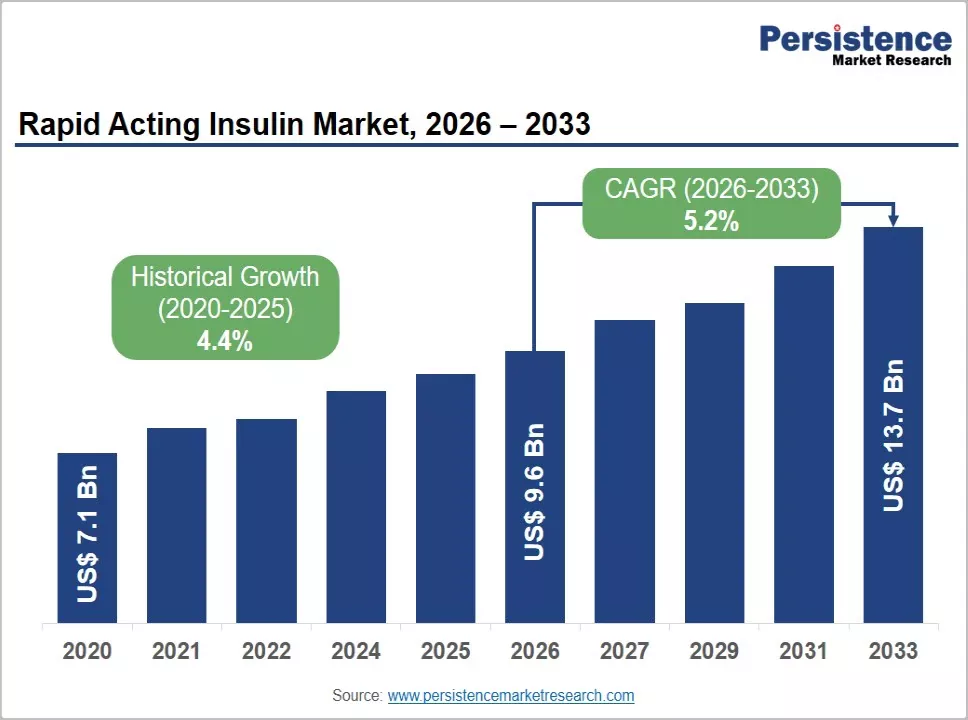
The global rapid acting insulin market size is likely to be valued at US$9.6 billion in 2026 and is estimated to reach US$13.7 billion by 2033, growing at a CAGR of 5.2% during the forecast period from 2026 to 2033, driven by the rising diabetes burden and surging biosimilar access. New ultra-fast formulations and pump use are also lifting demand and prefilled pens remain the preferred delivery form across the globe.
Key Industry Highlights:
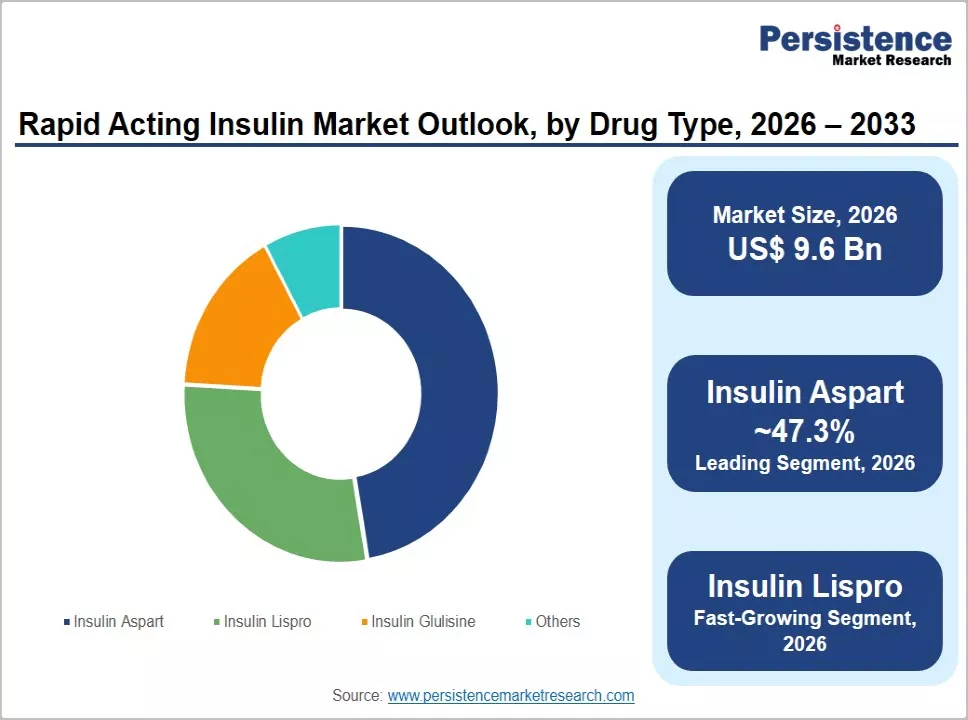
- Leading Drug Type: Insulin aspart, about 47.3% share in 2026, as it has a broad label, wide payer coverage, and a growing set of biosimilars.
- Dominant Delivery Mode: Prefilled pens, around 61.4% share in 2026, as patients prefer easy dosing and dose accuracy.
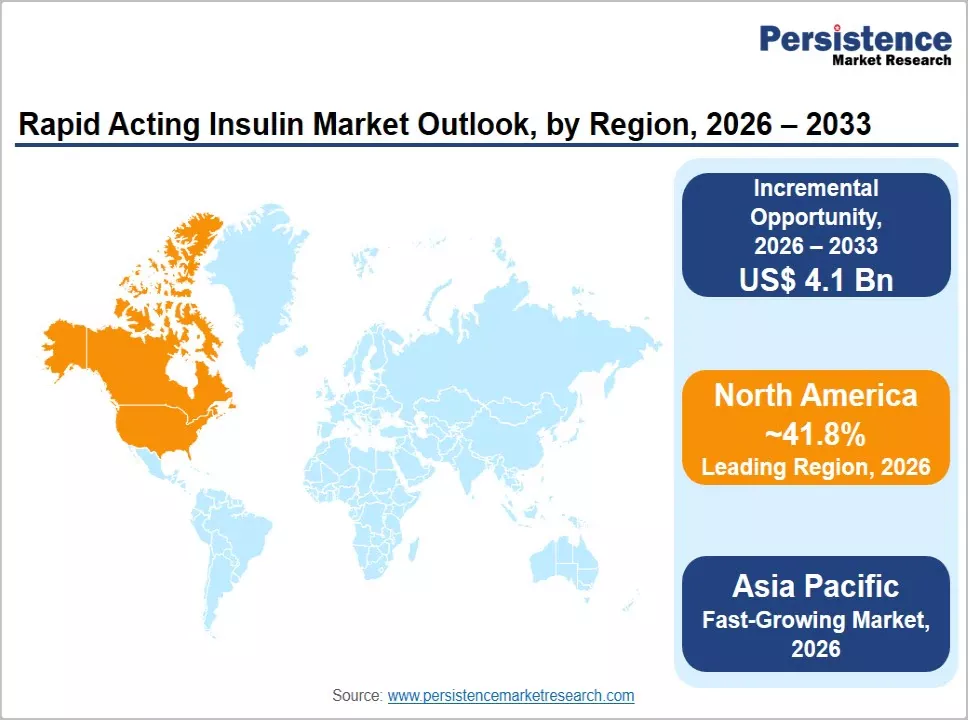
- Leading Region: North America, with about 41.8% share in 2026, owing to high insulin use, strong reimbursement, and early access to new products.
- Fast-growing Region: Asia Pacific, backed by a very large diabetes population, rising diagnosis, and wider insulin access.
- Latest Approval: In July 2025, the FDA approved Kirsty (insulin aspart-xjhz), developed by Biocon Biologics, as the first interchangeable biosimilar to NovoLog in the U.S. Available in prefilled pens and multidose vials, Kirsty was approved to improve glycemic control in adults and pediatric patients with diabetes. The interchangeable designation allows the product to be substituted for its reference insulin under applicable U.S. laws, creating another potential route to improve access to rapid-acting insulin.
DRO Analysis
Driver - Rising Diabetes Prevalence to Fuel Demand for Mealtime Insulin
Diabetes is expanding worldwide. The International Diabetes Federation (IDF) estimates 589 million adults aged 20 to 79 had diabetes in 2024. It projects 853 million by 2050. About 252 million people remain undiagnosed. Type 2 diabetes makes up over 90% of cases. Rapid acting insulin is used at mealtimes to control post-meal glucose, so a larger patient pool supports volume. Almost 3 in 4 adults with diabetes live in low- and middle-income countries. About 1 in 8 adults is at high risk of type 2 diabetes. These trends point to a long growth runway.
Costs keep rising too. IDF reports that diabetes health spending passed US$1 trillion in 2024. The disease causes over 3.4 million deaths a year. Type 1 diabetes affects 1.8 million children and young adults under age 20. These patients need insulin for life. This sustains long-term demand. People with type 2 diabetes also face an 84% higher risk of heart failure. Better glucose control is therefore a care priority. Mealtime insulin is a key tool for it.
Biosimilar Approvals to Bolster Long-term Market Growth
Biosimilar entry is widening access. On February 14, 2025, the FDA approved Merilog (insulin aspart-szjj) from Sanofi as the first rapid-acting insulin biosimilar. On July 15, 2025, the FDA approved Kirsty (insulin aspart-xjhz) from Biocon Biologics as the first interchangeable rapid-acting biosimilar. Pharmacists can substitute it for NovoLog under state laws. Merilog is sold as a SoloStar pen and a vial. Each approval adds a lower-cost option for payers.
The pipeline keeps growing. On July 24, 2026, the FDA approved Garzulys from Meitheal as the third NovoLog biosimilar. More suppliers should lower prices and expand use. Lower prices can raise volume, even as revenue per unit falls. This supports unit growth in price-sensitive markets. Biosimilar makers also compete on supply reliability. Payers and pharmacy benefit managers can steer volume to lower-cost products.
Restraint - Price Erosion and Insulin Cost Caps May Slow Revenue Growth
Pricing pressure is strong. In the U.S., Medicare Part D plans cannot charge more than US$35 for a one-month supply of each covered insulin since January 1, 2023. The law also removed the deductible for covered insulin. Biosimilars add more pressure. Revenue per patient therefore stays flat even as use grows. Price caps in one major market can also shape pricing talks elsewhere.
Access gaps remain outside high-income markets. IDF says 3 in 4 adults with diabetes live in low- and middle-income countries. Many lack steady insulin supply and cold storage. Hypoglycemia risk also needs patient education. Our view is that these gaps limit near-term growth in emerging regions. Supply chains for pens and cartridges are complex. Shortages can interrupt therapy in weaker health systems.
Opportunity - Ultra-fast Formulations and Pump Use to Support Premium Demand
Faster insulins are gaining ground. Eli Lilly received FDA approval for Lyumjev (insulin lispro-aabc) in June 2020. Later, the FDA approved Lyumjev 100 units/mL for insulin pumps. In the phase 3 PRONTO-Pump-2 trial, 432 adults with type 1 diabetes were studied. Lyumjev met HbA1c noninferiority to Humalog at week 16. Lilly also reported the 200 units/mL formulation as pen or syringe only. Fiasp from Novo Nordisk was approved earlier for pumps. Competition is therefore active in the premium tier.
Mealtime control also improved. The same trial showed superior one-hour and two-hour post-meal glucose reduction when dosed 0 to 2 minutes before meals. Such results support premium pricing. Pump users need fast insulin for automated systems. This creates a steady upsell path. Real-world outcome data will help payers weigh the extra cost.
Large Undiagnosed Population to Open New Demand Channels
Diagnosis gaps point to future demand. IDF counts 252 million adults with undiagnosed diabetes. In China, 49.7% of adults with diabetes are undiagnosed, about 73.5 million. In India, the share is 43.0%. As screening grows, more patients enter treatment. Wider screening also finds patients earlier. Earlier treatment can raise lifetime insulin use.
Many will progress to insulin over time. Type 2 diabetes is progressive, so mealtime insulin use rises with disease duration. Better health coverage can speed this shift. Online and retail pharmacies also widen reach. Digital tools and pharmacy chains support refills. These channels help patients stay on therapy.
Category-wise Analysis
Drug Type Insights
Insulin aspart is predicted to lead with a share of about 47.3% in 2026, as it has a broad label, wide payer coverage, and a growing set of biosimilars. Merilog, Kirsty, and Garzulys all reference NovoLog. Biosimilar entry should expand volume. Brand sales may face price pressure. Insulin glulisine holds a small share. Apidra is its main product, and use is limited.
Insulin lispro is estimated to be the fastest-growing drug type over the forecast period, as ultra-fast formulations gain use. Lyumjev has FDA approval for adults with type 1 or type 2 diabetes. It also has an approved pump use. This is our analyst view, as public sales splits are limited. Ultra-fast products aim to match insulin action with the first meal peak. Dosing can occur 0 to 2 minutes before a meal.
Delivery Mode Insights
Prefilled pens are anticipated to dominate with a share of around 61.4% in 2026, as pens are easy to use and give accurate doses. Merilog comes as a 3 mL single-use prefilled pen and a 10 mL vial. Patients inject it 5 to 10 minutes before a meal. Pens also reduce dosing errors. Vials and syringes stay relevant in low-cost settings. Hospitals also use vials for inpatient care.
Insulin pumps are expected to be the fastest-growing delivery mode over the forecast period, as automated systems need fast-acting insulin. The Lyumjev pump label supports this trend. Fiasp also has pump approval. Higher device use lifts insulin consumption. Closed-loop systems adjust doses by the minute, so reliable fast insulin is essential. Pump makers and drug makers are building closer ties.
Regional Insights
North America Rapid Acting Insulin Market Trends
North America is predicted to dominate in 2026 globally with a share of approximately 41.8%, supported by high insulin use, strong reimbursement, and early access to new products. IDF reports 56.2 million adults with diabetes in the region in 2024. Health spending on diabetes reached about US$438.6 billion. Biosimilar launches are most active here.
U.S. Rapid Acting Insulin Market Trends
In North America, a share of nearly 67.5% is expected to be held by the U.S. in 2026, as it has a very large patient pool and the most active biosimilar pipeline. The Centers for Disease Control and Prevention (CDC) estimates 40.1 million people had diabetes in 2023, or 12.0% of the population. The FDA has approved three NovoLog biosimilars since February 2025. Medicare caps monthly insulin cost-sharing at US$35.
Asia Pacific Rapid Acting Insulin Market Trends
Asia Pacific is anticipated to be the fastest-growing region during the forecast period. IDF counts 215.4 million adults with diabetes in the Western Pacific region in 2024. South Asia adds a large patient base. Diagnosis is rising, but gaps remain. Wider insulin access should lift volumes.
China Rapid Acting Insulin Market Trends
China will likely lead in Asia Pacific in 2026 with a share of about 38.2%. IDF estimates 148.0 million adults with diabetes in China in 2024. Prevalence is 11.9%. About 49.7% of cases are undiagnosed. Diabetes health spending was about US$168.9 billion. The disease caused about 755,500 deaths. Type 1 diabetes affects about 598,900 people of all ages in China, including about 116,600 aged 0 to 19. These patients need lifelong insulin. Volume-based procurement is likely to keep prices low.
India Rapid Acting Insulin Market Trends
In 2026, India is projected to account for a share of just about 17.4% in Asia Pacific, owing to a large patient base and rising insulin access. IDF estimates 89.8 million adults with diabetes in 2024, with 43.0% undiagnosed. The ICMR-INDIAB study, covering 2008 to 2020, estimated about 101 million people with diabetes and 136 million with prediabetes. Spending per person remains low, at about US$109.5.
Europe Rapid Acting Insulin Market Trends
Europe is predicted to hold a share of approximately 16.9% in 2026 globally, supported by universal health coverage and strong biosimilar uptake. IDF reports 65.6 million adults with diabetes in the region in 2024. Diabetes spending was about US$192.9 billion. Payer pressure keeps prices under watch. Demand therefore grows in volume more than value.
Germany Rapid Acting Insulin Market Trends
Germany is likely to hold a share of about 21.6% in Europe in 2026. IDF estimates 6.5 million adults with diabetes in 2024. Prevalence is 7.8%. About 20.4% of cases are undiagnosed. Spending reached about US$40.4 billion, or US$6,236.9 per person. Statutory insurance covers insulin, which supports steady demand.
U.K. Rapid Acting Insulin Market Trends
A share of nearly 14.7% is predicted to be held by the U.K. in Europe in 2026, as the National Health Service (NHS) covers insulin and the diagnosed population is growing. Diabetes UK reports over 4.7 million people with a diagnosis in 2024-25, up 155,803 from the year before. The charity estimates almost 6 million people live with diabetes, including undiagnosed cases. Diabetes UK warns that diabetes could cost the NHS nearly GBP 18 billion by 2035 if rates keep rising. Pressure to control costs favors lower-priced insulin.
Competitive Landscape
The global rapid acting insulin market is highly consolidated, with a few large firms holding most of the share. Novo Nordisk, Eli Lilly and Company, and Sanofi lead with branded products. Biocon Biologics and Meitheal Pharmaceuticals are entering with biosimilars. Branded firms compete on ultra-fast formulations, devices, and pump links. Meitheal and Biocon Biologics are expanding the biosimilar field. Smaller firms may partner with larger firms for distribution.
Competition is shifting toward price and access. Biosimilar launches add rivals to the aspart segment. Interchangeability helps pharmacy-level substitution. Players with strong supply, device skills, and payer contracts are better placed to hold share. Pricing and supply contracts will define winners.
Key Industry Developments:
- In May 2026, Sandoz announced European Commission authorization for Bysumlog, a biosimilar insulin lispro, across the indications of its reference medicine. The authorization complemented the company's insulin aspart biosimilar Dazparda and followed its January 2026 European authorization for the long-acting insulin biosimilar Ondibta. Sandoz stated that these approvals strengthened its diabetes portfolio and could help broaden access to insulin treatment options across Europe.
- In May 2026, MannKind Corporation announced that the FDA had approved Afrezza, its inhaled mealtime insulin, for children and adolescents aged six years and older with diabetes. The expanded indication was supported by the INHALE-1 clinical trial, which evaluated inhaled insulin in pediatric patients and compared its performance with injected rapid-acting insulin analogues. The approval introduced a needle-free mealtime insulin option for eligible younger patients and extended the use of inhaled insulin beyond the adult population.
- In December 2025, the FDA approved a labeling change for Medtronic’s MiniMed 780G automated insulin delivery system to include Fiasp and Lyumjev among its compatible insulins. Fiasp, an accelerated-absorption formulation of insulin aspart, and Lyumjev, a faster-acting insulin lispro formulation, offer additional options for people using automated insulin delivery. The update broadened the system’s compatible insulin choices and supported greater flexibility in diabetes management.
Companies Covered in Rapid Acting Insulin Market
- Novo Nordisk
- Eli Lilly and Company
- Sanofi
- Biocon Biologics
- Meitheal Pharmaceuticals
- Others
Frequently Asked Questions
The global rapid acting insulin market is projected to be valued at US$9.6 billion in 2026.
The rapid acting insulin market is expected to reach US$13.7 billion by 2033.
Key market trends include rising biosimilar approvals, growing use of ultra-fast insulin in pumps, and surging diabetes prevalence.
Insulin aspart is expected to be the leading drug type with a share of around 47.3% in 2026, due to its broad label and growing biosimilar set.
The rapid acting insulin market is expected to grow at a CAGR of 5.2% from 2026 to 2033.
Novo Nordisk, Eli Lilly and Company, and Sanofi are a few key market players.


