




- Specialty & Fine Chemicals
- Polyurethane Leather Market
Polyurethane Leather Market Size, Share, and Growth Forecast, 2025 - 2032
Polyurethane Leather Market by Product Type (Coated PU Leather, Others), Application (Bags and Handbags, Others), End-user (Consumer Goods, Automotive, Residential Interior Design, Healthcare, Commercial Spaces), and Regional Analysis for 2025 - 2032

Polyurethane Leather Market Size and Trends Analysis
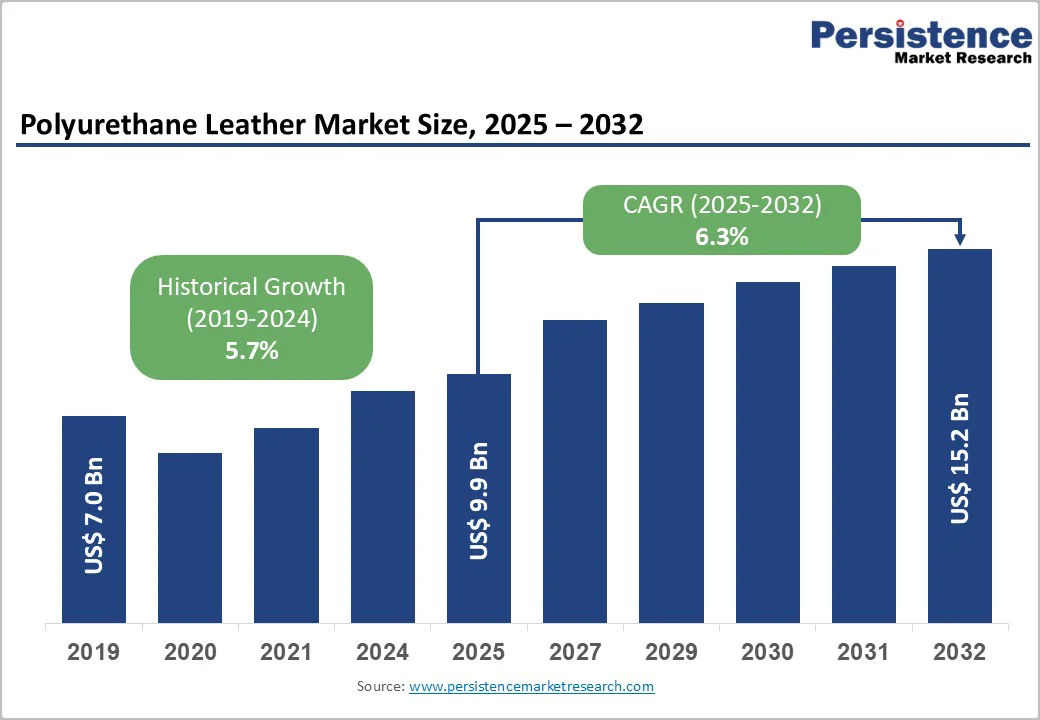
The global polyurethane leather market size is likely to be valued at US$9.9 billion in 2025, projected to reach US$15.2 billion by 2032, growing at a CAGR of 6.3% during the forecast period from 2025 to 2032.
The polyurethane leather market is experiencing robust growth driven by the increasing prevalence of sustainable fashion trends, rising demand for affordable leather alternatives in footwear, and advancements in microfiber technologies. Demand for durable, lightweight, and eco-friendly materials is driving the growth of polyurethane leather, supported by product innovation and its increasing use as a vegan alternative, particularly in automotive interiors.
Key Industry Highlights:
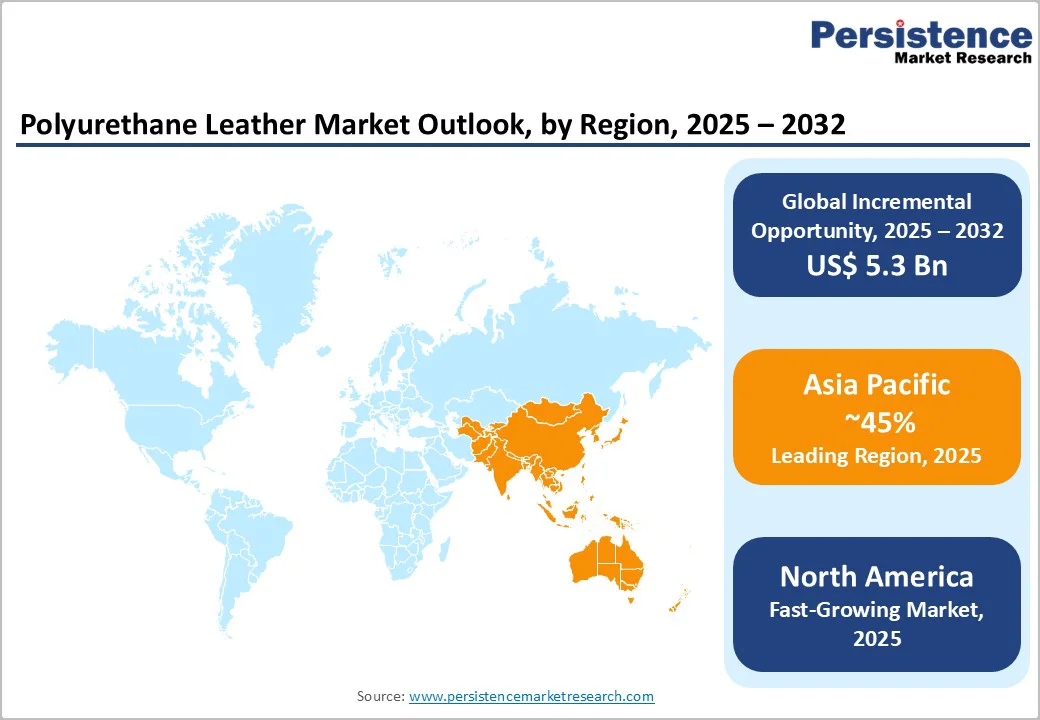
- Leading Region: Asia Pacific, commanding a 45% market share in 2025, driven by massive apparel manufacturing, high prevalence of footwear production, and strong R&D activities in China.
- Fastest-growing Region: North America, fueled by increasing sustainable fashion adoption, rising awareness of vegan alternatives, and growing investments in automotive interiors in the U.S.
- Dominant Product Type: Coated PU leather, holding approximately 45% of the market share, due to cost-effectiveness and versatility.
- Leading Application: Footwear, accounting for over 35% of market revenue, fueled by durability needs.
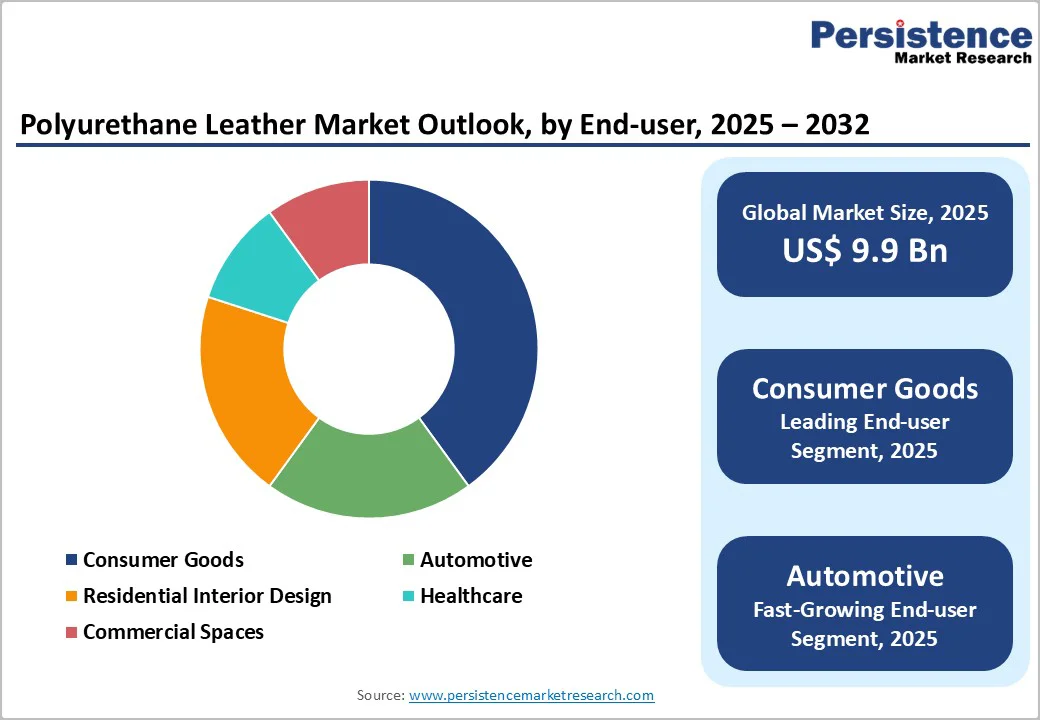
- Leading End-user: Consumer goods, contributing nearly 40% of market revenue, due to fashion demands.
- Key Market Driver: Rising consumer preference for ethical, cruelty-free materials is accelerating the shift toward polyurethane leather as a sustainable alternative to animal leather.
- Market Opportunity: Expansion in electric vehicle (EV) interiors and luxury fashion segments creates strong opportunities for high-performance, recyclable polyurethane leather variants.
| Key Insights | Details |
|---|---|
|
Polyurethane Leather Market Size (2025E) |
US$9.9 Bn |
|
Market Value Forecast (2032F) |
US$15.2 Bn |
|
Projected Growth (CAGR 2025 to 2032) |
6.3% |
|
Historical Market Growth (CAGR 2019 to 2024) |
5.9% |
Market Factors - Growth, Barriers, and Opportunity Analysis
Rising Prevalence of Sustainable Fashion Trends and Demand for Affordable Leather Alternatives
The rising prevalence of sustainable fashion trends and the surge in demand for affordable, cruelty-free leather alternatives are the primary growth engines of the polyurethane leather market. Consumers today are more environmentally conscious, seeking products that minimize animal cruelty and reduce ecological impact. This shift has accelerated the adoption of PU leather, which offers a vegan-friendly and cruelty-free alternative to traditional animal leather while maintaining a similar look, feel, and durability. Brands across footwear, apparel, handbags, and accessories are responding by incorporating PU leather into collections, emphasizing sustainability in marketing and design.
Affordability is another key factor fueling PU leather demand. Compared to genuine leather, PU leather is significantly less expensive to produce and purchase, making it accessible across mass-market, mid-range, and premium segments. Fast-fashion retailers particularly favor PU leather due to its versatility, ease of customization, and compatibility with large-scale production. Advances in microfiber and coated PU leather allow manufacturers to achieve high-quality textures, colors, and finishes without incurring the costs associated with animal hides.
High Development and Environmental Impact Costs
The polyurethane (PU) leather industry faces significant challenges related to high development costs and environmental impact. Developing advanced PU leather formulations requires substantial investment in research and development to achieve the desired combination of durability, flexibility, aesthetic appeal, and performance. High-quality grades, such as microfiber or bio-based PU leather, demand precise chemical engineering, specialized machinery, and rigorous testing protocols, all of which contribute to elevated production costs. Meeting evolving consumer expectations for a premium feel, design versatility, and sustainability adds further pressure on development budgets.
Environmental impact is another major concern. Conventional PU leather production relies heavily on fossil-based polyols and isocyanates, leading to significant energy consumption, greenhouse gas emissions, and chemical waste. Solvent-based processes can release volatile organic compounds (VOCs) and hazardous byproducts, creating regulatory and disposal challenges. Manufacturers must also manage the environmental footprint of raw material extraction, coating processes, and end-of-life disposal, which adds operational complexity and cost.
Advancements in Recycled and Bio-Based PU Leather Formulations
Advancements in recycled and bio-based PU leather formulations are transforming the synthetic leather industry, driven by growing environmental awareness and pressure to reduce dependence on petroleum-based materials. Manufacturers are increasingly adopting recycled polyurethane, post-consumer plastics, and recovered textile fibers to create circular PU leather solutions with lower carbon footprints. Mechanical and chemical recycling technologies are improving the quality and consistency of regenerated polyols, enabling the development of PU leather that closely matches the performance of virgin materials. At the same time, innovations in bio-based polyols derived from plant oils, biomass, and algae are helping replace fossil-based components without compromising durability, flexibility, or tactile quality.
Advanced water-based and solvent-free production methods further support these sustainable formulations by reducing emissions and hazardous waste. Emerging hybrid systems combine recycled and bio-derived ingredients to enhance material strength, softness, and aging resistance. These next-generation PU leathers are increasingly adopted in footwear, fashion accessories, automotive interiors, and consumer goods as brands commit to more responsible material sourcing.
Category-wise Analysis
Product Type Insights
Coated PU Leather dominates with a 45% share in 2025, due to its low production cost, easy processability, and excellent printability. These advantages make it widely preferred for bags, handbags, and various footwear styles. Its ability to replicate diverse textures and colors at an affordable price ensures strong adoption across mass-market and mid-range product categories. For example, Storite 8 Inch Stylish Small PU Leather Sling Cross Body Bag, A PU leather sling bag priced around INR 560 (US$6.25), ideal for everyday use.
Microfiber PU leather is the fastest-growing segment, prized for its suede-like softness, superior breathability, and high durability. Its premium look and feel make it well-suited for luxury handbags, footwear, and designer accessories, while its strength and comfort are driving increased adoption in automotive seating. As brands increasingly prioritize high-performance and vegan materials, microfiber PU leather continues to gain strong market momentum. For instance, premium vegan handbags made with high-grade PU, often microfiber PU, offer the look and feel of genuine leather at a significantly lower cost.
Application Insights
Footwear remains the largest application, with a 35% share in 2025, driven by the material’s excellent abrasion resistance, flexibility, and ability to withstand daily wear. PU leather also offers wide design versatility, enabling brands to produce stylish, lightweight, and cost-effective shoes. Growing demand for vegan and durable footwear further reinforces this segment’s lead. For example, Puma Women's Carina Slim Perf Sneakers are popular sneakers from a global brand that often use synthetic or PU leather uppers for flexibility, lightweight comfort, and abrasion resistance.
Bags and handbags are the fastest-growing application segment, fueled by rapid fast-fashion cycles and the growing demand for vegan accessories. Brands are increasingly adopting PU leather to deliver stylish, lightweight, and cost-effective designs that align with consumer preferences for ethical and cruelty-free materials. The expansion of online retail and trend-driven product launches further supports category growth. A notable example is the Telfar Shopping Bag, a vegan leather “It bag” that sold out repeatedly, highlighting how demand for cruelty-free accessories can rival traditional leather in fashion-forward markets.
End-user Insights
Consumer goods lead with nearly 40% share in 2025, driven by strong demand for apparel, belts, wallets, handbags, and other small leather accessories. Brands prefer PU leather for its affordability, versatility, and ability to mimic real leather while offering better color consistency and durability. Rising fashion trends and vegan material preferences further support this segment’s dominance. For example, Affordability & Mainstream Appeal, PU leather products such as wallets and belt sets or casual sling bags are priced much lower than equivalent genuine leather items, driving adoption especially in mass and mid segments.
The automotive segment is the fastest-growing segment, due to rising EV production and the need for lightweight materials that improve overall efficiency. Automakers are increasingly choosing PU leather for its durability, abrasion resistance, and easy maintenance, making it ideal for high-use interiors. Its design flexibility and premium feel further accelerate its adoption across modern vehicle cabins. For example, Premium EV brands are adopting synthetic leathers such as PU or bio-based alternatives to meet consumer demand for ethical, high-performance materials in vehicle interiors.
Regional Insights
North America Polyurethane Leather Market Trends
Market growth in North America is shaped by a strong demand for high-performance, sustainable, and design-flexible materials across the automotive, furniture, footwear, and consumer goods sectors. A key trend is the rapid adoption of eco-friendly PU leather, driven by growing regulatory emphasis on lowering emissions, reducing hazardous chemicals, and promoting non-animal alternatives. Manufacturers in the region are increasingly transitioning toward water-based PU systems, solvent-free coating lines, and formulations using recycled or bio-based components to meet both brand and consumer expectations for greener materials.
Expanding use of advanced microfiber PU leather, particularly in premium automotive interiors, luxury accessories, and high-durability upholstery. Its superior tactile quality, abrasion resistance, and lightweight nature align well with the region’s focus on comfort and elevated aesthetics. North America is also experiencing rising collaboration between material suppliers, fashion labels, and technology-driven design studios to develop customized, performance-enhanced PU leather solutions.
Europe Polyurethane Leather Market Trends
Europe accounts for approximately 20% of the market and is experiencing rapid evolution, driven by a strong focus on sustainability, premium material quality, and stringent regulatory compliance. A major trend is the accelerated shift toward environmentally responsible PU leather, driven by strict EU regulations targeting VOC emissions, microplastics, and chemical safety. This is pushing manufacturers to adopt water-based coatings, solvent-free processes, and bio-based raw materials, while also investing in recyclable PU systems. European consumers’ strong preference for vegan, cruelty-free, and low-impact materials is also influencing product development across fashion, automotive, and upholstery applications.
Growing demand for high-performance microfiber PU leather, which offers enhanced breathability, durability, and luxury aesthetics suitable for premium footwear, designer accessories, and next-generation automotive interiors. Europe is also witnessing increased collaboration between material developers, fashion houses, and mobility OEMs to co-create advanced PU leather solutions aligned with circular design principles. Additionally, the rise of electric vehicles and sustainable furniture manufacturing continues to boost the adoption of lightweight, long-lasting PU alternatives.
Asia Pacific Polyurethane Leather Market Trends
Asia Pacific dominates the market with a 45% share in 2025, led by China and India, driven by rapid industrial expansion, rising consumer spending, and the region’s role as a global manufacturing hub for footwear, apparel, automotive interiors, and furniture. China, India, South Korea, and Southeast Asian countries are witnessing steady growth in demand for durable, lightweight, and cost-effective synthetic materials, supporting large-scale adoption of PU leather across mid-range and premium product segments. A key trend shaping the market is the shift toward eco-friendly production, including water-based PU systems, solvent-free coating technologies, and bio-derived polyols, as regional governments tighten environmental regulations and brands prioritize sustainability.
Manufacturers in Asia Pacific are increasingly investing in automated production lines, microfiber-based PU leather, and high-performance grades tailored for sportswear, luxury fashion, and EV interiors. Another important trend is vertical integration, enabling better control over raw materials, quality consistency, and cost efficiency. With global fashion and automotive brands expanding sourcing partnerships in the region, Asia Pacific continues to strengthen its influence in both volume manufacturing and advanced material development, making it the fastest-evolving market for PU leather worldwide.
Competitive Landscape
The global polyurethane leather market is highly competitive, shaped by strong manufacturing clusters and rapid technological advancements. Chinese and South Korean producers dominate large-scale, cost-efficient volume production, benefiting from extensive raw material availability, integrated supply chains, and expanding export capacity. These manufacturers continue to invest in automation, solvent-free coating lines, and high-throughput facilities to meet surging demand from the footwear, furniture, and automotive sectors.
Japanese companies such as Kuraray, Toray, and Teijin lead the market in innovation, specializing in premium microfiber PU leather, bio-based formulations, and advanced performance materials with superior durability, breathability, and sustainability credentials. Their focus on R&D has positioned Japan as the global benchmark for high-end synthetic leather. The market has witnessed aggressive capacity expansions, vertical integration initiatives, and strategic collaborations. Key players are partnering with global fashion houses, sportswear brands, and automotive OEMs to secure multi-year supply agreements and co-develop next-generation eco-friendly materials. These partnerships also support traceability, circularity, and compliance with tightening environmental regulations.
Key Industry Developments
- In October 2025, Stahl introduced this long-lasting, embossable polyurethane (EPU) coating solution. It is a 100% solids PU resin, allowing for greater design freedom in post-embossing techniques without the use of harmful substances such as those found in PVC, addressing sustainability concerns.
- In October 2024, the Mitsubishi Chemical Group announced the use of its plant-derived polyol "BioPTMG" in bio-synthetic leather products, such as bags and cases. They also launched new grades of their biomass-based polycarbonatediol, BENEBiOL, with a bio-based content of over 80% for use in synthetic leather and other coatings.
Companies Covered in Polyurethane Leather Market
- Kuraray
- Toray
- Teijin
- Nanya
- Favini
- Sappi
- Asahi Kansei
- Ducksung
- DAEWON Chemical
- Filwel
- Kolon INDUSTRIES Inc.
- Sanfang
- Wenzhou Imitation Leather
- Anhui Anli
- Fujian Tianshou
- Shandong Jinfeng
- Yantai Wanhua
- Shandong Tongda
- Jiaxing Hexin
- Kunshan Xiefu
- Huafeng Group
- Wenzhou Huanghe
Frequently Asked Questions
The global polyurethane leather market is projected to reach US$9.9 billion in 2025.
Rising consumer preference for sustainable, vegan, and affordable leather alternatives, especially in the footwear and automotive sectors, is the primary growth driver.
The polyurethane leather market is expected to grow at a CAGR of 6.3% from 2025 to 2032.
The development of next-generation bio-based, recycled-content, and waterborne polyurethane leather represents a significant market opportunity, supported by accelerating adoption in electric vehicles and high-end fashion applications.
Key players include Kuraray, Toray, Teijin, Anhui Anli, Sanfang, Yantai Wanhua, Huafeng Group, and Asahi Kansei.


