




- Medical Devices
- Plasma Surgery Market
Plasma Surgery Market Size, Share, and Growth Forecast 2026 - 2033
Plasma Surgery Market by Product (Neutral Plasma Surgery System, Plasma Ablation Systems, Cold Plasma Surgical Systems), by Application (Ablation, Resection, Dissection), by End User (Speciality Clinics, Ambulatory Surgical Centers, Hospitals), by Regional Analysis, 2026 - 2033

Plasma Surgery Market Size and Trend Analysis
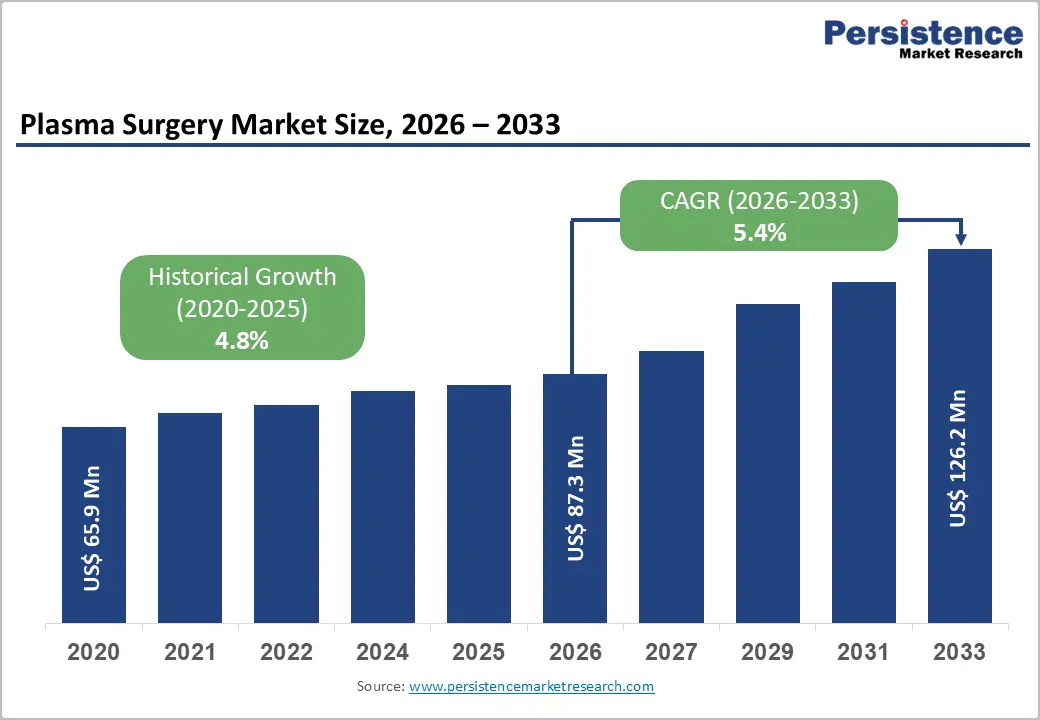
The global plasma surgery market is expected to be valued at US$ 87.3 million in 2026 and projected to reach US$ 126.2 million by 2033, growing at a CAGR of 5.4% between 2026 and 2033.
The plasma surgery market is gaining momentum as platelet-rich plasma (PRP) and related plasma-based therapies become increasingly popular across cosmetic, orthopedic, and regenerative medicine applications. Rising demand for minimally invasive aesthetic procedures, amplified by celebrity endorsements and professional society tracking, has accelerated public awareness and acceptance. PRP’s ability to concentrate growth factors from a patient’s own blood has positioned it as an attractive option for wound healing, sports injuries, musculoskeletal disorders, hair restoration, and disc-related conditions. Expanding clinical research and growing outpatient adoption are strengthening confidence in its therapeutic potential while lowering reliance on more invasive, high-cost interventions.
Technological progress is also shaping market dynamics through emerging applications such as cold plasma oncology, where low-temperature plasma has demonstrated the ability to selectively damage cancer cells in laboratory and animal studies. These promising findings are driving academic-industry collaborations and early-stage clinical exploration. Together, rising procedural volumes, expanding indications, and innovation-driven research pipelines are shaping current trends and driving sustained growth across global plasma surgery markets.
Key Market highlights
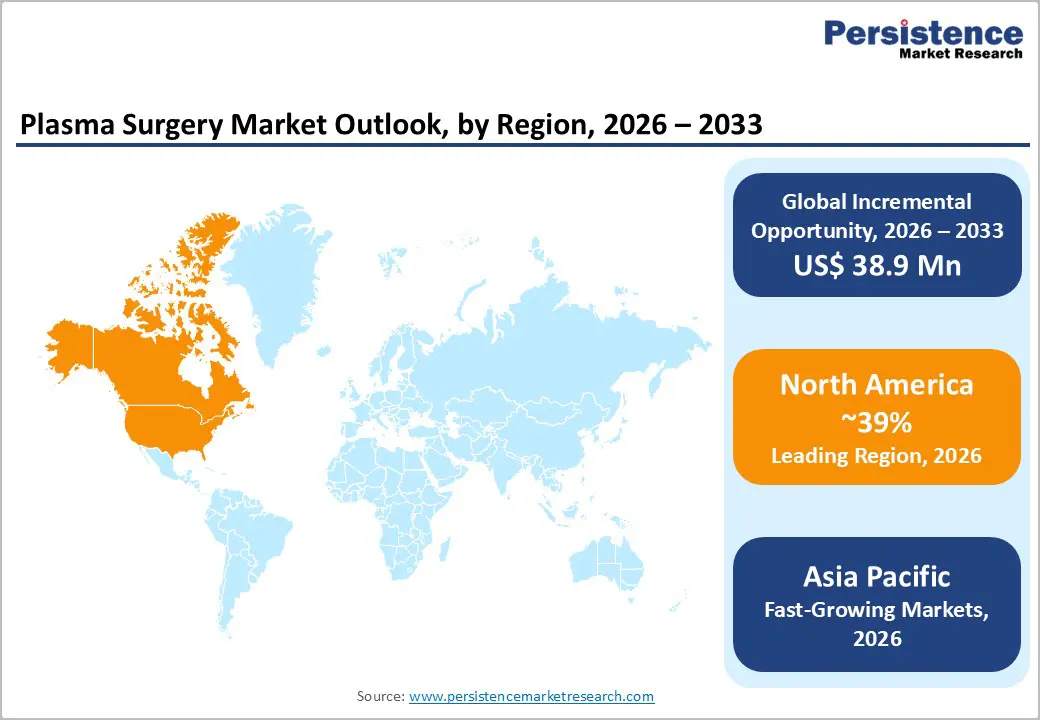
- North America leads the plasma surgery market, supported by advanced surgical infrastructure, rapid technology adoption, strong reimbursement pathways, and high procedural volumes.
- Asia Pacific is the fastest-growing region, driven by healthcare modernization, expanding hospital capacity, rising cosmetic and orthopedic procedures, and increasing medical tourism.
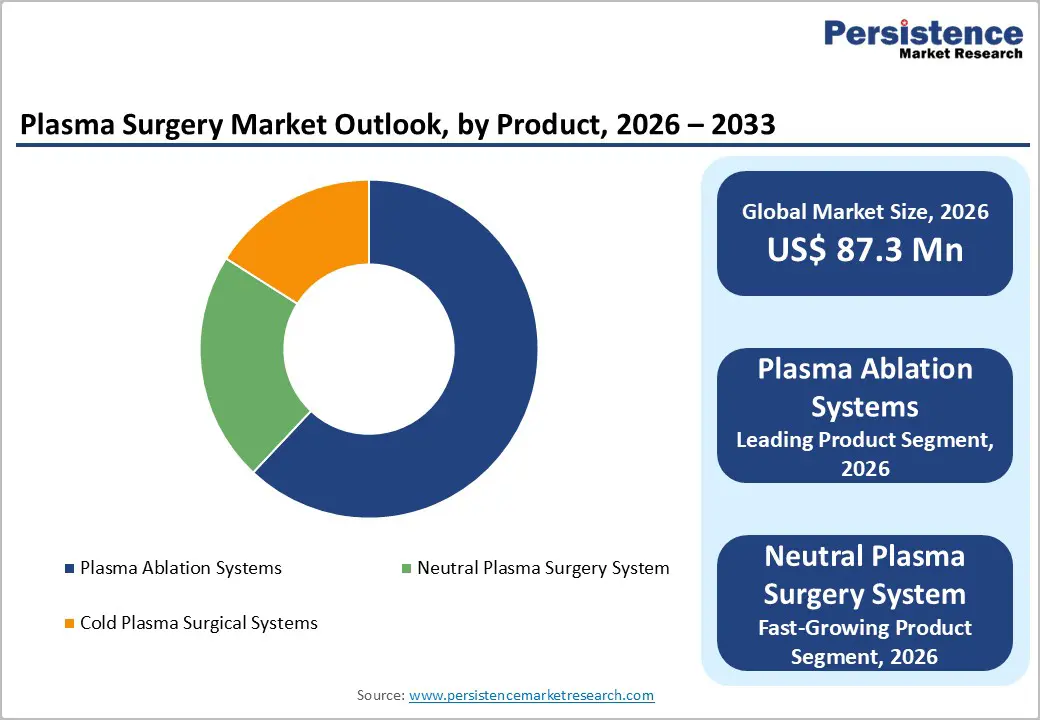
- Plasma ablation systems hold the largest product share due to precision cutting, reduced blood loss, shorter operating times, and broad use in minimally invasive surgeries.
- Cold atmospheric plasma and regenerative plasma therapies represent the fastest-growing technology segments, supported by oncology research, wound-care applications, and rising demand for outpatient-friendly systems.
| Key Insights | Details |
|---|---|
|
Plasma Surgery Market Size (2026E) |
US$ 87.3 million |
|
Market Value Forecast (2033F) |
US$ 126.2 million |
|
Projected Growth CAGR (2026-2033) |
5.4% |
|
Historical Market Growth (2020-2025) |
4.8% |
Market Dynamics
Driver: Increase in the Use of Platelet Rich Plasma in Cosmetic Surgery and Wound Healing Surgery
The contour of the nose bulb and nostrils can be altered with the non-invasive skin tightening treatment known as plasma fibroblast. This technique works best on the nose for pore reduction, skin tone, and skin shaping. The most prevalent cosmetic procedure for the face, with 352,555 patients in 2020, is nose reshaping, according to the American Society of Plastic Surgeons' statistics report.
The regenerative properties of platelet-rich plasma have been extensively documented in research for years and have been used in multiple areas of plastic surgery. According to the American Society of Plastic Surgeons, more than 231,140 aesthetic surgeries using platelet-rich plasma were performed in 2020. As a result, the demand for plasma surgery is increasing.
Promising outcomes of plasma surgery include wound healing, bone formation in bisphosphonate-related osteonecrosis of the jaw, and soft-tissue repair in the alveolar socket following dental surgery. Also, it is projected that medical variables will create numerous therapeutic expansion opportunities, propelling the market in the future.
Growing healthcare spending offers hospitals and businesses substantial potential to increase revenue. The Organization for Economic Cooperation and Development (OECD) projected that by 2020, US$10 trillion would have been spent on healthcare around the globe. In most European nations, healthcare spending is increasing more quickly than GDP (Gross Domestic Product).
Restraint: Complications in Electrosurgery and Potential Risk of Burns
The risk of flammable gases, such as anaesthetics or intestinal gas; interference with pacemakers and monitors; neuromuscular stimulation, including ventricular fibrillation; accidental burns; and infection transfer are some of the problems associated with electrosurgery.
Laparoscopic surgery, electrosurgical device injury and damage are expected to occur 1–2 times per 1000 patients. Unrecognized intestinal injuries and significant vascular damage are a couple of these consequences. Unrecognized thermal injuries to the intestine during laparoscopic surgery are highly harmful and difficult to identify, making them particularly deadly with a significant related mortality. Vascular injuries, however, can be diagnosed through the appearance of unexpected bleeding. The safety association for plasma surgery has suffered due to the high number of burn cases and OR mishaps, which is expected to impede market growth.
Opportunity: Expanding Clinical Applications and Technology Innovation Fuel Plasma Surgery Market Growth
The plasma surgery market offers strong growth opportunities as demand for minimally invasive, high-precision surgical solutions increases across cosmetic, orthopedic, dermatologic, and regenerative medicine applications. Rising acceptance of platelet-rich plasma therapies for musculoskeletal injuries, hair restoration, and wound healing continues to broaden the addressable patient population. Technological advances in cold atmospheric plasma, improved energy-delivery systems, and multifunctional probes are opening new therapeutic areas, including oncology and infection control, encouraging hospitals to invest in next-generation platforms. Rapid healthcare expansion in the Asia Pacific and Latin America, coupled with growing medical tourism, is creating attractive entry points for global and regional manufacturers. Companies also have opportunities to collaborate with academic centers to validate new indications through clinical trials, accelerating regulatory clearances and physician confidence. The development of portable, outpatient-friendly systems and cost-efficient consumables can further drive adoption in ambulatory settings, enabling vendors to capture recurring revenue while strengthening long-term market positioning.
Category-wise Insights
Product Analysis
Plasma ablation systems accounted for an estimated 62% share of the plasma surgery market in 2026, reflecting their growing role in complex surgical procedures requiring precise tissue removal and effective hemostasis. These systems are widely adopted in otolaryngology, oncology, and minimally invasive interventions because they shorten operative times while limiting collateral thermal injury. Clinical evidence has supported this trend, including comparative studies of adolescent nasopharyngeal angiofibroma surgery showing that plasma-assisted endoscopic excision can significantly reduce blood loss and shorten procedure duration, particularly in embolized patients. Surgeons value plasma ablation for its ability to maintain clear surgical fields, which improves visualization and procedural control. Continued integration into endoscopic platforms and refinements in probe design are expanding use across specialties. As hospitals seek technologies that enhance efficiency and safety while lowering complication rates, plasma ablation systems are expected to remain the dominant product category in this market.
Application Analysis
The dissection segment represented about 49% of the total market share in 2025, driven by the clinical advantages plasma-based tools offer during soft-tissue separation. Plasma dissection reduces the risk of postoperative infections by producing less surgical smoke, which can contain toxic particles and microbial contaminants associated with conventional electrosurgery. Lower thermal spread also limits collateral tissue damage, allowing faster wound healing and improved collagen deposition, which strengthens postoperative tissue integrity. These benefits translate into shorter recovery periods and fewer complications, making plasma dissection particularly attractive in ENT, orthopedic, and general surgical applications. Surgeons increasingly favor these devices for procedures requiring delicate manipulation near critical structures, where precision is essential. The combination of improved patient outcomes, operating-room safety, and efficiency gains continues to support high adoption rates. As hospitals prioritize minimally invasive techniques and faster patient turnover, plasma-based dissection tools are likely to retain a leading role in the application landscape.
End User Analysis
Hospitals captured roughly 54% of the plasma surgery market in 2025, reflecting rapid uptake of plasma-based and PRP-related therapies across multiple clinical departments. Rising osteoarthritis prevalence, growing demand for non-surgical pain management, and increasing volumes of hair-restoration procedures have accelerated hospital adoption. Physicians are incorporating plasma technologies into orthopedic care pathways, sports-injury management, dermatology, and wound-healing programs because of their favorable safety profiles and regenerative potential. Large medical centers also benefit from the capital resources required to install advanced plasma systems and train surgical teams, further reinforcing their leadership. Multidisciplinary settings enable hospitals to systematically evaluate outcomes and expand indications based on real-world evidence, thereby fostering broader clinical confidence. As patient volumes rise and preference shifts toward minimally invasive options with shorter recovery times, hospitals are expected to remain the primary end users driving demand in the global plasma surgery market.
Regional Insights
North America Plasma Surgery Market Trends and Insights
North America remains a prominent market for plasma surgery due to its advanced healthcare infrastructure, widespread adoption of minimally invasive technologies, and strong investment climate. Hospitals and ambulatory centers across the United States routinely incorporate high-precision energy-based devices to improve procedural outcomes and shorten recovery times, supporting steady procedural growth. Government funding programs, private equity participation, and venture capital inflows aimed at surgical innovation continue strengthening clinical capabilities and accelerating the commercialization of new platforms. Medical tourism also contributes, as patients from abroad seek sophisticated cosmetic and reconstructive procedures supported by experienced specialists and well-regulated facilities. Regulatory approvals have further shaped adoption patterns, including authorization of helium-plasma and radiofrequency systems for dermatologic and aesthetic indications, as well as clearance of cold atmospheric plasma for clinical investigation in oncologic settings. These developments reinforce physician confidence and encourage broader clinical use. Combined with strong reimbursement pathways, extensive practitioner training, and an innovative ecosystem, North America is expected to maintain its leadership position in the plasma surgery landscape.
Asia Pacific Plasma Surgery Market Trends and Insights
Asia Pacific is emerging as a rapidly expanding plasma surgery market, supported by healthcare modernization, rising procedural volumes, and growing demand for cosmetic and regenerative treatments. Countries such as China, Japan, South Korea, and India are investing heavily in tertiary hospitals, surgical robotics, and advanced energy-based systems, enabling faster uptake of plasma technologies in both reconstructive and aesthetic care. Increasing disposable incomes and expanding medical tourism hubs are drawing regional and international patients into seeking cost-effective yet technologically sophisticated procedures. Academic hospitals and research institutes are also intensifying studies around cold plasma applications, wound healing, and oncology, strengthening the regional innovation pipeline. Local manufacturers and distributor partnerships are improving affordability and device accessibility, accelerating penetration beyond major urban centers. Public-private collaborations to upgrade surgical infrastructure further enhance market momentum. Together, demographic growth, expanding clinician expertise, supportive investment climates, and rising awareness of minimally invasive treatment benefits are positioning the Asia Pacific as one of the fastest-growing regions for plasma surgery adoption worldwide.
Competitive Landscape
The plasma surgery market exhibits a moderately consolidated competitive structure, with a small group of established medical-device manufacturers accounting for a substantial portion of global revenues. Leading companies compete through technology differentiation, proprietary plasma platforms, and expanding clinical indications across dermatology, orthopedics, oncology, and wound care. Strategic partnerships with hospitals, distributors, and research institutions support geographic expansion and physician training programs. Mergers, acquisitions, and licensing agreements are frequently used to strengthen product portfolios and accelerate regulatory approvals. Smaller innovators focus on niche applications or next-generation cold-plasma systems, intensifying competition while pushing continuous innovation across the industry.
Key Market Developments
- In March 2022, Dutch Ophthalmic Research Center (International) BV launched EVA NEXUS, an advanced infusion system for cataract surgery designed to operate at lower infusion pressures while maintaining stable anterior chamber control, even in complex cases.
- In September 2022, Alfa Instruments s.r.l. entered a distribution partnership with Bausch + Lomb Company, granting Bausch + Lomb rights to market and sell Alfa Instruments’ Vitreocare surgical intraocular dyes outside Italy.
Companies Covered in Plasma Surgery Market
- Plasma surgical
- Mechan Europe ltd
- Bovie medical corporation (Apyx Medical Corporation)
- Nova Plasma Ltd.
- Royal Biologics
- 4T Medical
- Dutch Ophthalmic Research Center
- Alfa Instruments
- Others
Frequently Asked Questions
The global plasma surgery market is valued at US$ 87.3 million in 2026.
Rising cosmetic procedures, sports injuries, regenerative medicine adoption, technological advancements, expanding medical tourism, and increasing research validating plasma-based therapies globally.
North America leads with 39% share in 2025.
Expansion into oncology and wound-care indications, emerging Asia markets, outpatient settings, device innovation, partnerships, regulatory approvals, and cost-effective minimally invasive platforms.
Leaders include Plasma surgical, Mechan Europe ltd, Bovie medical corporation (Apyx Medical Corporation), Nova Plasma Ltd..


