




- Metalworking & Fabrication
- Offset Printing Press Market
Offset Printing Press Market Size, Share, and Growth Forecast 2025 - 2032
Offset Printing Press Market by Product Type (Sheet-Fed Offset Press, Web-Fed Offset Press), Application (Packaging, Publication, Commercial Printing, Others), End-user (Printing Companies, Product Companies, Publishing Houses), and Regional Analysis for 2025 - 2032

Offset Printing Press Market Size and Trend Analysis
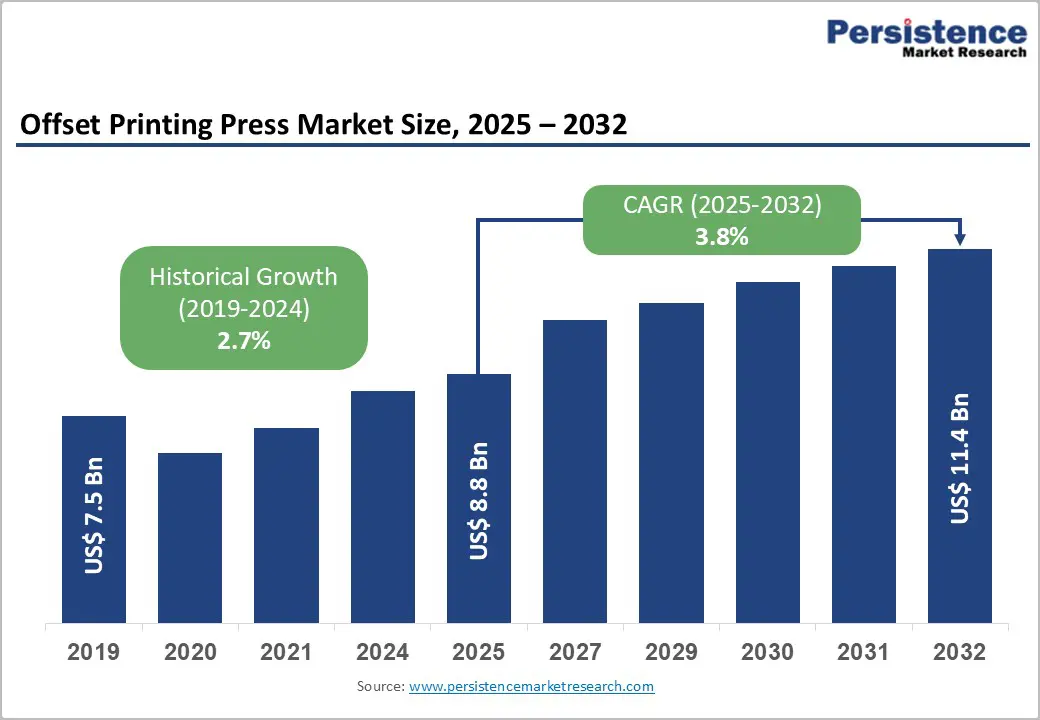
The global offset printing press market size is likely to be valued at US$8.8 billion in 2025 and is expected to reach US$11.4 billion by 2032, growing at a CAGR of 3.8% during the forecast period from 2025 to 2032, driven by strong demand in packaging, commercial printing, and publication segments, supported by the adoption of automation, AI-enabled workflow solutions, and hybrid offset-digital press technologies.
Sheet-fed offset presses retain the largest share, favored for their flexibility, high-quality output, and cost-effectiveness across short- and medium-run jobs. Web-fed presses are gaining traction in high-volume newspaper, magazine, and continuous-feed printing applications. Rising focus on sustainable printing solutions, including eco-friendly inks, energy-efficient presses, and recyclable substrates, is accelerating market growth.
Key Industry Highlights
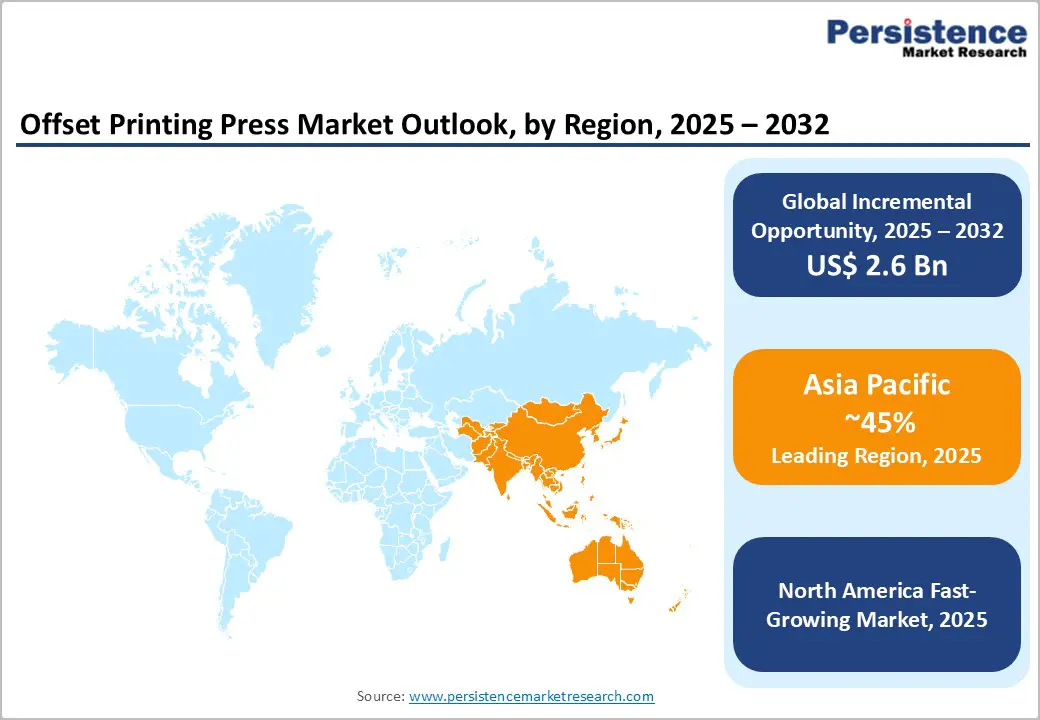
- Leading Region: Asia Pacific leads the market with around 45% share, driven by rapid industrialization, strong packaging and commercial print growth in China, India, and Japan, rising e-commerce, and accelerating adoption of automated and eco-efficient press technologies.
- Fastest Growing Region: North America is the fastest-growing region, driven by strict quality standards, rapid adoption of AI-enabled automation, rising e-commerce packaging demand, and sustained investment and partnerships in high-end commercial and packaging printing.
- Leading Product Type: Sheet-fed offset presses lead the product type segment with 58% revenue share, driven by their cost-efficient, high-quality output and strong adoption in commercial and packaging print.
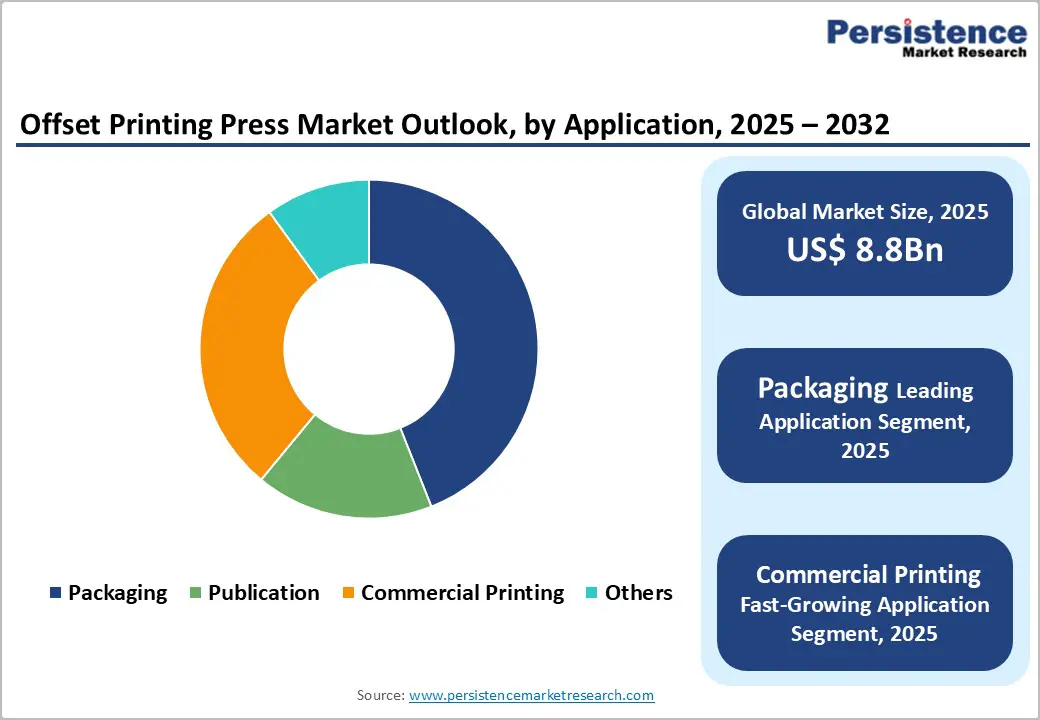
- Leading Application Type: Packaging leads the market with over 48% revenue share, driven by strong consumer goods and e-commerce growth, especially across APAC.
- Leading End-user: Printing companies represent the leading segment in the market with about 50% revenue share, driven by continuous workflow modernization, high-volume print demand, and ongoing investments in automated, high-quality press technologies.
| Key Insights | Details |
|---|---|
|
Offset Printing Press Market Size (2025E) |
US$8.8 Bn |
|
Market Value Forecast (2032F) |
US$11.4 Bn |
|
Projected Growth CAGR (2025-2032) |
3.8% |
|
Historical Market Growth (2019-2024) |
2.7% |
Market Factors - Growth, Barriers, and Opportunity Analysis
Growth in the Packaging Industry
The demand for packaged goods is increasing across sectors such as food and beverages, personal care, pharmaceuticals, and e-commerce. To enhance shelf appeal and improve the customer experience, brands are prioritizing premium, high-quality packaging and driving investments in sheet-fed and web-fed offset presses. These presses are favored for their excellent color accuracy, consistent high-volume output, and cost efficiency, particularly for folding cartons, labels, and retail packaging. In the Asia Pacific region, rapid industrialization, urbanization, and growing e-commerce penetration in countries such as China, India, and Southeast Asia are fueling strong demand for printed packaging solutions.
Printers are also adopting automated, hybrid, and AI-enabled offset presses to support short-run personalization and variable data printing while maintaining efficiency in large-scale production. Investments in eco-friendly inks, energy-efficient presses, and recyclable substrates are helping manufacturers meet sustainability goals, a rising priority for global brands. As packaging becomes more complex and consumer demand for customized, visually striking designs grows, this segment continues to be a key driver of growth, ensuring that offset printing presses remain essential in modern production workflows worldwide.
Transition to Digital Media
The growing use of digital platforms for news, marketing, and educational content has led to a decline in demand for traditional print products, including newspapers, magazines, catalogues, brochures, and corporate communications. This trend is especially evident in mature markets such as North America and Europe, where widespread digital adoption and mobile-first content consumption have significantly reduced print circulation. Publishers and organizations are reallocating budgets from printed advertising to digital marketing channels, social media, and e-books, which provide faster delivery, personalized content, and measurable results at lower costs.
The shift to digital media affects both commercial and publication printing segments, prompting printers to reconsider investments in new offset presses. Digital technologies offer advantages such as short-run flexibility, on-demand printing, and personalized content, making them more appealing than traditional long-run offset printing. While high-volume packaging and premium commercial printing continue to drive demand, the overall growth of offset printing is limited by declining traditional publication printing. This highlights the importance of hybrid offset-digital solutions and automation to remain competitive in a predominantly digital-first landscape.
Hybrid & Sustainable Printing Solutions
Hybrid presses, which merge the high-quality, cost-effective output of traditional offset printing with the adaptability of digital technology, are increasingly preferred by printers looking for short-run customization, variable data printing, and faster turnaround times. These systems allow commercial, packaging, and label printers to handle both high-volume and personalized jobs efficiently, minimizing setup times and operational costs while ensuring consistent color and print quality. Adoption of hybrid presses is growing rapidly in regions such as Asia Pacific and North America, driven by brands’ demand for flexible, high-quality printing solutions that cater to diverse customer needs and e-commerce packaging requirements.
Sustainability is becoming a key factor in purchasing decisions. Printers are incorporating eco-friendly inks, energy-efficient presses, waterless offset systems, and recyclable substrates to comply with stricter environmental regulations and meet rising ESG expectations from consumers and brand owners. These initiatives not only reduce carbon footprint and waste but also enhance operational efficiency and brand image. By combining hybrid technology with sustainable practices, offset press manufacturers can tap into new market opportunities, strengthen customer loyalty, and position themselves for long-term growth in a market increasingly focused on innovation, flexibility, and environmental responsibility.
Category-wise Analysis
Product Type Insights
Sheet-fed offset presses dominate the market, accounting for approximately 58% of revenue share in 2025. They are favored for their ability to deliver high-quality, cost-effective short- to medium-run printing across commercial applications, premium packaging, and branded marketing materials. Key advantages include excellent color accuracy, broad substrate compatibility, and modular designs that support automation, inline color management, and quick plate changes. Advanced models such as the Heidelberg Speedmaster CX series and Komori Lithrone G40 are widely used for high-end commercial printing and folding carton production, offering features such as automated plate handling, inline quality control, and high productivity to meet the needs of modern print operations.
Web-fed offset presses are the fastest-growing segment, fueled by the modernization of newspaper, magazine, and catalog production, particularly in emerging markets where print readership remains strong. These presses deliver high throughput, lower per-unit costs for long runs, and enhanced operational efficiency through automated tension control, inline finishing, and digital workflow integration. Examples include Manroland Web Systems’ Lithoman series, designed for continuous high-speed operation, consistent color quality, and flexible web handling, enabling large-volume production while minimizing waste and downtime.
Application Type Insights
The packaging segment dominates the market, accounting for over 48% of revenue share in 2025, driven by the growing consumption of packaged goods, the expansion of organized retail, and the surge in e-commerce shipments. Offset presses remain the preferred choice for folding cartons, labels, and premium packaging formats that demand high color accuracy and consistent quality. For instance, the Koenig & Bauer Rapida 106 is widely used for premium folding cartons. The increasing demand for personalized and short-run packaging for e-commerce products is prompting printers to invest in versatile sheet-fed offset presses, enhancing both flexibility and operational efficiency. Rapid industrialization in the Asia Pacific region, along with manufacturers’ shift toward high-value and sustainable packaging solutions, further reinforces the segment’s leading position.
Commercial printing is the fastest-growing application segment, driven by demand for advertising materials, brochures, catalogs, and high-end corporate stationery. The publication segment remains steady, supported by ongoing demand for books, educational materials, and professional journals in both mature and developing markets. Printers are upgrading to advanced sheet-fed and hybrid offset systems to meet tight turnaround times, automated workflows, and higher print quality. For example, the Bauer Rapida 106 is used in commercial printing to deliver high-speed production and consistent color fidelity for both short- and long-run jobs. Growth is also supported by the increasing adoption of automated prepress and finishing solutions, which minimize downtime and boost productivity.
End-user Type Insights
Printing companies remain the leading end-user segment, accounting for 50% of revenue, driven by their reliance on high-volume, cost-efficient printing solutions across commercial, publishing, and packaging applications. Their market leadership is supported by ongoing investments in workflow automation, digital prepress integration, and color-management systems, which boost productivity and reduce turnaround times. As printers expand their offerings to include premium packaging, hybrid printing, and value-added finishing, the demand for advanced offset presses continues to grow. For instance, the Ryobi 920 is widely used for high-volume brochures, catalogues, and premium packaging, enhancing efficiency, shortening turnaround times, and enabling value-added finishing services.
Packaging companies represent the fastest-growing end-user segment, fueled by rising demand for branded, mass-market, and specialty packaging solutions across FMCG, e-commerce, pharmaceuticals, and retail. These companies are investing in high-performance presses capable of producing premium folding cartons, labels, and high-finish packaging that require precise color reproduction and durability. Publishing houses provide a steady demand, particularly for books, educational materials, academic journals, and niche publications. For example, the Harris V-3000 is used for high-end folding cartons, while publishing houses continue to generate consistent demand for books and journals, sustaining the ongoing use of offset presses.
Regional Insights
North America Offset Printing Press Market Trends
North America has become the fastest-growing region, fueled by strong adoption of advanced technologies and modernization across commercial, packaging, and publication printing. Leading printers in the U.S. and Canada are upgrading to AI-enabled, automated offset presses that offer rapid plate changes, inline color control, and predictive maintenance, significantly enhancing efficiency and reducing downtime. For example, Heidelberg USA has supplied multiple Speedmaster CX presses to commercial and packaging printers, enabling faster turnaround times and superior print quality.
Sustainability initiatives are also driving market growth, with printers increasingly adopting eco-friendly inks, energy-efficient presses, and recyclable substrates to comply with stringent environmental regulations and meet customer ESG expectations. The expansion of e-commerce and demand for premium packaged goods is further boosting the need for high-quality folding cartons, labels, and promotional materials, supporting offset press sales. At the same time, traditional print segments, such as newspapers and periodicals, are declining, prompting publishers to invest in modern web-fed presses or hybrid digital-offset solutions to stay competitive.
Europe Offset Printing Press Market Trends
Europe’s offset printing press market is experiencing steady, moderate growth, driven by sustainability initiatives, automation adoption, and strong demand for packaging, commercial printing, and premium labels, even as traditional publication printing gradually declines. The rising demand in packaging, commercial printing, and labeling supports the adoption of high-performance sheet-fed and web-fed presses. The expansion of e-commerce and premium consumer goods, along with the modernization of newspaper and magazine presses, is further contributing to market growth. Printers are increasingly investing in hybrid digital-offset systems to efficiently handle both short-run personalized jobs and high-volume production.
There is growing demand for high-performance sheet-fed and web-fed offset presses, particularly in packaging, commercial printing, and labeling segments. Printers are upgrading to advanced automation, inline quality control, and hybrid digital-offset solutions to increase throughput, reduce make-ready times, and maintain consistent color across large runs. The growth of e-commerce, premium consumer products, and branded packaging is driving high-volume adoption, while the modernization of newspaper and magazine presses supports web-fed press expansion. Companies such as Manroland Web Systems are modernizing European web-fed press operations, enhancing efficiency and enabling sustained long-run publication printing.
Asia Pacific Offset Printing Press Market Trends
The Asia Pacific region leads the offset printing press market, driven by the growing packaging sector, which is fueled by rising demand for consumer goods and the expansion of e-commerce. Brands in China, India, and Southeast Asia are increasingly opting for premium folding cartons, labels, and point-of-sale packaging, making offset presses essential for achieving high color accuracy and cost-effective large-volume production. Increased cross-border trade and export-oriented manufacturing are further boosting packaging investments. For instance, Komori Asia has delivered several Lithrone GX presses to commercial and packaging printers across India and Southeast Asia, supporting high-volume, premium-quality output.
Printers in the region are upgrading to automated, connected offset workflows, incorporating AI-powered quality checks, automated plate handling, and software-driven end-to-end production. Computer-to-plate (CTP) technology is also expanding, with thermal CTP widely adopted in commercial offset shops to accelerate prepress and improve efficiency. Hybrid printing is gaining traction as well, with offset-digital presses growing rapidly to accommodate both short-run and high-volume jobs. Printers are increasingly investing in energy-efficient presses and eco-friendly inks to meet sustainability targets and comply with regulatory requirements.
Competitive Landscape
The global offset printing press market has a moderately fragmented structure, driven by rising demand across packaging, commercial printing, and publication segments. Growth in emerging markets, especially Asia Pacific, and advances in automation, hybrid printing, and eco-friendly presses have attracted both global OEMs and regional players, driving a competitive and dynamic market.
With key leaders including Heidelberger Druckmaschinen AG, Komori Corporation, Koenig & Bauer AG, Manroland, RMGT, and Mitsubishi Heavy Industries, the market sees intense competition. These players compete through extensive R&D, product innovation, and expansion of service networks, focusing on automation, hybrid offset-digital systems, and sustainability. Strategic collaborations, aftermarket services, and customer training programs are additional differentiators.
Key Industry Developments:
- In April 2025, Komori expanded its portfolio with the Lithrone GX29, a 29-inch offset press tailored for commercial and packaging applications. The press delivers high ROI through advanced automation, integration with the KP-Connect Pro workflow, support for specialty substrates, and eco-friendly features that minimize energy consumption, waste, and emissions.
- In November 2025, Koenig & Bauer announced the successful real-world implementation of LED light curing on its Cortina waterless offset press, enabling consistent, high-quality printing on coated papers. European printers, including Freiburger Druck and Rodi Media Group, reported benefits such as more vibrant colors, reduced ink usage, lower waste, and expanded commercial opportunities in newspapers and glossy magazines.
Offset Printing Press Market Scope
| Report Attribute | Details |
|---|---|
|
Historical Data/Actuals |
2019 - 2024 |
|
Forecast Period |
2025 - 2032 |
|
Market Analysis |
Value: US$ Bn |
|
Geographical Coverage |
|
|
Segmental Coverage |
|
|
Competitive Analysis |
|
|
Report Highlights |
|
Companies Covered in Offset Printing Press Market
- Heidelberg
- Komori Corporation
- Manroland Sheetfed
- KBA Group (Koenig & Bauer AG)
- Ryobi MHI Graphic Technology Ltd.
- Goss International
- Mitsubishi Heavy Industries Printing & Packaging Machinery, Ltd.
- Adast Systems, a.s.
- Shinohara Machinery Co., Ltd.
- Akiyama International Co., Ltd.
- Sakurai Graphic Systems Corporation
- TKS (Tokyo Kikai Seisakusho, Ltd.)
- Hamada Printing Press Co., Ltd.
Frequently Asked Questions
The global offset printing press market is projected to grow from US$8.8 billion in 2025 to US$11.4 billion by 2032, indicating strong and sustained expansion over the period.
The key demand drivers for the offset printing press market are the growth of the packaging industry, ongoing technological advancements such as automation and hybrid presses, and steady demand in commercial and publishing printing.
The sheet-fed offset press segment dominates the market, accounting for 58% of revenue share, driven by its cost-effective, high-quality output and widespread use in commercial and packaging printing.
Asia Pacific leads the market, holding more than 45% of the share, driven by rapid industrial growth and increasing print demand in China and India.
A significant growth opportunity exists in hybrid and eco-friendly printing solutions, where combining digital and offset technologies with sustainable inks addresses changing customer preferences and regulatory standards.


