




- Media & Entertainment
- Print-on-demand Market
Print-on-demand Market Size, Share, and Growth Forecast 2026 - 2033
Print-on-demand Market by Platform (Software, Service), by Product (Apparel, Home Decor, Drinkware, Accessories, Others), Technology (Digital Printing, Offset Printing, Flexographic Printing, Screen Printing), End-user (E-commerce, Publishing, Fashion & Apparel, Art & Creative, Corporate, Education, Others), Distribution Channel (Online, Offline), and Regional Analysis, 2026 - 2033

Print-on-demand Market Size and Trend Analysis
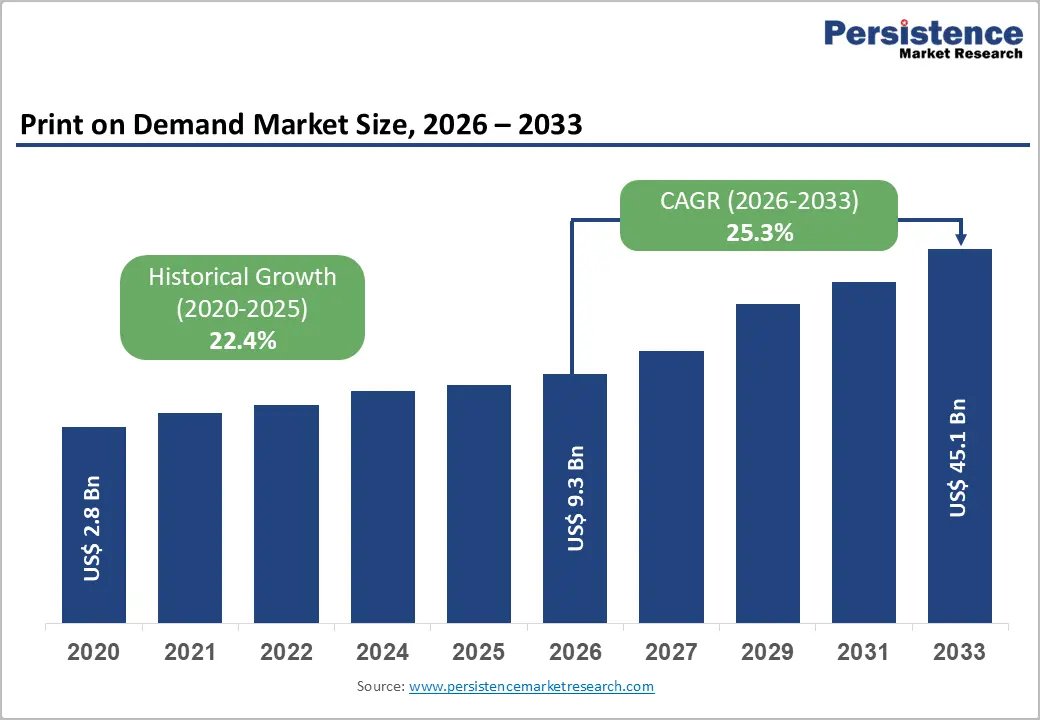
The global Print-on-demand Market size is expected to be valued at US$ 9.3 billion in 2026 and projected to reach US$ 45.1 billion by 2033, growing at a CAGR of 25.3% between 2026 and 2033.
The print-on-demand (POD) market is gaining strong momentum, supported by rapid e-commerce expansion and increasing consumer preference for personalized and limited-edition products. Integration of POD solutions across major online marketplaces has simplified product customization and order fulfillment for sellers worldwide. Technological advancements in digital printing, faster production cycles, and the rise of creator-led brands continue to accelerate market penetration across apparel, accessories, and home décor segments.
Key Industry Highlights:
- Leading Region: North America leads the Print on Demand market with a 34% share in 2025, supported by strong e-commerce infrastructure, advanced digital ecosystems, and innovation-driven customization trends.
- Fastest Growing Region: Asia Pacific, holding 29% share in 2025, is the fastest-growing region, driven by expanding manufacturing capabilities, rapid digital adoption, and rising online retail penetration.
- Leading Category: Software dominates the Print on Demand market with a 62% share in 2025, driven by seamless e-commerce integration, automation capabilities, and scalable cloud-based infrastructure.
- Fastest Growing Category: Service-based platforms are emerging as the fastest-growing category, supported by rising demand for end-to-end fulfillment, logistics management, and outsourced operational solutions.
- Key Market Opportunity: Sustainable materials and eco-friendly production models present a major growth opportunity, particularly in Europe, which is projected to grow at a CAGR of 24% between 2026 and 2033.
| Key Insights | Details |
|---|---|
|
Print-on-demand Size (2026E) |
US$ 9.3 billion |
|
Market Value Forecast (2033F) |
US$ 45.1 billion |
|
Projected Growth CAGR(2026-2033) |
25.3% |
|
Historical Market Growth (2020-2025) |
22.4% |
Market Dynamics
Drivers - Seamless Integration of Print-on-demand with Expanding Global E-commerce Ecosystems
The integration of print-on-demand (POD) services with leading e-commerce platforms has significantly transformed online retail operations. Global e-commerce sales have reached nearly US$ 6 trillion in recent years, reflecting a strong digital commerce environment that supports personalized offerings. POD enables instant customization without inventory risks, reducing upfront investment requirements for sellers.
Major platforms such as Shopify, Amazon, and Etsy provide built-in POD integrations that improve operational efficiency and accelerate go-to-market timelines. Merchants leveraging these integrations often report stronger conversion rates due to differentiated product offerings. This model lowers entry barriers for startups and creators, encouraging scalable growth and continuous innovation across apparel, accessories, and lifestyle product categories.
Continuous Advancements in Digital Printing Technologies Enhancing Cost Efficiency and Quality
Rapid advancements in digital printing technologies are strengthening the operational foundation of the POD market. Innovations in inkjet and direct-to-garment printing have improved color accuracy, material compatibility, and production speed. Industry sources indicate digital print output has been expanding at over 15% annually, reflecting increased adoption across commercial applications.
These technological efficiencies significantly reduce setup costs compared to conventional bulk printing methods. Faster turnaround times and improved automation allow manufacturers to process small-batch and single-unit orders economically. As production becomes more streamlined and cost-effective, industries such as fashion, home décor, and promotional merchandise increasingly rely on POD solutions to meet evolving customization demands.
Restraints - Significant Capital Investment Requirements Limiting Entry of Small and Emerging Players
High initial capital requirements for print-on-demand equipment and supporting software infrastructure present a considerable barrier to entry for smaller businesses. Advanced digital printers, automation tools, and design management systems require substantial upfront investment, which can strain financial resources for startups and micro-entrepreneurs.
Industry surveys indicate that limited access to funding remains a key constraint, particularly in developing regions where financing options are restricted. These cost pressures create competitive imbalances, favoring established players with stronger capital bases. Consequently, market consolidation risks increase, potentially slowing innovation from smaller independent entrants.
Ongoing Quality Control and Product Consistency Issues Across Diverse Materials
Maintaining consistent product quality across different fabrics, materials, and substrates remains a significant operational challenge in POD models. Variations in color accuracy, print durability, and finishing standards can lead to higher product return rates and customer dissatisfaction.
Compliance with standardized quality frameworks, such as ISO guidelines, is often difficult to implement uniformly in on-demand production environments. This challenge becomes more critical in premium segments where durability and finish are key purchasing factors. Inconsistent output may weaken brand credibility and limit long-term customer retention in competitive markets.
Opportunity - Growing Adoption of Sustainable and Eco-Friendly Materials Creating Premium Market Potential
The rising global emphasis on sustainability presents significant growth opportunities for print-on-demand providers adopting eco-friendly materials and processes. Increasing consumer awareness and preference for environmentally responsible brands are reshaping purchasing behavior across apparel and lifestyle categories. Regulatory initiatives such as the EU Green Deal further accelerate demand for sustainable production models.
Companies investing in recycled fabrics, water-based inks, and low-waste printing technologies can position themselves within high-value premium segments. Sustainable branding also enhances customer loyalty and supports premium pricing strategies. As environmental accountability becomes central to purchasing decisions, eco-conscious POD offerings are expected to gain strong competitive traction.
Integration of Artificial Intelligence to Enable Advanced Personalization and Design Automation
Artificial intelligence is unlocking new opportunities in design automation and hyper-personalization within the POD ecosystem. AI-powered tools enable automated artwork generation, pattern customization, and rapid mock-up creation, significantly reducing design turnaround times for sellers and creators.
The expanding adoption of AI in creative workflows enhances scalability and supports mass customization without increasing operational complexity. This capability is particularly impactful in high-demand segments such as accessories, fashion, and gifting. As AI-driven personalization improves user engagement and conversion rates, e-commerce platforms leveraging such technologies are likely to experience sustained revenue growth.
Category-wise Analysis
Platform Insights
Software leads the Platform segment, accounting for approximately 62% of the market share in 2025. Its dominance is driven by seamless integration capabilities with e-commerce platforms, automation of order processing, and real-time inventory synchronization. Cloud-based POD software solutions enable efficient design uploads, payment processing, and fulfillment tracking, significantly reducing operational complexity for merchants. These scalable and cost-efficient systems are particularly attractive to small and mid-sized sellers operating in highly competitive online environments.
Service-based platforms are emerging as the fastest-growing segment, supported by increasing demand for end-to-end fulfillment, logistics management, and design assistance. Businesses are increasingly outsourcing operational functions to focus on branding and marketing. This shift toward managed POD solutions is strengthening long-term platform partnerships and enhancing operational efficiency across global seller networks.
Product Insights
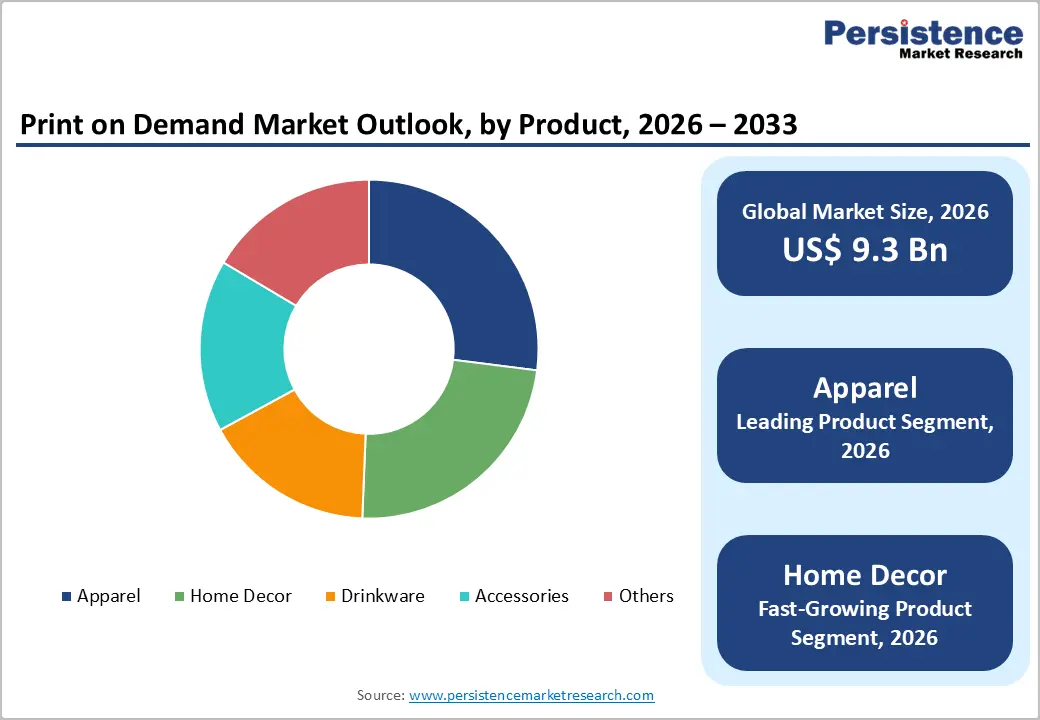
Apparel dominates the product segment, holding approximately 32% market share in 2025. The segment benefits from sustained consumer interest in personalized fashion, including custom t-shirts, hoodies, and athleisure wear. The growing creator economy and influencer-driven merchandising trends further accelerate demand. Apparel’s repeat purchase nature and compatibility with digital printing technologies contribute significantly to its revenue leadership within the POD ecosystem.
Home décor and lifestyle products represent the fastest-growing product category, fueled by rising demand for customized interior aesthetics and gifting solutions. Consumers increasingly seek unique wall art, decorative items, and personalized home accessories. This diversification beyond fashion broadens revenue streams and reduces dependency on apparel-centric sales cycles.
Technology Insights
Digital Printing leads the Technology segment with roughly 49% market share in 2025, primarily due to its efficiency in short production runs and rapid order fulfillment. Technologies such as direct-to-garment (DTG) and sublimation printing enable high-quality output with minimal setup costs. Continuous advancements in ink formulations and printer capabilities further enhance compatibility across diverse fabrics and materials.
Direct-to-film (DTF) and hybrid printing technologies are emerging as the fastest-growing technological categories. These methods offer improved durability, vibrant color reproduction, and expanded substrate compatibility. Their growing adoption reflects increasing demand for higher-quality customization and more complex design applications within the POD market.
End-user Insights
E-commerce accounts for approximately 48% of the End User segment in 2025, supported by expansive online marketplaces and direct-to-consumer retail models. The integration of POD services within digital storefronts enables streamlined customization and fulfillment. Personalization capabilities enhance customer retention and brand differentiation, making e-commerce platforms central to POD market expansion.
Individual creators and influencers represent the fastest-growing end-user segment. The rise of social commerce and content-driven merchandising is empowering creators to launch niche product lines with minimal risk. This growing entrepreneurial ecosystem is significantly expanding the addressable market for print-on-demand services.
Distribution Channel Insights
Online distribution leads the segment with approximately 75% market share in 2025, driven by the rapid expansion of digital retail and global marketplace accessibility. E-commerce platforms provide scalable infrastructure, international shipping capabilities, and integrated payment systems. The low-inventory model aligns perfectly with digital storefront operations, strengthening online channel dominance.
Offline and hybrid distribution models are emerging as the fastest-growing channels, supported by experiential retail strategies and localized customization kiosks. Retail stores and pop-up outlets are increasingly incorporating on-demand printing solutions to enhance customer engagement and offer immediate product personalization.
Regional Insights
North America Print-on-demand Market Trends
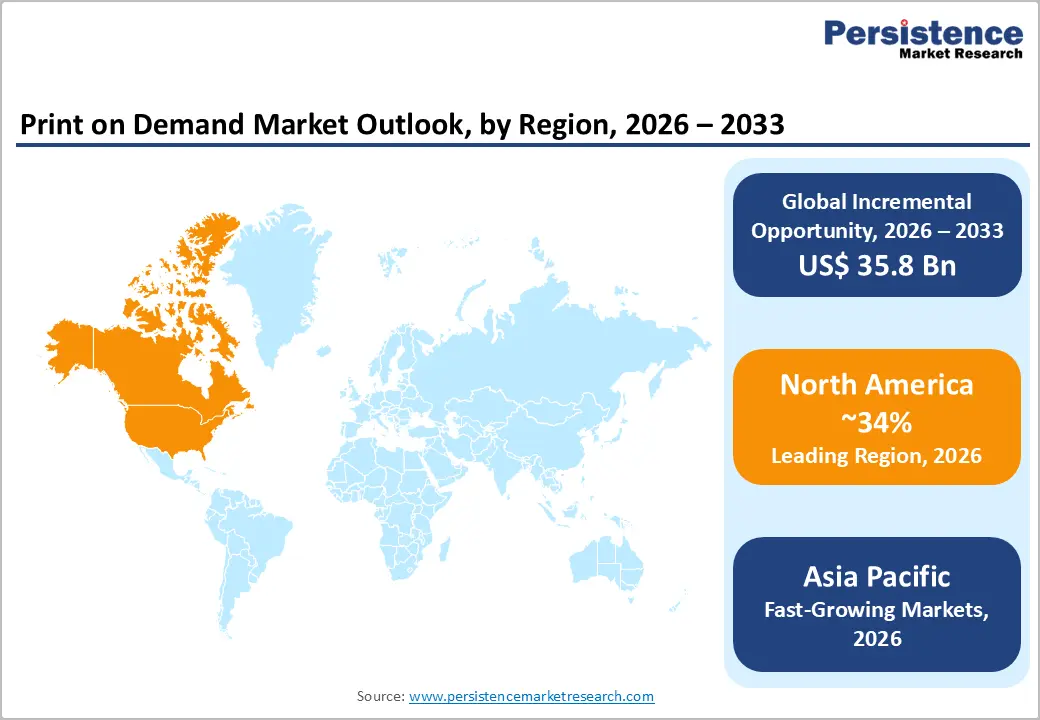
North America holds a leading position in the global print-on-demand market, accounting for approximately 34% of total revenue share in 2025. The dominance is primarily driven by the United States, supported by advanced e-commerce infrastructure, strong digital payment ecosystems, and widespread adoption of customized merchandise. High internet penetration and a well-established creator economy further strengthen regional demand.
The region also benefits from robust data protection frameworks and consumer trust in online transactions, encouraging higher spending on personalized products. Major e-commerce platforms and technology innovators continue integrating POD services into their ecosystems, enhancing automation and fulfillment efficiency while supporting the expansion of small and independent brands.
Europe Print-on-demand Market Trends
Europe represents a mature yet steadily expanding market for print-on-demand, supported by strong digital commerce adoption across Germany, the U.K., and France. Regulatory harmonization under frameworks such as GDPR strengthens consumer confidence in online purchasing and data-driven personalization models. The region demonstrates stable demand across apparel, home décor, and promotional merchandise categories.
Europe is projected to grow at a CAGR of approximately 24% between 2026 and 2033, driven by sustainability-focused initiatives and circular economy objectives. Increasing preference for eco-friendly materials and localized production models aligns with regional environmental goals, positioning Europe as a key hub for responsible and innovation-led POD growth.
Asia Pacific Print-on-demand Market Trends
Asia Pacific accounts for nearly 29% of the global market share in 2025 and is emerging as the fastest-growing regional market. Countries such as China, India, and Japan benefit from strong manufacturing ecosystems, cost-efficient production capabilities, and expanding digital infrastructure. Rapid urbanization and smartphone penetration continue to accelerate online retail adoption across the region.
The surge in regional e-commerce platforms and cross-border trade is significantly expanding access to customized products. Cost advantages in printing and logistics, combined with a growing base of digital entrepreneurs, position the Asia Pacific as a dynamic growth engine for the global print-on-demand industry.
Competitive Landscape
The print-on-demand market is highly fragmented, characterized by the presence of numerous small and medium-sized enterprises competing alongside established global players. The competitive environment is shaped by innovation, platform scalability, and fulfillment efficiency. Market participants focus on expanding production networks, strengthening technology integration, and enhancing customer experience to gain a competitive advantage in a rapidly evolving digital commerce ecosystem.
Strategic initiatives increasingly center on partnerships with e-commerce platforms, investments in AI-driven design tools, and automation capabilities to improve turnaround times. Companies are also introducing subscription-based models and value-added services to build recurring revenue streams and strengthen long-term customer retention in a dynamic marketplace.
Key Market Developments
- In March 2025, Printful expanded its AI-powered design tools to accelerate artwork creation and improve production efficiency across its global fulfillment facilities, enabling sellers to generate customized products faster while enhancing automation, workflow optimization, and scalability within its print-on-demand operations.
- In July 2024, Gelato partnered with multiple e-commerce platforms to introduce sustainable product lines, focusing on eco-friendly materials and localized production networks to reduce carbon footprints, strengthen responsible sourcing initiatives, and align its print-on-demand offerings with growing global sustainability demands.
- In November 2024, Printify strengthened its European operations through strategic acquisitions aimed at expanding regional production capacity, enhancing logistics capabilities, and improving service efficiency, reinforcing its market presence while supporting faster delivery timelines and broader seller access across key European markets.
Companies Covered in Print-on-demand Market
- Printful
- Printify
- Gelato
- Zazzle
- Redbubble
- Cimpress (Vistaprint)
- Gooten
- Spring (Teespring)
- Spreadshirt (SPOD)
- Society6
- Apliiq
- CafePress
- TeePublic
- T-Pop
- Lulu Press
Frequently Asked Questions
The market is projected to reach US$ 9.3 billion in 2026, supported by strong e-commerce expansion and rising demand for personalized products.
E-commerce growth and digital printing advances drive demand significantly.
Digital Printing dominates technology with 49% share in 2025.
North America leads with a 34% share in 2025, driven by advanced digital infrastructure and strong U.S. market presence.
Sustainable materials and AI-driven personalization present strong growth opportunities across global markets.


