




- Industrial Automation
- Triple Offset Butterfly Valves Market
Triple Offset Butterfly Valves Market Size, Share, Trends, Growth, Regional Forecasts 2025 - 2032
Triple Offset Butterfly Valves Market by Material Type (Cast Steel, Stainless Steel, Cast Iron, Others), Size (Small, Medium, Large), Industry (Oil & Gas, Chemicals & Petrochemicals, Power Generation, Pulp & Paper, Metals & Mining), and Regional Analysis 2025 – 2032

Triple Offset Butterfly Valves Market Share and Trends Analysis
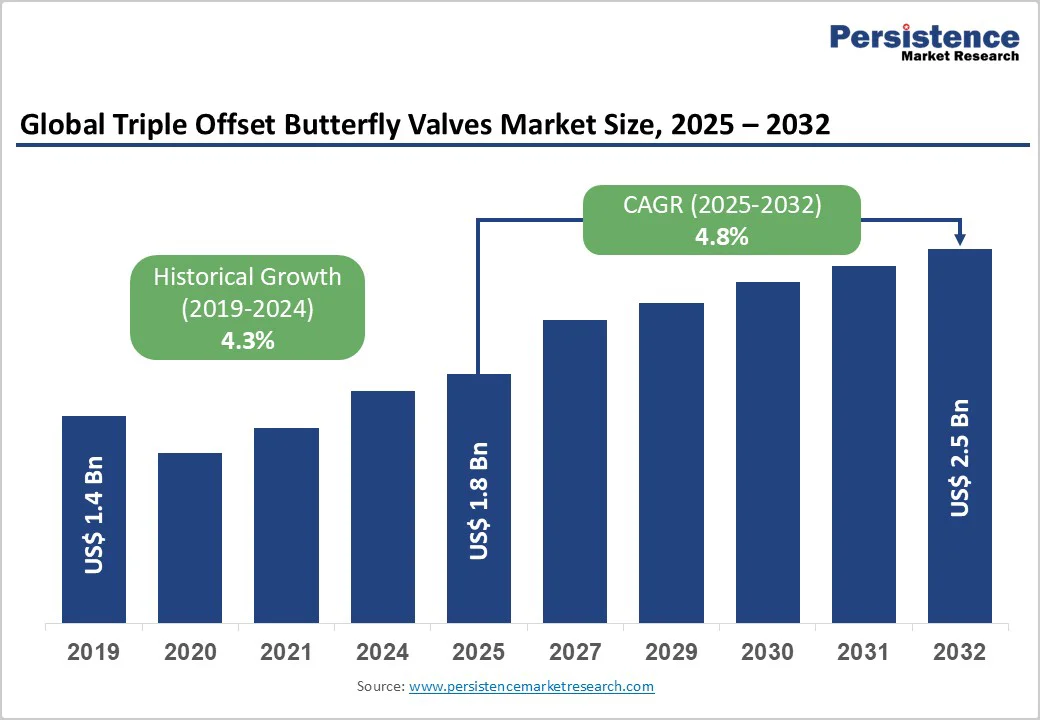
The global triple offset butterfly valves market size is likely to value at US$ 1.8 Billion in 2025 and is projected to reach US$ 2.5 billion, growing at a CAGR of 4.8% between 2025 and 2032. Triple offset butterfly valves (TOBVs) represent a sophisticated evolution in industrial flow control technology, offering superior sealing performance with their unique three-dimensional offset design. These valves eliminate friction during operation, provide zero-leakage shutoff, and deliver extended service life compared to traditional butterfly valves, making them essential for high-pressure, high-temperature applications across demanding industrial environments.
Key Industry Highlights:
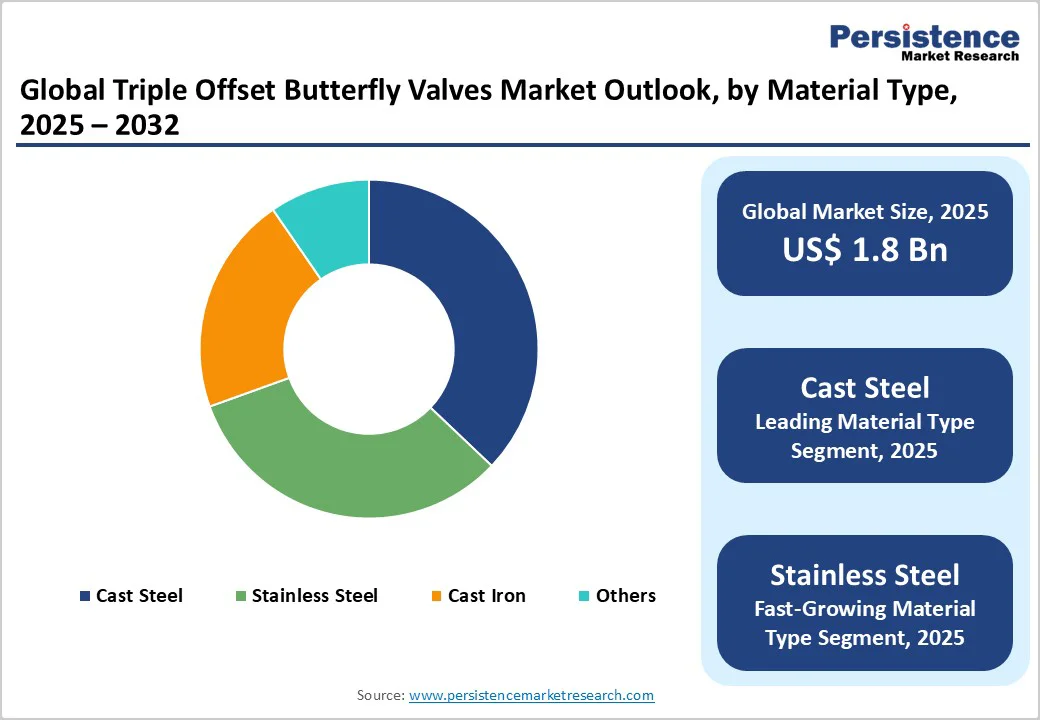
- Leading Material Segment: Cast steel dominates with 37% market share while stainless steel exhibits fastest growth at 5.4% CAGR, reflecting demand for corrosion-resistant solutions in chemical and pharmaceutical applications
- Size Segmentation Leadership: Medium-sized valves (10-25 inches) hold 46% market share with large valves (above 25 inches) demonstrating prominent 4.7% CAGR growth driven by infrastructure mega-projects
- Industry Dynamics: Oil & gas leads with 26% market share while chemicals & petrochemicals shows fastest growth at 5.4% CAGR, supported by expanding processing capacity and safety requirements
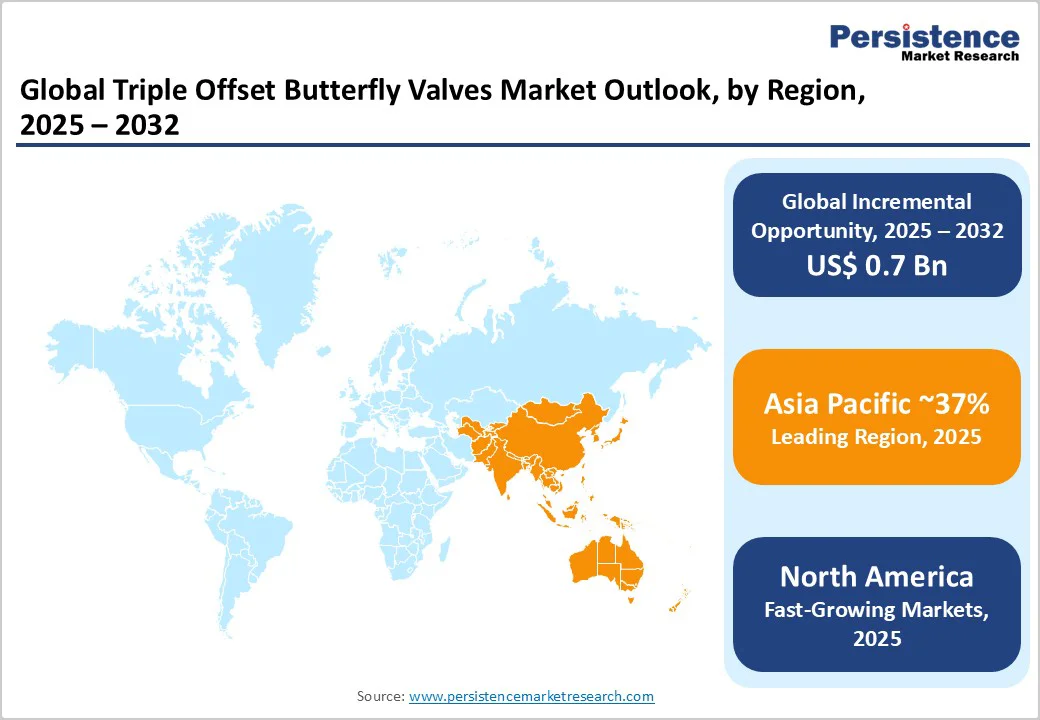
- Regional Growth Leaders: Asia Pacific dominates with 41% global market share, North America exhibits prominent 4.7% CAGR, and Europe maintains 23.6% market share through regulatory harmonization and advanced manufacturing
- Technology Innovation: Smart valve integration with IoT connectivity and predictive maintenance capabilities drives market transformation, with leading manufacturers investing over $5.8 billion in technological advancement and strategic acquisitions
- Competitive Landscape: Market exhibits moderate concentration with top players including Emerson, Flowserve, and KSB maintaining leadership through innovation, global reach, and comprehensive product portfolios
| Key Insights | Details |
|---|---|
| Triple Offset Butterfly Valves Market Size (2025E) | US$ 1.8 billion |
| Market Value Forecast (2032F) | US$ 2.5 billion |
| Projected Growth CAGR (2025-2032) | 4.8% |
| Historical Market Growth (2019-2024) | 4.3% |
Market Dynamics Analysis
Driver - Expanding Oil and Gas Infrastructure Development
The relentless expansion of global oil and gas infrastructure stands as the primary growth catalyst for the triple offset butterfly valve market. With global energy demand projected to increase by nearly 50% by 2050, according to the U.S. Energy Information Administration, investments in exploration, production, and distribution networks are surging. Oil and gas exploration activities are intensifying, necessitating deployment of reliable flow control devices capable of handling extreme pressures and temperatures. Triple offset butterfly valves, with their zero-leakage performance and ability to operate under harsh conditions, are increasingly specified for critical isolation and shut-off applications across upstream, midstream, and downstream operations. More than 300,000 Vanessa valves have been installed globally in oil and gas, chemical, petrochemical, power, and process industry sectors, demonstrating their proven reliability in demanding applications.
Industrial Automation and Smart Manufacturing Integration
The industrial automation revolution is fundamentally transforming valve technology adoption, with smart valves becoming integral components of Industry 4.0 initiatives. Industrial Internet of Things (IIoT) integration enables real-time monitoring, predictive maintenance, and enhanced process control capabilities. Automated valves are increasingly replacing manual systems to improve operational efficiency, reduce human intervention, and enhance safety protocols. According to the U.S. Bureau of Labor Statistics, automation technologies are being adopted to address labor shortages and improve productivity, supporting long-term market growth. Smart valve technologies with IoT connectivity can reduce water loss by up to 15% in water management systems, as reported by the U.S. Environmental Protection Agency. The integration of artificial intelligence and machine learning algorithms enables predictive analytics, optimizing valve performance and reducing downtime while extending operational life cycles.
Restraint - High Initial Capital Investment Requirements
The sophisticated engineering and advanced materials required for triple offset butterfly valve manufacturing result in significantly higher initial costs compared to conventional valve alternatives. Premium materials such as specialized stainless steel grades, exotic alloys including Inconel and Hastelloy, and precision machining requirements contribute to elevated production costs. Small and medium-sized enterprises may face budget constraints when considering upgrades from traditional valve systems, particularly in price-sensitive markets where initial capital expenditure is a primary concern. The complex three-offset geometry and metal-to-metal sealing mechanisms require specialized manufacturing capabilities and quality control processes, further increasing production costs and limiting market accessibility for cost-conscious applications.
Technical Complexity and Specialized Maintenance Requirements
Triple offset butterfly valves require specialized technical expertise for proper installation, commissioning, and maintenance operations. The sophisticated three-dimensional offset design and precision sealing mechanisms demand trained personnel with specific knowledge of valve geometry, torque requirements, and sealing principles. Limited availability of qualified technicians and specialized service capabilities can create operational challenges, particularly in remote locations or developing markets. The complexity of predictive maintenance systems and smart valve technologies also requires investment in training programs and technical infrastructure, potentially deterring adoption among organizations with limited technical resources or established maintenance practices focused on simpler valve technologies.
Opportunity - Advanced Material Technologies and Product Innovation
Technological advancement in valve materials and manufacturing processes opens significant opportunities for market expansion and product differentiation. Progress in composite polymers, advanced ceramics, and specialized alloys enables the development of valves capable of handling increasingly demanding applications. Digital twin technology and virtual visualization capabilities enhance valve design optimization and predictive maintenance applications. The transition to non-metallic valves using ceramics, composites, and specialized polymers offers opportunities in corrosion-resistant and lightweight applications. Innovation in sealing mechanisms, including revolutionary sealing materials and smart monitoring systems, improves valve longevity, reliability, and maintenance efficiency. Companies investing in research and development of next-generation valve technologies can capture premium market segments and establish competitive advantages in specialized applications.
Renewable Energy and Sustainable Infrastructure Growth
The global transition toward renewable energy systems creates expanding opportunities for specialized valve applications in solar, wind, and hydroelectric facilities. Renewable energy infrastructure requires sophisticated flow control solutions for heat transfer fluids, hydraulic systems, and cooling applications. Solar power plants utilize control valves to regulate heat transfer fluid flow for optimal energy conversion, while wind turbines rely on valves for hydraulic fluid management in turbine mechanisms. The growing emphasis on sustainability and energy efficiency drives demand for advanced valve technologies that optimize system performance and reduce environmental impact. Government investments in renewable energy projects and infrastructure modernization create long-term growth opportunities for valve manufacturers capable of developing solutions tailored to sustainable energy applications and environmental compliance requirements.
Category-wise Analysis
Material Type Insights
Cast steel dominates the triple offset butterfly valve market with a 37% market share, establishing its position as the leading material segment. Cast steel's prominence stems from its exceptional strength-to-weight ratio, cost-effectiveness, and proven performance in high-pressure applications across oil and gas, petrochemical, and power generation industries. The material's versatility enables manufacturers to produce valves suitable for temperatures ranging from -29°C to +538°C, with appropriate material combinations extending this range to -100°C to +700°C. Cast steel's mechanical properties provide reliable performance under extreme pressure conditions while maintaining manufacturing efficiency and cost competitiveness.
Stainless steel represents the fastest-growing segment with a 5.4% CAGR, driven by increasing demand for corrosion-resistant solutions in chemical processing, pharmaceutical, and food & beverage applications. Stainless steel grades, including CF8, CF8M, and CF3M, offer superior resistance to aggressive media and enable compliance with stringent hygiene standards. The material's durability and low maintenance requirements make it increasingly preferred for applications requiring extended service life and reduced operational costs. Growing emphasis on sustainable manufacturing and environmental compliance further supports stainless steel adoption, as its recyclability aligns with circular economy principles and corporate sustainability objectives.
Size Analysis
Medium-sized valves (10-25 inches) command the largest market share at 46%, reflecting their optimal balance between flow capacity and installation flexibility across diverse industrial applications. This size range serves the majority of industrial pipeline systems, including HVAC systems, wastewater management, and thermal power plants, where moderate flow volumes and space constraints require versatile valve solutions. Medium-sized valves offer cost-effective solutions for mid-scale industries while maintaining the performance characteristics essential for reliable flow control in demanding environments.
Large valves (Above 25 inches) demonstrate the most prominent growth with a 4.7% CAGR, driven by expanding infrastructure projects and increasing demand for high-capacity flow control systems. Large-diameter applications in heavy-duty industrial sectors, including oil & gas processing, petrochemical facilities, and water infrastructure projects, require valves capable of handling substantial flow volumes under extreme conditions. The growth in mega-scale industrial projects, particularly in emerging markets, creates sustained demand for large valve solutions. Infrastructure investments in desalination plants, power generation facilities, and large-scale chemical processing operations continue driving the adoption of large-diameter triple offset butterfly valves.
Industry Analysis
Oil & Gas maintains its position as the leading end-use segment with a 26% market share, reflecting the industry's critical dependence on reliable flow control solutions across upstream, midstream, and downstream operations. The sector's emphasis on operational safety, environmental compliance, and process efficiency drives continuous demand for high-performance valve technologies. Oil and gas applications require valves capable of handling hydrocarbons, high pressures, and extreme temperatures while providing zero-leakage performance and extended service life.
Chemicals & Petrochemicals emerges as the fastest-growing segment with a 5.4% CAGR, driven by expanding chemical processing capacity and increasing demand for specialized flow control solutions. The industry's handling of corrosive chemicals, extreme temperatures, and hazardous materials necessitates advanced valve technologies with superior sealing capabilities and material compatibility. Triple offset butterfly valves provide essential safety features including fire-safe design and bubble-tight sealing required for chemical processing applications. The segment benefits from growing investments in petrochemical infrastructure, particularly in Asia Pacific markets where chemical manufacturing capacity continues expanding to meet regional and global demand.
Regional Insights
North America Triple Offset Butterfly Valves Market Trends
North America exhibits a prominent 5.8% CAGR, positioning the region as a key growth driver in the global triple offset butterfly valve market. The United States dominates the North American market performance, holding a significant share of the regional market, followed by Canada. The region's market leadership stems from substantial investments in shale gas exploration and petrochemical processing facilities, creating sustained demand for high-performance valve solutions. Modernization of aging infrastructure, including pipelines and water systems, drives replacement demand for advanced valve technologies capable of improving operational efficiency and regulatory compliance.
The region benefits from a strong presence of leading valve manufacturers, including Emerson, Flowserve, Bray International, and Crane Co., which maintain extensive manufacturing capabilities and research and development facilities. Advanced automation adoption and Industrial Internet of Things (IIoT) integration accelerate smart valve deployment across energy, chemical, and water treatment sectors. Regulatory frameworks emphasizing environmental protection and operational safety support market growth, while investment in renewable energy infrastructure creates opportunities for specialized valve applications in solar and wind power generation systems.
Europe Triple Offset Butterfly Valves Market Trends
Europe holds a significant 23.6% share of the global market, with Germany leading, followed by the United Kingdom and France in the European market share. The region's market strength reflects advanced manufacturing capabilities, stringent environmental regulations, and comprehensive industrial safety standards. European markets benefit from regulatory harmonization through directives such as the Tobacco Products Directive and industrial safety standards that promote adoption of advanced valve technologies across critical applications.
Germany's industrial leadership in chemical processing, automotive manufacturing, and renewable energy systems drives consistent demand for high-performance valve solutions. The country's emphasis on Industry 4.0 initiatives and smart manufacturing technologies creates opportunities for IoT-enabled valve systems and predictive maintenance solutions. The United Kingdom's focus on water infrastructure modernization and North Sea oil and gas operations supports market growth, while France's nuclear power generation capacity and chemical industry expansion contribute to regional demand. European manufacturers including KSB, Hobbs Valve, and ZWICK maintain strong technological capabilities and focus on innovation in triple offset butterfly valve design.
Asia Pacific Triple Offset Butterfly Valves Market Trends
Asia Pacific dominates with a 41% share of the global market, establishing the region as the largest and most dynamic market for triple offset butterfly valve applications. China leads regional growth with rapid industrialization, infrastructure development, and expanding manufacturing capacity across chemical, petrochemical, and power generation sectors. The country's substantial investments in water treatment infrastructure, renewable energy projects, and industrial automation drive sustained demand for advanced valve technologies. India demonstrates significant growth potential with expanding power generation capacity, industrial infrastructure development, and increasing focus on water management systems.
Regional market dominance stems from several key factors, including large-scale infrastructure investments, growing industrial production capacity, and increasing adoption of automation technologies. Infrastructure spending in water and wastewater treatment is accelerating, with Indonesia announcing seven new projects worth USD 1.9 billion and Malaysia planning 77 sewage treatment plants by 2040 with a USD 12.8 billion allocation. India's water demand is projected to exceed supply by two times by 2030, driving urgent expansion of treatment capacity and creating sustained demand for advanced valve technologies. Manufacturing advantages, including cost-effective production capabilities, skilled workforce availability, and established supply chain networks, support regional competitiveness. Government initiatives promoting industrial modernization, environmental protection, and energy efficiency create favorable market conditions for advanced valve technology adoption.
Competitive Landscape
The triple offset butterfly valve market exhibits moderate concentration characteristics, with leading players commanding significant market share through established distribution networks, technological expertise, and global manufacturing capabilities. Market concentration analysis indicates moderate fragmentation with opportunities for regional players and specialized manufacturers. The competitive landscape features established multinational corporations alongside numerous regional suppliers, creating diverse market dynamics across different geographic segments and application areas. Leading manufacturers maintain competitive advantages through extensive research and development investments, comprehensive service networks, and the ability to provide integrated solutions combining valves, actuators, and control systems.
Strategic Developments
- Product Innovation and Technology Enhancement: In November 2024, Heap & Partners Ltd unveiled its Phase Butterfly Valve Range encompassing high-performance triple offset butterfly valves with advanced sealing mechanisms and automation compatibility. Parker Hannifin launched the enhanced TFP throttle valve series with DFplus Gen IV pilot valve in 2024, delivering 30% faster response times and improved flow rate capabilities.
- Strategic Acquisitions and Market Consolidation: In February 2023, Flowserve announced acquisition of Velan Inc., a Montreal-based manufacturer of engineered industrial valves, strengthening the company's valve portfolio and expanding its presence in key markets. The industry witnessed over $5.8 billion in investments and 24 major mergers in 2023, demonstrating active consolidation trends and strategic repositioning among market participants.
Companies focus on developing smart valve solutions with embedded sensors, IoT connectivity, and predictive maintenance capabilities to address the growing demand for automation and operational efficiency. Cost leadership through operational excellence involves manufacturing optimization, supply chain integration, and economies of scale to maintain competitive pricing while preserving quality standards. Market expansion through strategic partnerships enables companies to access new geographic markets, develop application-specific solutions, and enhance customer service capabilities across diverse industrial sectors.
Companies Covered in Triple Offset Butterfly Valves Market
- Emerson Electric Co.
- The Flowserve Corporation
- Cameron International Corp.
- Adams Armaturen GmbH
- L&T Valves Limited
- Neles Oyj
- The Weir Group
- Bray International, Inc.
- Velan, Inc.
- The Crane Company.
- Others.
Frequently Asked Questions
The global triple offset butterfly valves market is valued at US$ 1.8 billion in 2025, representing a substantial and growing segment within the broader industrial valve industry.
Market growth is primarily driven by expanding oil and gas infrastructure development, increasing industrial automation and smart manufacturing integration, and stringent environmental regulations requiring advanced flow control solutions with zero-leakage performance.
The Triple Offset Butterfly Valves Market Trends market is expected to grow at a CAGR of 4.8% between 2025 and 2032, reflecting steady expansion.
Key opportunities include emerging markets infrastructure development in the Asia Pacific regions, advanced material technologies and product innovation, and renewable energy infrastructure growth requiring specialized valve solutions for sustainable applications.
Leading market players include Emerson Electric Co., Flowserve Corporation, KSB SE & Co. KGaA, Bray International, Crane Co., KITZ Corporation, and Schlumberger (Cameron), representing established manufacturers with global reach and technological expertise.


