




- Home Appliances
- Office Multifunction Devices Market
Office Multifunction Devices Market Size, Share, and Growth Forecast, 2026 - 2033
Office Multifunction Devices Market by Device Type (Printers, Copiers, Scanners, Fax Machines), Functionality (Print, Copy, Scan, Fax, All-in-One), End-user (Corporate Offices, Educational Institutions, Others), and Regional Analysis for 2026 - 2033

Office Multifunction Devices Market Size and Trends Analysis
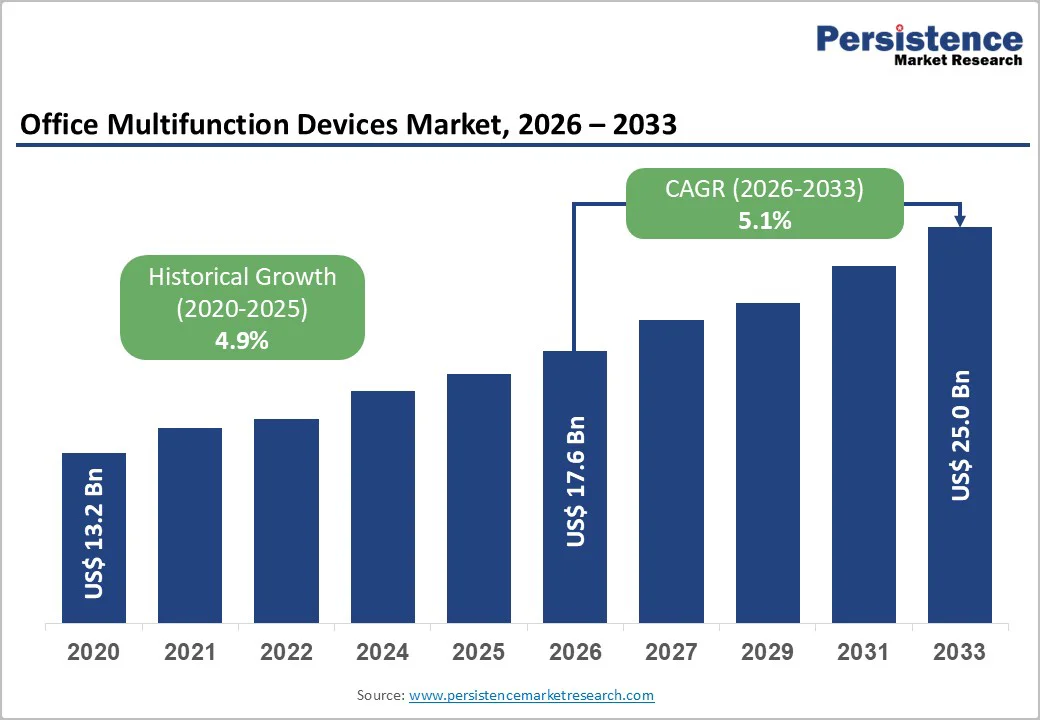
The global office multifunction devices market size is likely to be valued at US$17.6 billion in 2026 and is expected to reach US$25.0 billion by 2033, growing at a CAGR of 5.1% during the forecast period from 2026 to 2033, driven by the rising adoption of hybrid and remote work models, increasing demand for integrated print, scan, copy, and fax solutions, advancements in cloud and mobile connectivity, cost efficiencies from consolidating multiple functions into single devices, and growing investments in office infrastructure across corporate, educational, and government sectors.
Advancements in connectivity and cloud integration support secure remote workflows and mobile printing. Cost efficiencies from consolidating multiple functions into single devices drive adoption, particularly among small and medium enterprises.
Key Industry Highlights:
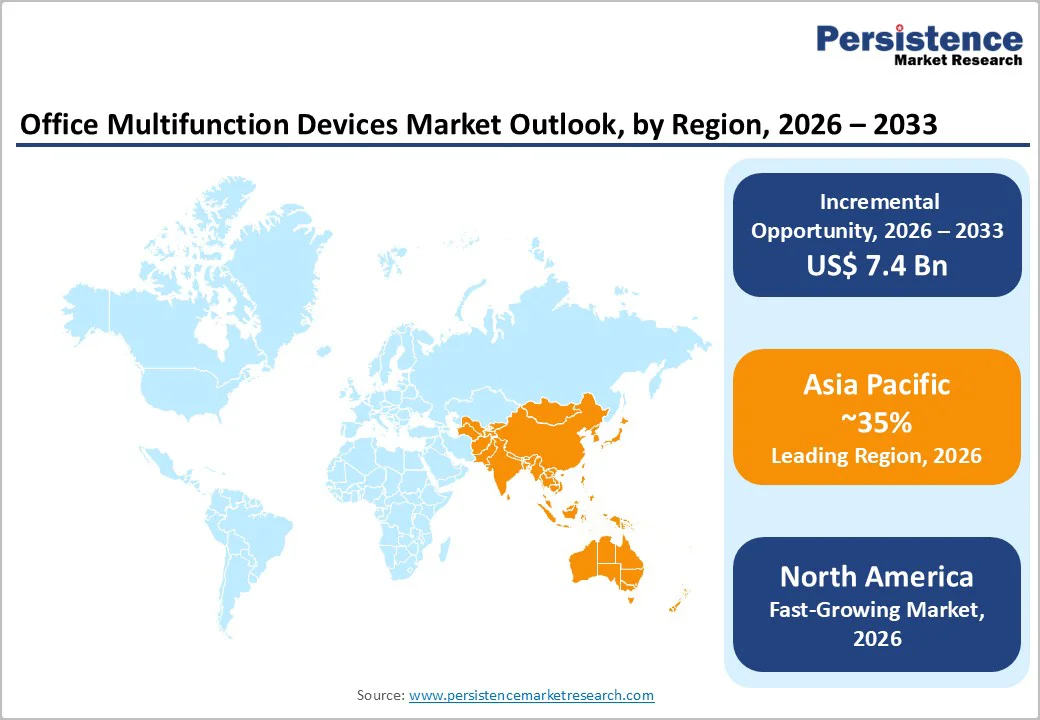
- Leading Region: Asia Pacific is anticipated to be the leading region, accounting for a market share of 35% in 2026, driven by strong manufacturing capabilities, rapid SME expansion, and growing demand for cost-effective printing solutions.
- Fastest-growing Region: North America is likely to be the fastest-growing region in the office multifunction devices market in 2026, driven by strong demand in the U.S., supported by a mature innovation ecosystem, widespread enterprise digital transformation, and high penetration of managed print services.
- Leading Device Type: Printers are projected to represent the leading device type in 2026, accounting for 60% of the revenue share, driven by the widespread adoption of laser-based multifunction printers integrating multiple document functions.
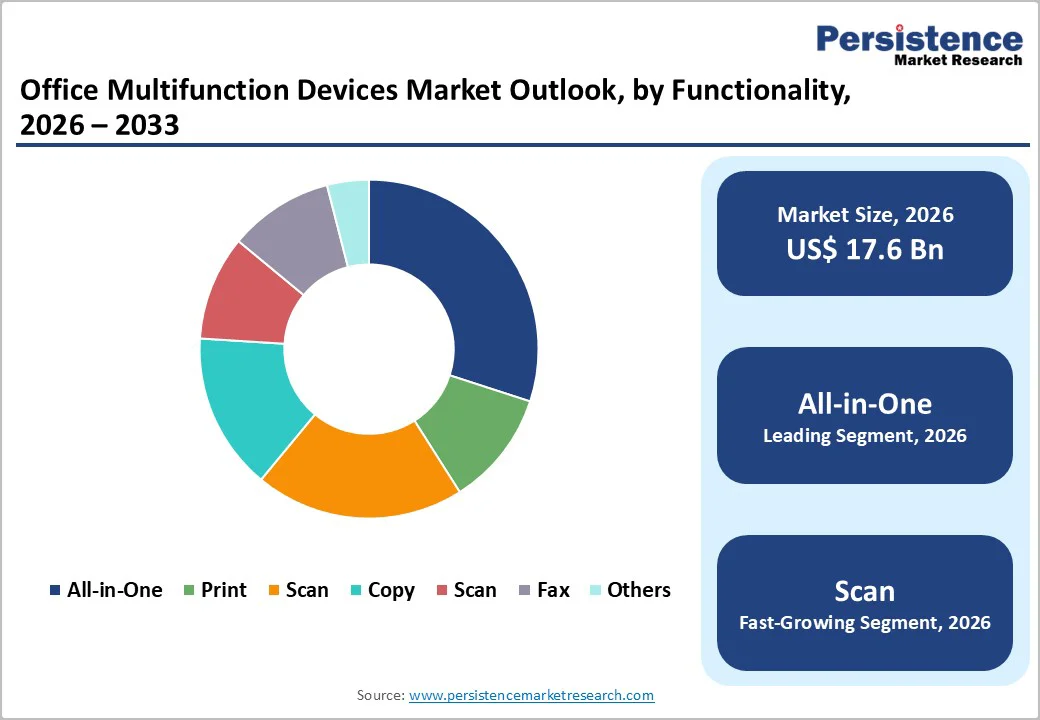
- Leading Functionality: All-in-one is expected to be the leading functionality type in 2026, capturing over 68% of the revenue share, driven by organizations’ preference for integrated devices that offer cost efficiency, space optimization, and streamlined workflow management.
- Leading End-user: Corporate offices are anticipated to be the leading end-user type, accounting for over 46% of the revenue share in 2026, driven by strong e-commerce adoption for gourmet and specialty food purchases.
| Key Insights | Details |
|---|---|
|
Office Multifunction Devices Market Size (2026E) |
US$17.6 Bn |
|
Market Value Forecast (2033F) |
US$25.0 Bn |
|
Projected Growth (CAGR 2026 to 2033) |
5.1% |
|
Historical Market Growth (CAGR 2020 to 2025) |
4.9% |
Market Factors - Growth, Barriers, and Opportunity Analysis
Increasing Adoption of Hybrid Work Models
The office multifunction devices market is being strongly driven by organizations restructuring workplace operations to support both in-office and remote employees. Hybrid work environments demand flexible document workflows that seamlessly integrate physical and digital processes, sustaining the need for multifunction devices capable of printing, scanning, copying, and secure document sharing. Despite increasing digitization, essential business functions, such as contracts, compliance documents, invoices, and records, still rely on printed and scanned materials, reinforcing the continued relevance of multifunction devices in distributed work settings.
The rise of hybrid work has accelerated the adoption of cloud-connected and wireless-enabled multifunction devices, enabling employees to print, scan, and access documents securely from multiple locations. Enterprises are increasingly prioritizing devices with mobile printing, cloud storage integration, and enhanced security features to protect sensitive data accessed remotely. This trend has also boosted demand for managed print services (MPS), which allow organizations to centrally manage device fleets, optimize usage, and reduce operating costs across dispersed offices. As hybrid work models become a long-term standard, organizations continue to invest in advanced multifunction devices that balance productivity, security, and cost efficiency, supporting sustained market growth.
Shift Toward Paperless Workflows and Digital Transformation
Organizations are increasingly adopting paperless workflows to improve operational efficiency, reduce costs, and achieve sustainability goals. The widespread use of cloud-based document management systems, electronic signatures, and digital collaboration platforms has lessened reliance on physical printing and copying, particularly in corporate and service-oriented sectors. As digital-first processes become standard, overall print volumes are declining, which directly affects demand for office multifunction devices. Enterprises are implementing digital approvals and automated workflows to minimize manual document handling.
Regulatory requirements and environmental initiatives promoting paper reduction and energy efficiency further limit the need for printed materials. Sectors such as information technology, finance, and professional services are rapidly moving toward fully digital operations, extending replacement cycles for office hardware. While scanning remains essential for digitizing legacy documents, the reduced demand for printing and copying constrains overall market growth. Consequently, manufacturers are focusing on value-added features, such as enhanced security, cloud integration, and managed print services, to maintain competitiveness in an increasingly paperless business environment.
Cloud-Native and Mobile Printing Integration
Organizations are increasingly operating in distributed and hybrid work environments, creating a need for seamless access to printing and scanning from multiple locations and devices. This drives demand for multifunction devices that integrate with cloud platforms and mobile applications. Cloud-enabled printing allows users to securely submit print jobs, retrieve scanned documents, and manage workflows without relying on on-premises infrastructure, enhancing business continuity and enabling centralized document management.
Mobile printing capabilities boost productivity for remote employees, field staff, and mobile-first enterprises by providing access to documents via smartphones, tablets, and laptops. Integration with widely used cloud services facilitates collaboration while reducing IT complexity and infrastructure costs. As businesses prioritize flexibility, scalability, and secure remote access, cloud-native and mobile-enabled multifunction devices allow manufacturers to differentiate their products, expand service-based revenue streams, and encourage long-term adoption across corporate, education, and government sectors. Advanced authentication and encryption features further address growing concerns over data security.
Category-wise Analysis
Device Type Insights
The printers segment is projected to dominate the office multifunction devices market, accounting for around 60% of total revenue in 2026. This growth is driven by the widespread use of multifunction printers that combine printing, copying, scanning, and faxing in a single device. Organizations across corporate offices, government agencies, and educational institutions continue to rely heavily on printing for contracts, invoices, regulatory documents, and recordkeeping. The segment also benefits from strong demand for color printing, duplex functionality, and secure print release features, particularly in regulated industries. For example, HP Inc. has reinforced its market leadership through its LaserJet multifunction printer portfolio, widely adopted across enterprises for secure, high-volume document handling.
The scanners segment is expected to be the fastest-growing segment in 2026, fueled by accelerating digitization initiatives and the increasing need for high-speed document capture in hybrid work environments. Organizations are digitizing legacy paper records to enhance accessibility, compliance, and workflow automation. Regulatory requirements for electronic records in sectors such as healthcare, finance, and government have further driven demand for advanced scanning solutions. Scanners are especially important in hybrid workplaces, enabling employees to convert physical documents into digital formats for remote access and collaboration. For instance, Canon Inc. has expanded the deployment of its high-speed imageRUNNER scan-focused multifunction devices among enterprises seeking intelligent document capture with cloud connectivity.
By Functionality Insights
The all-in-one segment is projected to lead the market, capturing approximately 68% of total revenue in 2026. This growth is driven by organizations increasingly favoring integrated devices that combine printing, scanning, copying, and faxing within a single unit. All-in-one devices help reduce capital expenditure by eliminating the need for multiple standalone machines and lower maintenance costs through centralized servicing. This functionality is particularly appealing to small and medium enterprises seeking scalable and cost-effective office solutions. For example, Ricoh Company, Ltd. offers multifunction devices that combine all-in-one capabilities with cloud access and advanced security features, making them widely adopted across corporate and government offices.
The scan functionality segment is expected to be the fastest-growing functionality type in 2026, as organizations increasingly prioritize scanning for document digitization, workflow automation, and secure data storage. Integration with cloud platforms enables scanned documents to be quickly shared, archived, and accessed remotely, supporting hybrid and distributed work environments. This growth is especially pronounced in industries with stringent compliance requirements, where accurate and secure document capture is critical. For instance, Konica Minolta has reported rising adoption of its scan-focused multifunction solutions that support intelligent data capture and seamless cloud integration.
End-user Insights
Corporate offices are expected to lead the market in 2026, capturing approximately 46% of the total revenue share. This growth is driven by high-volume document processing requirements and the widespread adoption of managed print services. Large enterprises and multinational corporations depend on multifunction devices to support daily operations such as contract management, reporting, invoicing, and internal communications. Corporate offices also prioritize advanced features, including user authentication, data encryption, and workflow automation. For instance, Xerox Corporation maintains a strong presence in corporate environments through its enterprise-grade multifunction devices and managed print service solutions.
The healthcare segment is projected to be the fastest-growing end-user in 2026, fueled by increasing demand for secure printing, scanning, and document management solutions that comply with stringent regulatory standards. Hospitals, clinics, and diagnostic centers handle sensitive patient data, making secure document workflows critical. Healthcare providers increasingly rely on multifunction devices for printing prescriptions, scanning patient records, and managing administrative documentation. The ongoing digitization of medical records and integration with electronic health record (EHR) systems further support growth in this segment. For example, Brother Industries offers multifunction devices specifically designed for secure document handling in clinical environments.
Regional Insights
North America Office Multifunction Devices Market Trends
North America is expected to be the fastest-growing region in the office multifunction devices market in 2026, driven by digital transformation initiatives, the adoption of hybrid work models, and increasing focus on data security. Organizations are increasingly deploying multifunction devices that combine printing, scanning, copying, and faxing with cloud connectivity and mobile access, streamlining workflows for distributed teams. The U.S., which holds the largest regional share, leads adoption due to high penetration of managed print services (MPS) and enterprise demand for energy-efficient, secure devices. For instance, Lexmark International, Inc. has launched multifunction devices with integrated security and cloud-based management tools designed for enterprise and government applications, reflecting a broader trend toward operational efficiency and secure document handling.
The market is also shifting toward AI-enabled, cloud-integrated, and service-oriented multifunction devices that enhance productivity and reduce operational costs. Remote and hybrid work models are accelerating demand for mobile printing and cloud-based workflows, enabling employees to securely access, print, and scan documents from any location. Subscription- and service-based models are gaining traction, helping enterprises manage costs and maximize device uptime. For example, Sharp Corporation offers cloud-connected multifunction devices with intelligent document management and automated workflow capabilities, allowing North American businesses to improve efficiency, maintain compliance, and scale operations across multiple offices.
Europe Office Multifunction Devices Market Trends
Europe is expected to be a key market for office multifunction devices in 2026, driven by strong regulatory frameworks, energy efficiency initiatives, and widespread digital transformation across enterprises and public institutions. Organizations are increasingly adopting multifunction devices that combine printing, scanning, copying, and faxing with cloud and mobile connectivity, enabling secure workflows and centralized management. Countries such as Germany, the UK, and France lead adoption due to mature IT infrastructure and high levels of enterprise digitization. For example, Toshiba Corporation has deployed multifunction devices across European corporate and government offices featuring low-energy modes, secure print management, and cloud-based document handling, reflecting the region’s focus on efficiency and regulatory compliance.
The market is also witnessing increased adoption of intelligent, service-oriented, and cloud-native multifunction devices to support hybrid work and distributed office operations. Enterprises leverage AI-powered workflow automation, secure document capture, and mobile printing to boost productivity while ensuring compliance with data protection regulations such as GDPR. Subscription and managed print service models are gaining traction as businesses seek predictable costs and simplified device maintenance. For instance, Oki Electric Industry Co., Ltd. offers multifunction devices integrated with cloud solutions, mobile printing, and intelligent scanning features to facilitate secure, scalable, and efficient digital workflows across European enterprises and public sector organizations.
Asia Pacific Office Multifunction Devices Market Trends
The Asia Pacific region is expected to be the leading market for office multifunction devices in 2026, capturing approximately 35% of the market share, driven by rapid digitalization, SME growth, and government-led modernization initiatives. Organizations are increasingly adopting multifunction devices that combine printing, scanning, copying, and faxing with cloud connectivity, mobile printing, and robust document security features to support hybrid and distributed work environments. The region’s large, cost-sensitive, and fast-growing SME segment fuels demand for devices that offer high efficiency, reliability, and low operating costs.
There is also a rising adoption of cloud-native, AI-enabled, and service-oriented multifunction devices to meet the evolving needs of modern enterprises and educational institutions. Cloud integration and intelligent scanning allow remote access, secure document sharing, and streamlined workflows, which are essential for hybrid work and digital learning. Subscription and managed print service models are gaining traction, particularly in emerging economies, where scalable solutions are preferred. For example, Kyocera Corporation provides multifunction devices in the region featuring cloud-based document management, mobile printing, and automated workflow capabilities, helping organizations improve productivity, reduce IT complexity, and maintain secure operations across multiple locations.
Competitive Landscape
The global office multifunction devices market is moderately fragmented, shaped by a mix of established technology leaders and regional specialists competing across both hardware and value-added services. While the top firms collectively capture a substantial share of revenue, numerous niche players remain active across various segments. The competitive landscape is marked by ongoing product innovation, expanded cloud and mobile integration, and investments in secure printing and workflow automation.
Key market players include HP Inc., Canon Inc., Ricoh Company, Ltd., Epson America, Sharp Corporation, Toshiba Corporation, Konica Minolta, and Kyocera Document Solutions. Competition revolves around broad product portfolios and differentiated service offerings that cater to diverse customer requirements. These companies leverage R&D, strategic partnerships, and enhanced software ecosystems, such as cloud-native printing solutions and integrated mobile workflows, to strengthen customer loyalty and extend market reach. Panasonic has entered select enterprise markets with multifunction devices emphasizing durability and IoT integration, and Muratec focuses on high-performance scanning solutions for large-scale digitization, illustrating the varied strategies shaping the market.
Key Industry Developments:
- In November 2025, Canon India launched its next-generation imageFORCE series of color and mono office multifunction devices, featuring the imageFORCE C5100 color series and 6100 mono series, designed for future-ready workspaces. The lineup emphasizes four core pillars, security, reliability, connectivity, and sustainability, and aims to enhance productivity while streamlining workflows in hybrid and digitally driven office environments.
- In June 2025, SHARP Business Systems (India) Pvt. Ltd. introduced its new A3 color multifunction printer series in India during the SHARP National Dealer Meet 2025. The series, including models BP-22C20/BP-22C20T and BP-22C25/BP-22C25T, is designed to boost office productivity with copy and print speeds of 20 PPM and 25 PPM, offering a combination of performance, compact design, and cost-effective color output in a single device.
Companies Covered in Office Multifunction Devices Market
- Canon Inc.
- Xerox Corporation
- Ricoh Company, Ltd.
- Konica Minolta, Inc.
- HP Inc.
- Brother Industries, Ltd.
- Kyocera Corporation
- Sharp Corporation
- Toshiba Corporation
- Lexmark International, Inc.
- Epson America, Inc.
- Samsung Electronics Co., Ltd.
- Dell Technologies Inc.
- Oki Electric Industry Co., Ltd.
Frequently Asked Questions
The global office multifunction devices market is projected to reach US$17.6 billion in 2026.
Growing adoption of hybrid work models, digital workflows, and demand for integrated, secure, and cost-efficient document management solutions.
The office multifunction devices market is expected to grow at a CAGR of 5.1% from 2026 to 2033.
Opportunities in the market include integration of cloud-native and mobile printing solutions, implementation of AI-driven workflow automation, growth of managed print services, expansion into emerging economies, and increased adoption across education and healthcare sectors.
Canon Inc., Xerox Corporation, Ricoh Company, Ltd., Konica Minolta, Inc., HP Inc., and Brother Industries, Ltd. are the leading players.


