




- Industrial Machinery
- High-Pressure Spray Hose Market
High-Pressure Spray Hose Market Size, Share, and Growth Forecast, 2026 - 2033
High-Pressure Spray Hose Market Material Type (PVC, Rubber, Polyethylene, Misc), Coating (Coated, Non-Coated), End-Use (Agriculture, Industrial, Construction, Automotive Service Station, Others), Region Analysis 2026-2033

High-Pressure Spray Hose Market Size and Trends Analysis
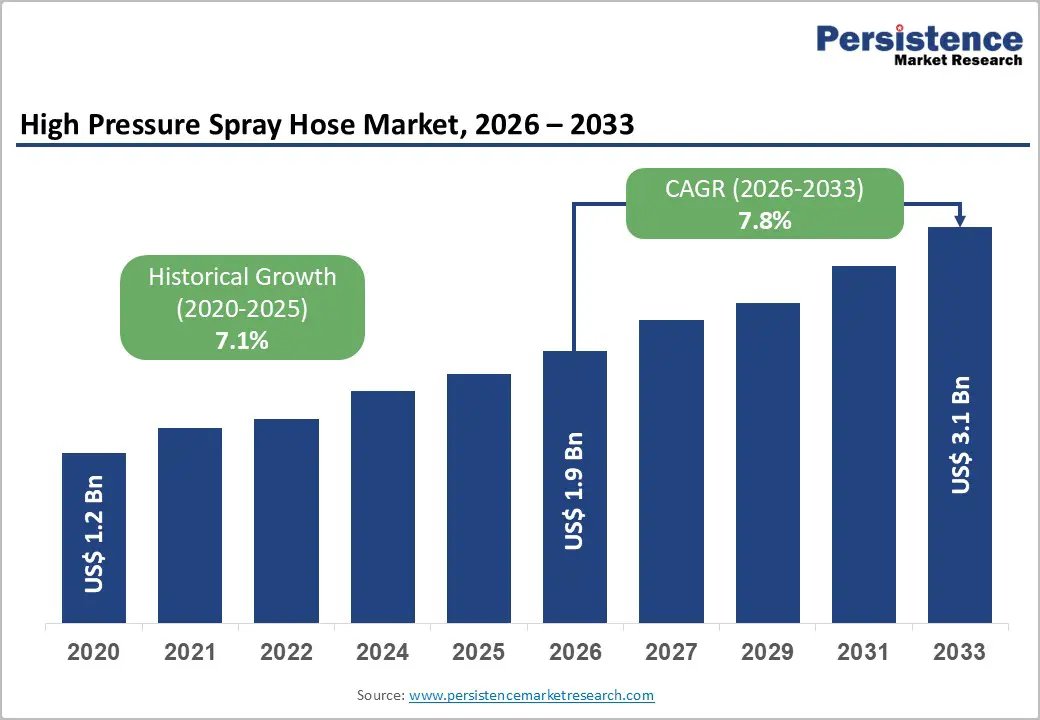
The global high-pressure spray hose market size is projected to reach US$1.9 billion in 2026 and US$3.1 billion by 2033, growing at a CAGR of 7.8% between 2026 and 2033. Market expansion is driven by systematic mechanization of agriculture with irrigation systems and pesticide delivery requiring high-pressure spray hoses with UV resistance and abrasion tolerance, rapid urbanization and infrastructure development creating consistent demand for construction-grade hoses for concrete pumping and dewatering operations, and material technology advancement enabling specialized rubber, PVC, and polyethylene formulations delivering superior pressure tolerance, chemical resistance, and extended service life across diverse industrial applications.
Key Highlights Summary
- Polyethylene commands 33% market share with established agricultural positioning, while rubber expands fastest at 7.9% CAGR, driven by industrial and construction applications requiring superior pressure tolerance.
- Coated hoses maintain 58% market share with premium durability benefits, while non-coated expands 7.1% CAGR driven by cost-sensitive agricultural and emerging market adoption.
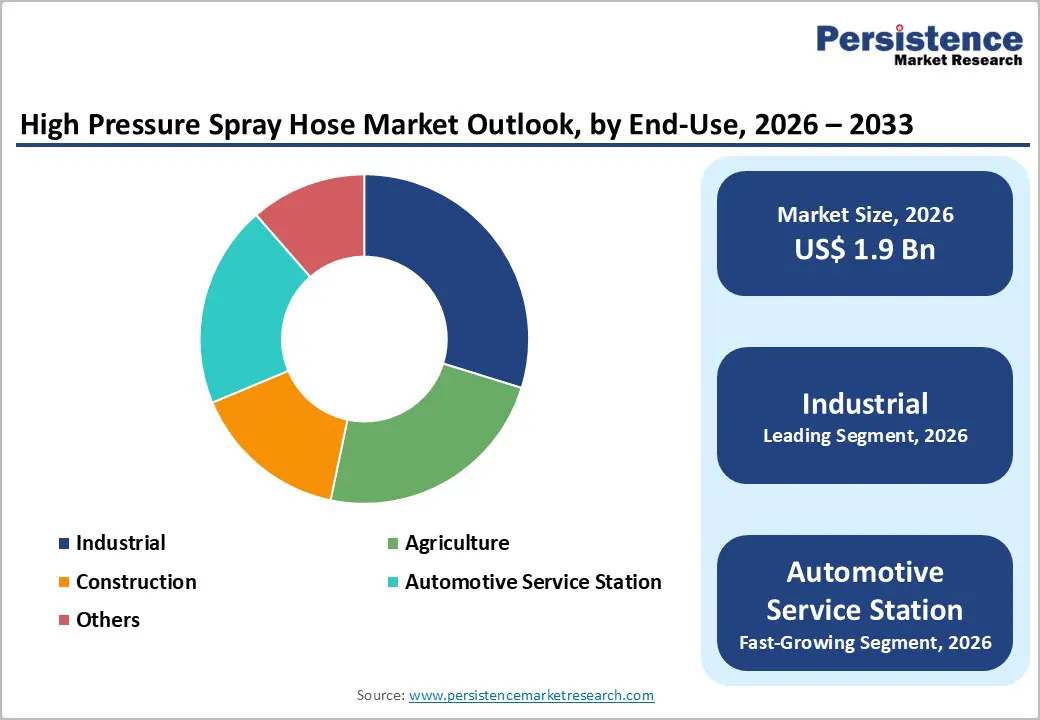
- Industrial applications lead 30% market share, while automotive service stations expand fastest at 8% CAGR, driven by vehicle fleet growth and professional car wash expansion.
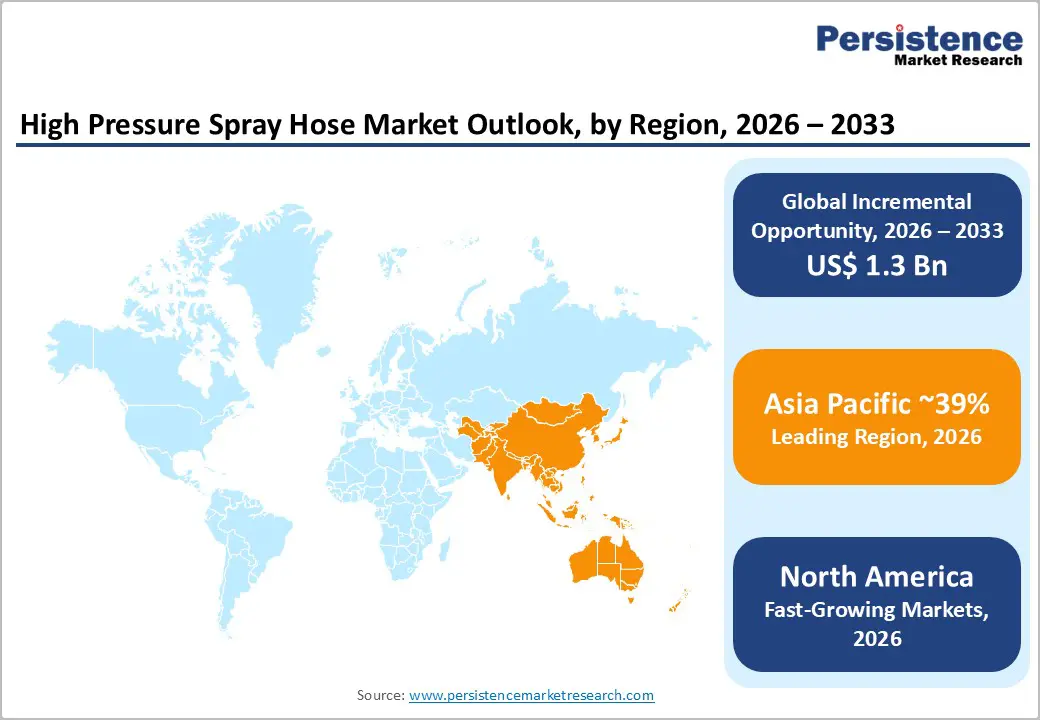
- North America holds 22% at a 7.8% CAGR, with premium positioning, Europe maintains 24% by emphasizing specialty applications, and Asia-Pacific dominates 39%, with the fastest regional growth led by India and China's agricultural expansion.
- Parker launches HyDraulic X-tra series (March 2024), Eaton partners with Bosch Rexroth (June 2025), Kuriyama launches eco-friendly line (November 2024), Gates introduces AI predictive maintenance (February 2025), PIRTEK expands Asia facility (September 2025), demonstrating technology and sustainability momentum.
| Key Insights | Details |
|---|---|
| High-Pressure Spray Hose Market Size (2026E) | US$1.9 Bn |
| Market Value Forecast (2033F) | US$3.1 Bn |
| Projected Growth (CAGR 2026 to 2033) | 7.8% |
| Historical Market Growth (CAGR 2020 to 2025) | 7.1% |
Market Dynamics Analysis
Market Drivers
Agricultural Mechanization and Precision Irrigation System Expansion
Agricultural mechanization systematically drives spray hose demand, with global irrigated agriculture covering 360 million hectares (2024) and expanding at 1.5% annually, requiring high-pressure spray systems for efficient water distribution and pesticide application. Precision irrigation investments totaling around USD 15.2 billion annually, with India's irrigated agriculture expanding at a 3.8% CAGR, demonstrate sustained heavy adoption momentum, supporting consistent spray hose market expansion, particularly for smallholder and large-scale farming operations. Mechanized agricultural practices, including drip irrigation, overhead sprinklers, and boom paint spraying equipment requiring specialty UV-resistant and chemical-compatible spray hoses, create an emerging agricultural specialty segment estimated at USD 400-500 million annually, supporting high-value component positioning.
Industrial and Manufacturing Sector Expansion with Fluid Transfer Requirements
Industrial manufacturing systematically drives spray hose adoption, supported by a global industrial hose market expanding at a 4.9% CAGR, reflecting accelerating mechanization and automation trends. Demand is reinforced by chemical processing, pharmaceutical, and food and beverage industries that require FDA-compliant, chemically resistant, and high-performance hose solutions. Concurrently, pharmaceutical manufacturing investments exceeding USD 150 billion annually are strengthening capacity additions worldwide. These dynamics are creating an emerging regulated-industry spray hose segment valued at approximately USD 300–400 million annually, enabling premium pricing, specification-driven procurement, and structurally higher margins, positioning the segment as an attractive, resilient, and long-term growth opportunity for manufacturers globally.
Market Restraints
Raw Material Cost Volatility and Petroleum-Based Input Uncertainty
Market expansion remains constrained by volatility in rubber and polyethylene prices, with quarterly cost swings of 10–20% directly impacting hose pricing strategies and manufacturer profitability. Strong correlations between petroleum prices and synthetic rubber and polymer inputs, combined with geopolitical disruptions across global supply chains, continue to affect raw material availability. This persistent pricing uncertainty restricts long-term contracting, complicates cost forecasting, and disproportionately limits adoption within price-sensitive customer segments, ultimately moderating otherwise stable demand growth across industrial and commercial applications worldwide markets.
Intense Competition and Price Pressure from Emerging Manufacturers
Market expansion is constrained by intense competitive pressure, as emerging manufacturers offer pricing of USD 0.50–1.00 per meter, compared with USD 2–3 for branded products, driving significant margin compression. Chinese and Indian suppliers are capturing incremental share through aggressive cost-leadership strategies, while ongoing product-quality standardization across manufacturers is reducing differentiation. This environment limits premium positioning, weakens brand-based pricing power, and directly impacts revenue growth prospects for established suppliers across global industrial spray hose markets over the medium to long term.
Market Opportunities
Coated Hose Technology Innovation and Performance Enhancement
Coated hose technology represents a compelling opportunity, as advanced polyurethane and synthetic rubber coatings extend hose lifespan by 30–40% while significantly improving abrasion and UV resistance, supporting the growth of a premium coated segment. Ongoing innovation in smart coatings, including antimicrobial and self-healing properties, enhances hygiene, durability, and operational reliability. In parallel, rising demand for pharmaceutical-grade and food-grade compliant coatings is enabling specification-driven adoption in regulated industries. These performance advantages justify premium pricing, improve total cost of ownership, and position coated spray hoses as high-value solutions for applications with stringent safety, compliance, and longevity requirements across global industrial and commercial markets.
Automotive Service Station Expansion and Vehicle Care Equipment Growth
Automotive service stations represent a growing opportunity, supported by a global vehicle fleet of over 1.4 billion units and growing at 3.2% annually, driving demand for high-pressure washer systems used in professional vehicle cleaning. Growth is further reinforced by the expanding automotive aftermarket service equipment industry, aligned with the rapid proliferation of organized car wash and detailing franchises worldwide. These dynamics are creating an emerging automotive spray hose segment, driving demand for specialized automotive-grade, abrasion-resistant, and flexible products, while supporting deeper penetration across emerging markets through standardized service formats and recurring replacement demand within commercial vehicle care ecosystems globally and sustainably.
Segmentation Analysis
Material Type Analysis
Polyethylene commands 33% of the global market share, representing a dominant material type with lightweight properties, cost-effectiveness at USD 0.40-0.70 per meter, and suitability for agricultural applications. Polyethylene spray hoses account for ~40% of the irrigation equipment market, supporting consistent agricultural demand, particularly for irrigation systems and low-pressure applications, where cost optimization and flexibility remain priorities. This provides a stable revenue base and predictable production capacity.
Rubber expands at a 7.9% CAGR, driven by superior pressure-handling capability, chemical resistance, and durability, supporting premium industrial and construction applications. Rubber hose adoption in oil & gas, construction, and heavy industrial sectors is expanding at 7.9% CAGR, with global industrial sector growth enabling an emerging high-performance specialized segment, supporting premium market positioning and higher-value industrial targeting.
Coating Type Analysis
Coated hoses command 58% of the market share, driven by enhanced durability, UV resistance, and extended operational lifespan across diverse industrial and agricultural applications. Coated spray hoses delivering 30-40% lifespan extension, supporting cost-per-use efficiency with premium pricing at USD 1.50-2.50 per meter, justifying end-user adoption, particularly for commercial and industrial segments, providing a market stability anchor and consistent premium-margin revenue base.
Non-coated hoses expand at a 7.1% CAGR, driven by cost-sensitive agricultural segments and budget-conscious buyers in emerging markets seeking economical solutions. Non-coated hose pricing at USD 0.40-0.80 per meter, enabling mass-market agricultural penetration, supports the emerging volume-focused market segment, particularly in India, China, and Southeast Asia, where affordability remains a critical adoption factor.
End-Use Analysis
Industrial applications account for 30% of market share, driven by chemical processing, pharmaceutical manufacturing, and fluid transfer operations that require specialty spray hose solutions. Industrial chemical market expansion at 3.2% CAGR, combined with pharmaceutical manufacturing growth at 6.5% CAGR, supporting consistent, strong demand, particularly for FDA-compliant and corrosion-resistant spray hoses, providing a market stability anchor and a premium-price positioning opportunity.
Automotive service station expands at an 8% CAGR, driven by vehicle fleet growth, professional car wash expansion, and development of the aftermarket service industry. The global car wash service market is expanding at 8% CAGR, with franchise growth in developed and emerging markets supporting the emerging specialized automotive segment, enabling dedicated automotive-focused product positioning and professional equipment supplier positioning.
Regional Market Insights
North America
North America maintains a 25-28% market share, expanding at a 7.8% CAGR, supported by agricultural modernization, growth in construction equipment, and premium industrial applications. The USA market features high-performance hose demand, supported by advanced coating technologies and specialized materials, enabling premium product positioning. Established hydraulic and industrial equipment manufacturers and a strong technical infrastructure drive innovation-focused market dynamics. Advanced manufacturing capabilities supporting specialized product development and quality control. Strong emphasis on performance standards and regulatory compliance across agricultural and industrial applications. Established distribution networks ensuring reliable supply and technical support services.
Europe
Europe maintains 24% market share with a consistent growth pace driven by stringent environmental regulations, premium product standards, and advanced agricultural mechanization. Europe commanding leadership in specialized spray hose solutions, with Germany, the United Kingdom, France, and Spain demonstrating advanced technical expertise supporting premium material adoption and coated hose positioning, particularly in regulated pharmaceutical and food processing applications, where quality standards remain paramount. Stringent environmental and safety standards are driving specialized product development. Strong emphasis on sustainability and circular economy principles in material selection. Established premium manufacturer presence supporting innovation and quality differentiation.
Asia Pacific
Asia Pacific dominates with 39% market share and a significant growth trajectory driven by agricultural expansion, manufacturing growth, and emerging market mechanization. India, China, and Southeast Asia are demonstrating the fastest regional growth, with India's agricultural mechanization expanding at 7.2% CAGR and emerging rural infrastructure investment supporting emerging high-volume market development at the fastest regional growth pace, enabling localized production ecosystem development and cost-competitive emerging supplier opportunities, particularly in the agricultural and industrial segments. Emerging manufacturing capabilities supporting cost-competitive production and localized solutions. Rapid agricultural mechanization and infrastructure investment are driving spray hose adoption. Growing industrial sector expansion supporting diverse end-use applications and market growth.
Competitive Landscape
Market leaders employ innovation-focused product development, advancing coated hose technology and specialized materials, geographic expansion targeting Asia-Pacific agricultural and emerging markets, strategic partnerships strengthening supply chain integration, sustainability positioning through eco-friendly materials, and segment-specific product development targeting agriculture, industrial, and automotive service applications. Cost leadership strategies critical for volume penetration.
Strategic Developments
- In March 2024, Parker Hannifin introduced Hannifin HyDraulic X-tra series, offering increased durability and abrasion resistance for heavy-duty industrial applications, representing technological advancement supporting premium market positioning and infrastructure equipment specialization.
- In June 2025, Eaton Corporation entered a strategic partnership with Bosch Rexroth to expand their joint hydraulic components offering, strengthening their market position with comprehensive hydraulic solutions and technological integration to support market leadership.
- In November 2024, Kuriyama introduced environmentally certified spray hose products made from sustainable materials and manufactured using sustainable processes, advancing its circular economy positioning and environmental responsibility messaging, supporting the premium sustainability-conscious market segment.
Companies Covered in High-Pressure Spray Hose Market
- Parker Hannifin
- Gates Corporation
- Eaton Corporation
- Kuriyama Tigerflex
- PIRTEK
- Manuli Hydraulics
- Alfagomma
- Jason Industrial
- Semperit
- Ryco Hydraulics
- Hydrasearch
- Sinopulse
- Goodyear
- Stauff
Frequently Asked Questions
The High Pressure Spray Hose Market is anticipated at US$ 1.9 Billion in 2026 and projected to reach US$ 3.1 Billion by 2033.
Market growth is driven by agricultural mechanization, expanding construction and infrastructure activity, rising industrial hose demand, and growth in the global vehicle fleet.
The market expands at 7.8% CAGR between 2026 and 2033.
Key opportunities include Asia-Pacific agricultural expansion, premium coated hose innovation, and rising automotive service and car wash infrastructure demand.
Leading players include Parker Hannifin, Gates Corporation, Eaton Corporation, Kuriyama Tigerflex, PIRTEK, and Manuli Hydraulics, supported by continuous product launches, partnerships, and regional capacity expansions.


