




- Industrial Machinery
- High-Pressure Booster Market
High-Pressure Booster Market Size, Share, and Growth Forecast 2026 - 2033
High-Pressure Booster Market by Booster Type (Air Booster Pumps, Gas Booster Pumps, Hydraulic Booster Pumps), Pressure Range (Upto 500 Bar, 501-1000 Bar, Above 1000 Bar), Industry (Oil & Gas, Manufacturing, Automotive & Aerospace, Construction & Mining, Others), by Regional Analysis, 2026 - 2033

High-Pressure Booster Market Size and Trend Analysis
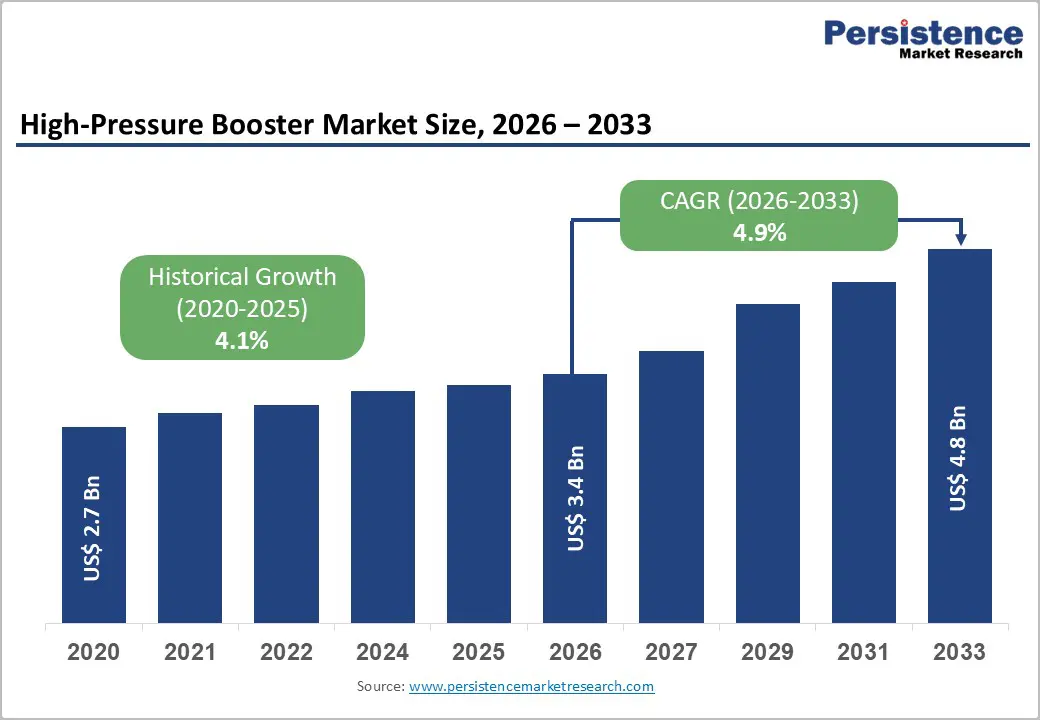
The global High-Pressure Booster Market size is expected to be valued at US$ 3.4 billion in 2026 and projected to reach US$ 4.8 billion by 2033, growing at a CAGR of 4.9% between 2026 and 2033.
The market is witnessing steady expansion due to increasing demand for high-pressure systems across oil & gas, manufacturing, and energy infrastructure. High-pressure boosters play a crucial role in applications such as gas compression, pressure testing, and enhanced oil recovery. The expansion of industrial automation and the modernization of production facilities are further supporting adoption. Additionally, rising global energy exploration and large-scale infrastructure projects are increasing the need for reliable pressure-boosting technologies across multiple industrial sectors worldwide.
Key Market Highlights
- Leading Region: North America leads with 35% share in 2025 driven by U.S. shale production and strong regulations.
- Fastest Growing Region: Asia Pacific grows fastest at 5.8% CAGR (2025–2032) supported by China's infrastructure and India's refinery expansion.
- Leading Category: Hydraulic Booster Pumps dominate with 45% share due to strong demand in oil & gas operations.
- Fastest Growing Category: Above 1000 Bar segment grows fastest at 5.5% CAGR, driven by enhanced oil recovery applications.
- Key Opportunity: Variable speed drive (VSD) technologies improving energy efficiency in industrial and manufacturing operations.
| Key Insights | Details |
|---|---|
|
High-Pressure Booster Size (2026E) |
US$ 3.4 billion |
|
Market Value Forecast (2033F) |
US$ 4.8 billion |
|
Projected Growth CAGR (2026-2033) |
4.9% |
|
Historical Market Growth (2020-2025) |
4.1% |
Market Dynamics
Drivers - Growing Oil and Gas Exploration and Enhanced Recovery Operations Driving Demand for High-Pressure Booster Systems
Growing global oil and gas exploration activities are increasing the demand for high-pressure booster systems, particularly in upstream operations where advanced pressure control is essential. These systems support enhanced oil recovery methods such as gas injection and reservoir pressure maintenance, enabling operators to improve extraction efficiency and extend the productive life of mature oilfields.
Rising production activity across major energy-producing regions is strengthening the need for reliable pressure equipment capable of operating under extreme conditions. Industry standards and safety regulations further encourage the adoption of durable booster technologies, allowing operators to maintain operational stability while managing fluctuating production environments and complex reservoir characteristics.
Rapid Expansion of Industrial Automation and Smart Manufacturing Increasing the Need for Precision High-Pressure Booster Technologies
The growing implementation of automation in manufacturing facilities is significantly increasing the use of high-pressure boosters for precision industrial processes. Applications such as hydrostatic testing, pressure calibration, and advanced molding require consistent pressure output, making booster systems essential for maintaining operational accuracy and production efficiency in automated environments.
The expansion of robotics and digitally connected production systems is further encouraging the integration of booster technologies in modern factories. Smart monitoring systems and energy-efficient designs enable manufacturers to improve equipment performance, reduce downtime, and optimize energy consumption, thereby supporting productivity gains across sectors such as automotive, aerospace, and advanced industrial manufacturing.
Restraints - High Initial Investment and Ongoing Maintenance Expenses Limiting Adoption of High-Pressure Booster Systems Across Cost-Sensitive Industries
The adoption of high-pressure booster systems is often constrained by significant upfront investment and installation costs, particularly for advanced hydraulic and gas booster configurations used in heavy industrial applications. Small and medium-scale enterprises frequently face financial challenges when upgrading or replacing existing infrastructure with high-pressure equipment designed for demanding industrial conditions.
Maintenance requirements further increase total cost of ownership, as high-pressure operations continuously stress seals, valves, and mechanical components. Equipment downtime caused by component wear or system failures can disrupt production schedules, making companies cautious about investing in complex booster technologies without clear long-term operational benefits.
Strict Safety, Environmental, and Equipment Compliance Standards Slowing Deployment of High-Pressure Booster Technologies
High-pressure booster systems must comply with strict safety and engineering standards to ensure reliable performance in hazardous industrial environments. Regulations related to pressure equipment design, testing procedures, and operational safety require manufacturers and end users to implement additional inspection, certification, and monitoring processes before system deployment.
Environmental and workplace safety regulations also impose strict requirements on leakage control, emissions, and equipment reliability. Meeting these regulatory standards often increases design complexity and operational costs, particularly for industries such as oil and gas, chemical processing, and heavy manufacturing, where pressure systems operate under highly regulated conditions.
Opportunities - Advancements in Energy-Efficient Booster Technologies Creating Opportunities for Sustainable and High-Performance Industrial Systems
The development of energy-efficient high-pressure booster technologies is creating significant opportunities across industrial and energy sectors. Innovations such as variable-speed drive systems and advanced pressure control mechanisms help reduce energy consumption while maintaining stable, high-pressure output for demanding applications such as pressure testing, gas compression, and enhanced recovery operations.
Manufacturers are increasingly focusing on integrating smart monitoring systems, modular designs, and automation-ready components into booster equipment. These improvements enable industries to optimize operational efficiency, reduce energy losses, and meet sustainability targets while boosting productivity across sectors such as advanced manufacturing, energy processing, and heavy industrial operations.
Rapid Infrastructure Development and Industrial Expansion in Emerging Economies Driving New Demand for Booster Systems
Large-scale infrastructure development projects in emerging economies are creating significant opportunities for high-pressure booster systems across construction, mining, and industrial development. Major transportation networks, tunnels, and energy infrastructure projects require reliable high-pressure equipment to support hydraulic operations, drilling, and heavy machinery.
Expanding industrialization and government-supported infrastructure initiatives are further encouraging the installation of advanced pressure systems in new facilities. Growing local manufacturing capabilities and long-term infrastructure investments are making booster technologies more accessible, thereby supporting sustained demand in developing regions with expanding construction and resource-extraction sectors.
Category-wise Analysis
Booster Type Insights
Hydraulic Booster Pumps lead the High-Pressure Booster Market, accounting for nearly 45% of total demand in 2025 due to their superior power density and ability to deliver extremely high pressure in demanding industrial environments. These systems are widely used in offshore oil platforms, heavy manufacturing, and energy operations where consistent high-pressure output is essential. Their durability, compact design, and ability to handle viscous fluids make them particularly suitable for oil & gas applications and advanced industrial processes.
Gas Booster Pumps are emerging as the fastest-growing category as industries increasingly require reliable systems for gas compression, pressure testing, and hydrogen handling. Rising demand for compressed gases in energy storage, chemical processing, and industrial automation is accelerating adoption. Their ability to maintain precise pressure levels and support specialized applications is encouraging greater integration across modern industrial operations.
Pressure Range Insights
The 501–1000 Bar pressure range dominates approximately, accounting for 42% share in 2025 due to its balanced combination of performance, safety, and cost efficiency. This pressure range is widely used across oil and gas recovery operations, industrial pressure testing, and manufacturing processes that require stable, high-pressure output. Its ability to deliver efficient performance without the complexity of ultra-high-pressure systems makes it suitable for diverse industrial applications.
Above 1000 Bar systems represent the fastest-growing pressure category as industries increasingly require ultra-high-pressure capabilities for specialized applications. These systems are gaining traction in advanced oil recovery techniques, aerospace component testing, and heavy-duty mining operations. Their growing use in research facilities and high-performance industrial equipment is expanding their role in modern high-pressure engineering applications.
Industry Insights
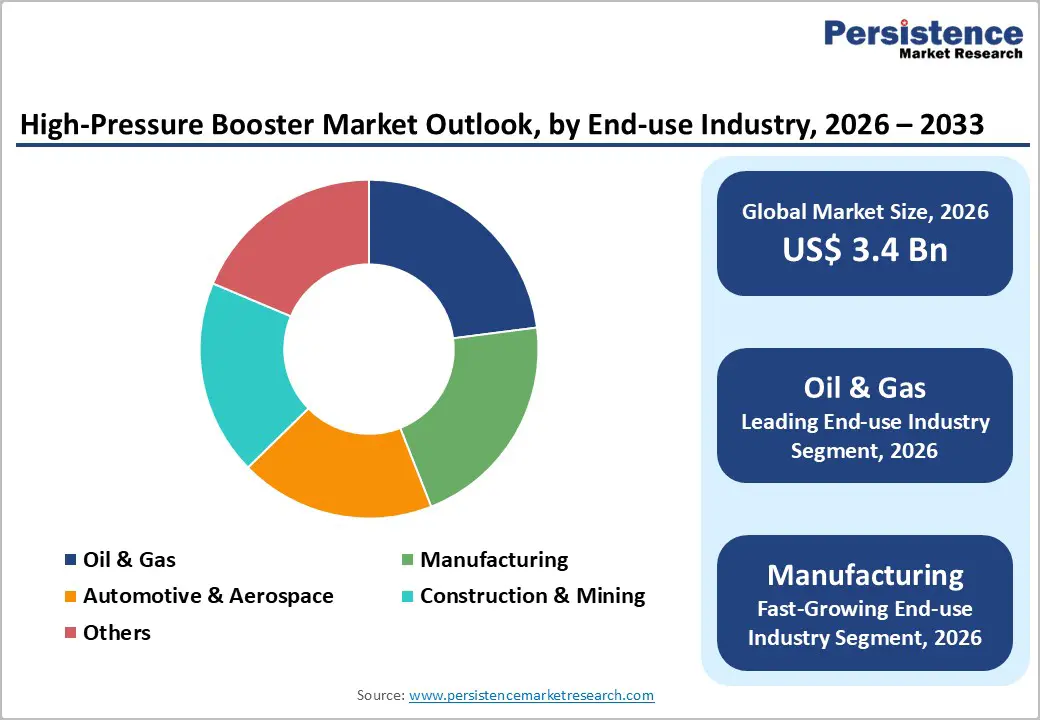
Oil & gas remains the dominant industry in the high-pressure booster market, accounting for around 38% of overall demand in 2025. High-pressure boosters are essential in upstream operations for reservoir pressure management, gas injection, and enhanced oil recovery techniques. Their ability to support drilling activities and maintain stable pressure conditions makes them critical equipment for maintaining productivity and efficiency across large-scale energy production facilities.
Manufacturing is emerging as the fastest-growing Industry as factories adopt advanced automation and precision engineering processes. High-pressure boosters are increasingly used for hydrostatic testing, material forming, and specialized industrial equipment operations. Expanding production of automotive components, aerospace systems, and heavy machinery is accelerating demand for reliable pressure boosting technologies in modern manufacturing environments.
Regional Insights
North America High-Pressure Booster Market Trends
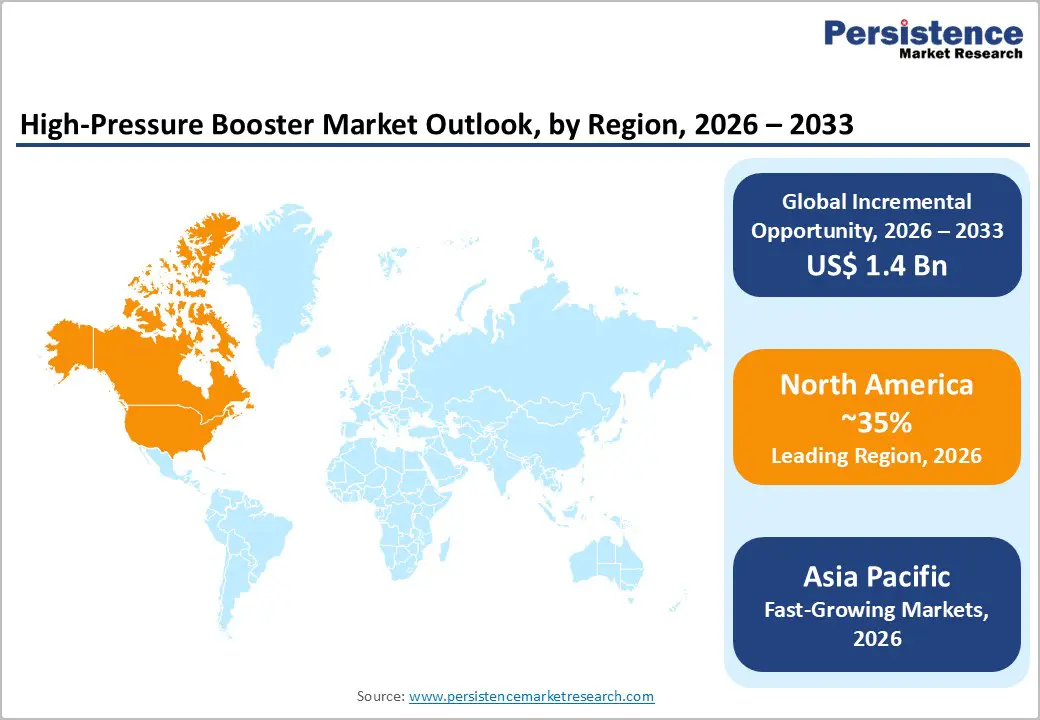
North America leads the High-Pressure Booster Market, accounting for nearly 35% share in 2025, supported by strong oil and gas production and advanced industrial infrastructure. Extensive shale exploration in the United States, particularly across major basins, relies heavily on high-pressure booster systems for hydraulic fracturing and pressure control operations. Increasing investments in hydrogen energy projects and pipeline modernization are also strengthening demand for reliable booster technologies across the energy and process industries.
Growing adoption of advanced manufacturing and aerospace production is further driving demand for precision pressure systems in the region. High-pressure boosters are increasingly used for composite material processing, testing applications, and industrial automation. Strong regulatory frameworks governing pipeline safety and pressure equipment reliability are encouraging infrastructure upgrades, creating sustained opportunities for booster manufacturers.
Europe High-Pressure Booster Market Trends
Europe is projected to grow at a CAGR of around 4.6% between 2026 and 2033, supported by the region’s transition toward cleaner energy infrastructure and modernization of industrial facilities. Countries such as Germany, the United Kingdom, and France are expanding gas networks and hydrogen-blending initiatives, thereby increasing the need for advanced pressure boosting technologies in energy transport and storage systems.
The region’s strong regulatory framework for pressure equipment and industrial safety is also encouraging the adoption of high-performance booster systems. Expanding investments in offshore energy projects, carbon management initiatives, and advanced manufacturing facilities are supporting demand for reliable high-pressure equipment. These developments are strengthening the role of booster technologies in Europe’s evolving industrial and energy landscape.
Asia Pacific High-Pressure Booster Market Trends
Asia Pacific holds approximately 28% share of the global High-Pressure Booster Market in 2025 and is experiencing rapid expansion driven by industrialization and large-scale infrastructure investments. Countries such as China, India, and Japan are expanding oilfield modernization programs, refinery expansions, and manufacturing capacity, all of which require high-pressure booster systems for energy extraction and industrial processing.
The region is also witnessing strong growth in automotive production, construction activity, and heavy industrial development. Expanding manufacturing hubs and rising investments in mining, energy infrastructure, and industrial automation are accelerating the adoption of advanced pressure systems. Increasing domestic production capabilities and cost advantages further support regional demand for high-pressure booster technologies.
Competitive Landscape
The high-pressure booster market is moderately consolidated, with leading manufacturers maintaining strong positions through advanced engineering capabilities, global distribution networks, and continuous product innovation. Companies are investing heavily in research and development to improve pressure efficiency, durability, and operational safety of booster systems. Increasing focus on energy-efficient technologies and compact system designs is helping manufacturers meet evolving industrial performance requirements.
Strategic expansion into emerging industrial regions is becoming a key competitive strategy as infrastructure and energy projects increase globally. Market participants are also strengthening their service portfolios through maintenance contracts, system upgrades, and digital monitoring solutions. Integration of smart sensors, remote diagnostics, and customized pressure configurations is enabling suppliers to differentiate their offerings and support long-term industrial partnerships.
Key Developments:
- In June 2025, Siemens introduced a variable speed drive (VSD) hydraulic booster system designed for high-pressure oilfield operations, improving pressure control and reducing energy consumption by around 25%, helping operators enhance efficiency and support more sustainable energy extraction processes.
- In March 2024, Flowserve completed the acquisition of a specialized pressure technology firm to strengthen its ultra-high-pressure equipment portfolio, enabling the company to expand advanced booster solutions designed for enhanced oil recovery and other demanding industrial pressure applications.
- In October 2023, Atlas Copco launched a new series of air booster systems engineered to comply with API 674 standards, focusing on improved reliability, high-pressure performance, and operational safety for industries requiring consistent compressed air boosting in demanding environments.
Companies Covered in High-Pressure Booster Market
- Xylem Inc.
- Grundfos Holding A/S
- Pentair Plc
- Flowserve Corporation
- KSB SE & Co. KGaA
- Ebara Corporation
- Atlas Copco AB
- Ingersoll Rand Inc.
- Gardner Denver
- Sulzer Ltd.
- Franklin Electric Co., Inc.
- DAB Pumps
- CNP (Nanfang Pump Industry Co.)
- Weir Group PLC
- Haskel International LLC
Frequently Asked Questions
The global High-Pressure Booster Market is projected to reach US$ 3.4 billion in 2026.
Expansion of oil & gas enhanced recovery and increasing industrial automation are key drivers supporting booster system adoption.
North America leads with 35% share in 2025, driven by strong shale production and advanced industrial infrastructure.
Energy-efficient VSD booster systems in the Above 1000 Bar segment (5.5% CAGR) are creating major efficiency opportunities.
Major companies include Parker Hannifin, Flowserve, Atlas Copco, and Siemens Energy.


