




- Food Ingredients & Additives
- Functional Enzyme Blends Market
Functional Enzyme Blends Market Size, Share, and Growth Forecast 2026 - 2033
Functional Enzyme Blends Market by Enzyme Type (Amylases, Proteases, Lipases, Cellulases, Others), by Source (Microbial, Plant-based, Animal-based), by Application (Food & Beverages, Animal Feed, Pharmaceuticals & Nutraceuticals, Biofuels, Industrial uses), by Regional Analysis, 2026 - 2033

Functional Enzyme Market Share and Trends Analysis
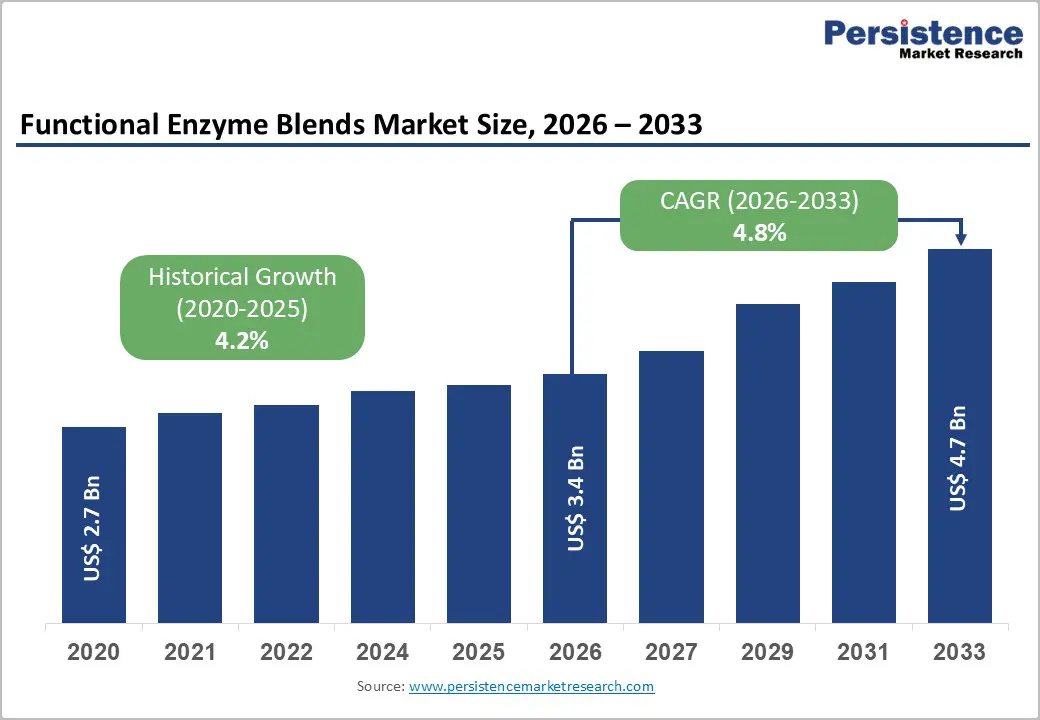
The global functional enzyme blends market size is expected to be valued at US$ 3.4 billion in 2026 and projected to reach US$ 4.7 billion by 2033, growing at a CAGR of 4.8% between 2026 and 2033.
Growth is underpinned by the increasing use of tailored enzyme cocktails to improve process efficiency, product quality, and sustainability across food, feed, pharmaceutical, biofuel, and industrial sectors. Rising demand for processed and convenience foods with better texture, digestibility, and shelf life, combined with the shift toward greener manufacturing and lower energy consumption, is driving intensified adoption of multi-enzyme systems instead of single-enzyme solutions. Regulatory and scientific recognition of enzymes as processing aids rather than chemical additives in many jurisdictions, along with advances in biotechnology, strain engineering, and fermentation technology, enable companies to design highly specific, stable, and cost-effective functional enzyme blends for complex substrates and challenging process conditions.
Key Industry Highlights:
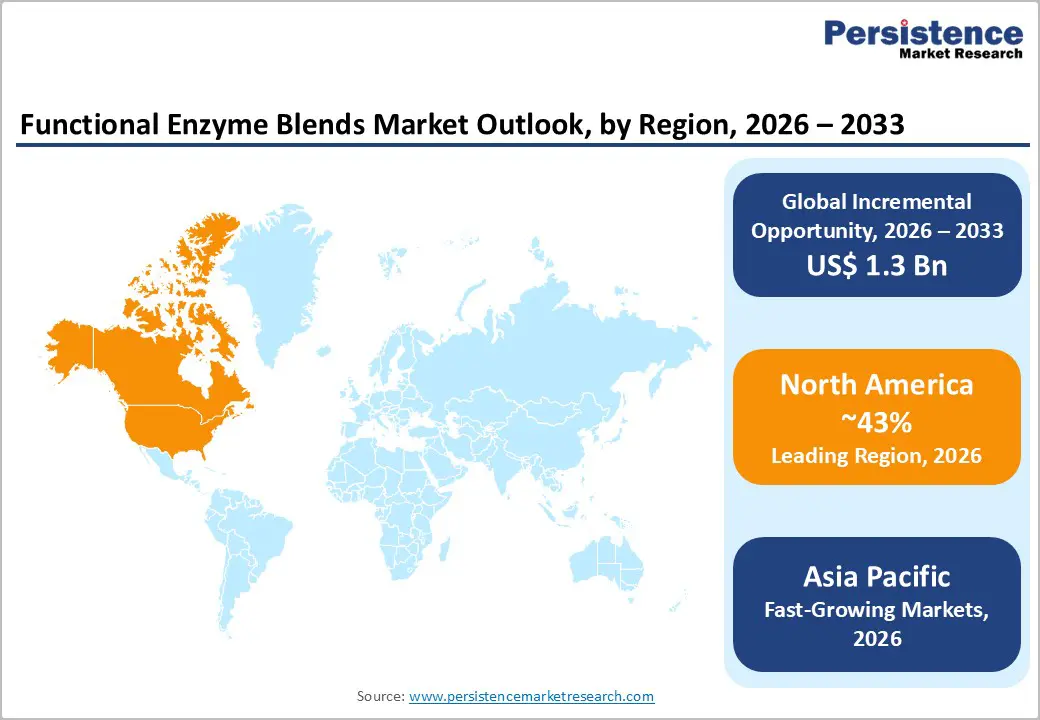
- North America leads the functional enzyme blends market with approximately 43% share in 2025, driven by a mature processed food industry, strong fuel ethanol production, clear regulatory pathways for enzymes, and a robust biotechnology innovation ecosystem anchored in the United States and supported by federal research funding and industrial collaboration.
- Asia Pacific is expected to be the fastest-growing region through 2032, propelled by the rapid expansion of processed foods, large and intensifying livestock production, significant investments in biofuels and biogas, and competitive manufacturing capabilities in countries such as China and India, where local and international enzyme producers collaborate to serve rising demand.
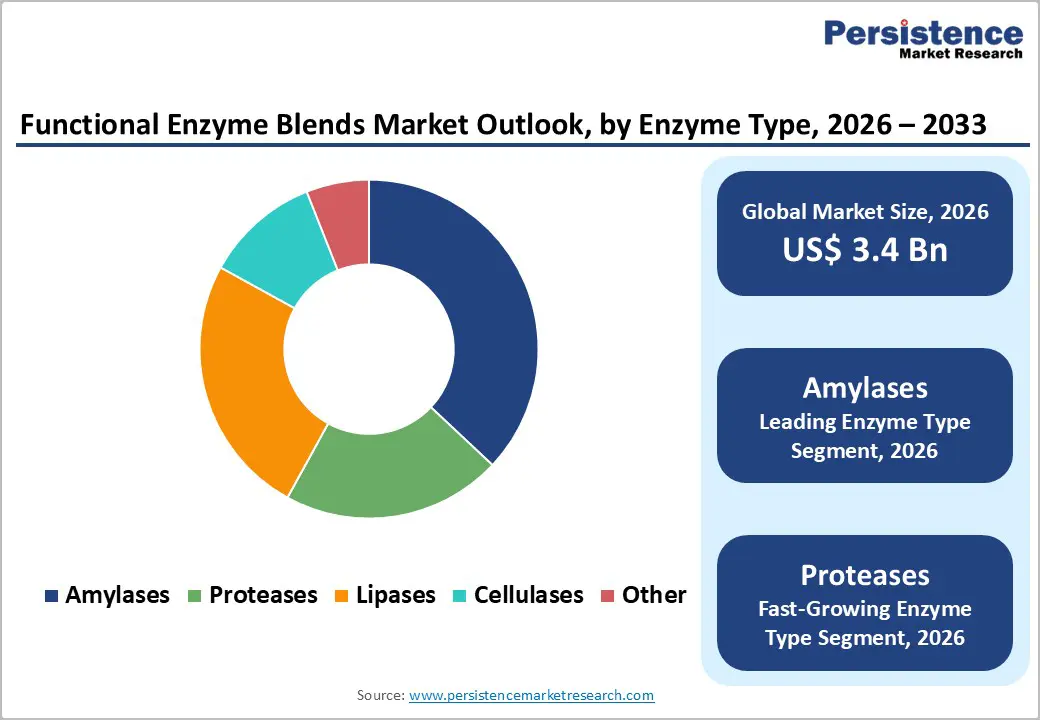
- Among enzyme types, amylases dominate with a 37% share in 2025, owing to their central role in starch hydrolysis for baking, brewing, sweetener production, and bioethanol, and their broad integration into high-volume processes that underpin global food and beverage supply chains.
- By source, microbial enzymes hold the largest share, while plant-based enzyme sources are expected to register the fastest growth, reflecting increasing emphasis on sustainable, non-animal-derived ingredients and the appeal of “plant-based” positioning in foods, nutraceuticals, and clean-label meat tenderizers and digestive aids.
- The most attractive opportunity lies at the intersection of plant-based foods, digestive health, and bio-based industrial processes, where tailored functional enzyme blends can improve sensory quality, nutrient bioavailability, and process efficiency, enabling manufacturers to meet consumer expectations, regulatory requirements, and decarbonization targets simultaneously.
| Key Insights | Details |
|---|---|
| Functional Enzyme Blends Market Size (2026E) | US$ 3.4 Bn |
| Market Value Forecast (2033F) | US$ 4.7 Bn |
| Projected Growth (CAGR 2026 to 2033) | 4.8% |
| Historical Market Growth (CAGR 2020 to 2025) | 4.2% |
Market Dynamics
Drivers - Rising Demand for Efficient and Sustainable Food & Feed Processing
A key driver for functional enzyme blends is the growing demand for efficient, sustainable processing in the food and animal feed industries. Global population growth and rising protein consumption are pressuring supply chains to extract more value from agricultural raw materials. Enzyme blends combining amylases, proteases, and cellulases enable higher starch conversion, protein hydrolysis, and fiber breakdown, improving yields and nutrient availability. International organizations such as the Food and Agriculture Organization (FAO) highlight that nearly 14% of the world’s food is lost between harvest and retail, emphasizing the need for technologies that reduce loss and improve utilization. In animal nutrition, multi-enzyme preparations are used to degrade non-starch polysaccharides and anti-nutritional factors, improving feed conversion ratios and supporting gut health; poultry and swine producers increasingly rely on xylanase-, phytase- and carbohydrase-containing blends to optimize performance. By lowering processing temperatures, shortening reaction times, and reducing the need for harsh chemicals, enzymes contribute directly to energy savings and reduced greenhouse gas emissions, aligning with corporate sustainability targets and environmental regulations.
Biotechnology Advancements and Regulatory Support for Enzyme Use
Another strong growth driver is progress in biotechnology and supportive regulatory frameworks that encourage enzyme innovation and commercialization. Improvements in microbial strain engineering, directed evolution, and fermentation technology allow enzyme producers to tailor catalytic properties, pH and temperature stability, and substrate specificity. Leading companies such as Novozymes A/S, DSM Firmenich, BASF SE, DuPont de Nemours, Inc., and AB Enzymes GmbH have invested heavily in R&D to design multi-enzyme formulations targeting specific process bottlenecks in baking, brewing, dairy processing, bioethanol production, and detergent manufacturing. In many regions, including the European Union and United States, food enzymes undergo structured safety assessments by bodies such as the European Food Safety Authority (EFSA) and are often classified as processing aids, which can simplify labelling in finished products compared with traditional additives. The U.S. Food and Drug Administration (FDA)’s GRAS framework for enzyme preparations and the Codex Alimentarius guidelines on food enzymes provide regulatory clarity for manufacturers. This supportive environment encourages adoption of functional enzyme blends as safer, more sustainable alternatives to chemical catalysts and synthetic processing aids across multiple industries.
Restraints - High Formulation Complexity and Customization Requirements
Functional enzyme blends are inherently complex, as they must combine different enzyme activities with compatible pH and temperature optima while maintaining stability throughout processing and storage. Designing blends for specific substrates—such as whole grains, plant proteins, or lignocellulosic biomass-requires extensive application-specific testing and often customization at the customer level. This complexity can make development and scale-up relatively time-consuming and costly, especially for smaller formulators and end users without in-house enzyme expertise. In segments like biofuels or advanced biorefining, process conditions can be severe, requiring highly robust enzyme systems; suboptimal match between enzyme blend and process parameters can lead to inconsistent performance, limiting confidence and slowing broader adoption.
Pricing Pressure and Cost Sensitivity in End-User Industries
Many key end-use industries, including baking, animal feed, and commodities-based biofuels, operate under significant margin pressure. While enzymes typically offer strong cost-benefit ratios, the upfront cost of functional enzyme blends can be perceived as high, especially in emerging markets or during commodity price volatility. Users sometimes hesitate to switch from established processes or single-enzyme solutions to more advanced blends if the value proposition is not clearly quantified in terms of yield improvement, energy savings, or reduced waste. Moreover, fluctuations in fermentation raw material costs and capacity utilization can affect enzyme pricing. In cost-sensitive sectors, particularly small and mid-sized mills or feed manufacturers, this price sensitivity can slow adoption of premium, highly engineered functional blends in favor of standard enzyme products.
Opportunities - Growth of Plant-Based Foods, Nutraceuticals, and Digestive Health
Functional enzyme blends are well positioned to benefit from the rapid expansion of plant-based foods, high-protein products, and digestive health-focused nutraceuticals. Global interest in plant-based meat, dairy alternatives, and protein beverages is rising as consumers seek to reduce animal product intake for health and environmental reasons. Enzyme cocktails combining proteases, amylases, and lipases can improve solubility, emulsification, flavor, and texture of plant proteins derived from soy, pea, wheat, or novel sources. In nutraceuticals and dietary supplements, multi-enzyme digestive blends containing proteases, amylases, lipases, and cellulases are increasingly marketed to support macronutrient digestion and help manage conditions such as lactose intolerance or gluten sensitivity, under guidance of healthcare professionals. Trends highlighted by organizations such as the World Gastroenterology Organisation and national nutrition bodies show rising concern about digestive disorders and food intolerances, encouraging consumers to explore enzyme-based solutions. For enzyme manufacturers, this creates opportunities to collaborate with food formulators, supplement brands, and contract manufacturers to develop proprietary functional blends tailored to specific consumer health platforms such as gut health, sports nutrition, and healthy aging.
Decarbonization, Biofuels Expansion, and Circular Bioeconomy Initiatives
Global decarbonization efforts and circular bioeconomy strategies provide substantial future potential for functional enzyme blends in biofuels and industrial bioprocesses. Policies aimed at reducing greenhouse gas emissions, such as renewable fuel mandates in the United States, European Union, and several Asia Pacific countries, continue to support demand for bioethanol, biodiesel, and emerging bio-based chemicals. Multi-enzyme cocktails combining cellulases, hemicellulases, and accessory enzymes are critical to converting lignocellulosic biomass such as agricultural residues, forestry by-products, or dedicated energy crops into fermentable sugars.
National energy and environment agencies, including the International Energy Agency (IEA), project that sustainable bioenergy and advanced biofuels will play a key role in achieving net-zero pathways. Functional enzyme blends that enable higher conversion rates, lower enzyme dosages, or operation at milder conditions can significantly improve the economics and environmental profile of biorefineries. In addition, industrial sectors such as textiles, pulp and paper, leather, and detergents are exploring enzyme-based process intensification to replace or reduce chemicals, water, and energy use, aligning with corporate ESG commitments and tightening pollution regulations. This opens long-term opportunities for enzyme companies that can develop application-specific blends and demonstrate measurable sustainability benefits.
Category-wise Analysis
Enzyme Type Insights
Within enzyme types, amylases represent the leading segment, accounting for around 37% of the functional enzyme blends market in 2025. Amylases are essential for starch hydrolysis, producing dextrins and sugars used in baking, brewing, starch processing, sweetener production, and bioethanol. In baking, blends containing fungal and bacterial amylases help improve loaf volume, crumb softness, and shelf life by modifying starch retrogradation, supporting the vast global bread and bakery sector. In brewing and distilling, amylase-rich blends optimize mash conversion efficiency and consistency. Given that starch-based crops such as wheat, corn, rice, and potatoes constitute a large fraction of global calorie intake according to the FAO, demand for efficient starch conversion is structurally strong. Amylase-centered blends are also widely used in syrups and sweeteners, including glucose and maltose syrups used in confectionery, beverages, and processed foods. Their broad applicability, well-understood functionality, and favorable cost-benefit profile explain the segment’s leadership.
Source Insights
By source, microbial enzymes are the leading and most widely adopted segment, and they are estimated to represent well above 60% of functional enzyme blends in 2025, with plant-based enzymes constituting the fastest-growing subsegment. Microbial enzymes, produced by bacteria and fungi such as Bacillus and Aspergillus species, offer high productivity, robustness, and broad pH and temperature ranges, making them suitable for industrial-scale fermentation and diverse process environments. Safety evaluations by bodies like EFSA and the FDA frequently focus on microbial strains and their production processes, and many microbial enzyme preparations have long histories of safe use in food and feed. At the same time, plant-based enzymes, such as bromelain from pineapple or papain from papaya, are gaining traction in applications where “plant-derived” and “vegan” labelling is important, for example in certain nutraceuticals and clean-label meat tenderizers. As demand for sustainable and non-animal origins rises-alongside concerns over animal-derived inputs-plant-based sources are anticipated to post the highest growth rates, supported by improved extraction and stabilization technologies.
Regional Insights
North America Functional Enzyme Blends Market Trends and Insights
North America is the leading regional market, accounting for about 43% of the global functional enzyme blends market in 2025, with the United States as the primary contributor. The region benefits from a mature processed food industry, advanced animal feed and biofuel sectors, and a strong innovation ecosystem in biotechnology and industrial enzymes. The U.S. FDA maintains clear regulatory pathways for enzyme preparations used in food through the GRAS process, and many enzyme products have GRAS notices or food additive approvals, providing regulatory certainty for manufacturers. High penetration of industrialized baking, brewing, starch processing, and high-fructose corn syrup production creates steady demand for enzyme blends targeting yield and quality improvements. North America is also one of the largest producers of fuel ethanol, supported by renewable fuel standards; multi-enzyme cocktails are critical in corn ethanol and cellulosic ethanol processes to maximize sugar release and fermentation efficiency.
Asia Pacific Functional Enzyme Blends Market Trends and Insights
Asia Pacific is the fastest-growing regional market for functional enzyme blends, expected to post the highest CAGR between 2025 and 2032, driven by rapid industrialization of food processing, expanding livestock production, and increasing investments in biofuels and biobased industries. Major economies such as China, India, Japan, and ASEAN countries are experiencing rising demand for processed foods, bakery products, dairy, and beverages as incomes grow and urbanization continues. In China and India, large-scale flour milling, bakery, and brewing operations have embraced functional enzyme blends to improve efficiency and standardize product quality across large networks of plants and outlets.
For animal nutrition, Asia Pacific hosts some of the world’s largest poultry and aquaculture sectors; multi-enzyme feed formulations are widely used to enhance feed digestibility, reduce phosphorus excretion, and improve growth performance. National and regional safety standards for feed additives are evolving, but enzymes are generally well accepted when safety is demonstrated. On the energy side, China and India both pursue biofuel and biogas projects where enzyme blends help convert agricultural residues and food waste into bioenergy, aligning with waste reduction and air quality goals. The region also benefits from competitive manufacturing costs and an increasing number of local enzyme producers and formulation companies, which collaborate with global leaders such as Novozymes A/S, DSM-Firmenich, and Advanced Enzyme Technologies Ltd. (headquartered in India). Together, these dynamics position Asia Pacific as the primary growth engine for the functional enzyme blends market over the forecast period.
Competitive Landscape
The competitive landscape of the functional enzyme blends market is characterized by the presence of several well-established global and regional players focusing on innovation, formulation quality, and application diversification. Competition is driven by continuous research to improve enzyme efficiency, stability, and specificity for food, feed, pharmaceutical, and industrial applications. Companies emphasize strategic collaborations, capacity expansions, and tailored solutions to meet evolving customer requirements. Cost competitiveness, regulatory compliance, and strong distribution networks play key roles in market positioning. Emerging markets offer growth opportunities, prompting investments in localized production and technology adaptation to gain a competitive edge.
Key Developments:
- In October 2025, M2 Ingredients, the largest functional mushroom grower and supplier in the Western Hemisphere, announced the launch of unique, full life-cycle mushroom extracts, including LionXtract™ (Lion’s Mane Extract), ReiExtract™ (Reishi Extract), CordyExtract™ (Cordyceps Extract), and Myco-Six™ (an extract blend of six mushrooms).
Companies Covered in Functional Enzyme Blends Market
- Novozymes A/S
- DuPont de Nemours, Inc.
- BASF SE
- DSM-Firmenich
- AB Enzymes GmbH
- Advanced Enzyme Technologies Ltd
- Amano Enzyme Inc.
- Kemin Industries, Inc.
- Biocatalysts Ltd.
- Specialty Enzymes & Biotechnologies Co.
- Enzyme Development Corporation
- Adisseo, Chr. Hansen Holding A/S
- Kerry Group plc
- Roquette Frères
Frequently Asked Questions
The functional enzyme blends market is projected to reach around US$ 3.4 billion in 2026, supported by rising use of enzyme cocktails in food processing, animal feed, biofuels, and industrial applications seeking higher efficiency and sustainability.
Demand is primarily driven by the need for efficient, sustainable processing in food, feed, and biofuel industries, advances in microbial strain engineering and fermentation technology, supportive regulatory frameworks for enzyme use, and growing interest in plant-based, clean-label, and digestive health-oriented products.
North America leads the market, with approximately 43% share in 2025, reflecting its mature processed food sector, significant fuel ethanol production, strong animal feed and livestock industries, clear regulatory pathways for enzyme preparations, and established presence of major global enzyme producers.
Asia Pacific is expected to be the fastest-growing region through 2032, driven by rapid industrialization of food and feed production, growth in biofuels and biogas projects, expanding middle-class consumption of processed foods, and increasing involvement of both local and global enzyme manufacturers in markets such as China, India, and ASEAN.
Key companies include Novozymes A/S, DuPont de Nemours, Inc., BASF SE, DSM-Firmenich, AB Enzymes GmbH, Advanced Enzyme Technologies Ltd., Amano Enzyme Inc., Kemin Industries, Inc., Biocatalysts Ltd., Specialty Enzymes & Biotechnologies Co., Enzyme Development Corporation, and Adisseo, along with other global and regional players active in food, feed, and industrial enzyme solutions.


