




- Home Care & Utilities
- Double Coated Foam Tape Market
Double Coated Foam Tape Market Size, Share, and Growth Forecast 2026 - 2033
Double Coated Foam Tape Market by Material Type (Polyethylene (PE), Polyurethane Resins (PUR), Polyvinyl Chloride (PVC), Others), by Adhesive Type (Acrylic-based, Rubber-based, Silicon-based), by Application, by End Use, by Regional Analysis, 2026–2033

Double Coated Foam Tape Market Size and Trend Analysis
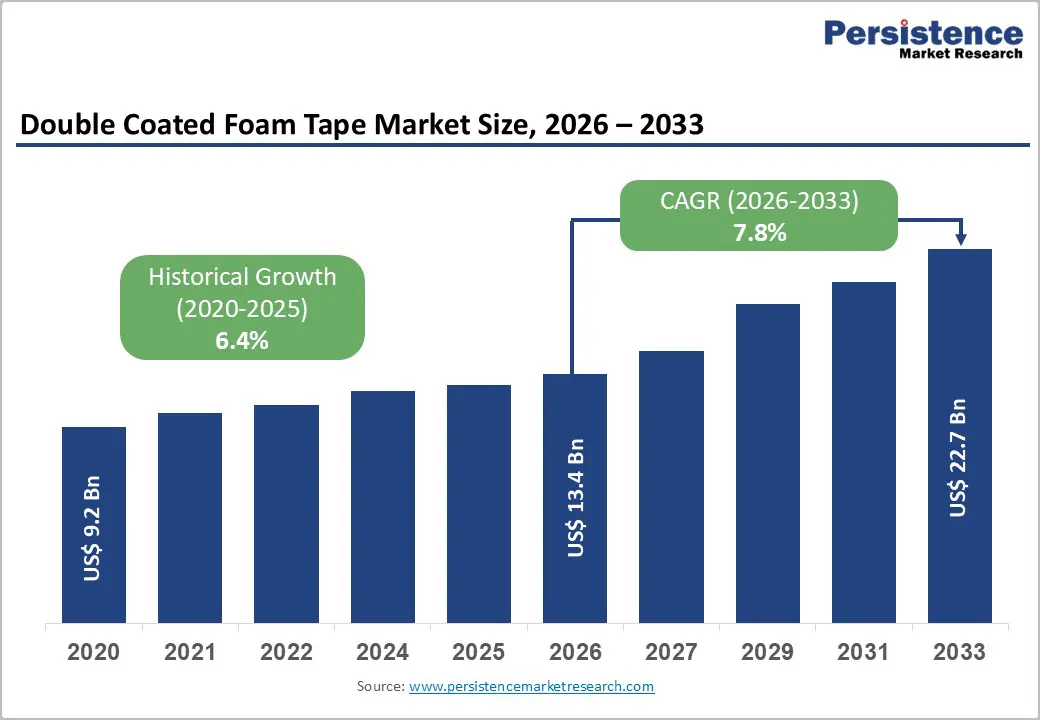
The global Double Coated Foam Tape market size is expected to be valued at US$ 13.4 billion in 2026 and projected to reach US$ 22.7 billion by 2033, growing at a CAGR of 7.8% between 2026 and 2033. Market growth is supported by increasing adoption of high-performance bonding solutions across automotive, building & construction, and electronics industries. Manufacturers favor double coated foam tapes for their lightweight nature, vibration dampening, gap-filling ability, and clean aesthetics compared to mechanical fasteners. Rising use of lightweight substrates, design miniaturization, and energy-efficient construction practices further strengthen demand, positioning foam tapes as a critical component in modern assembly and structural applications.
Key Market Highlights
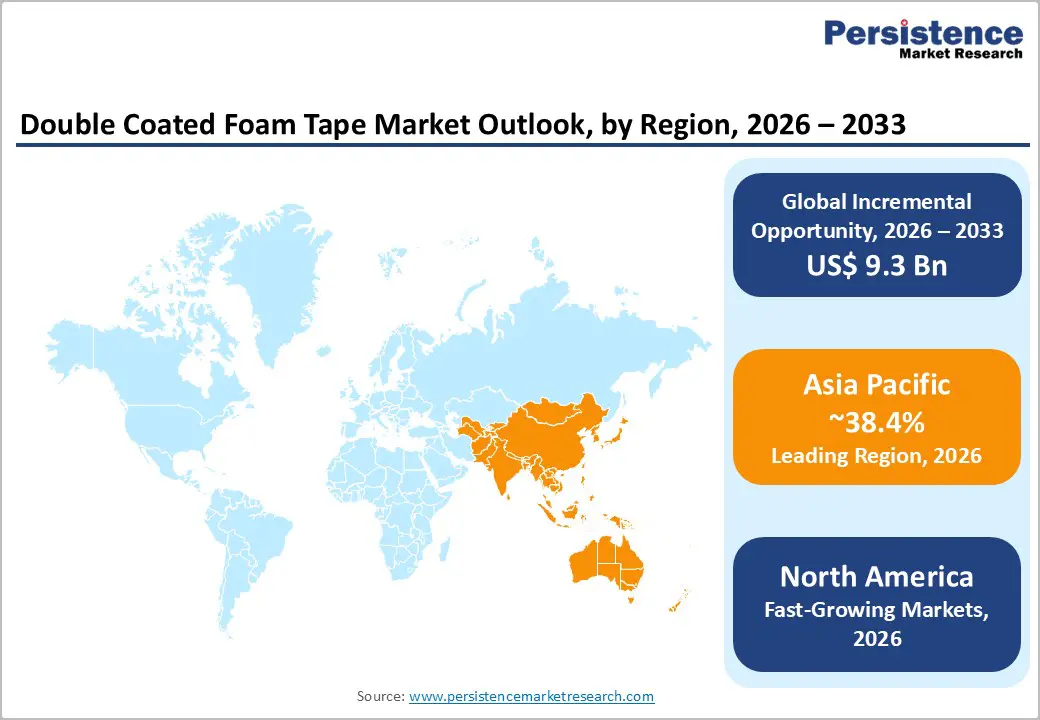
- Leading Region: Asia Pacific leads the global Double Coated Foam Tape market with 38.4% share in 2025, supported by strong automotive, electronics, and construction activity across China, Japan, India, and ASEAN, underpinned by cost-competitive manufacturing ecosystems.
- Fastest-Growing Region: Asia Pacific is also the fastest-growing region during 2026–2033, driven by rapid industrialization, localized tape production, government support for EVs and smart infrastructure, and expanding export-oriented manufacturing bases.
- Leading Product Category: Acrylic-based double coated foam tapes dominate the market with approximately 45% share in 2025, reflecting superior UV resistance, weather durability, and long-term adhesion performance in automotive, outdoor, and structural glazing applications.
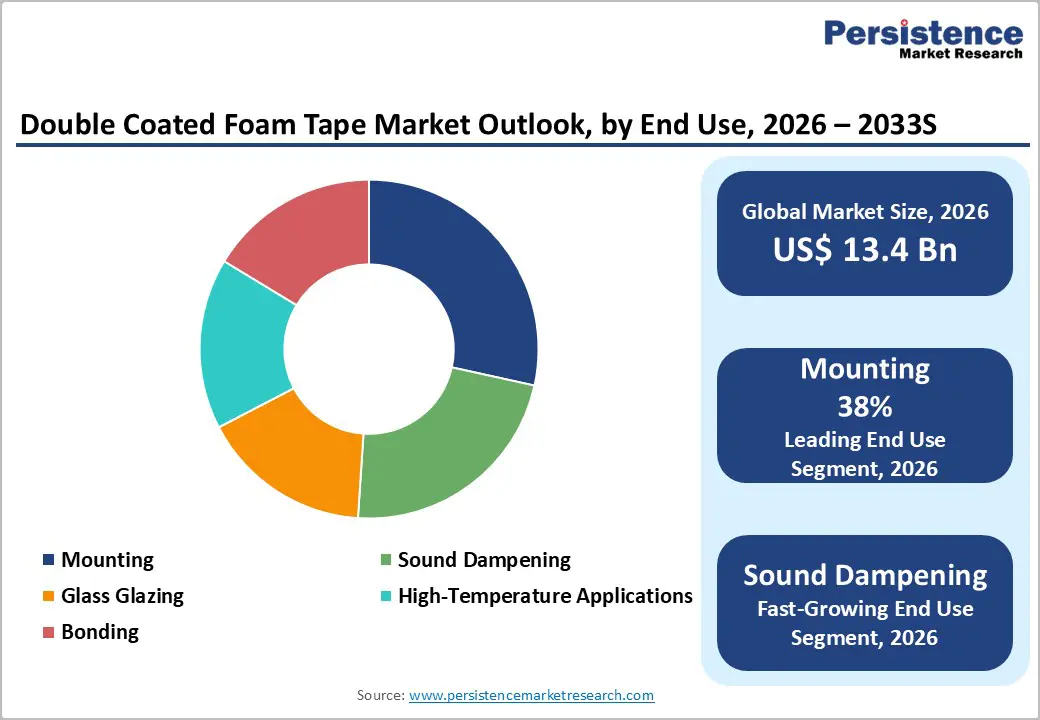
- Leading End-Use Segment: Mounting applications account for around 38% of global demand in 2025, as industrial users and DIY consumers increasingly replace mechanical fasteners and liquid adhesives to improve installation speed, aesthetics, and surface integrity.
- High-Growth Opportunity Segment: High-performance foam tapes engineered for electric vehicles, advanced electronics, and energy-efficient building envelopes represent a key growth opportunity, as demand rises for solutions offering enhanced heat resistance, dielectric strength, and sustainable material profiles.
| Global Market Attributes | Key Insights |
|---|---|
| Double Coated Foam Tape Market Size (2026E) | US$ 13.4 billion |
| Market Value Forecast (2033F) | US$ 22.7 billion |
| Projected Growth CAGR (2026–2033) | 7.8% |
| Historical Market Growth (2020–2025) | 6.4% |
Market Dynamics
Market Growth Drivers
Rising Adoption of Lightweight Bonding Solutions in Automotive and Transportation
The accelerating shift toward lightweight vehicle design and advanced joining technologies is a key growth driver for the double coated foam tape market. Regulatory frameworks such as U.S. CAFÉ standards and EU CO? emission norms are compelling automakers to reduce vehicle weight, encouraging replacement of mechanical fasteners with tapes and adhesives that support lightweight materials.
Double coated foam tapes enable reliable bonding of trims, emblems, sensors, and interior components while delivering vibration dampening and noise reduction. These benefits are particularly critical in electric vehicles, where cabin quietness and structural efficiency are differentiators, supporting rising adoption across OEM and aftermarket automotive applications.
Expanding Use in High-Performance Building Envelope and Glazing Applications
Growing emphasis on energy-efficient buildings and advanced façade engineering is another major driver for the market. Stricter building codes and sustainability standards are increasing the use of high-performance glazing, curtain walls, and insulated façade systems that require durable, long-lasting bonding and sealing solutions.
Double-coated foam tapes are widely used in glass glazing, cladding panels, and HVAC systems due to their ability to provide thermal isolation, stress absorption, and airtight sealing. Rising renovation and retrofit activity further boosts demand, as foam tapes support efficient upgrades of window systems and modular façade elements.
Market Restraints
Volatility in Raw Material Prices and Supply Chain Disruptions
A key restraint for the double-coated foam tape market is its exposure to fluctuations in raw material prices and periodic supply chain disruptions. Core inputs such as polyethylene, polyurethane, and PVC foams, along with acrylic- and rubber-based adhesive systems, are closely tied to petrochemical feedstocks, making costs sensitive to crude oil price movements and refinery utilization rates.
In addition, logistics bottlenecks, geopolitical disruptions, or unplanned shutdowns in chemical manufacturing can tighten material availability. Such conditions compress margins for tape producers and converters, forcing difficult pricing decisions. End users may respond by postponing projects, reducing order volumes, or opting for lower-cost alternatives, temporarily restraining market momentum.
Stringent Environmental Regulations on VOCs and Plastic Waste
Increasingly stringent environmental regulations related to VOC emissions, solvent usage, and plastic waste management present another significant market restraint. Foam and adhesive manufacturing processes often involve chemicals subject to strict regulatory oversight, particularly in Europe and North America, with similar trends emerging across Asia.
Compliance with regulations such as EU REACH and regional environmental standards in the U.S. can raise production costs and increase formulation complexity, especially for solvent-based adhesive systems. Furthermore, growing scrutiny of plastic waste and end-of-life disposal is driving demand for recyclable and low-impact materials, challenging suppliers that lack sustainable foam tape solutions.
Market Opportunities
Growth Potential in Electric Vehicles and Advanced Mobility Applications
Rapid expansion of electric vehicles and advanced mobility platforms presents a major opportunity for double coated foam tape suppliers. EV architectures rely extensively on foam tapes for battery pack assembly, cell-to-frame bonding, gasketing, thermal interface retention, and sensor mounting, where conventional fasteners are less effective due to vibration and space constraints.
As EV adoption accelerates globally, demand is rising for specialized foam tapes offering high temperature resistance, flame retardancy, dielectric strength, and low outgassing performance. These advanced formulations are critical in battery systems, power electronics, and charging infrastructure, enabling suppliers to differentiate through technology and capture higher value applications.
Increasing Demand for High-Performance Tapes in Electronics and Smart Devices
The continued proliferation of consumer electronics, smart devices, and industrial IoT hardware creates strong growth opportunities for double coated foam tapes. Compact electronic assemblies require precise bonding solutions that can secure displays, sensors, batteries, and housings while absorbing shock and accommodating thermal expansion.
Double coated foam tapes deliver controlled compression, impact protection, and clean aesthetics in space-constrained designs. As manufacturers increasingly adopt automated assembly and miniaturized components, demand is rising for tapes optimized for die-cutting accuracy, low contamination, and long-term reliability, supporting sustained uptake across electronics and smart device applications.
Category-wise Insights
Material Type Analysis
Polyethylene (PE) foam is expected to remain the leading segment, accounting for around 40% of the global double coated foam tape market in 2025. PE foam tapes offer a favorable balance of cost efficiency, compressibility, resilience, and surface conformability, supporting widespread adoption across automotive, building & construction, household, and electronics applications. Their compatibility with both acrylic- and rubber-based adhesives further strengthens their position in high-volume mounting and sealing uses.
Polyurethane (PUR) foam tapes are anticipated to be the fastest-growing material category over the forecast period. Superior flexibility, higher temperature resistance, and enhanced durability make PUR foams increasingly attractive for demanding applications in automotive interiors, electronics, and advanced mobility systems where long-term performance under dynamic conditions is critical.
Adhesive Type Analysis
Acrylic-based double coated foam tapes are projected to dominate, holding approximately 45% share in 2025. Acrylic adhesives deliver excellent resistance to UV exposure, oxidation, moisture, and temperature extremes, making them the preferred choice for automotive exteriors, façade systems, and structural glazing where long service life and reliability are essential.
Silicone-based adhesives are expected to witness the fastest growth during the forecast period. Their ability to perform under extreme temperatures, maintain flexibility, and provide strong adhesion on difficult substrates supports rising adoption in high-temperature electronics, EV battery systems, and industrial applications that demand specialized performance characteristics.
Application Analysis
Automotive is anticipated to be the leading segment, representing roughly 35% of global demand in 2025. Foam tapes are extensively used for mounting trims, emblems, sensors, interior panels, and NVH components, while also supporting improved aesthetics and corrosion prevention by eliminating mechanical fasteners.
Electrical & electronics applications are expected to grow at the fastest pace over the forecast period. Increasing electronic content in vehicles, expansion of consumer electronics, and growth in smart devices are driving demand for precision bonding solutions that provide cushioning, vibration resistance, and secure attachment in compact, high-density assemblies.
End Use Analysis
Mounting applications are expected to dominate the market, accounting for close to 38% share in 2025. Double coated foam tapes are widely used for mounting signage, displays, mirrors, cable channels, and decorative elements due to their ease of installation, immediate bonding strength, and clean appearance.
Sound dampening and vibration control applications are projected to be the fastest-growing end-use segment. Rising focus on noise reduction in electric vehicles, consumer electronics, and modern buildings is increasing demand for foam tapes that combine bonding with acoustic and vibration management capabilities across diverse environments.
Regional Insights
North America Double Coated Foam Tape Market Trends and Insights
North America represents a significant share of the global double-coated foam tape market, accounting for approximately 32.1% of demand in 2025, led by the United States. Strong automotive production, including light trucks, SUVs, and electric vehicles, drives extensive use of foam tapes for exterior trims, emblems, structural bonding, and NVH control, supported by vehicle lightweighting regulations.
Beyond automotive, non-residential construction and infrastructure investment sustain demand for foam tapes in façades, glazing, HVAC systems, and weather-resistant joints. A mature ecosystem of adhesive manufacturers, converters, and testing organizations enables rapid adoption of advanced tape technologies, reinforcing North America’s role as both a revenue-generating and innovation-driven regional market.
Europe Double Coated Foam Tape Market Trends and Insights
Europe is characterized by strong regulatory alignment, sustainability focus, and high engineering standards across the automotive and construction sectors. Countries such as Germany, the U.K., France, and Spain utilize foam tapes in vehicle manufacturing, façade systems, and industrial equipment, supported by strict environmental and building performance regulations.
Over the forecast period, the European double-coated foam tape market is expected to grow at a moderate CAGR of around 5.4%, reflecting steady replacement demand and renovation activity. Emphasis on low-VOC, solvent-free, and recyclable tape solutions aligned with circular economy goals positions Europe as a key hub for sustainable and high-performance foam tape development.
Asia Pacific Double Coated Foam Tape Market Trends and Insights
Asia Pacific is the fastest growing and largest regional market, accounting for an estimated 38.4% share of global demand in 2025, driven by China, Japan, India, and ASEAN economies. Rapid industrialization and expansion of automotive, electronics, and construction sectors fuel broad-based consumption of foam tapes for bonding, cushioning, and insulation.
China’s dominance in vehicle and electronics manufacturing, combined with strong EV and smart infrastructure policies, underpins regional growth. Japan’s precision manufacturing and emerging construction and appliance markets in India and Southeast Asia further accelerate adoption, while cost-competitive production and expanding local supply chains strengthen the Asia Pacific’s global market position.
Competitive Landscape
The global double coated foam tape market is moderately fragmented, with competition involving multinational adhesive manufacturers alongside regional converters and specialized players. Market positioning is driven by product performance, portfolio depth, and the ability to deliver application-specific, die-cut, and converted solutions supported by strong technical expertise and customer support.
Leading participants focus on developing high-bond and acrylic-based foam technologies with enhanced temperature resistance, durability, and sustainability credentials. Common competitive strategies include capacity expansion, regional footprint strengthening, acquisitions, and collaborative product development with automotive, electronics, and construction OEMs to secure long-term specifications and recurring demand.
Key Market Developments
- In September 2024, Essentra plc expanded its portfolio of double-sided and Double-Coated Foam Tapes for industrial and display applications, highlighting high-bond performance and compatibility with metals, plastics, and composites to support demanding mounting uses.
- In March 2023, Essentra plc introduced new double-sided foam tape solutions for signage, appliances, and HVAC systems, targeting improved assembly efficiency, long-term durability, and enhanced resistance to environmental stress in commercial and industrial installations.
Companies Covered in Double Coated Foam Tape Market
- Essentra plc
- 3M Company
- Nitto Denko Corporation
- Tesa SE
- Avery Dennison Corporation
- Lintec Corporation
- Scapa Group Ltd.
- Saint-Gobain Performance Plastics
- Intertape Polymer Group Inc.
- Adhesives Research, Inc.
Frequently Asked Questions
The global Double Coated Foam Tape market size is expected to reach approximately US$ 13.4 billion in 2026.
Key drivers include automotive lightweighting trends, rising EV adoption, stricter building energy-efficiency regulations, and expanding electronics production, supporting dominant demand for acrylic-based tapes and mounting applications.
Asia Pacific leads the global market with a 38.4% share in 2025, supported by large automotive, electronics, and construction industries across China, Japan, India, and ASEAN.
A major opportunity lies in high-performance foam tapes for EVs, advanced electronics, and energy-efficient buildings, where demand is rising for heat-resistant, dielectric, and sustainable adhesive solutions.
Key market players include Essentra plc, 3M Company, Nitto Denko Corporation, Tesa SE, Avery Dennison Corporation, and Lintec Corporation.


