




- Medical Devices
- Double Chamber Prefilled Syringes Market
Double Chamber Prefilled Syringes Market Size, Share and Growth Forecast, 2026 - 2033
Double Chamber Prefilled Syringes Market by Application (Vaccines & Immunization, Oncology, Hemophilia, Diabetes Management, Others), Product Type (Conventional Dual Chamber Syringes, Others), Chamber Configuration, and Regional Analysis for 2026 - 2033

Double Chamber Prefilled Syringes Market Share and Trends Analysis
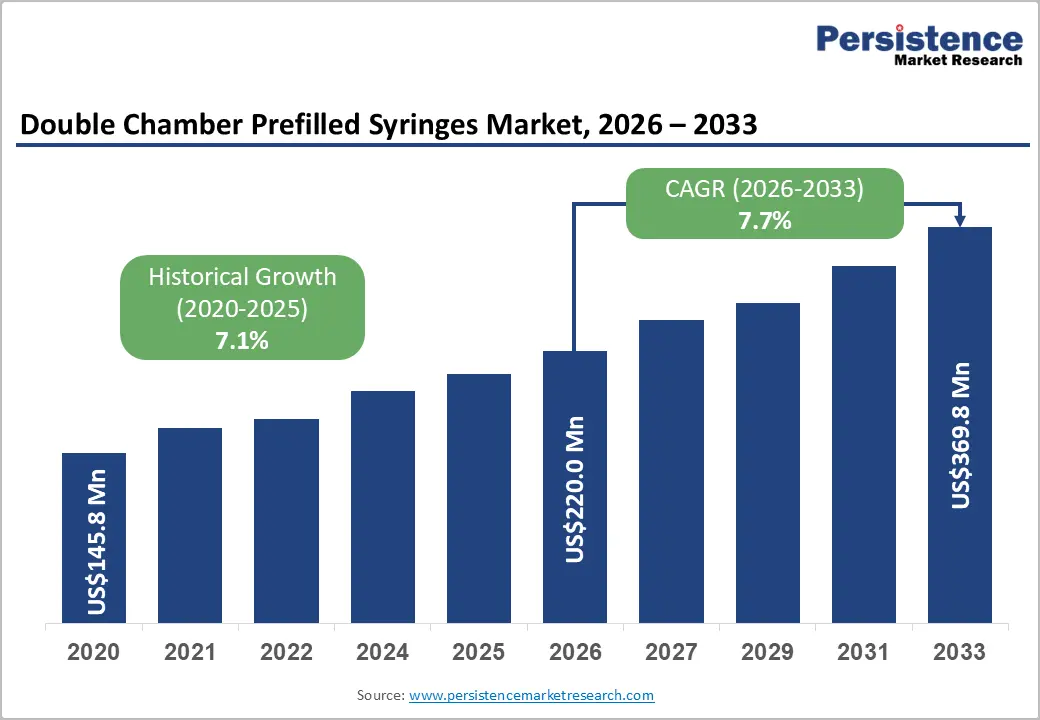
The global double chamber prefilled syringes market size is likely to be valued at US$220.0 million in 2026 and is projected to reach US$369.8 million by 2033, growing at a CAGR of 7.7% during the forecast period from 2026 to 2033, driven by rising demand for biologics injection devices, increasing adoption of lyophilized drug reconstitution syringes, and accelerated uptake of combination drug delivery devices in chronic and acute care.
Growth is reinforced by expanding biologics pipelines, especially in oncology and autoimmune disorders. Regulatory support from agencies such as the U.S. FDA and EMA, along with WHO prequalification initiatives, is contributing to broader standardization and adoption of advanced pharmaceutical packaging syringes, supporting the global expansion of dual chamber systems.
Key Industry Highlights:
- Dominant Application Segment: The vaccines & immunization segment is expected to hold around 28% share in 2026, while autoimmune diseases will be the fastest-growing at 8.1% CAGR through 2033, driven by biologics expansion and rising use of self-administered biologic injections.
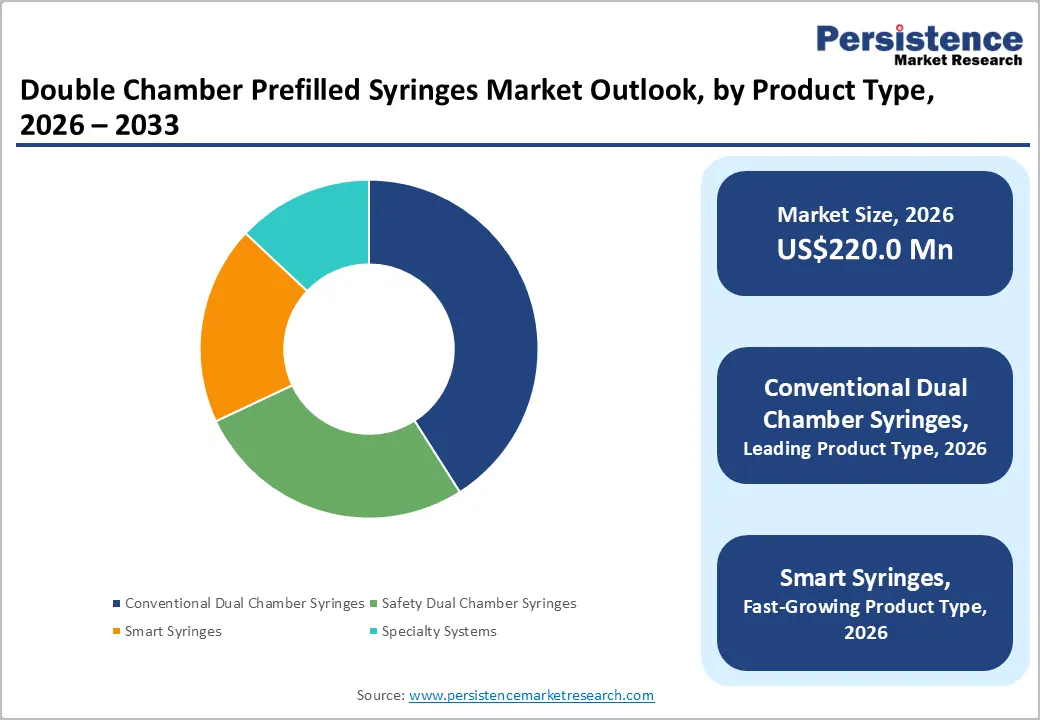
- Leading Product Type: Conventional dual chamber syringe systems are projected to lead with about 41% share in 2026, while smart syringes will be the fastest-growing at 7.9% CAGR, supported by rising adoption of smart prefilled syringe technology.
- Dominant Chamber Configuration: Lyophilized powder + diluent is expected to dominate with nearly 46% share in 2026, while active + stabilizer will be the fastest-growing at 7.8% CAGR, driven by demand for lyophilized drug reconstitution syringes.
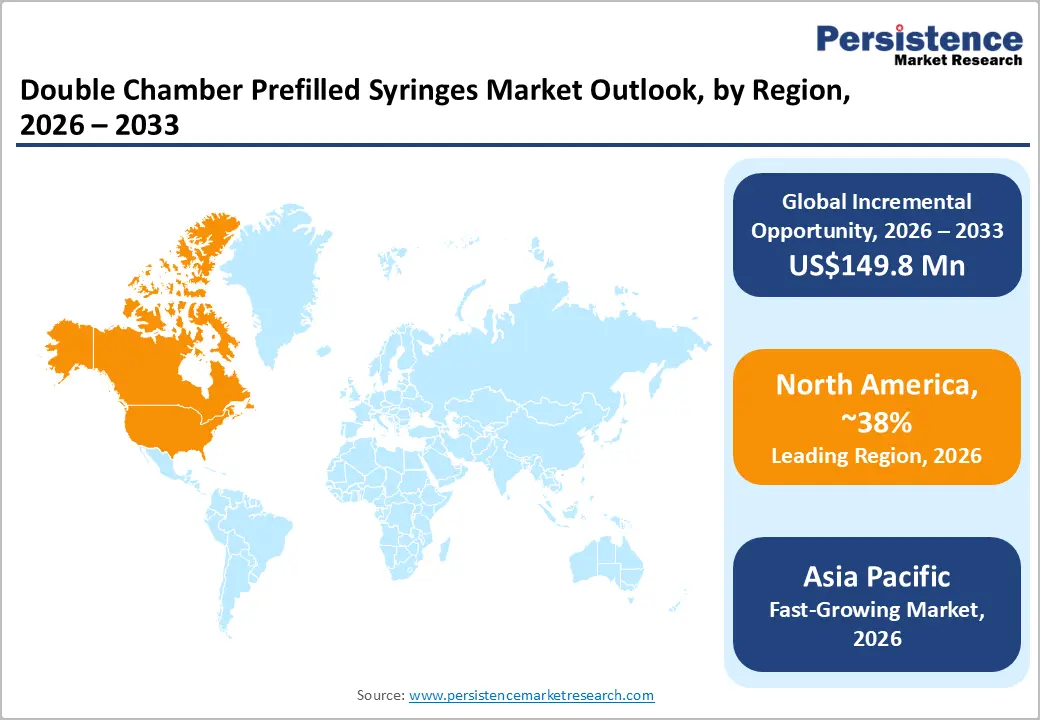
- Regional Leadership: North America is expected to lead with around 38% share in 2026, while Asia Pacific is the fastest-growing region, driven by manufacturing expansion, vaccination programs, and rising healthcare infrastructure in China and India within the injectable drug delivery systems market.
- Competitive Environment: The market is driven by strategic partnerships, capacity expansion, and innovation in advanced drug delivery systems, with a strong focus on smart platforms and biologics-compatible dual chamber syringe systems.
DRO Analysis
Driver - Expansion of Biologics and Lyophilized Drug Demand in Chronic Therapies
The strongest growth driver for the dual chamber syringe systems market is the rapid expansion of biologics and freeze-dried formulations requiring reconstitution at the point of care. U.S. FDA biologics approvals consistently account for over 40% of new molecular entity approvals, highlighting a strong pipeline shift toward complex biologics. These therapies require stable separation of active ingredients, making lyophilized drug reconstitution syringes essential for maintaining efficacy. Rising chronic disease burden is further increasing reliance on precise biologic-based treatment delivery.
Growing adoption of prefilled syringe drug delivery systems is reducing preparation errors and improving dosing accuracy across clinical settings. WHO immunization programs and EMA cold-chain optimization strategies are accelerating demand for stable, ready-to-use formats like vaccine delivery syringes. Pharmaceutical companies are reporting 30-40% reductions in handling errors with prefilled systems, improving patient safety and compliance. This is significantly boosting the uptake of advanced drug delivery systems across hospitals and home-care environments.
Restraint - High Manufacturing Complexity and Regulatory Compliance Burden
A major restraint for this market is the high manufacturing complexity of dual chamber systems, especially those requiring sterile barriers, lyophilized stability, and multi-material compatibility. Production depends on advanced aseptic filling lines and precision sealing technologies, significantly increasing capital expenditure compared to conventional syringes. This limits scalable adoption across smaller manufacturers.
Regulatory requirements under frameworks such as FDA 21 CFR Part 820 and EU MDR 2017/745 add further burden through strict validation and long approval cycles. These processes can extend product commercialization timelines by 12-24 months and raise unit costs by 20-35%. As a result, despite rising demand for pharmaceutical packaging syringes, adoption remains constrained by cost and compliance challenges.
Opportunity - Expansion of Self-Administration and Smart Drug Delivery Ecosystems
A key opportunity in the self-administered biologic injections segment is emerging due to the rapid shift toward home-based care and digital health integration. Expansion of home healthcare services, supported by CMS-backed reimbursement structures, is accelerating outpatient treatment across diabetes, autoimmune diseases, and oncology supportive care. This is increasing reliance on user-friendly prefilled syringe drug delivery solutions.
This shift is creating strong demand for smart prefilled syringe technology with dose tracking, safety sensors, and auto-injection features. Smart-enabled systems are projected to capture 12-18% of dual-chamber syringe adoption in advanced healthcare markets by 2030. Improved adherence rates of up to 25-30% in chronic therapies are further strengthening adoption. This positions drug delivery devices as a high-growth innovation segment in digital therapeutics ecosystems.
Category-wise Analysis
Application Segment
The vaccines & immunization segment is estimated to lead the double chamber prefilled syringes market with 28% share in 2026, as large-scale immunization programs are increasingly relying on stable, ready-to-use formats that reduce preparation errors and ensure dosing accuracy. This drives strong adoption of vaccine delivery syringes, particularly in mass vaccination and public health campaigns where speed and consistency are critical. The segment’s dominance is further supported by expanding vaccine manufacturing capacity and rising use of lyophilized formulations requiring dual-chamber systems to maintain stability and enable efficient large-volume deployment.
The autoimmune diseases segment is estimated to be the fastest growing at 8.1% CAGR through 2033, due to increasing prevalence of chronic immune disorders and expanding reliance on biologic therapies that require long-term, precise dosing. This is driving stronger uptake of self-administered biologic injections, as patients increasingly shift toward home-based treatment models to improve convenience and adherence. Growth is further supported by rising approvals of subcutaneous biologics, which are better suited for outpatient use, thereby accelerating demand for biologics injection devices in chronic disease management.
Product Type Insights
The conventional dual chamber syringe systems segment is estimated to lead with 41% share in 2026, primarily due to its cost efficiency, proven clinical reliability, and widespread use in hospital-based drug reconstitution. These systems are extensively preferred in emergency care and oncology settings, where rapid preparation and accurate mixing are essential, strengthening their role in pharmaceutical packaging syringes. Continued reliance on established hospital infrastructure and growing biologics administration volumes are further estimated to sustain their dominant position in the market.
The smart syringes segment is estimated to be the fastest growing at 7.9% CAGR by 2033, driven by increasing integration of digital monitoring, dose tracking, and safety features that enhance treatment adherence and reduce medication errors. This is supporting wider adoption of smart prefilled syringe technology, especially in chronic disease management and connected healthcare systems. Rising hospital digitization and expansion of data-driven care models are further estimated to accelerate demand, as healthcare providers shift toward more intelligent and patient-centric drug delivery solutions.
Chamber Configuration Insights
The lyophilized powder + diluent configuration is estimated to lead with 46% share in 2026, as it is widely used in biologics and vaccines that require reconstitution to maintain stability and therapeutic effectiveness. This makes it a key enabler of lyophilized drug reconstitution syringes, particularly in applications where active compounds degrade quickly in pre-mixed form. Its leadership is further supported by increasing demand for reduced cold-chain dependence and improved storage flexibility in large-scale immunization and biologics delivery programs.
The active + stabilizer configuration is estimated to be the fastest growing at 7.8% CAGR by 2033, as it enhances stability and preserves drug integrity in highly sensitive biologics used in oncology and autoimmune therapies. This is improving performance in oncology injectable delivery systems, ensuring consistent therapeutic effectiveness until administration. Growth is further estimated to be driven by rising adoption of advanced biologics and precision therapies, where extended shelf life and reduced degradation risks are becoming critical formulation requirements.
Regional Analysis
North America Double Chamber Prefilled Syringes Market Trends
North America is estimated to account for around 38% share of the global double chamber prefilled syringes market in 2026, supported by strong biologics consumption, advanced healthcare infrastructure, and early adoption of advanced drug delivery systems. The region benefits from rising chronic disease prevalence, favorable reimbursement systems, and increasing demand for home-based biologic therapies. Growing investments in sterile injectable manufacturing and digital healthcare platforms are further accelerating the adoption of self-administered biologic injections and connected delivery technologies.
The U.S. is projected to contribute nearly 72% of the North American market in 2026, driven by its large biologics pipeline, high healthcare expenditure, and strong FDA-regulated manufacturing ecosystem. Rising demand for oncology biologics and prefilled syringe drug delivery systems is encouraging the expansion of domestic sterile fill-finish infrastructure and biologics manufacturing facilities. Meanwhile, Canada is estimated to hold close to 10% regional share, supported by expanding immunization programs, biologics adoption, and investments in outpatient healthcare modernization and specialty injectable therapies.
Europe Double Chamber Prefilled Syringes Market Trends
Europe is estimated to hold approximately 30% share of the global market in 2026, driven by strong pharmaceutical manufacturing capabilities and increasing use of pharmaceutical packaging syringes in oncology and immunology applications. Regulatory harmonization under the EMA and EU MDR frameworks is improving product standardization and commercialization efficiency across the region. Investments in sustainable medical packaging and biologics manufacturing are further strengthening demand for combination drug delivery devices.
Germany is projected to account for nearly 27% of the European market in 2026, supported by its advanced pharmaceutical production ecosystem and growing investments in biologics manufacturing and sterile fill-finish infrastructure. Rising use of injectable biologics in hospital care continues to strengthen demand for dual-chamber syringe systems. The U.K. is estimated to contribute around 18% regional share, driven by increasing biologics research activity, home-based healthcare adoption, and expanding use of self-administered biologic injections within connected care models.
Asia Pacific Double Chamber Prefilled Syringes Market Trends
Asia Pacific is estimated to be the fastest-growing regional market through 2033, supported by expanding pharmaceutical manufacturing capacity, rising healthcare investments, and large patient populations. Rapid growth in vaccine production and biologics development is accelerating demand for injectable drug delivery systems market products across emerging economies. Government-led immunization initiatives and healthcare infrastructure modernization are further strengthening the adoption of dual chamber syringe systems in the region.
China is projected to account for nearly 38% of the Asia Pacific market in 2026, driven by strong biologics R&D investments, expansion of pharmaceutical manufacturing infrastructure, and rising demand for injectable therapies. Increased development of domestic biologics facilities and hospital expansion projects is supporting the adoption of lyophilized drug reconstitution syringes and advanced injectable systems. India is estimated to hold around 21% regional share, supported by its strong vaccine manufacturing base, expanding pharmaceutical exports, and rising investments in sterile injectable production and biologics-compatible delivery technologies.
Competitive Landscape
The global double-chamber prefilled syringes market is moderately consolidated, with leading players such as Becton Dickinson, Gerresheimer AG, SCHOTT Pharma, and West Pharmaceutical Services accounting for a significant share of global revenue. These companies are strengthening their market position through investments in sterile manufacturing, biologics-compatible packaging, and advanced drug delivery systems, while expanding partnerships with pharmaceutical manufacturers for high-value prefilled syringe drug delivery solutions.
Companies such as Stevanato Group, Nipro Corporation, and Terumo Corporation are focusing on regional expansion and specialized injectable therapies. Strict regulatory requirements, high manufacturing complexity, and sterile fill-finish infrastructure needs continue to limit new entrants. However, growing demand for smart prefilled syringe technology is encouraging collaborations between medical device firms and digital healthcare companies, supporting gradual market consolidation and innovation in dual chamber syringe systems.
Key Industry Developments:
- In January 2026, Becton Dickinson announced a US$110 million expansion of its Columbus, Nebraska, prefilled syringe facility to increase Neopak syringe and cannula production. The investment supports rising demand for biologics and GLP-1 therapies within advanced prefilled syringe drug delivery systems.
- In March 2024, SCHOTT Pharma expanded in the U.S. with a New Prefillable Syringe Manufacturing Facility in Wilson, North Carolina. The site also manufactures glass prefillable syringes for GLP-1 therapies, supporting the growing market demand.
Companies Covered in Double Chamber Prefilled Syringes Market
- Becton Dickinson
- Gerresheimer AG
- SCHOTT Pharma
- West Pharmaceutical Services
- Nipro Corporation
- Terumo Corporation
- Stevanato Group
- Catalent Inc.
- AptarGroup
- Ypsomed AG
- SHL Medical
- Vetter Pharma
- B. Braun Melsungen AG
- Oval Medical Technologies
- West China Pharmaceutical
Frequently Asked Questions
The global double chamber prefilled syringes market is projected to reach US$220.0 million in 2026.
Rising biologics adoption, increasing demand for prefilled syringe drug delivery, and growth in home-based injectable therapies drive the market.
The market is expected to grow at a CAGR of 7.7% from 2026 to 2033.
Growth opportunities lie in smart prefilled syringe technology, self-administration trends, and expansion of biologics-based therapies.
Becton Dickinson, Gerresheimer AG, SCHOTT Pharma, and West Pharmaceutical Services are key market players.


