




- Semiconductor Materials & Components
- ASIC Design Service Market
ASIC Design Service Market Size, Share, and Growth Forecast, 2026 - 2033
ASIC Design Service Market By Service Type (Design Services, Verification Services, Others), Technology (Digital ASIC, Analog ASIC, Mixed Signal ASIC), Application (Automotive, Others), End-user (Healthcare, Telecommunications, Others), and Regional Analysis for 2026 - 2033

ASIC Design Service Market Size and Trends Analysis
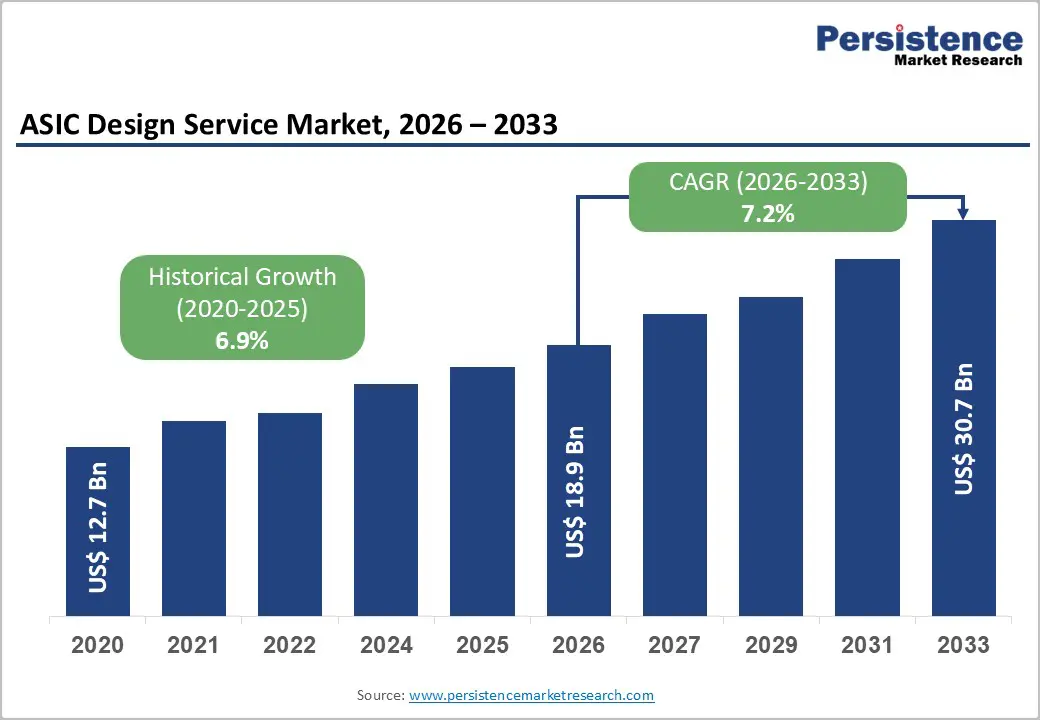
The global ASIC design service market size is ly to be valued at US$18.9 billion in 2026, and is expected to reach US$30.7 billion by 2033, growing at a CAGR of 7.2% during the forecast period from 2026 to 2033, driven by the increasing prevalence of custom chip demand in AI and 5G, rising need for specialized semiconductor solutions, and advancements in mixed-signal ASIC technologies.
Growing demand for efficient, high-performance ASIC design services, especially in automotive and telecommunications, is accelerating adoption across applications. Advances in verification and prototype services are further boosting uptake by offering faster time-to-market options. The increasing recognition of ASIC design services as critical for edge computing and IoT in emerging markets remains a major driver of market growth.
Key Industry Highlights:
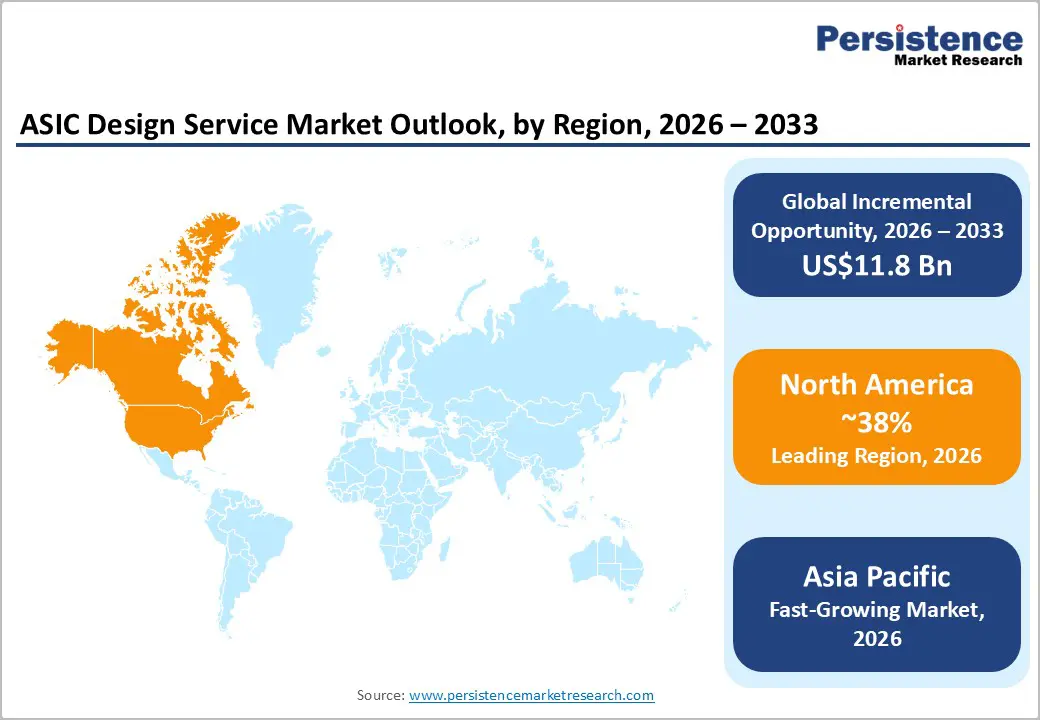
- Leading Region: North America, to account for a 38% market share in 2026, driven by the region’s advanced semiconductor infrastructure, strong research and development capabilities, and high public awareness of custom chip benefits.
- Fastest-growing Region: Asia Pacific, fueled by AI chip boom, 5G expansion, and growing investments in automotive electronics.
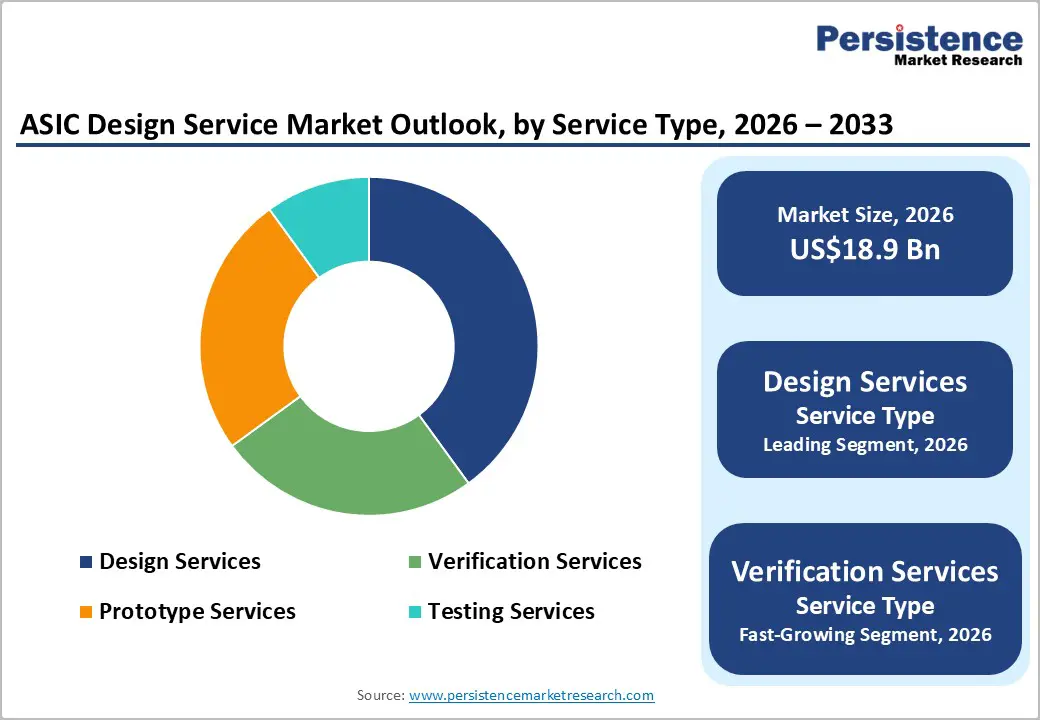
- Dominant Service Type: Design services, to hold approximately 40% of the revenue share, as they form the core of custom ASIC development.
- Leading Technology: Digital ASIC is expected to account for over 50% of the market revenue, due to widespread use in consumer and telecom devices.
- Leading End-user: Consumer electronics, to lead with approximately 35% revenue share, due to high-volume chip customization.
| Key Insights | Details |
|---|---|
|
ASIC Design Service Market Size (2026E) |
US$18.9 Bn |
|
Market Value Forecast (2033F) |
US$30.7 Bn |
|
Projected Growth (CAGR 2026 to 2033) |
7.2% |
|
Historical Market Growth (CAGR 2020 to 2025) |
6.9% |
Market Factors - Growth, Barriers, and Opportunity Analysis
Increasing Demand for Custom Chip in AI and 5G
The demand for custom chips has surged with the rapid growth of AI and 5G technologies. Off-the-shelf processors often struggle to meet the specific performance and efficiency needs of these high-computation applications. AI workloads, including machine learning model training and inference, require processors optimized for parallel processing, high memory bandwidth, and low latency, making custom-designed chips a more effective solution. Likewise, 5G networks need specialized chips capable of handling massive data throughput, real-time signal processing, and energy-efficient operation to support dense network deployments and edge computing.
As a result, companies are increasingly investing in application-specific integrated circuits (ASICs) and field-programmable gate arrays (FPGAs) to achieve tailored performance enhancements. Custom chips offer optimization in power consumption, processing speed, and thermal management, all of which are critical in AI data centers and 5G infrastructure. They also enable hardware-software co-design, allowing algorithms to run more efficiently while lowering operational costs. As AI models become more complex and 5G adoption expands across industrial, automotive, and consumer sectors, reliance on custom chip solutions is expected to grow, driving further innovation in semiconductor design and manufacturing.
High Development and Tool Licensing Costs
High development and tool licensing costs pose a major challenge for companies pursuing next-generation ASIC design services and innovative platforms. Creating advanced solutions, such as verification systems, prototype validation, or testing frameworks, demands extensive research, specialized EDA software, and high-performance computing resources, all of which are far costlier than standard design processes. Complexity adds a layer of difficulty. Advanced ASICs, multi-core designs, and high-frequency products are highly sensitive to timing closure, power integrity, and yield, necessitating meticulous optimization to ensure functionality throughout fabrication. Sustaining long-term performance often requires expensive tape-out iterations, sophisticated simulation testing, and the integration of premium IP blocks, significantly increasing R&D expenditures.
Meeting strict customer requirements for tape-out success, defect rates, and batch consistency involves multiple validation studies across diverse conditions and technology nodes, adding both time and financial pressure to development schedules. Scaling operations demands controlled design environments, specialized software licenses, and rigorous quality assurance systems, further increasing overall costs. For smaller companies, these challenges can hinder migration to new nodes or delay market entry.
Developments in Mixed-Signal and AI-Enabled Design Platforms
Advances in mixed-signal and AI-enabled ASIC design platforms are reshaping the global semiconductor landscape by addressing two key challenges: analog-digital integration barriers and design cycle constraints. Mixed-signal platforms enable seamless analog-digital co-design, reducing dependence on separate flows and supporting the development of complex SoCs for applications such as 5G and automotive. Innovations such as advanced PDKs, multi-domain simulation, hybrid verification, and AI-assisted layout improve design convergence, reduce iterations, and accelerate time-to-market for foundries and IDMs.
AI-enabled platforms, leveraging machine learning for routing, predictive verification, generative design, and automated testing, streamline workflows by enhancing early error detection, the first line of defense against delays. These solutions eliminate manual bottlenecks, increase accuracy, and allow broad usability without expert intervention, making them ideal for large-scale advanced node programs. Emerging technologies, including quantum-inspired optimization, bio-adhesive IP reuse, and VLP-based simulation, further boost design speed and responsiveness.
Category-wise Analysis
Service Type Insights
Design services are expected to dominate the market, accounting for roughly 40% of revenue in 2026. This dominance stems from their focus on core customization, handling of high-complexity designs, and strong client demand, making them a preferred choice for ASIC development. Design services encompass architecture design, functional verification, and differentiation, making them well-suited for large-scale chip programs. Cadence Design Systems, for example, provides end-to-end custom silicon services, including architecture creation, RTL design, verification, physical design, tape-out support, and post-silicon testing, demonstrating the kind of high-customization, complexity-driven offerings that fuel market leadership.
Verification services represent the fastest-growing segment due to their critical role in validation and their increasing application in advanced-node designs. Their strong error-detection capabilities make them essential for ensuring reliability and minimizing tape-out risks. Ongoing innovations in formal verification are further driving adoption, particularly in North America and Europe, where demand for bug-free designs is intensifying. For instance, STMicroelectronics standardized on Synopsys’s formal verification platform for advanced microcontroller designs, using it to identify corner-case bugs early in the cycle, accelerate verification closure, and reduce the risk of issues appearing late in the design process or post-silicon.
Technology Insights
Digital ASICs are expected to lead the market, holding approximately 50% of the market share in 2026, driven by high-volume logic, large processor programs, and strong global demand for computing chips. Their dominance continues as devices expand digital features. Rising adoption of mixed-signal hybrids and expanded analog campaigns highlight the growing focus on integrated solutions. Broadcom has partnered with Google to co-develop multiple generations of Google’s TPU digital ASICs, purpose-built chips that accelerate machine learning and AI workloads far more efficiently than general-purpose processors. These chips are high-volume digital ASICs optimized for large-scale computing tasks rather than general computing.
Mixed-signal ASICs are expected to be the fastest-growing segment, fueled by strong demand from IoT sensors and increasing adoption in automotive electronics. The shift toward integrated analog-digital platforms, coupled with improved co-design capabilities, is accelerating market uptake. Advancements in sensor fusion and its progression into production trials further support growth. Companies such as Swindon design and supply high-volume mixed-signal ASICs that combine analog front-ends for capturing physical sensor signals with digital processing logic and signal conditioning on a single chip. These ASICs are widely used in automotive applications such as Tire Pressure Monitoring Systems (TPMS) and in industrial sensor interfaces that connect to IoT networks.
Application Insights
The telecommunications sector is expected to dominate, capturing over 40% of the market share in 2026, driven by the rapid rollout of 5G networks, rising data traffic, and ongoing infrastructure upgrades. Telecom systems rely on high-performance, reliable, and scalable chip solutions to support base stations, network switching, and optical transmission. Investments in network densification, edge computing, and low-latency connectivity further strengthen telecom’s leading position, as operators prioritize robust hardware to meet growing global communication demands. For example, Ericsson established a new ASIC R&D hub in Bengaluru, India, hiring over 150 engineers to develop custom System-on-Chip (SoC) solutions for 5G and future 6G infrastructures, supporting its Radio Access Network (RAN), baseband processing, and transport products.
The automotive segment is projected to be the fastest-growing market, driven by the strong presence of electric vehicles (EVs) and the expanding role of Advanced Driver Assistance Systems (ADAS). Automotive ASICs provide fast, accessible, and low-latency intelligence, appealing to OEMs prioritizing safety and efficiency. Growth is further supported by electrification initiatives, outreach programs, and broader availability of both standard and premium ASICs, promoting rapid adoption in urban and semi-urban areas. Alchip Technologies, Ltd. recently introduced the semiconductor industry’s first Automotive ASIC platform at the Design Solutions Forum, specifically designed to meet the specialized demands of the global automotive market.
End-user Insights
The consumer electronics segment is expected to dominate the market, with approximately 35% share in 2026, driven by high volumes of gadgets and strong global demand for portable devices. Regular chip schedules, feature requirements, and widespread access to digital ASICs drive consistent demand. Rising focus on automotive and telecom further strengthens consumer leadership. MediaTek Inc. provides custom ASIC solutions for consumer electronics, including smartphones, tablets, wearables, and smart TVs. Their consumer ASICs integrate high-performance multimedia processing, connectivity (Wi-Fi, Bluetooth), low-power design, and advanced features such as AI acceleration, enabling device makers to deliver differentiated, energy-efficient portable products at a massive scale.
Aerospace is emerging as the fastest-growing segment in the ASIC design services market due to the increasing complexity, reliability demands, and customization requirements of modern aerospace systems. Aircraft, satellites, and space exploration platforms require highly specialized chips that can operate in extreme environments, including high radiation, temperature fluctuations, and long mission lifecycles. These stringent conditions make standard off-the-shelf solutions inadequate, driving strong demand for custom ASIC design services. The rapid growth of satellite constellations for communication, navigation, and earth observation has significantly increased the need for low-power, radiation-tolerant, and high-performance ASICs. Honeywell Aerospace announced a strategic collaboration with ForwardEdge ASIC LLC to develop high-reliability space microelectronics and custom ASIC solutions specifically for aerospace and space applications. The partnership focuses on developing radiation-insensitive ASICs optimized for satellite and space environments, which are essential for mission success and reduced risk in aerospace electronics.
Regional Insights
North America ASIC Design Service Market Trends
North America is projected to lead the market, capturing 38% of the share in 2026, driven by the region’s advanced semiconductor infrastructure, strong R&D capabilities, and high awareness of the benefits of custom chips. Design systems in the U.S. and Canada provide comprehensive support for service programs, ensuring broad accessibility of ASIC design services across consumer electronics, automotive, and telecom sectors. Rising demand for mixed-signal, user-friendly, and easily integrated solutions is further accelerating adoption, as these formats enhance performance and overcome the limitations of standard chips.
Technological innovations in ASIC design services, such as robust AI-assisted verification, faster prototype delivery, and targeted testing improvements, are attracting substantial investment from both public and private sectors. Government initiatives and CHIPS campaigns continue to support adoption by addressing supply risks, enabling node scaling, and mitigating emerging AI challenges, sustaining long-term market demand. The growing emphasis on automotive-grade and specialty applications, particularly in healthcare and other sectors, is expanding the range of ASIC design service applications.
Europe ASIC Design Service Market Trends
Europe’s growth is driven by rising awareness of the benefits of custom chips, strong design infrastructure, and government-led semiconductor initiatives. Countries such as Germany, France, and the U.K. have established frameworks that support routine design activities and encourage the adoption of innovative service delivery approaches, including ASIC design services. These solutions are particularly attractive to automotive sectors, regulation-conscious operators, and telecom users, improving yield and coverage.
Advances in ASIC design services, such as enhanced verification, application-specific delivery, and improved low-power solutions, are further expanding market potential. European governments are increasingly backing research and pilot programs that address both standard and specialized requirements, boosting market confidence. The region’s focus on convenient and secure solutions aligns with broader goals of preventive innovation and reduced dependency. Public awareness campaigns and promotional efforts are widening adoption in both urban and rural areas, while suppliers continue to invest in new tools and service variants to enhance efficiency and effectiveness.
Asia Pacific ASIC Design Service Market Trends
Asia Pacific is expected to be the fastest-growing market for ASIC design services during the 2026–2033 period, driven by rising fabless awareness, increasing government initiatives, and expanding application programs across the region. Countries such as India, China, Japan, and Southeast Asian nations are actively promoting design campaigns to support chip growth and address emerging AI demands. ASIC design services are particularly attractive in these markets due to their cost-effectiveness, scalability, and suitability for large-scale fabless operations in both urban and rural areas.
Technological advancements are enabling stable, efficient, and easy-to-deploy ASIC design services that can handle complex IP requirements and reduce risk exposure. These innovations are crucial for reaching remote designers and enhancing overall chip coverage. Strong demand from consumer electronics, automotive, and telecom sectors is further driving market expansion. Public-private partnerships, rising semiconductor investments, and increased funding for design research and manufacturing capacity are accelerating growth. The combination of convenient service delivery, enhanced customization, and lower risk of delays positions ASIC design services as a preferred solution across the region.
Competitive Landscape
The global ASIC design service market is characterized by competition between established semiconductor leaders and emerging boutique providers. In North America and Europe, companies such as Synapse Design and ICsense maintain leadership through strong R&D capabilities, extensive distribution networks, and deep industry connections, supported by innovative verification and prototyping programs. In the Asia Pacific region, Sankalp Semiconductor is gaining traction with localized solutions that improve accessibility. Mixed-signal delivery enhances integration, reduces design risks, and facilitates mass node transitions across markets. Strategic partnerships, collaborations, and acquisitions help consolidate expertise, expand IP libraries, and accelerate commercialization. Low-power solutions address battery challenges, supporting adoption in mobile and energy-sensitive applications.
Key Industry Developments
- In June 2025, Ericsson announced the launch of a new Application-Specific Integrated Circuit (ASIC) development unit in Bengaluru, India, marking a significant expansion of its semiconductor R&D footprint. The Swedish telecom infrastructure developer will add over 150 engineering roles to this initiative, integrating Bengaluru into its global Ericsson Silicon strategy and reinforcing its bet on programmable network infrastructure for both 5G and future 6G deployments.
- In February 2025, Honeywell and ForwardEdge ASIC LLC, a Lockheed Martin Corporation subsidiary, announced the launch of a strategic collaboration to develop high-reliability space microelectronics. As the semiconductor foundry of choice, Honeywell will support ForwardEdge ASIC’s pursuit of developing innovative solutions for space applications, such as satellites.
Companies Covered in ASIC Design Service Market
- Synapse Design
- Microsemi
- ChipGlobe GmbH
- Advanced Semiconductor Technology (AST)
- Sankalp Semiconductor
- Faststream Technologies
- Wafer Space
- Comport Data
- ICsense
- EnSilica
Frequently Asked Questions
The global ASIC design service market is projected to reach US$18.9 billion in 2026.
Key drivers include semiconductor advancements in AI and 5G, the rising need for power-efficient custom chips, and growth in the automotive and IoT sectors. Increased R&D investments further fuel expansion.
The ASIC design service market is poised to witness a CAGR of 7.2% from 2026 to 2033.
Opportunities lie in AI accelerators, advanced automotive systems, and emerging market expansions. Advanced process nodes and open-source tools enable broader accessibility.
Synapse Design, Sankalp Semiconductor, ICsense, ChipGlobe GmbH, and Advanced Semiconductor Technology (AST) are the key players.


