




- Hardware & Software IT Services
- North America Deck Design Software Market
North America Deck Design Software Market Size, Share, and Growth Forecast for 2025 - 2032
North America Deck Design Software Market by Deployment (Cloud-based, On-premise), Application (Residential, Commercial), End Use (Architects and Builders, Remodelers, Interior Designers), and Country Analysis from 2025 to 2032

North America Deck Design Software Market Size and Share Analysis
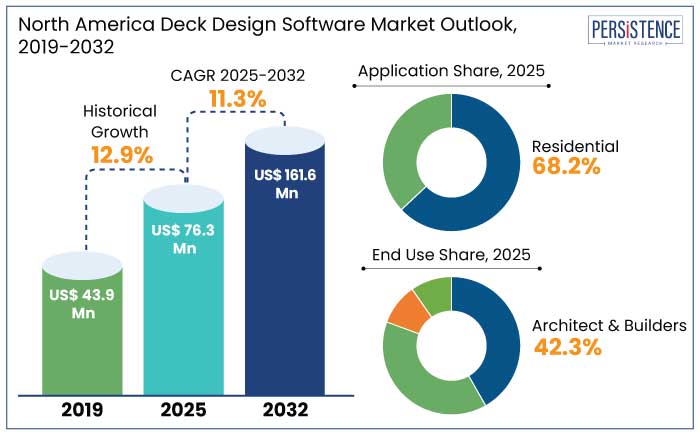
The North America deck design software market is projected to witness a CAGR of 11.3% during the forecast period from 2025 to 2032. It is anticipated to increase from US$ 76.3 Mn recorded in 2025 to a decent US$ 161.6 Mn by 2032.
Demand for deck design software in North America is thriving due to increasing use of digital tools in the real estate industry. These tools help reduce time, congestion, and costs associated with the design process.
Integration of AI and machine learning technologies is set to improve efficiency, driving demand for deck design software with in-built design templates. In the construction sector of North America, deck software is an essential tool that improves stakeholder communication, project management, and progress tracking while guaranteeing efficiency and alignment amongst multiple stakeholders. Software providers emphasizing user experience and accessibility are carving out a significant niche in North America.
Key Highlights of the Market
- The need for easy-to-use visualization tools that let builders and homeowners design intricate decks is growing in North America.
- Adoption of 3D modeling and virtual reality is gaining popularity for enhanced design visualization and client presentations.
- Investment in home improvement and outdoor living spaces is driving a surge in demand for specialized design software solutions in North America.
- Demand for mobile-compatible deck design applications is increasing, which aids in on-site planning and client consultations.
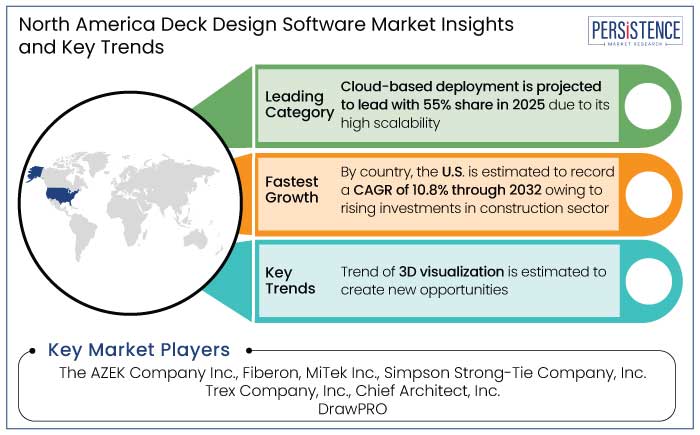
- In 2025, the cloud-based deployment segment is set to lead the market with a share of 55% due to superior scalability, security, and data protection.
- Based on application, the residential segment is anticipated to lead the market with a share of 68.2% in 2025 owing to use of on-site adjustments and visualizing projects in real time.
- The U.S. is estimated to lead with a market share of 68% in 2025 owing to investments in the construction sector.
- Canada is anticipated to hold a market share of 21.4% in 2025 amid increasing home renovation activities.
|
Market Attributes |
Key Insights |
|
North America Deck Design Software Market Size (2025E) |
US$ 76.3 Mn |
|
Projected Market Value (2032F) |
US$ 161.6 Mn |
|
North America Market Growth Rate (CAGR 2025 to 2032) |
11.3% |
|
Historical Market Growth Rate (CAGR 2019 to 2023) |
12.9% |
U.S. Leads North America with Ongoing Research and Development in Designing
The U.S. deck design software industry is set to command a share of 68% in 2025. The market is projected to report a CAGR of 10.8% from 2025 to 2032. Key market players in the U.S. are offering unique design tools. Increasing trend of outdoor living spaces and home improvement projects has led to the dominance as they look for user-friendly design software.
Construction market growth is fueled by substantial investments and rapid adoption of cloud-based technologies, including AI-powered material estimation and virtual reality for immersive design experiences. Positive government policies, such as the November 2021 Infrastructure Investment and Jobs Act have increased remodeling and building activity, which has led to profitable chances for the deck design software sector in the U.S.
Surging Home Renovations in Canada Poised to Drive Significant Growth
The deck design software industry in Canada is likely to hold 21.4% of North America's share in 2025. It is anticipated to register a CAGR of 9.7% from 2025 and 2032. Growth in outdoor living spaces and home renovations in Canada is primarily driven by increasing preference for enhancing residential properties. For example,
- In order to stimulate the deck-building industry, Canada created a US$ 4 Bn Housing Accelerator Fund in 2023 with the goal of accelerating home development.
Cost estimate, augmented reality, and sophisticated design tools are increasing usage among homeowners and contractors. Eco-friendly methods and sustainable material choices are fostering market growth in Canada.
Cloud-based Deployment Leads the Market due to High Convenience
In 2025, cloud-based deck design software segment is set to lead the North America deck design software market with a 55% share, reflecting its widespread adoption. It is driven by its scalability, cost-efficiency, and advanced security features. For example,
- Increasing penetration of high-speed internet in North America, reaching 93% of households in 2023, has facilitated the shift toward cloud solutions.
Businesses and people use cloud-based solutions for remote access and real-time collaboration, which makes them crucial for dynamic deck design projects. AI-powered design recommendations have been included in well-known platforms like Deckorators Design Tool, automating layout ideas and material optimization to improve user experiences. For instance,
- The emphasis on data security, with 78% of businesses in the construction sector adopting cloud-based solutions in 2024, bolsters confidence in cloud platforms.
Rise in Construction Investment Drives Residential Applications
Residential applications are set to dominate the North America deck design software market, accounting for 68.2% of total share in 2025 due to a rise in homeowner renovation projects. For example,
- Residential construction spending in North America reached US$ 625 Bn in 2023, marking a 6.8% annual increase, which underscores the surging emphasis on home improvement projects.
Use of cloud-based and mobile-app design tools has revolutionized deck design, allowing homeowners and professionals to make on-site adjustments and visualize projects in real time. For instance,
- Tools like Trex Deck Designer, updated in April 2023, include AR features, enhancing customer engagement by enabling users to visualize designs in their actual spaces.
The trend toward sustainability fuels demand, as homeowners prefer eco-friendly materials and designs, aligning with the broader push for green construction practices across the region.
North America Deck Design Software Market Introduction and Trend Analysis
Deck design software is in high demand in North America because of its 3D modeling, virtual reality capabilities, and easy-to-use visualization tools. Increased spending on outdoor living areas and house renovation is the main driver of this surge, which calls for specialist design software.
Software functionality is improved by incorporating elements like project planning and material cost estimation, which appeal to professional builders and contractors. New growth prospects are created by increasing usage of app-based and cloud-based deck design tools, especially by homeowners.
While code compliance and permit paperwork capabilities guarantee local building standards are satisfied, mobile-compatible applications facilitate on-site planning and client meetings. Cloud-based solutions support remote access and collaborative design processes, which are in line with the digitization of the sector and effective project management.
Historical Growth and Course Ahead
The deck design software industry in North America recorded a CAGR of 12.9% in the historical period from 2019 to 2023. Planners and designers can benefit from integrated templates, design possibilities, symbol libraries, scaled CAD drawing features, and collaborative tools provided by deck software.
AI, machine learning, and user analytics are all incorporated, and these facilitate effective communication and design review procedures. The deck software industry is rising due to its increased operational effectiveness and cost-effectiveness, as it complies with safety and regulatory requirements. Sales of deck design software in North America are estimated to record a CAGR of 11.3% during the forecast period between 2025 and 2032.
Market Growth Drivers
Adoption of 3D Visualization Boosts Demand for Deck Designing Tools in North America
In North America, the deck design business is undergoing an alteration due to 3D visualization technology, which enables homeowners to make realistic and well-informed selections. For example,
- In 2024, the technology accounted for 35% of all residential deck design software features, highlighting its growing importance in the market.
- Tools such as AutoDesk Revit and SketchUp allow users to explore design options in real-time, reducing construction errors by as much as 30%, according to a few studies.
- Enscape's real-time rendering updates in May 2024 have improved the immersive experience, enabling designers and homeowners to effectively evaluate textures, lighting, and layouts.
- The US$ 538 Bn investment in home renovation projects in North America in 2023 shows how much need there is for cutting-edge solutions to increase client happiness and expedite project processes.
High Popularity of Customized Outdoor Living Spaces to Drive Demand
The need for adaptable deck design software that can support unique characteristics is increasing as North America's appetite for personalized outdoor living areas grows. Rising desire for individualized outdoor spaces is set to propel demand for customized outdoor designs and it is set to reach US$ 50 Bn in 2025.
As homeowners prioritize unique designs that incorporate elements like custom decks, patios, and outdoor kitchens, software tools must evolve to offer versatile capabilities. Design platforms like SketchUp and Chief Architect have seen a rise in popularity due to their ability to accommodate custom features, allowing users to modify layouts, materials, and configurations. For instance,
- In May 2024, Chief Architect launched a new update that integrates unique material libraries, enabling users to select from a range of textures and finishes for an even more personalized experience.
As more people invest in outdoor living, these flexible solutions are becoming essential for designers and homeowners alike.
Market Restraining Factors
Limited Availability of Skilled Workforce Hinders the Industry
A significant skill gap exists in the deck design and construction sector. In 2024, 30% of professionals said it would be difficult to find qualified labor. The requirement for specific expertise in sophisticated materials, 3D modeling, and software integration makes this shortage worse. The need for qualified operators rises as designs become more complex, including sustainable materials, smart technology, and lighting. For example,
- HomeAdvisor reported a surge in demand for custom deck designs in February 2024, with over 40% of homeowners seeking unique outdoor spaces. However, contractors face challenges in keeping up with evolving technology and design needs, resulting in inefficiencies and increased costs.
Key Market Opportunities
Architects and Builders Demand Modernization in Designing Tools
In 2025, architects and builders are set to hold the demand for deck design software at 42.3%, owing to its critical role in project planning and execution. It is aided by sophisticated capabilities such as structural analysis and thorough visualization.
The rise in residential and commercial construction projects across North America is fueling demand for such solutions. For example,
- The U.S. Census Bureau reported a 6.5% increase in construction spending in 2023, emphasizing the need for efficient design tools.
The integration of Building Information Modeling (BIM) into deck design software, such as AutoCAD's 2024 version, has improved project coordination and sustainability. This is because tools now incorporate eco-friendly material options, promoting the industry's shift toward green building practices.
Trend for Remote Work to Open the Door to Innovation in Software
Owing to the remote working trend caused by the COVID-19 pandemic, cloud-based deck design software has become more widely used in the design and construction industries. It is facilitating remote work and international cooperation. Designing tools enable real-time editing, sharing, and collaboration, making communication and decision-making seamless, even across dispersed teams. For example,
- Microsoft announced updates to PowerPoint Online in July 2024, integrating AI-powered design suggestions to enhance workflow efficiency.
The global cloud-based software market is gaining popularity due to its scalability, accessibility, and effectiveness in project planning and client presentations.
Competitive Landscape for the North America Deck Design Software Market
The North America deck design software market is marked by competition and innovation, with key players making significant investments in research and development to address user needs. Chief Architect, a prominent company in the region, provides a suite of design software tailored for architects, engineers, and contractors, which is utilized in over 80 countries. The software is recognized for its user-friendly interface, powerful features, and extensive content library.
Competing with Chief Architect is SmartDraw, a cloud-based design platform suitable for businesses of all sizes. SmartDraw is known for its intuitive interface, ease of use, as well as a wide range of templates and shapes available in its library.
Recent Developments in North America Deck Design Software Market
- In September 2024, Panasonic Connect North America launched the Let's note™ FV4 enterprise laptop in the U.S., designed for professionals in various work environments, offering unique computing and productivity.
- In January 2024, PWT, the creator of the world's first manufacturer-treated laminated veneer lumber, joined NADA and offered an AIA-accredited course through Hanley Wood University in 2024. It aims to empower decking professionals with knowledge and resources for the construction industry.
- In October 2023, Zynga's Socialpoint Studio launched Top Troops, a medieval fantasy mobile game that combines mobile strategy, RPG, and merge mechanics in the Kingdom of King's Bay.
- In April 2023, Johnson Controls partnered with Nucor Corporation to recycle nearly 100% of secondary scrap steel at its US facilities, saving thousands of tons annually. The steel will be repurposed as low-embodied-carbon steel, reducing embodied carbon across the company's product portfolio.
Companies Covered in North America Deck Design Software Market
- The AZEK Company Inc.
- Fiberon
- MiTek Inc.
- Simpson Strong-Tie Company, Inc.
- Trex Company, Inc.
- Chief Architect, Inc.
- DrawPRO
- Luxwood Software Tools
- Dassault Systèmes
- Autodesk Inc.
Frequently Asked Questions
Yes, the market is set to reach US$ 161.6 Mn by 2032.
The industry is projected to be valued at US$ 76.3 Mn in 2025.
Over 60 million decks in the U.S. are over their useful life, with 30 million needing replacement or repair.
The U.S. is likely to account for a market share of 68% in 2025.
BASF SE, BENTELER International Aktiengesellschaft, BM Catalysts Limited, and BOSAL are few key players in the industry.


