




- Industrial Goods & Service
- Specialized Design Services Market
Specialized Design Services Market Size, Share, and Growth Forecast, 2026 - 2033
Specialized design services market by Product Type (Interior Designers, Industrial Designers, Graphic Designers, Fashion Designers, Others), Application (Business Use, Industrial Applications, Others), and Regional Analysis for 2026 - 2033

Specialized Design Services Market Size and Trends Analysis
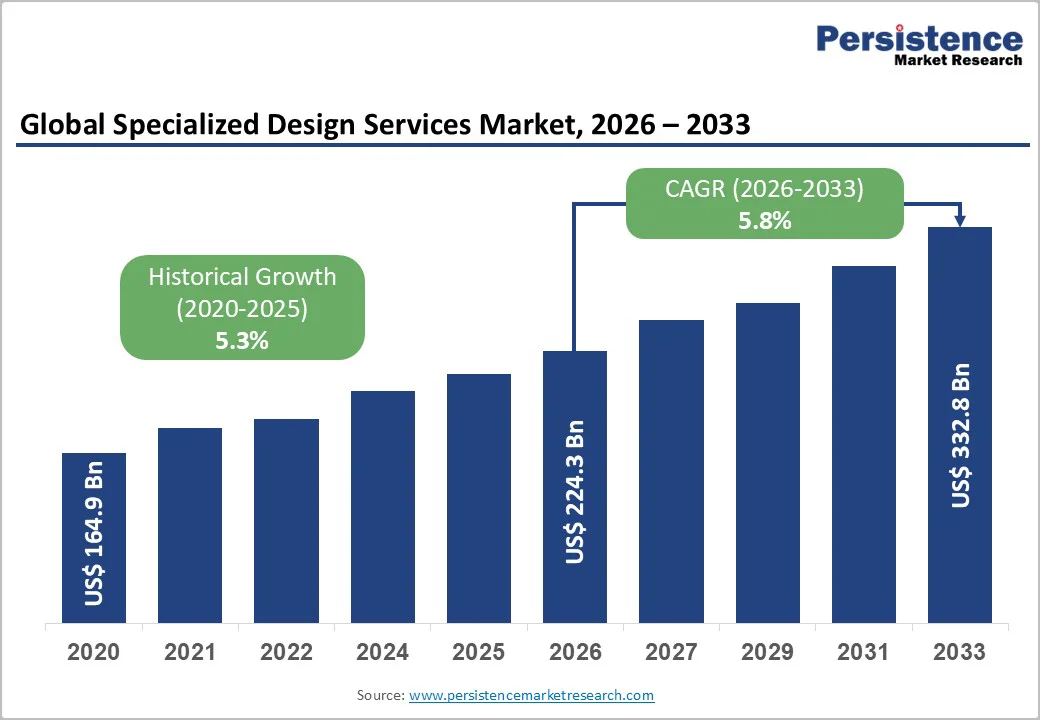
The global specialized design services market size is likely to be valued at US$ 224.3 billion in 2026, and is expected to reach US$ 332.8 billion by 2033, growing at a CAGR of 5.8% during the forecast period from 2026 to 2033, driven by the increasing prevalence of digital transformation in businesses, rising demand for innovative product designs in industrial applications, and advancements in creative tools such as AI-assisted software.
Demand for user-centric interior, graphic, and industrial design is rising, driven by sustainability and customization trends. Businesses increasingly rely on these specialized services to navigate complex consumer needs and stay competitive.
Key Industry Highlights:
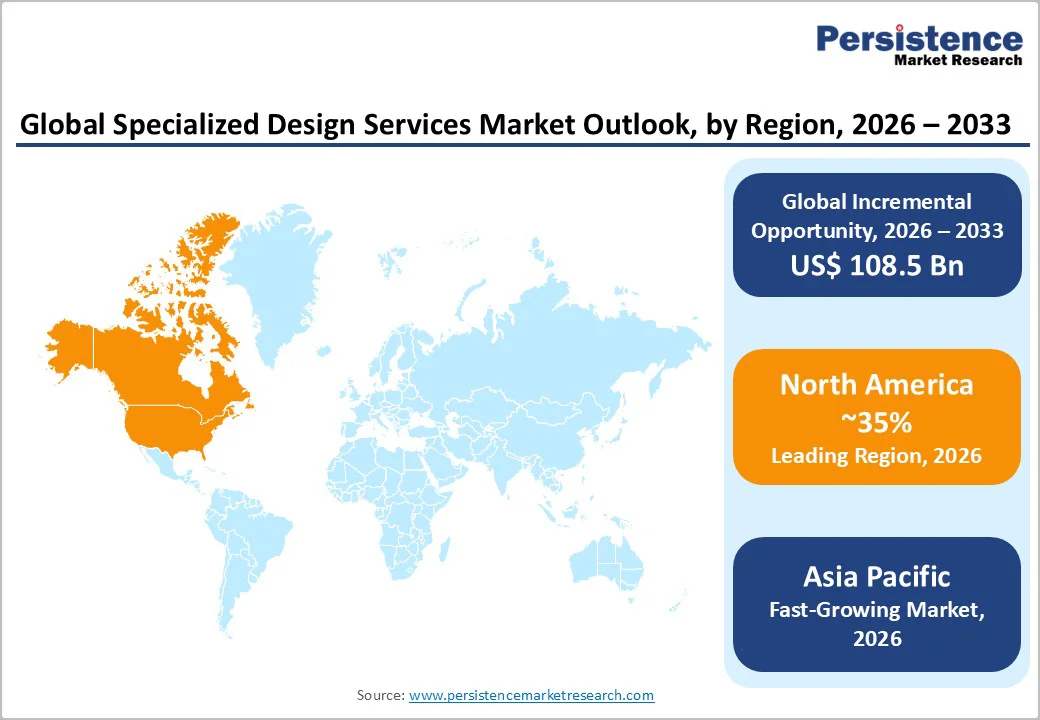
- Leading Region: North America is expected to have a 35% market share in 2026, driven by advanced creative hubs, high prevalence of graphic design in digital marketing, and strong R&D activities in the U.S.
- Fastest-growing Region: Asia Pacific is expected to be driven by increasing industrialization, rising awareness among industrial designers, and growing investments in fashion design in China and India.
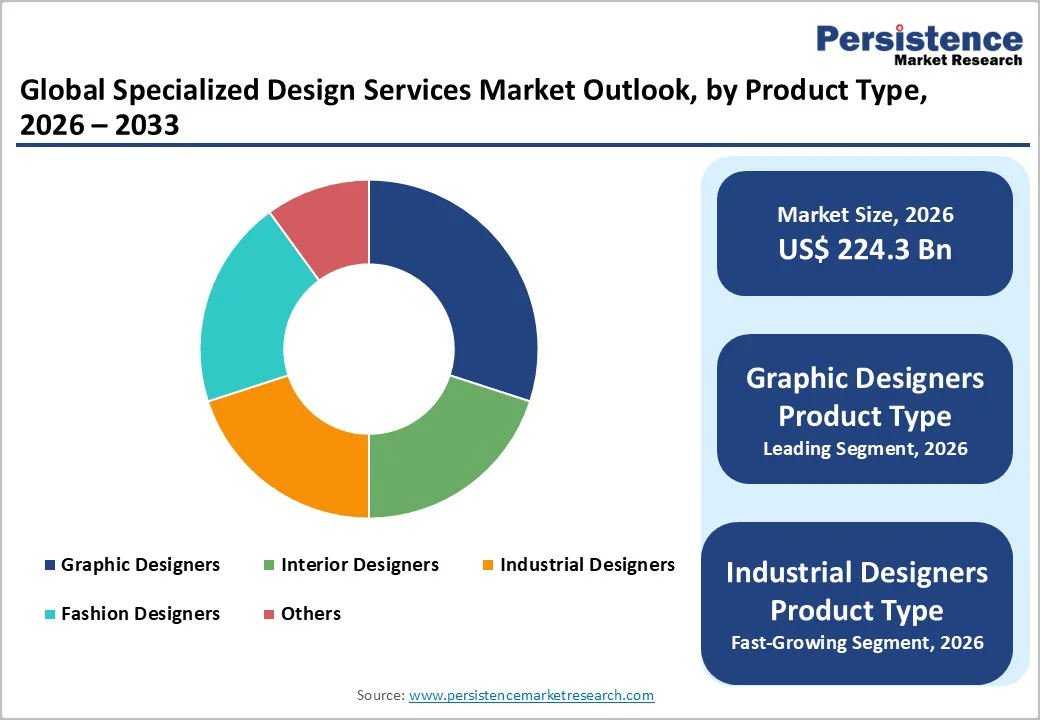
- Dominant Product Type: Graphic designers are likely to hold approximately 30% of the market share, as businesses increasingly rely on strong visual communication to build brand identity across digital and print platforms.
- Leading Application: Business use, estimated for over 60% of market revenue in 2026, driven by corporate rebranding.
| Key Insights | Details |
|---|---|
|
Specialized Design Services Market Size (2026E) |
US$224.3 Bn |
|
Market Value Forecast (2033F) |
US$332.8 Bn |
|
Projected Growth (CAGR 2026 to 2033) |
5.8% |
|
Historical Market Growth (CAGR 2020 to 2025) |
5.3% |
Market Factors - Growth, Barriers, and Opportunity Analysis
Digital Transformation and Rising Demand for Innovative Product Design
The rising prevalence of digital transformation across businesses is significantly boosting demand for specialized design services, especially as companies shift toward more advanced digital ecosystems. Organizations in sectors such as retail, healthcare, technology, and finance are increasingly adopting digital tools, cloud platforms, mobile applications, and data-driven systems to enhance customer engagement and operational efficiency. This transition requires sophisticated UX/UI design, service design, and digital branding to ensure seamless user experiences and a strong market presence. As businesses modernize their platforms, the need for intuitive interfaces, responsive designs, and visually compelling digital content continues to grow rapidly.
The demand for innovative product designs is accelerating, supported by rising competition, shorter product life cycles, and evolving consumer expectations. Companies are focusing on differentiation through unique aesthetics, improved functionality, and user-centered solutions. This trend is especially strong in electronics, automotive, smart devices, and consumer goods, where innovation directly influences customer preferences and brand loyalty. Designers play a crucial role in integrating advanced technologies such as 3D printing, virtual prototyping, and AI-driven insights into the product development process.
High Development And Talent Acquisition Costs
High development and talent acquisition costs are significant challenges in the specialized design services market, affecting both established firms and emerging studios. As design projects become more complex, requiring expertise in UX/UI, industrial design, AI-driven creativity, and sustainability, companies must invest heavily in advanced software, digital prototyping tools, and research capabilities. These technological investments increase operational expenses, particularly for smaller firms that lack the financial capacity to upgrade frequently. Maintaining competitive design environments often requires continuous training and access to premium tools, further driving up development costs.
Talent acquisition adds another major cost burden. Skilled designers with expertise in areas such as human-centered design, 3D modeling, AI-assisted creativity, or immersive media are in high demand but in limited supply. This results in higher salaries, extensive recruitment efforts, and substantial onboarding costs. Competition among agencies for top-tier talent also intensifies wage pressures, making retention equally challenging.
Advancements in AI-Assisted Design Tools and Sustainable Creative Services
Advancements in AI-assisted design tools and sustainable creative services present significant growth opportunities for the specialized design services market. AI-powered platforms now support designers with automated layout generation, predictive analytics, real-time prototyping, and intelligent asset management. These tools help reduce repetitive tasks, improve accuracy, and allow designers to focus more on innovation and strategic thinking. Machine learning algorithms can also analyze user behavior, enabling highly personalized design outputs for digital interfaces, branding, and product development.
Sustainability has become a core priority across industries, driving the adoption of eco-friendly design practices. Creative teams are increasingly using biodegradable materials, energy-efficient processes, and circular design principles to minimize environmental impact. Sustainable packaging, low-impact printing, and resource-efficient product design are gaining traction as companies work to meet regulatory requirements and consumer expectations. Designers now integrate lifecycle assessments and eco-innovation strategies into their projects to ensure long-term environmental benefits.
Category-wise Analysis
Product Type Insights
Graphic designers are expected to dominate the market, accounting for approximately 30% of the share in 2026, driven by the rising demand for digital marketing, branding, and visual communication. Their versatility and scalability make them essential for businesses seeking a strong brand presence across digital and print platforms. Graphic designers provide cohesive visual identity solutions that enhance recognition and customer engagement. Agencies such as Landor, for instance, have a long history of delivering brand identity, packaging, and corporate visual systems for large global brands, showing how established design firms fuel demand for professional graphic design services.
Industrial designers represent the fastest-growing segment, driven by rising demand for product innovation and the need for highly functional, user-centered designs in manufacturing. Their expertise is crucial for developing prototypes, improving ergonomics, and optimizing product performance. The growing integration of 3D printing and digital modeling tools enables faster iteration and cost-effective development, accelerating adoption across industries. Strong uptake in North America and Europe, supported by advanced manufacturing ecosystems, further fuels segment growth. For example, RKS Design, a U.S.-based industrial design and product-development firm, works on consumer, medical, and industrial products, blending engineering, user experience, and aesthetics to deliver market-ready innovations.
Application Insights
The business use segment is anticipated to lead the market, holding approximately 60% of the share in 2026, driven by strong demand for branding, product design, and strategic visual communication across industries. Companies increasingly rely on specialized design services to enhance brand identity, improve customer experience, and meet accessibility standards. This dominance is reinforced by continuous digital transformation in corporate environments. Businesses frequently redesign their websites or mobile apps to improve usability and align with modern brand strategies. For example, Pentagram, one of the world’s leading design consultancies, has developed brand identities, digital interfaces, and corporate communication systems for global companies, demonstrating how businesses rely heavily on professional design expertise.
Industrial applications are likely to be the fastest-growing segment, driven by the rising demand for rapid prototyping, product optimization, and ergonomic design solutions in manufacturing. Factories increasingly hire specialized design services to improve efficiency, reduce errors, and enhance worker safety. Customized design of machine interfaces, ergonomic tool handles, and optimized production equipment can minimize worker fatigue and increase productivity on assembly lines. For example, RKS Design, a design consultancy, has worked globally on industrial and consumer products blending engineering, ergonomics, and user-centered design to deliver manufacturing-ready solutions that improve usability and production safety. This kind of professional industrial design support illustrates why the industrial applications segment is expanding rapidly.
Regional Insights
North America Specialized Design Services Market Trends
North America is projected to lead, accounting for nearly 35% of the share in 2026, supported by strong demand for innovation, digital transformation, and user-driven product development across industries. Companies in technology, consumer electronics, healthcare, retail, and automotive are increasingly investing in specialized design services to enhance product usability, strengthen brand identity, and improve customer engagement. The region benefits from a mature design ecosystem, a large talent pool, and a strong culture of research and experimentation, enabling rapid adoption of advanced design methodologies.
Digital experience design remains a major trend, with rising demand for UX/UI, service design, and interactive digital content driven by the expansion of e-commerce, mobile apps, and cloud-based platforms. Businesses are also adopting AI-assisted design, data-led creativity, and virtual prototyping to accelerate development cycles and reduce costs. Sustainability is influencing design choices as companies prioritize eco-friendly materials, energy-efficient products, and environmentally conscious packaging.
The growth of smart devices, connected homes, and wearable technology is boosting the need for integrated design solutions that blend hardware, software, and user experience. For instance, Samsung’s SmartThings ecosystem uses integrated UX/UI and hardware-software design to ensure seamless control of home appliances through a unified digital interface, improving convenience and user engagement.
Europe Specialized Design Services Market Trends
Europe is expected to have a 20% share in 2026, driven by strong demand for innovation, sustainability, and high-quality product development across diverse industries. Companies in sectors such as automotive, fashion, consumer goods, and architecture increasingly rely on specialized design services to create differentiated products that meet modern consumer expectations. Europe’s long-standing design heritage, combined with advanced engineering capabilities, supports a mature ecosystem where creativity and technical precision go hand in hand.
Sustainability is a major trend shaping the market, as businesses adopt eco-friendly materials, circular design principles, and energy-efficient solutions. This push toward greener practices is influencing product design, packaging, and branding strategies across the region. Digital transformation is another key driver, with greater adoption of UX/UI design, virtual prototyping, 3D visualization, and AI-supported design processes. Growing investments in smart manufacturing, electric mobility, and connected devices are also expanding the need for advanced industrial and interaction design services.
Europe’s regulatory environment encourages high design standards, pushing companies to seek expert support to maintain compliance. For example, IKEA, headquartered in Sweden, repeatedly implements circular design and sustainable material strategies in its product development and packaging, reflecting how European firms embed eco-design and high-quality design heritage in their operations.
Asia Pacific Specialized Design Services Market Trends
Asia Pacific is likely to be the fastest-growing market for specialized design services, driven by rapid digital transformation, expanding startup ecosystems, and increasing investments in product innovation across major economies such as China, India, Japan, and South Korea. Businesses in sectors such as consumer electronics, automotive, e-commerce, and manufacturing are increasingly prioritizing user-centered design to enhance product appeal and improve customer experience. This shift is creating a high demand for services, including UX/UI design, industrial design, branding, and packaging design.
The region’s large consumer base and rising disposable incomes are also encouraging companies to adopt differentiated design strategies to stand out in competitive markets. Local design firms are growing quickly due to their ability to deliver culturally relevant solutions tailored to regional preferences. Advancements in digital tools, including AI-assisted design, virtual prototyping, and 3D modeling, are further accelerating productivity and enabling faster project execution. The increasing presence of global corporations establishing design centers in Asia Pacific to tap into local talent pools is supporting market expansion. For example, Samsung Electronics runs a large R&D and design center in Bangalore, India, combining hardware, software, and UX design teams to serve both regional and global markets, illustrating how global companies leverage local design talent in Asia Pacific.
Competitive Landscape
The global specialized design services market is highly competitive, driven by a diverse mix of large design agencies, mid-sized studios, and a rapidly expanding freelance workforce. In developed regions such as North America and Europe, companies such as IDEO, Pentagram, and Frog Design maintain strong leadership through advanced R&D capabilities, long-standing client relationships, and multidisciplinary design expertise. Their focus on innovation, user-centered design, and strategic consulting enables them to secure high-value projects across tech, healthcare, and consumer industries.
In the Asia Pacific region, firms such as RKS Design Inc. and emerging local studios are gaining momentum by offering cost-effective, culturally adaptable, and market-specific design solutions. The rising presence of startups and digital-first companies is also boosting demand for UX/UI, product design, and branding services. The market is evolving rapidly with the integration of AI-driven design tools, automation, and data analytics, giving companies adopting these technologies a competitive advantage.
Key Industry Developments
- In March 2025, Canva launched a major update with AI-assisted design features, enabling users to speed up design workflows and quickly generate brand-consistent visual content.
- In 2025, Envato upgraded its design-asset offerings and introduced new collaborative editing tools under its Elements/Market platform, making it easier for designers and businesses to access and customize creative assets.
Companies Covered in Specialized Design Services Market
- IDEO
- Whipsaw Inc.
- Pentagram
- RKS Design Inc.
- Continuum Green Energy Ltd.
- iCreativez
Frequently Asked Questions
The global specialized design services market is projected to reach US$224.3 billion in 2026.
The rising prevalence of digital transformation in businesses and the demand for innovative product designs are key drivers.
The specialized design services market is poised to witness a CAGR of 5.8% from 2026 to 2033.
Advancements in AI-assisted design tools and sustainable creative services are the key opportunities.
IDEO, Whipsaw Inc., Pentagram, RKS Design Inc., and Continuum Green Energy Ltd. are the key players.


