




- Hardware & Software IT Services
- Content Collaborations Market
Content Collaborations Market Size, Share, and Growth Forecast, 2025 - 2032
Content Collaborations Market By Industry Type (Technology, Healthcare, Others), Content Type (Blog Posts, Videos, Others), Target Audience, and Regional Analysis for 2025 – 2032

Content Collaborations Market Size and Trends Analysis
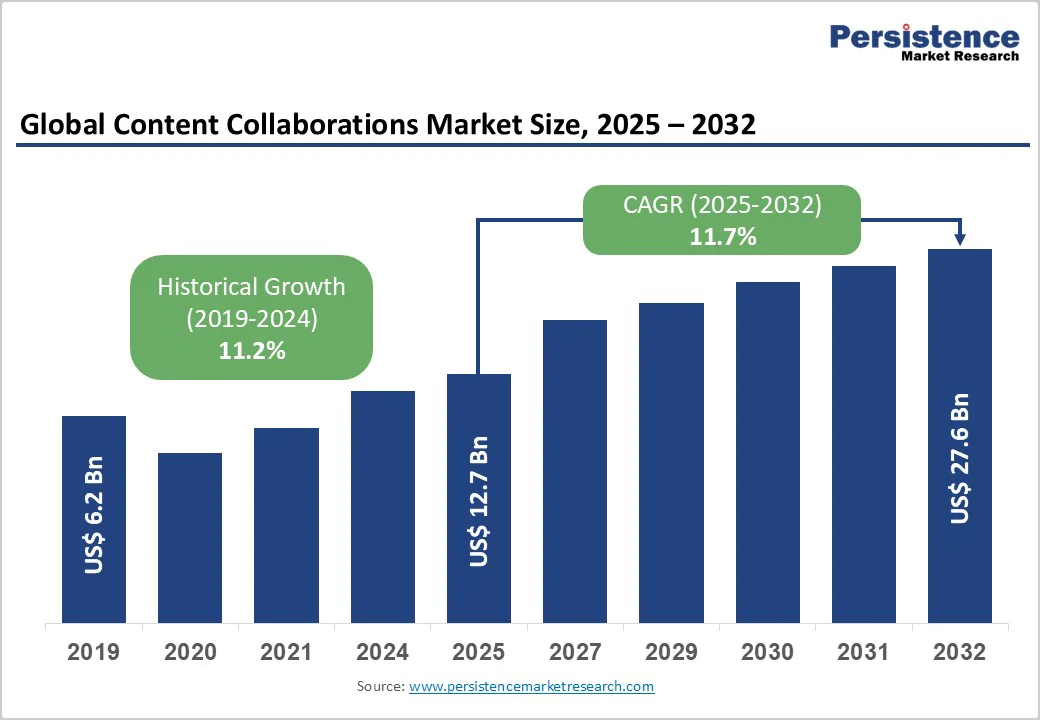
The global content collaborations market size is likely to be valued US$12.7 Billion in 2025, expected to US$27.6 Billion by 2032, growing at a CAGR of 11.7% during the forecast period from 2025 to 2032, driven by the increasing prevalence of digital marketing strategies, rising demand for authentic brand storytelling, and advancements in collaboration platforms. The need for co-created content to engage audiences, particularly in technology sectors, has significantly boosted the adoption of content collaborations across various industries. The market is further propelled by innovations in videos and social media content, catering to preferences for interactive and shareable options. The growing acceptance of content collaborations as essential for influencer partnerships, particularly targeting millennials, is a key growth factor.
Key Industry Highlights:
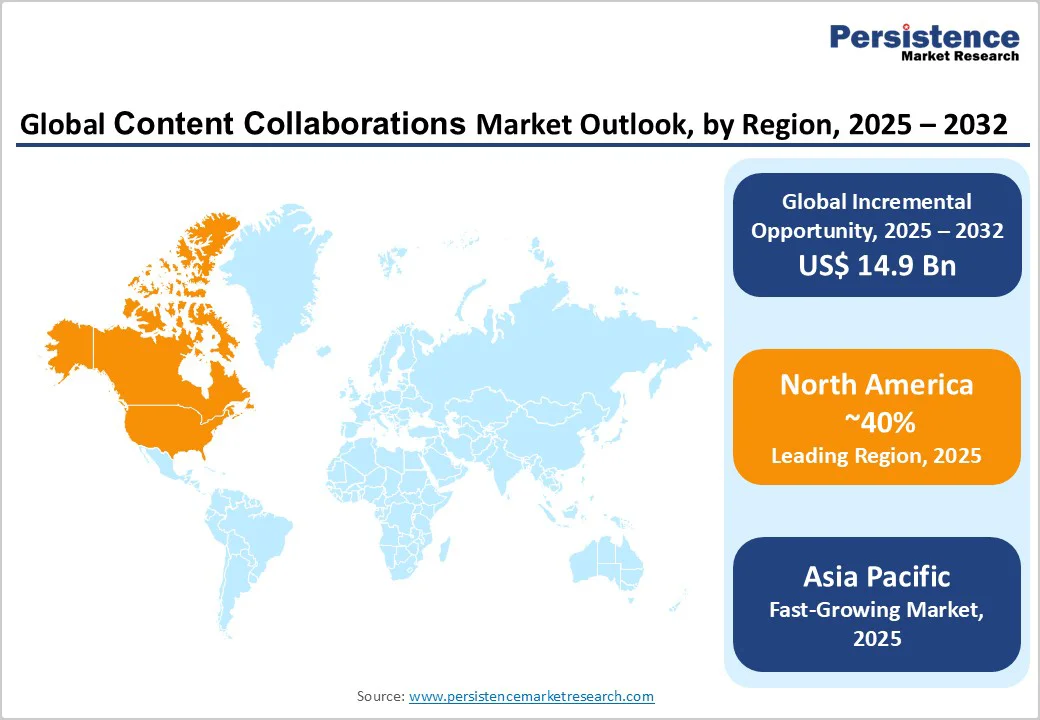
- Leading Region: North America, commanding a 40% market share in 2025, driven by mature digital ecosystems, high prevalence of influencer marketing, and strong R&D activities in the U.S.
- Fastest-growing Region: Asia Pacific, fueled by exploding social media users, rising awareness of branded content, and growing investments in e-commerce in China and India.
- Dominant Industry Type: Technology, holding approximately 35% of the market share, due to tech-savvy audiences.
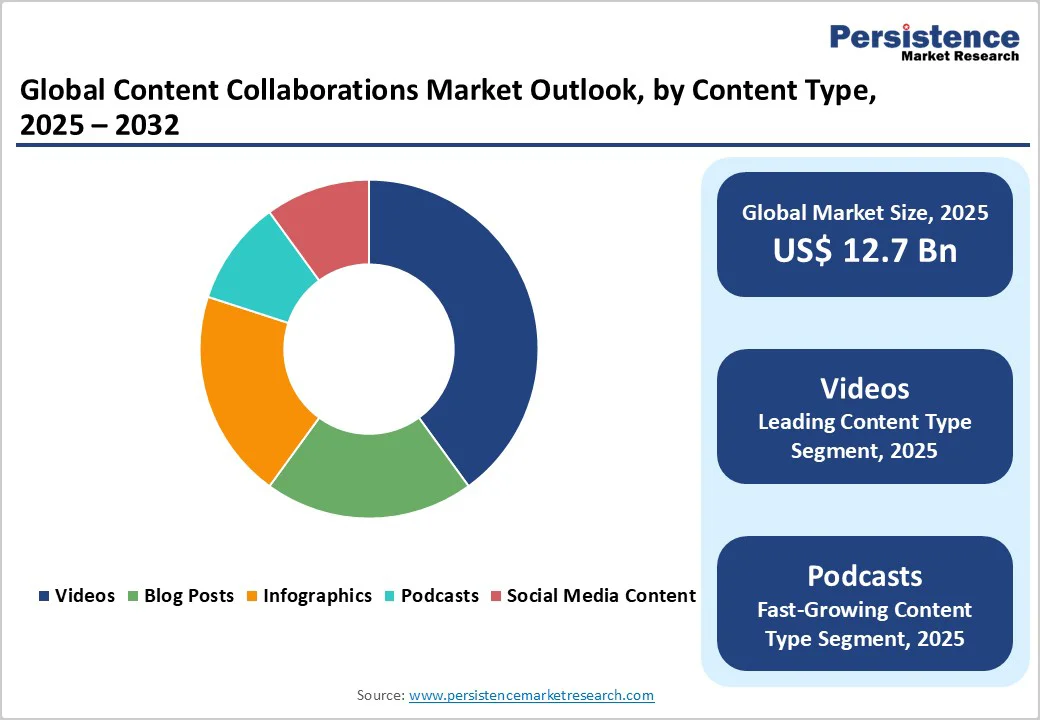
- Leading Content Type: Videos, accounting for over 40% of market revenue, driven by visual engagement.
- Leading Target Audience: Millennials, contributing nearly 30% of market revenue, due to platform affinity.
- Key Market Driver: Growing adoption of cloud-based and AI-powered collaboration tools to enhance efficiency and connectivity.
- Market Opportunity: Rapid digitalization and mobile penetration offer untapped market opportunities.
| Key Insights | Details |
|---|---|
|
Content Collaborations Market Size (2025E) |
US$12.7 Bn |
|
Market Value Forecast (2032F) |
US$27.6 Bn |
|
Projected Growth (CAGR 2025 to 2032) |
11.7% |
|
Historical Market Growth (CAGR 2019 to 2024) |
11.2% |
Market Factors – Growth, Barriers, and Opportunity Analysis
Rising Prevalence of Digital Marketing and Demand for Authentic Storytelling
The increasing prevalence of digital marketing globally is a primary driver of the content collaborations market. As brands compete for consumer attention in saturated online spaces, authenticity has become a key differentiator. Audiences, particularly millennials and Gen Z, increasingly prefer content that feels genuine, relatable, and value-driven rather than overtly promotional. This shift has encouraged brands to collaborate with creators, influencers, and thought leaders who can communicate messages in a more human and credible manner.
Digital marketing platforms spanning social media, streaming, and podcasts serve as powerful channels for these collaborations, allowing brands to connect with target audiences through immersive, story-based campaigns. The integration of user-generated content and live interactions further strengthens engagement and trust. Data analytics and AI-driven insights enable brands to personalize storytelling strategies, ensuring relevance and emotional resonance. As digital ecosystems continue to evolve, authentic storytelling will remain central to building lasting brand-consumer relationships and driving sustained growth in content collaboration initiatives.
High Coordination and Intellectual Property Costs
The high costs associated with coordination and intellectual property management in content collaborations pose a significant restraint on market growth. As multiple creators, organizations, and platforms collaborate across borders, managing creative rights, profit-sharing, and content ownership becomes increasingly complex. Coordination among diverse teams often spread across time zones and working through multiple digital tools demands extensive communication, legal agreements, and workflow management systems, which elevate operational expenses. Disputes over IP ownership, usage rights, and licensing frequently arise, especially when AI-generated or co-created content is involved.
Protecting digital assets from unauthorized use or replication requires investment in legal expertise, copyright management, and secure digital frameworks, further driving up costs. For smaller creators and startups, these expenses can limit participation and slow innovation. Companies also face compliance burdens due to differing copyright laws across regions, making cross-border collaborations more resource-intensive. As the market expands, addressing these challenges through standardized IP policies, blockchain-based verification, and transparent digital contracts will be critical to ensuring fair, efficient, and sustainable content collaboration ecosystems.
Advancements in AI-Assisted Content Creation and Virtual Collaborations
Advancements in AI-assisted content creation and virtual collaborations present significant growth opportunities for the content collaborations market. Artificial intelligence enables automated writing, video editing, image generation, and personalized content recommendations, significantly reducing production time and enhancing creativity. AI tools can analyze audience behavior, optimize engagement strategies, and tailor content to specific demographics, allowing for more targeted and efficient communication.
Virtual collaboration technologies powered by AI, cloud computing, and immersive tools such as AR and VR are reshaping teamwork by enabling real-time interaction across geographies. Teams can co-create and edit content simultaneously, supported by intelligent assistants that streamline workflows, suggest improvements, and ensure consistency. These innovations are also improving accessibility, allowing users with limited technical expertise to create professional-quality content effortlessly. Furthermore, the integration of AI in virtual platforms fosters data-driven decision-making, improved project management, and enhanced creativity.
Category-wise Analysis
Industry Type Insights
Technology dominates the market, expected to account for approximately 35% of the share in 2025. Its dominance is driven by innovation focus, digital natives, and marketing budgets, making it preferred for collaborations. Technology, such as those from Xerox, provides tech-themed content, ensuring relevance. Its ecosystem and trends make it preferred for brands.
Healthcare is the fastest-growing segment, driven by patient education and increasing adoption in telehealth. Healthcare offers trust-building, appealing for awareness. Focus on video innovation accelerates adoption in Europe and North America.
Content Type Insights
Videos lead the market, holding 40% share in 2025. Their strong visual appeal, easy accessibility across platforms, and ability to convey messages quickly drive dominance. Widely used for marketing, education, and entertainment, videos enhance engagement and brand reach, fueling growing demand among creators, enterprises, and digital audiences worldwide.
Podcasts is the fastest-growing segment, fueled by the rising popularity of audio content and increasing adoption in B2B marketing. Their convenience for on-the-go listening, combined with the ability to deliver in-depth storytelling and thought leadership, makes podcasts a powerful medium for audience engagement, brand visibility, and content monetization.
Target Audience Insights
Millennials dominate the market, contributing 30% share in 2025. Their widespread use of digital platforms, strong purchasing power, and social influence make them key drivers of engagement. Brands prefer millennials for campaigns due to their loyalty, authenticity, and ability to connect with diverse audiences through relatable, purpose-driven content.
Generation Z is the fastest-growing segment, driven by their preference for short-form, engaging, and authentic content. As digital natives, they actively participate across social platforms, valuing creativity, and real-time interaction. The availability of versatile collaboration tools further empowers Gen Z creators to co-develop, share, and monetize content seamlessly.
Regional Insights
North America Content Collaborations Market Trends
North America is account for 40% share in 2025, driven by advanced digital infrastructure, high cloud adoption, and strong enterprise demand for efficient communication and content management solutions. The United States and Canada dominate the region, supported by early adoption of AI, machine learning, and automation within collaboration tools. Major technology companies such as Microsoft, Google, and IBM lead the market through continuous innovation, extensive R&D, and integration of secure, scalable cloud-based platforms.
The widespread shift toward remote and hybrid work models has further accelerated the adoption of content collaboration platforms that enable real-time document sharing, workflow management, and team coordination across distributed environments. Data security, compliance, and governance remain top priorities, pushing organizations to invest in enterprise-grade solutions that align with regional data protection standards. North America’s mature corporate ecosystem and strong investment in digital transformation initiatives are fostering steady market expansion
Europe Content Collaborations Market Trends
Europe is 22% share in 2025, driven by the widespread adoption of hybrid work models, digital transformation initiatives, and stringent regulatory frameworks. Countries such as the United Kingdom, Germany, and France are leading this growth, with organizations increasingly shifting toward cloud-based collaboration tools to enhance real-time content sharing, productivity, and cross-border teamwork. The implementation of the General Data Protection Regulation (GDPR) has significantly influenced market dynamics, pushing enterprises to adopt solutions that ensure data sovereignty, secure hosting, and advanced privacy compliance.
Cloud deployment models are rapidly surpassing on-premises solutions as businesses prioritize flexibility, scalability, and cost efficiency. Additionally, Europe’s linguistic diversity fuels demand for multilingual interfaces and localized collaboration tools that support seamless communication across regions. The integration of AI, automation, and secure cloud frameworks is transforming content workflows and team management practices.
Asia Pacific Content Collaborations Market Trends
Asia Pacific is the fastest-growing market for content collaborations, fueled by increasing digital transformation, expanding cloud adoption, and the surge in remote and hybrid work models. Businesses across industries especially in IT, media, education, and e-commerce are embracing advanced collaboration tools to enhance content sharing, project management, and real-time communication.
The region’s fast-growing economies, such as China, India, Japan, and South Korea, are leading the demand due to strong investments in AI-driven and cloud-based collaboration solutions. Local platforms are gaining traction by offering region-specific interfaces and multilingual support, catering to diverse user bases. The rising number of small and medium-sized enterprises (SMEs) adopting affordable, scalable solutions further accelerates market expansion. Government initiatives promoting digital ecosystems and secure data management strengthen the market landscape. Strategic partnerships between global tech leaders and regional players are fostering innovation and accessibility.
Competitive Landscape
The global content collaborations market is highly competitive, featuring a blend of technology giants, software vendors, and emerging platform providers. North America and Europe dominate the market due to advanced digital ecosystems and strong enterprise adoption. Companies such as IBM and Microsoft leverage extensive R&D investments and robust cloud networks to offer seamless, AI-driven collaboration tools that enhance productivity and content management.
In the Asia Pacific region, the market is rapidly expanding as local influencers, startups, and regional platforms tailor collaboration solutions to specific cultural and linguistic needs, driving user engagement and adoption. The integration of artificial intelligence, machine learning, and virtual collaboration technologies such as AR/VR is reshaping how content is created, shared, and managed across global teams. Strategic partnerships, mergers, and acquisitions are intensifying competition, enabling firms to expand their market reach and technological capabilities.
Key Industry Developments
- In September 2025, BURLINGTON, Mass. Avid has introduced Avid Content Core, a new content data platform designed for news and entertainment production that uses AI and agentic workflows to transform content from static files into intelligent, connected, actionable data, the company said.
- In March 2024, Microsoft has accelerated integration of AI across its collaboration stack, rolling Copilot and Copilot Studio deeper into Microsoft 365 and Teams to streamline content creation, meeting summarization, and workflow automation while improving admin controls and prompt management for enterprise users. These moves reflect a strategic push to embed generative AI into everyday collaboration, reduce context switching, and increase platform stickiness for large enterprise account.
Companies Covered in Content Collaborations Market
- IBM
- Xerox
- HP Autonomy
- Air Watch
- Oracle
- Microsoft
Frequently Asked Questions
The global content collaborations market is projected to reach US$12.7 Billion in 2025.
The rising prevalence of digital marketing and demand for authentic storytelling are key drivers.
The market is poised to witness a CAGR of 11.7% from 2025 to 2032.
Advancements in AI-assisted content creation and virtual collaborations are a key opportunity.
IBM, Xerox, HP Autonomy, Oracle, and Microsoft are key players.


