




- Processed Food
- China Enzyme Modified Cheese Market
China Enzyme Modified Cheese Market Size, Share, Growth, and Regional Forecast, 2026 to 2033
China Enzyme Modified Cheese Market by Enzyme Type (Proteases, Lipases, Others), by Form (Paste, Powder), by End Use (Dairy Products, Baked Products, Processed Meals, Soups, Sides & Salad dressings, Snack coatings, Seasonings, Dressings, Dips & Sauces), by Regional Analysis, 2026-2033

Market Size and Share Analysis
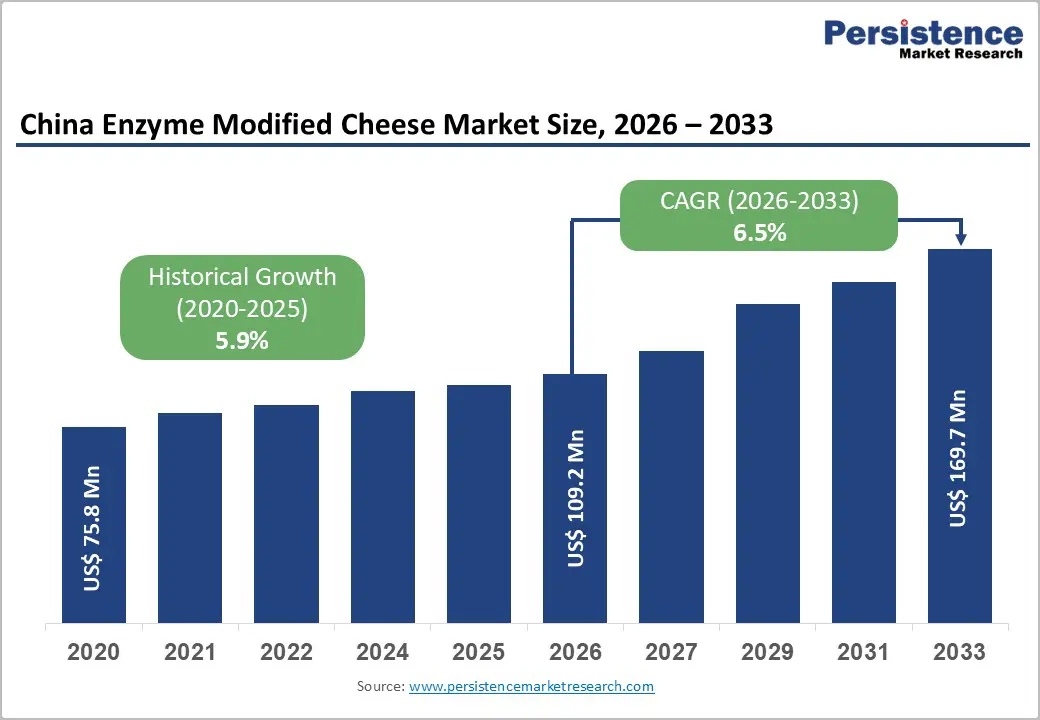
The China Enzyme Modified Cheese market size is expected to be valued at US$ 109.2 million in 2026 and projected to reach US$ 169.7 million by 2033, growing at a CAGR of 6.5% between 2026 and 2033
Key Industry Highlights
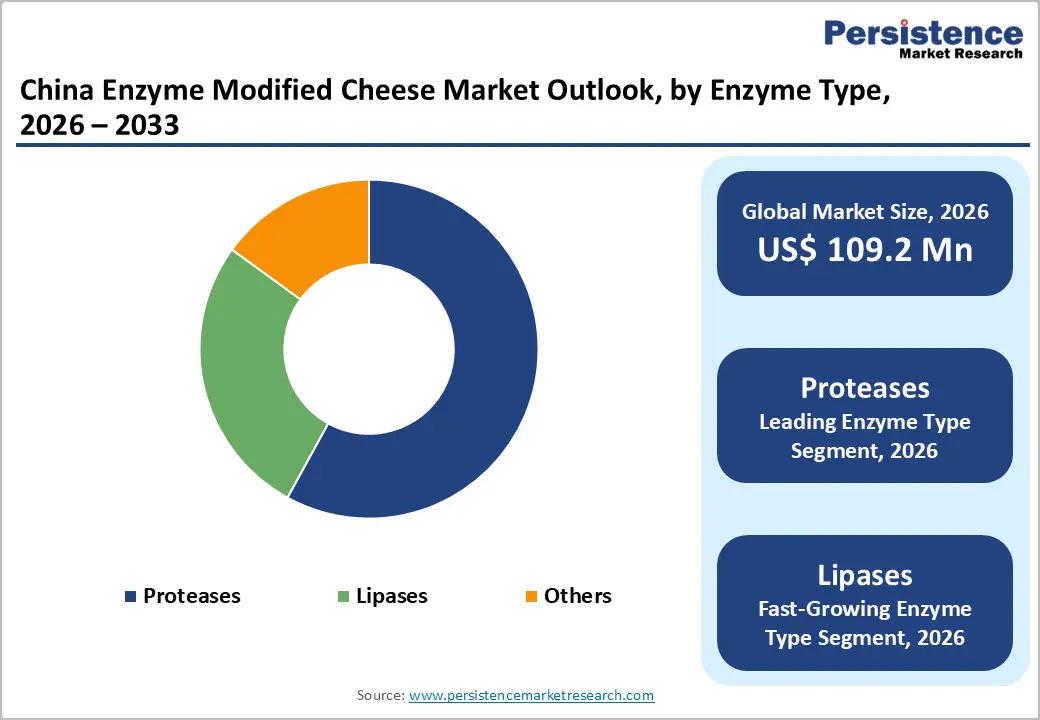
- Leading Enzyme Type Segment: Proteases, holding around 48% share, driven by their ability to rapidly generate savory and umami flavor depth essential for processed meals, soups, and instant food applications.
- Fastest-Growing End-Use Segment: Seasonings, fueled by the fusion of Western cheese notes with Chinese culinary formats such as instant noodles, tabletop seasonings, and snack flavor sachets.
- Market Drivers: Surging demand for processed and ready-to-eat meals, combined with EMC’s cost-efficiency, rapid flavor development, and batch-to-batch flavor standardization for large-scale food manufacturers.
- Strategic Opportunities: Development of reduced-fat and health-positioned EMC variants, enhanced with protein, calcium, or functional ingredients, aligning with China’s accelerating health and wellness focus.
| Key Insights | Details |
|---|---|
| China Enzyme Modified Cheese Market Size (2026E) | US$ 109.2 Mn |
| Market Value Forecast (2033F) | US$ 169.7 Mn |
| Projected Growth (CAGR 2026 to 2033) | 6.5% |
| Historical Market Growth (CAGR 2020 to 2025) | 5.9% |
Market Dynamics
Driver – Growing Demand for Processed and Ready-to-Eat Meals
The rapid urbanization of China and the resulting fast-paced lifestyle of its workforce have triggered a significant surge in the consumption of processed meals. According to PMR analysis, the China ready-to-eat meal market is projected to exceed 1 trillion yuan by 2026, growing at double-digit rates annually. Enzyme Modified Cheese provides a concentrated cheese flavor up to 10 to 20 times stronger than natural cheese allowing food processors to deliver premium sensory experiences in frozen pizzas, pasta, and instant snacks. This functional versatility is crucial for maintaining flavor consistency through rigorous industrial heating and storage processes, making EMC a preferred ingredient for domestic giants like COFCO and international brands operating within the region.
Cost-Efficiency and Flavor Standardization in Food Manufacturing
The economic viability of Enzyme Modified Cheese acts as a powerful driver for its adoption among food and beverage manufacturers. With the price of high-quality imported natural cheese being volatile, EMC serves as a strategic alternative that allows producers to reduce the total cheese content in their formulations without sacrificing taste. By using specialized enzymes like Proteases and Lipases, manufacturers can achieve specific ripening profiles in a matter of hours compared to the months required for traditional aging. This efficiency not only lowers raw material costs but also ensures that the final product maintains a standardized flavor profile across different production batches, which is essential for brand loyalty in a highly competitive retail environment.
Restraints – High Production Costs and Limited Domestic Supply
The China enzyme modified cheese market is also facing challenges due to the high production costs and limited domestic supply of enzyme-modified cheese. The specialized production processes and ingredients required for enzyme-modified cheese can result in high manufacturing costs, making it more expensive for producers to bring these products to market.
The domestic production capacity for enzyme-modified cheese in China is relatively limited, with a significant reliance on imported products to meet the growing demand. This supply-side constraint can lead to availability issues, longer lead times, and higher prices for consumers, potentially deterring wider adoption of enzyme-modified cheese.
Addressing cost and supply-side challenges through investments in domestic production, technology advancements, and strategic partnerships could be crucial in enhancing the market's accessibility and affordability for Chinese consumers.
Opportunity – Capitalizing on the health and wellness trend
There is a significant opportunity for enzyme modified cheese producers to capitalize on the health and wellness trend as consumers become increasingly health-conscious. With rising concerns over obesity and lifestyle-related diseases, there is a growing demand for dairy products that offer reduced fat content and enhanced nutritional benefits. Enzyme modified cheese, with its ability to retain flavor and texture while lowering fat content, perfectly aligns with this consumer preference.
Producers can leverage this opportunity by emphasizing the health benefits of enzyme modified cheese in their marketing campaigns. Highlighting its reduced fat content, higher protein levels, and calcium fortification can attract health-conscious consumers seeking nutritious yet flavorful dairy options.
Innovating with functional ingredients such as probiotics or omega-3 fatty acids can further enhance the health profile of enzyme modified cheese, appealing to a broad audience concerned with overall wellness.
Producers can tap into a growing segment of the market and establish themselves as leaders in the health and wellness space within the dairy industry by positioning enzyme modified cheese as a healthy alternative to traditional cheese varieties.
Category-wise Analysis
Enzyme Type Analysis
The Proteases segment is the leading category within the China Enzyme Modified Cheese market, accounting for a market share of approximately 48% in 2025. The dominance of Proteases is attributed to their critical role in breaking down milk proteins (caseins) into peptides and amino acids, which are responsible for the foundational "savory" and "umami" notes in cheese. In the Chinese food industry, where flavor depth is highly valued in applications like Processed Meals and Soups, the ability of Proteases to accelerate the development of complex flavor profiles is indispensable. Furthermore, the high stability and cost-effectiveness of microbial-derived Proteases make them the preferred choice for large-scale industrial fermentation, ensuring consistent quality for mass-market food products.
End Use Analysis
Processed Meals represent the leading end-use segment, holding a 35% market share in 2025. This dominance is fueled by the explosive growth of the Ready-to-Eat and Ready-to-Cook sectors in urban China, where cheese-based components are increasingly used in frozen pastas, lasagna, and rice-based gratins. On the other hand, the Seasonings segment is the fastest-growing category, projected to expand at a robust CAGR during the forecast period. The rising popularity of western-style savory snacks and the integration of cheese flavors into traditional Chinese seasonings have created a high demand for EMC. As consumers seek "gourmet" experiences at home, the use of Enzyme Modified Cheese in tabletop seasonings and instant noodle flavor packets is seeing unprecedented growth.
China Enzyme Modified Cheese Market Trends and Insights
China market is characterized by a high degree of regional concentration, with Eastern China serving as the primary hub for both consumption and production. This region, encompassing major economic centers like Shanghai, Jiangsu, and Zhejiang, accounts for over 40% of the total market share. The market leadership in Eastern China is a direct result of the high disposable income of its urban population and a well-established retail infrastructure that favors the adoption of Western dietary habits. Furthermore, the region hosts a dense cluster of food technology R&D centers and international food processing giants, creating a robust innovation ecosystem for dairy applications.
In contrast, Western China and Central China are emerging as high-growth pockets, albeit from a lower base. The expansion of high-speed rail and cold-chain logistics is bringing specialized dairy ingredients like EMC to these regions, where local manufacturers are beginning to incorporate cheese flavors into traditional snack profiles. The Chinese government's focus on "Common Prosperity" is driving income growth in these inland provinces, which in turn is shifting consumption patterns toward more diverse and premium food ingredients. Regulatory frameworks like the National Food Safety Standards continue to harmonize across these regions, providing a stable environment for market participants to scale their operations nationally.
Market Structure Analysis
The China Enzyme Modified Cheese market is moderately consolidated, with a few global leaders and specialized domestic players holding significant influence. Key companies such as Kerry Group plc. and The Edlong Corporation leverage their global R&D capabilities and long-standing expertise in dairy fermentation to maintain a competitive edge. These leaders focus on "flavor-mapping" to cater to the specific taste preferences of the Chinese palate, which often favors creamier and slightly sweeter cheese notes compared to Western markets. Strategies for expansion involve the establishment of local application centers in Shanghai or Guangzhou to provide technical support to domestic food processors. Emerging business models are increasingly focusing on "Precision Fermentation" and sustainable sourcing to differentiate themselves in a market that is becoming more environmentally conscious.
Key Developments:
Kerry Group plc. introduced a novel range of enzyme-modified cheese products tailored specifically for the Chinese market, featuring innovative flavour profiles and enhanced nutritional benefits. Leveraging their expertise in food technology and consumer insights, Kerry Group plc. aims to address evolving consumer preferences and tap into the growing demand for healthier and more diverse dairy options in China.
Companies Covered in China Enzyme Modified Cheese Market
- Kerry Group plc.
- Jeneil Biotech
- IBT - InterBioTech AG
- The Edlong Corporation
- Aarkay Food Products Ltd.
- Others
Frequently Asked Questions
The China Enzyme Modified Cheese market is projected to be valued at US$ 109.2 Mn in 2026.
Growing Demand for Processed and Ready-to-Eat Meals to drives the demand for China Enzyme Modified Cheese Market.
The China Enzyme Modified Cheese market is poised to witness a CAGR of 6.5% between 2026 and 2033
Capitalizing on the health and wellness trend is the key market opportunity
Major players in the China Enzyme Modified Cheese Market include Kerry Group plc., Jeneil Biotech, The Edlong Corporation, and others


