Yeast Ingredients Market Size, Share, Growth, and Regional Forecast, 2026 to 2033

Yeast Ingredients Market by Product (Yeast Extracts, Yeast Autolysates, Yeast Beta-Glucans, Yeast Derivatives / Hydrolyzed Yeast, Yeast Cell Wall Fractions, and Specialty Functional Yeast Ingredients), by Form (Powder, Liquid, Slurry, and Flakes), Application (Food & Beverages, Animal Feed, Nutraceuticals & Dietary Supplements, Pharmaceuticals & Biotechnology, and Cosmetics & Personal Care, and Others) End-user, and Regional Analysis from 2026 to 2033

ID: PMRREP3872
Calendar

March 2026

181 Pages

Author : Amol Patil

Yeast Ingredients Market Share and Trend Analysis

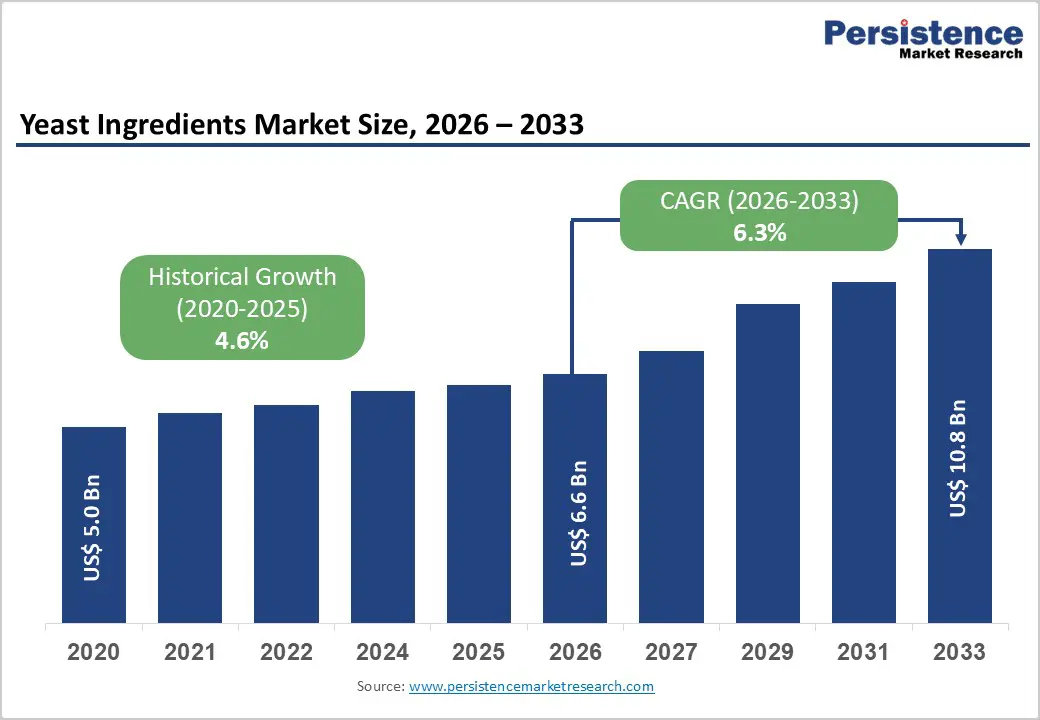
The global yeast ingredients market size is estimated to grow from US$ 6.6 billion in 2026 to US$ 10.8 billion by 2033. The market is projected to record a CAGR of 6.3% during the forecast period from 2026 to 2033.

Global demand for yeast-derived ingredients is witnessing steady expansion as food processors, feed producers, and biotechnology companies increasingly adopt fermentation-based solutions that enhance flavor, nutrition, and product functionality. Yeast extracts, autolysates, and specialty derivatives are widely utilized to deliver natural umami taste, improve nutritional composition, and support clean-label product development across processed foods and beverages.

The shift from artificial additives and synthetic flavor enhancers has encouraged manufacturers to integrate yeast-based ingredients into soups, sauces, savory snacks, ready meals, and plant-based formulations. Beyond food processing, yeast components are also gaining importance in nutraceuticals and animal nutrition due to their bioactive compounds, including beta-glucans, peptides, and essential vitamins that contribute to immune health and digestive performance. Continuous advancements in fermentation efficiency, strain optimization, and extraction technologies are helping producers achieve higher purity levels and consistent product quality. Strategic collaborations between ingredient suppliers and food manufacturers, along with expanding B2B distribution channels, are further strengthening global commercialization. Increasing interest in natural functional ingredients and sustainable fermentation technologies is reinforcing long-term market momentum across both developed and emerging economies.

Key Industry Highlights:

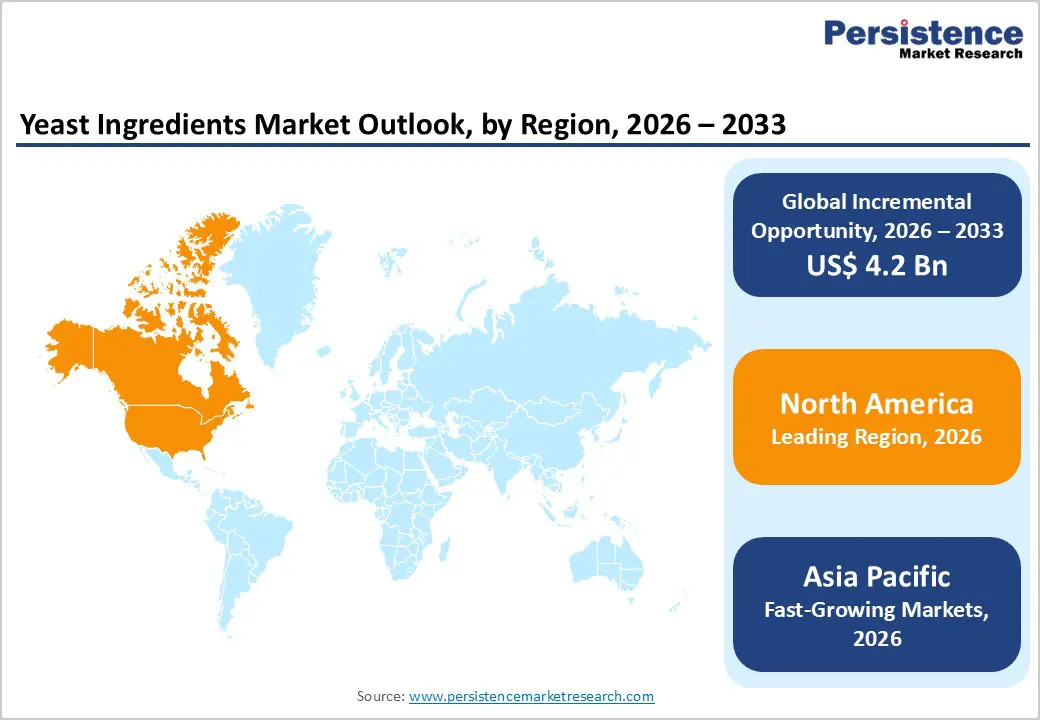
  • Leading Region: North America holds the largest share at 46.7%, supported by advanced fermentation technology capabilities, strong food processing infrastructure, significant R&D investment, and the presence of established ingredient manufacturers.
  • Fastest-Growing Region: Asia Pacific is expanding fastest due to rapid growth in processed food consumption, increasing demand for natural flavor enhancers, expanding livestock and aquaculture industries, and rising investment in biotechnology-based ingredient production.
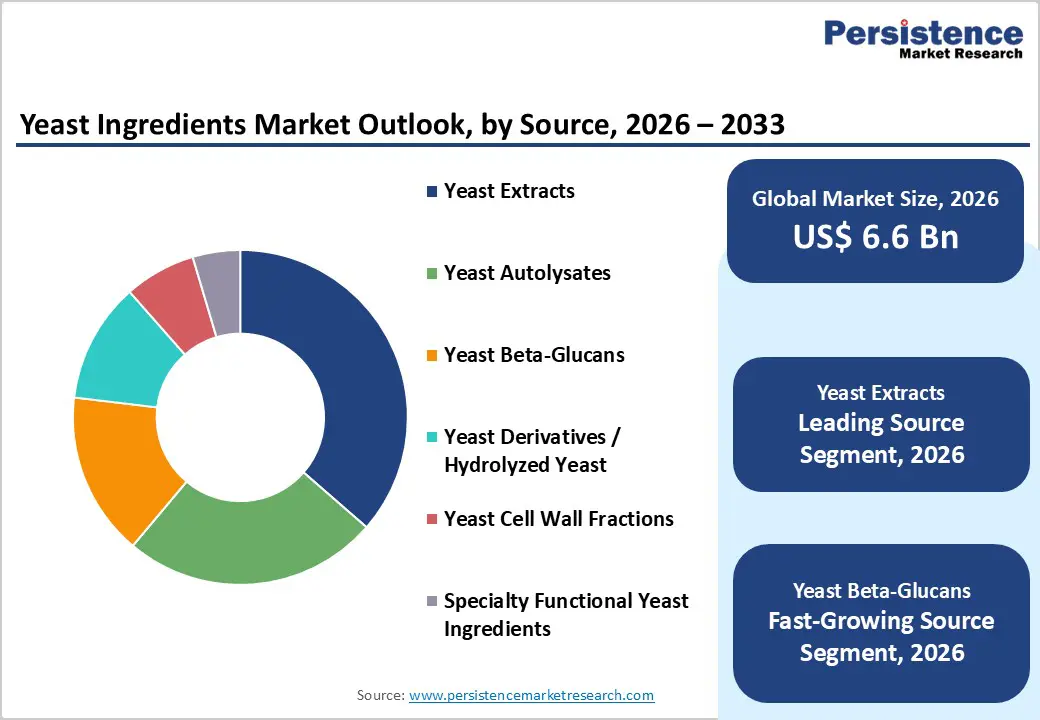
  • Leading Product Segment: Yeast extracts dominate the market with a 56.8% share due to their strong umami flavor profile, wide adoption as natural flavor enhancers, and compatibility with large-scale food manufacturing processes.
  • Fastest-Growing Product Segment: Yeast autolysates are experiencing accelerated growth as technological improvements enhance nutrient availability and expand their applications across functional foods, dietary supplements, and specialized feed formulations.
  • Leading Application Segment: Food & beverages lead with a 38.7% share, driven by widespread use of yeast ingredients in savory foods, bakery products, processed meals, and flavor-enhancing seasoning systems.
  • Fastest-Growing Application Segment: Animal feed is growing rapidly as livestock and aquaculture producers increasingly incorporate yeast-based additives to improve gut health, nutrient absorption, and feed efficiency while reducing reliance on antibiotics and synthetic growth promoters.
Key Insights Details
Yeast Ingredients Market Size (2026E) US$ 6.6 Bn
Market Value Forecast (2033F) US$ 10.8 Bn
Projected Growth (CAGR 2026 to 2033) 6.3%
Historical Market Growth (CAGR 2020 to 2025) 4.6 %

yeast-ingredients-market-size-2026-2033

Market Dynamics

Driver - Increasing Demand for Natural Flavor Enhancers and Clean-Label Food Ingredients

Growing consumer preference for natural and minimally processed foods is significantly accelerating the use of yeast-derived ingredients across global food systems. Food manufacturers are under increasing pressure to replace artificial additives, chemical flavor enhancers, and monosodium glutamate (MSG) with ingredients that can deliver similar sensory performance while maintaining clean-label positioning. Yeast extracts and related derivatives have emerged as effective alternatives because they provide strong umami flavor characteristics and enhance taste complexity in processed foods. The expansion of convenience foods, ready-to-eat meals, savory snacks, soups, sauces, and instant products has further increased the demand for reliable flavor-enhancing solutions. Yeast ingredients also contribute functional nutritional benefits, including amino acids, peptides, vitamins, and bioactive compounds that improve overall food quality. Manufacturers are integrating these ingredients not only for flavor development but also for nutritional fortification.

Technological improvements in fermentation processes and strain development are enabling producers to manufacture high-purity yeast derivatives with consistent performance across multiple food applications. In addition, increasing adoption of plant-based and reduced-sodium diets is encouraging food companies to utilize yeast extracts to maintain taste intensity while lowering salt content. As global consumers continue prioritizing healthier and more transparent ingredient lists, the demand for yeast-based flavor solutions is expected to expand steadily across the food, nutraceutical, and animal nutrition industries.

Restraints - Volatility in Raw Material Supply and Production Cost Pressures

One of the primary constraints involves fluctuations in the availability and pricing of raw materials used in yeast cultivation, particularly sugar substrates, molasses, and other fermentation feedstock. These inputs are often influenced by agricultural output, climate conditions, and global commodity price volatility, which can directly affect production costs for yeast manufacturers. In addition to raw material uncertainties, large-scale fermentation and downstream processing require substantial capital investment in specialized infrastructure, including fermentation tanks, filtration systems, drying equipment, and quality control facilities. Maintaining consistent microbial growth conditions is essential for ensuring stable product composition and functionality, which increases operational complexity and energy consumption. Regulatory compliance also represents an important consideration. Yeast-derived ingredients used in food, nutraceutical, and pharmaceutical applications must meet stringent safety, labeling, and quality standards in different regions. Variations in regulatory frameworks across countries can increase approval timelines for new product formulations.

Furthermore, some food manufacturers remain cautious when reformulating established recipes, as flavor balance and sensory performance must be maintained when replacing synthetic additives. These factors collectively create operational and cost challenges that can slow broader adoption despite strong underlying demand.

Opportunity - Expanding Applications in Functional Nutrition, Animal Feed, and Biotechnology

Rapid diversification of applications across multiple industries is creating substantial opportunities for yeast-derived ingredients in the coming years. Beyond traditional use as fermentation agents and flavor enhancers, yeast extracts, beta-glucans, and cell-wall fractions are increasingly recognized for their nutritional and functional benefits. In the food sector, manufacturers are utilizing these ingredients to develop fortified foods, protein-enriched snacks, and functional beverages that support immune health and digestive wellness. The animal nutrition and aquaculture industries are also emerging as important growth areas. Yeast-based feed additives help improve gut health, nutrient absorption, and disease resistance in livestock and aquatic species, making them valuable alternatives to antibiotic growth promoters. As global regulations increasingly restrict antibiotic use in animal farming, demand for natural feed supplements such as yeast derivatives continues to rise.

Biotechnology advancements are further unlocking new commercial potential. Improved strain engineering, fermentation optimization, and extraction technologies are enabling manufacturers to produce highly specialized yeast ingredients tailored for pharmaceutical, nutraceutical, and cosmetic formulations. At the same time, increasing investments in sustainable fermentation platforms are allowing companies to produce bio-based ingredients with lower environmental impact. As research continues to expand the functional benefits of yeast-derived compounds, these ingredients are expected to play a larger role in next-generation food innovation, health products, and sustainable industrial biotechnology.

Category-wise Analysis

By Product Insights

Yeast extracts are projected to remain the dominant product category in the global yeast ingredients market in 2026, representing 36.4% of total revenue. Their leadership is mainly supported by widespread application as natural flavor enhancers in processed foods such as soups, sauces, savory snacks, ready meals, and seasonings. The ingredient is valued for its strong umami taste profile and ability to replace monosodium glutamate (MSG) in clean-label formulations. Food manufacturers prefer yeast extracts due to their consistent composition, high protein content, and compatibility with multiple processing conditions.

Additionally, the ingredient contributes essential amino acids, vitamins, and peptides that improve nutritional value in fortified foods. Increasing consumer demand for natural, minimally processed ingredients is accelerating adoption across global food manufacturing. Continuous improvements in fermentation technologies and downstream processing have also enhanced extraction efficiency and sensory quality. As companies seek cost-effective flavor solutions while meeting clean-label expectations, yeast extracts continue to maintain strong commercial traction across large-scale food processing operations.

By Application Insights

The food & beverages segment is expected to account for the largest share of the yeast ingredients market in 2026, contributing 52.6% of overall revenue. Growth in this segment is largely linked to the expanding role of yeast-derived ingredients in enhancing flavor, improving nutritional profiles, and supporting fermentation processes in a wide range of food products.

Manufacturers increasingly incorporate yeast extracts and derivatives in bakery goods, processed snacks, ready-to-eat meals, plant-based products, and beverages to enhance taste complexity and nutritional value. These ingredients provide natural umami characteristics while enabling the reduction of artificial additives and sodium levels in formulations. Rising consumer preference for clean-label foods and naturally sourced flavoring agents further supports demand expansion. Moreover, yeast ingredients provide functional benefits, including improved mouthfeel, protein enrichment, and fermentation stability. As global food companies continue investing in innovative product development and healthier formulations, yeast-derived components are becoming integral to modern food processing, reinforcing the segment’s continued leadership.

By End-user Insights

Food & beverage manufacturers are expected to represent the largest end-user group in 2026, capturing 54.3% of total market revenue. Their strong position is primarily attributed to large-scale consumption of yeast-derived ingredients in commercial food production. Companies in this sector rely heavily on yeast extracts, autolysates, and specialty derivatives to enhance flavor intensity, improve nutritional value, and support fermentation processes in numerous packaged food products. Large manufacturers maintain extensive research and development pipelines focused on improving taste profiles while reducing artificial additives, sodium content, and chemical flavor enhancers. Yeast ingredients provide an effective natural alternative that aligns with these formulation goals. Additionally, established production infrastructure enables rapid integration of new ingredients once validated for quality and regulatory compliance. Strong distribution networks and global product portfolios allow large food companies to quickly commercialize yeast-based innovations across multiple product categories. As consumer demand for natural, functional, and high-quality foods increases worldwide, food manufacturers remain the primary drivers of yeast ingredient consumption.
yeast-ingredients-market-outlook-by-source-2026-2033

Region-wise Insights

North America Yeast Ingredients Market Trends

North America is anticipated to hold the largest share of the global yeast ingredients market in 2026, accounting for 46.7% of the total market value, with the United States serving as the key contributor to regional growth. The region benefits from a well-established food processing industry and strong demand for natural flavoring solutions used in packaged and convenience foods. Food manufacturers across the United States and Canada increasingly utilize yeast extracts and derivatives to improve taste complexity while reducing artificial additives in formulations. Consumer preference for clean-label products and reduced-sodium foods has further strengthened the adoption of yeast-based ingredients as natural flavor enhancers.

Additionally, the presence of major ingredient manufacturers and advanced fermentation technology providers supports ongoing innovation and large-scale production capabilities. Companies are investing in research focused on improving fermentation efficiency, strain development, and extraction processes to enhance product functionality and consistency. The nutraceutical and animal nutrition industries also contribute to market expansion, as yeast beta-glucans and other derivatives are widely incorporated for immune support and digestive health benefits. Strong distribution infrastructure, high consumer purchasing power, and rapid adoption of innovative food technologies collectively reinforce North America’s leadership in the global yeast ingredients market.

Europe Yeast Ingredients Market Trends

Europe represents a mature yet steadily expanding market for yeast ingredients, supported by strong regulatory oversight, sustainability initiatives, and a well-developed food manufacturing ecosystem. Countries such as Germany, the United Kingdom, France, Italy, and the Netherlands serve as major consumption centers due to their advanced processed food industries and established fermentation technology capabilities. Regional food producers are increasingly incorporating yeast extracts and related derivatives into packaged foods to enhance flavor profiles while replacing synthetic additives.

European consumers demonstrate a strong preference for natural and minimally processed ingredients, which encourages manufacturers to adopt yeast-based flavoring and nutritional solutions. Regulatory frameworks promoting transparency in ingredient labeling and food safety further strengthen consumer confidence in yeast-derived products. In addition, the region’s growing focus on sustainable food systems and circular bioeconomy initiatives supports investment in fermentation-based ingredient production. Research institutions and biotechnology companies across Europe are actively developing improved yeast strains and fermentation processes to increase yield and functional performance. Retailers and private-label brands are also expanding clean-label product offerings, creating additional downstream demand for yeast ingredients. These factors collectively position Europe as a stable and innovation-driven market with consistent long-term growth potential.

Asia Pacific Yeast Ingredients Market Trends

Asia Pacific is projected to be the fastest-growing regional market for yeast ingredients, expected to expand at a CAGR of approximately 8.5% between 2026 and 2033. Rapid urbanization, expanding middle-class populations, and rising consumption of processed foods are major factors supporting demand across the region. Countries such as China, India, Japan, and South Korea are witnessing strong growth in packaged foods, bakery products, and savory snack categories where yeast extracts and flavor enhancers are widely utilized.

Additionally, yeast derivatives are increasingly used in animal nutrition and aquaculture feed across the region, driven by the expansion of livestock and seafood production industries. Governments and private companies are investing in biotechnology research to improve fermentation processes and expand domestic ingredient manufacturing capabilities. The region also benefits from growing consumer awareness of functional nutrition and health-supporting ingredients, encouraging adoption of yeast beta-glucans and related products in nutraceutical applications. Local food manufacturers are forming strategic collaborations with global ingredient companies to enhance product innovation and production efficiency. With its large consumer base, expanding industrial food sector, and increasing investment in biotechnology, the Asia Pacific continues to emerge as the most dynamic growth hub for yeast ingredients worldwide.
yeast-ingredients-market-outlook-by-region-2026-2033

Competitive Landscape

The global yeast ingredients market is highly competitive, with strong participation from Angel Yeast Co., Ltd., Lallemand Inc., Associated British Foods plc, Lesaffre et Compagnie, Kerry Group plc, and Alltech, Inc.. These companies leverage advanced fermentation technologies, large-scale production capabilities, and global ingredient distribution networks to strengthen their market presence while enhancing flavor development, nutritional value, and functional performance of yeast-derived ingredients.

Growing demand for clean-label foods, natural flavor enhancers, and functional nutrition is accelerating product innovation. Manufacturers are focusing on expanding fermentation capacity, improving strain optimization, strengthening regulatory compliance, and forming strategic collaborations while increasing R&D investments to develop high-value yeast extracts, beta-glucans, and specialty yeast derivatives.

Key Industry Developments:

  • In November 2025, Angel Yeast Co., Ltd. inaugurated a large-scale fermented protein production facility aimed at strengthening China’s biomanufacturing capabilities. The new plant significantly expands the company’s production capacity for yeast-derived proteins and related fermentation-based ingredients. The initiative also supports growing demand for sustainable bio-based ingredients across food, feed, and biotechnology industries.
  • In December 2024, Yeastup AG secured CHF 8.9 million in Series A funding to establish a new production facility dedicated to converting spent brewer’s yeast into high-value protein and fiber ingredients. Using its patented process, the company can simultaneously extract protein, beta-glucan, and mannoprotein for applications across food, nutraceutical, and cosmetic sectors. The facility, developed by repurposing a former dairy plant, is expected to upcycle over 20,000 tons of brewer’s spent yeast annually, supporting circular bioeconomy initiatives.
  • In June 2024, Lesaffre et Compagnie announced the signing of a transaction with dsm-firmenich concerning its yeast extract business, marking a strategic move to strengthen its presence in fermentation-based ingredients and expand its global portfolio.

Companies Covered in Yeast Ingredients Market

  • Angel Yeast Co., Ltd
  • Lallemand Inc.
  • Associated British Foods plc.
  • Lesaffre et Compagnie
  • Kerry Group plc.
  • Alltech, Inc.
  • Leiber GmbH
  • Oriental Yeast Co., Ltd.
  • Bioven Ingredients
  • dsm-firmenich AG
  • Novonesis A/S
  • Biorigin
  • Sensient Technologies Corporation
  • Cargill, Incorporated
  • Synergy Flavors, Inc.
  • Others
Frequently Asked Questions

The global yeast ingredients market is projected to be valued at US$ 6.6 Bn in 2026.

Growing demand for clean-label, natural food ingredients and increasing consumption of processed bakery and fermented food products is driving the global yeast ingredients market.

The global yeast ingredients market is poised to witness a CAGR of 6.3 % between 2026 and 2033.

Rising adoption of plant-based foods, nutraceuticals, and organic yeast products across food, feed, and biotechnology applications is creating major market opportunities.

Angel Yeast Co., Ltd., Lallemand Inc., Associated British Foods plc., Lesaffre et Compagnie, Kerry Group plc., and Alltech, Inc. are some of the key players in the yeast ingredients market.

Global Yeast Ingredients Market Report Scope
Report Attribute Details
Historical Data/Actuals 2020 - 2025
Forecast Period 2026 - 2033
Market Analysis
  • Value: US$ Bn
  • Volume (in Units) If Applicable
Geographical Coverage
  • North America
  • Europe
  • East Asia
  • South Asia and Oceania
  • Middle East and Africa
  • Latin America
Segmental Coverage
  • By Product
  • By Form
  • By Source
  • By Application
  • By End User
  • By Region
Competitive Analysis
  • Angel Yeast Co., Ltd
  • Lallemand Inc.
  • Associated British Foods plc.
  • Lesaffre et Compagnie
  • Kerry Group plc.
  • Alltech, Inc.
  • Leiber GmbH
  • Oriental Yeast Co., Ltd.
  • Bioven Ingredients
  • dsm-firmenich AG
  • Novonesis A/S
  • Biorigin
  • Sensient Technologies Corporation
  • Cargill, Incorporated
  • Synergy Flavors, Inc.
  • Others
Report Highlights
  • Market Forecast and Trends
  • Competitive Intelligence & Share Analysis
  • Growth Factors and Challenges
  • Strategic Growth Initiatives
  • Future Opportunities and Revenue Pockets
  • Market Analysis Tools
Market Segmentation

By Product

  • Yeast Extracts
  • Yeast Autolysates
  • Yeast Beta-Glucans
  • Yeast Derivatives / Hydrolyzed Yeast
  • Yeast Cell Wall Fractions
  • Specialty Functional Yeast Ingredients

By Form

  • Powder
  • Liquid
  • Slurry
  • Flakes

By Source

  • Saccharomyces Cerevisiae
  • Candida Utilis
  • Kluyveromyces Species
  • Pichia Pastoris
  • Others

By Application

  • Food & Beverages
  • Animal Feed
  • Nutraceuticals & Dietary Supplements
  • Pharmaceuticals & Biotechnology
  • Cosmetics & Personal Care
  • Others

By End User

  • Food & Beverage Manufacturers
  • Animal Feed Manufacturers
  • Nutraceutical Companies
  • Pharmaceutical & Biotech Companies
  • Others

By Region

  • North America
  • Europe
  • East Asia
  • South Asia and Oceania
  • Latin America
  • Middle East and Africa

Related Reports

  1. Executive Summary
    1. Global Yeast Ingredients Market Snapshot 2026 and 2033
    2. Market Opportunity Assessment, 2026-2033, US$ Bn
    3. Key Market Trends
    4. Industry Developments and Key Market Events
    5. Demand Side and Supply Side Analysis
    6. PMR Analysis and Recommendations
  2. Market Overview
    1. Market Scope and Definitions
    2. Market Dynamics
      1. Driver
      2. Restraint
      3. Opportunities
      4. Trends
    3. Macro-Economic Factors
    4. Forecast Factors - Relevance and Impact
    5. COVID-19 Impact Assessment
  3. Value Added Insights
    1. Value Chain analysis
    2. Key Market Players
    3. Key Promotional Strategies by key players
    4. PESTLE Analysis
    5. Porter's Five Forces Analysis
    6. Regulatory Landscape
  4. Price Trend Analysis, 2025
    1. Region-wise Price Analysis
    2. Price by Segments
    3. Price Impact Factors
  5. Global Yeast Ingredients Market Outlook: Historical (2020 - 2025) and Forecast (2026 - 2033)
    1. Key Highlights
    2. Global Yeast Ingredients Market Outlook: Product
      1. Introduction/Key Findings
      2. Historical Market Size (US$ Bn) Analysis by Product, 2020-2025
      3. Current Market Size (US$ Bn) Forecast and Volume (Tons) Analysis, by Product, 2026-2033
        1. Yeast Extracts
        2. Yeast Autolysates
        3. Yeast Beta-Glucans
        4. Yeast Derivatives / Hydrolyzed Yeast
        5. Yeast Cell Wall Fractions
        6. Specialty Functional Yeast Ingredients
      4. Market Attractiveness Analysis: Product
    3. Global Yeast Ingredients Market Outlook: Form
      1. Introduction/Key Findings
      2. Historical Market Size (US$ Bn) Analysis by Form, 2020-2025
      3. Current Market Size (US$ Bn) Forecast and Volume (Tons) Analysis, by Form, 2026-2033
        1. Powder
        2. Liquid
        3. Slurry
        4. Flakes
      4. Market Attractiveness Analysis: Form
    4. Global Yeast Ingredients Market Outlook: Source
      1. Introduction/Key Findings
      2. Historical Market Size (US$ Bn) Analysis by Source, 2020-2025
      3. Current Market Size (US$ Bn) Forecast and Volume (Tons) Analysis, by Source, 2026-2033
        1. Saccharomyces Cerevisiae
        2. Candida Utilis
        3. Kluyveromyces Species
        4. Pichia Pastoris
        5. Others
      4. Market Attractiveness Analysis: Source
    5. Global Yeast Ingredients Market Outlook: Application
      1. Introduction/Key Findings
      2. Historical Market Size (US$ Bn) Analysis by Application, 2020-2025
      3. Current Market Size (US$ Bn) Forecast and Volume (Tons) Analysis, by Application, 2026-2033
        1. Food & Beverages
        2. Animal Feed
        3. Nutraceuticals & Dietary Supplements
        4. Pharmaceuticals & Biotechnology
        5. Cosmetics & Personal Care
        6. Others
      4. Market Attractiveness Analysis: Application
    6. Global Yeast Ingredients Market Outlook: End User
      1. Introduction/Key Findings
      2. Historical Market Size (US$ Bn) Analysis by End User, 2020-2025
      3. Current Market Size (US$ Bn) Forecast and Volume (Tons) Analysis, by End User, 2026-2033
        1. Food & Beverage Manufacturers
        2. Animal Feed Manufacturers
        3. Nutraceutical Companies
        4. Pharmaceutical & Biotech Companies
        5. Others
      4. Market Attractiveness Analysis: End User
  6. Global Yeast Ingredients Market Outlook: Region
    1. Key Highlights
    2. Historical Market Size (US$ Bn) Analysis by Region, 2020-2025
    3. Current Market Size (US$ Bn) Forecast and Volume (Tons) Analysis, by Region, 2026-2033
      1. North America
      2. Europe
      3. East Asia
      4. South Asia & Oceania
      5. Latin America
      6. Middle East & Africa
    4. Market Attractiveness Analysis: Region
  7. North America Yeast Ingredients Market Outlook: Historical (2020 - 2025) and Forecast (2026 - 2033)
    1. Key Highlights
    2. Pricing Analysis
    3. North America Market Size (US$ Bn) Forecast and Volume (Tons) Analysis, by Country, 2026-2033
      1. U.S.
      2. Canada
    4. North America Market Size (US$ Bn) Forecast and Volume (Tons) Analysis, by Product, 2026-2033
      1. Yeast Extracts
      2. Yeast Autolysates
      3. Yeast Beta-Glucans
      4. Yeast Derivatives / Hydrolyzed Yeast
      5. Yeast Cell Wall Fractions
      6. Specialty Functional Yeast Ingredients
    5. North America Market Size (US$ Bn) Forecast and Volume (Tons) Analysis, by Form, 2026-2033
      1. Powder
      2. Liquid
      3. Slurry
      4. Flakes
    6. North America Market Size (US$ Bn) Forecast and Volume (Tons) Analysis, by Source, 2026-2033
      1. Saccharomyces Cerevisiae
      2. Candida Utilis
      3. Kluyveromyces Species
      4. Pichia Pastoris
      5. Others
    7. North America Market Size (US$ Bn) Forecast and Volume (Tons) Analysis, by Application, 2026-2033
      1. Food & Beverages
      2. Animal Feed
      3. Nutraceuticals & Dietary Supplements
      4. Pharmaceuticals & Biotechnology
      5. Cosmetics & Personal Care
      6. Others
    8. North America Market Size (US$ Bn) Forecast and Volume (Tons) Analysis, by End User, 2026-2033
      1. Food & Beverage Manufacturers
      2. Animal Feed Manufacturers
      3. Nutraceutical Companies
      4. Pharmaceutical & Biotech Companies
      5. Others
  8. Europe Yeast Ingredients Market Outlook: Historical (2020 - 2025) and Forecast (2026 - 2033)
    1. Key Highlights
    2. Pricing Analysis
    3. Europe Market Size (US$ Bn) Forecast and Volume (Tons) Analysis, by Country, 2026-2033
      1. Germany
      2. Italy
      3. France
      4. U.K.
      5. Spain
      6. Russia
      7. Rest of Europe
    4. Europe Market Size (US$ Bn) Forecast and Volume (Tons) Analysis, by Product, 2026-2033
      1. Yeast Extracts
      2. Yeast Autolysates
      3. Yeast Beta-Glucans
      4. Yeast Derivatives / Hydrolyzed Yeast
      5. Yeast Cell Wall Fractions
      6. Specialty Functional Yeast Ingredients
    5. Europe Market Size (US$ Bn) Forecast and Volume (Tons) Analysis, by Form, 2026-2033
      1. Powder
      2. Liquid
      3. Slurry
      4. Flakes
    6. Europe Market Size (US$ Bn) Forecast and Volume (Tons) Analysis, by Source, 2026-2033
      1. Saccharomyces Cerevisiae
      2. Candida Utilis
      3. Kluyveromyces Species
      4. Pichia Pastoris
      5. Others
    7. Europe Market Size (US$ Bn) Forecast and Volume (Tons) Analysis, by Application, 2026-2033
      1. Food & Beverages
      2. Animal Feed
      3. Nutraceuticals & Dietary Supplements
      4. Pharmaceuticals & Biotechnology
      5. Cosmetics & Personal Care
      6. Others
    8. Europe Market Size (US$ Bn) Forecast and Volume (Tons) Analysis, by End User, 2026-2033
      1. Food & Beverage Manufacturers
      2. Animal Feed Manufacturers
      3. Nutraceutical Companies
      4. Pharmaceutical & Biotech Companies
      5. Others
  9. East Asia Yeast Ingredients Market Outlook: Historical (2020 - 2025) and Forecast (2026 - 2033)
    1. Key Highlights
    2. Pricing Analysis
    3. East Asia Market Size (US$ Bn) Forecast and Volume (Tons) Analysis, by Country, 2026-2033
      1. China
      2. Japan
      3. South Korea
    4. East Asia Market Size (US$ Bn) Forecast and Volume (Tons) Analysis, by Product, 2026-2033
      1. Yeast Extracts
      2. Yeast Autolysates
      3. Yeast Beta-Glucans
      4. Yeast Derivatives / Hydrolyzed Yeast
      5. Yeast Cell Wall Fractions
      6. Specialty Functional Yeast Ingredients
    5. East Asia Market Size (US$ Bn) Forecast and Volume (Tons) Analysis, by Form, 2026-2033
      1. Powder
      2. Liquid
      3. Slurry
      4. Flakes
    6. East Asia Market Size (US$ Bn) Forecast and Volume (Tons) Analysis, by Source, 2026-2033
      1. Saccharomyces Cerevisiae
      2. Candida Utilis
      3. Kluyveromyces Species
      4. Pichia Pastoris
      5. Others
    7. East Asia Market Size (US$ Bn) Forecast and Volume (Tons) Analysis, by Application, 2026-2033
      1. Food & Beverages
      2. Animal Feed
      3. Nutraceuticals & Dietary Supplements
      4. Pharmaceuticals & Biotechnology
      5. Cosmetics & Personal Care
      6. Others
    8. East Asia Market Size (US$ Bn) Forecast and Volume (Tons) Analysis, by End User, 2026-2033
      1. Food & Beverage Manufacturers
      2. Animal Feed Manufacturers
      3. Nutraceutical Companies
      4. Pharmaceutical & Biotech Companies
      5. Others
  10. South Asia & Oceania Yeast Ingredients Market Outlook: Historical (2020 - 2025) and Forecast (2026 - 2033)
    1. Key Highlights
    2. Pricing Analysis
    3. South Asia & Oceania Market Size (US$ Bn) Forecast and Volume (Tons) Analysis, by Country, 2026-2033
      1. India
      2. Southeast Asia
      3. ANZ
      4. Rest of SAO
    4. South Asia & Oceania Market Size (US$ Bn) Forecast and Volume (Tons) Analysis, by Product, 2026-2033
      1. Yeast Extracts
      2. Yeast Autolysates
      3. Yeast Beta-Glucans
      4. Yeast Derivatives / Hydrolyzed Yeast
      5. Yeast Cell Wall Fractions
      6. Specialty Functional Yeast Ingredients
    5. South Asia & Oceania Market Size (US$ Bn) Forecast and Volume (Tons) Analysis, by Form, 2026-2033
      1. Powder
      2. Liquid
      3. Slurry
      4. Flakes
    6. South Asia & Oceania Market Size (US$ Bn) Forecast and Volume (Tons) Analysis, by Source, 2026-2033
      1. Saccharomyces Cerevisiae
      2. Candida Utilis
      3. Kluyveromyces Species
      4. Pichia Pastoris
      5. Others
    7. South Asia & Oceania Market Size (US$ Bn) Forecast and Volume (Tons) Analysis, by Application, 2026-2033
      1. Food & Beverages
      2. Animal Feed
      3. Nutraceuticals & Dietary Supplements
      4. Pharmaceuticals & Biotechnology
      5. Cosmetics & Personal Care
      6. Others
    8. South Asia & Oceania Market Size (US$ Bn) Forecast and Volume (Tons) Analysis, by End User, 2026-2033
      1. Food & Beverage Manufacturers
      2. Animal Feed Manufacturers
      3. Nutraceutical Companies
      4. Pharmaceutical & Biotech Companies
      5. Others
  11. Latin America Yeast Ingredients Market Outlook: Historical (2020 - 2025) and Forecast (2026 - 2033)
    1. Key Highlights
    2. Pricing Analysis
    3. Latin America Market Size (US$ Bn) Forecast and Volume (Tons) Analysis, by Country, 2026-2033
      1. Brazil
      2. Mexico
      3. Rest of LATAM
    4. Latin America Market Size (US$ Bn) Forecast and Volume (Tons) Analysis, by Product, 2026-2033
      1. Yeast Extracts
      2. Yeast Autolysates
      3. Yeast Beta-Glucans
      4. Yeast Derivatives / Hydrolyzed Yeast
      5. Yeast Cell Wall Fractions
      6. Specialty Functional Yeast Ingredients
    5. Latin America Market Size (US$ Bn) Forecast and Volume (Tons) Analysis, by Form, 2026-2033
      1. Powder
      2. Liquid
      3. Slurry
      4. Flakes
    6. Latin America Market Size (US$ Bn) Forecast and Volume (Tons) Analysis, by Source, 2026-2033
      1. Saccharomyces Cerevisiae
      2. Candida Utilis
      3. Kluyveromyces Species
      4. Pichia Pastoris
      5. Others
    7. Latin America Market Size (US$ Bn) Forecast and Volume (Tons) Analysis, by Application, 2026-2033
      1. Food & Beverages
      2. Animal Feed
      3. Nutraceuticals & Dietary Supplements
      4. Pharmaceuticals & Biotechnology
      5. Cosmetics & Personal Care
      6. Others
    8. Latin America Market Size (US$ Bn) Forecast and Volume (Tons) Analysis, by End User, 2026-2033
      1. Food & Beverage Manufacturers
      2. Animal Feed Manufacturers
      3. Nutraceutical Companies
      4. Pharmaceutical & Biotech Companies
      5. Others
  12. Middle East & Africa Yeast Ingredients Market Outlook: Historical (2020 - 2025) and Forecast (2026 - 2033)
    1. Key Highlights
    2. Pricing Analysis
    3. Middle East & Africa Market Size (US$ Bn) Forecast and Volume (Tons) Analysis, by Country, 2026-2033
      1. GCC Countries
      2. South Africa
      3. Northern Africa
      4. Rest of MEA
    4. Middle East & Africa Market Size (US$ Bn) Forecast and Volume (Tons) Analysis, by Product, 2026-2033
      1. Yeast Extracts
      2. Yeast Autolysates
      3. Yeast Beta-Glucans
      4. Yeast Derivatives / Hydrolyzed Yeast
      5. Yeast Cell Wall Fractions
      6. Specialty Functional Yeast Ingredients
    5. Middle East & Africa Market Size (US$ Bn) Forecast and Volume (Tons) Analysis, by Form, 2026-2033
      1. Powder
      2. Liquid
      3. Slurry
      4. Flakes
    6. Middle East & Africa Market Size (US$ Bn) Forecast and Volume (Tons) Analysis, by Source, 2026-2033
      1. Saccharomyces Cerevisiae
      2. Candida Utilis
      3. Kluyveromyces Species
      4. Pichia Pastoris
      5. Others
    7. Middle East & Africa Market Size (US$ Bn) Forecast and Volume (Tons) Analysis, by Application, 2026-2033
      1. Food & Beverages
      2. Animal Feed
      3. Nutraceuticals & Dietary Supplements
      4. Pharmaceuticals & Biotechnology
      5. Cosmetics & Personal Care
      6. Others
    8. Middle East & Africa Market Size (US$ Bn) Forecast and Volume (Tons) Analysis, by End User, 2026-2033
      1. Food & Beverage Manufacturers
      2. Animal Feed Manufacturers
      3. Nutraceutical Companies
      4. Pharmaceutical & Biotech Companies
      5. Others
  13. Competition Landscape
    1. Market Share Analysis, 2025
    2. Market Structure
      1. Competition Intensity Mapping
      2. Competition Dashboard
    3. Company Profiles
      1. Angel Yeast Co., Ltd.
        1. Company Overview
        2. Product Portfolio/Offerings
        3. Key Financials
        4. SWOT Analysis
        5. Company Strategy and Key Developments
      2. Lallemand Inc.
      3. Associated British Foods plc.
      4. Lesaffre et Compagnie
      5. Kerry Group plc.
      6. Alltech, Inc.
      7. Leiber GmbH
      8. Oriental Yeast Co., Ltd.
      9. Bioven Ingredients
      10. dsm-firmenich AG
      11. Novonesis A/S
      12. Biorigin
      13. Sensient Technologies Corporation
      14. Cargill, Incorporated
      15. Synergy Flavors, Inc.
      16. Others
  14. Appendix
    1. Research Methodology
    2. Research Assumptions
    3. Acronyms and Abbreviations

Research Methodology Framework for Market Research Excellence

At Persistence Market Research, we implement a comprehensive, validated, and multi-dimensional approachto market analysis that delivers actionable insights across complex market landscapes. Our methodology combines the analytical rigor of leading consulting firms with innovative research techniques, ensuring robust market assessments that guide strategic decision-making with confidence.

Core Research Philosophy

Our methodology is built on four foundational pillars:

Research Philosophy Image

At Persistence Market Research, our methodology is designed to transcend conventional market studies by combining analytical rigor, multi-source validation, and future-focused insights.

We integrate advanced research frameworks, robust data collection strategies, cutting-edge analytics, and innovative technologies to deliver a 360-degree view of complex markets.

We integrate advanced research frameworks, robust data collection strategies, cutting-edge analytics, and innovative technologies to deliver a 360-degree view of complex markets.

Each stage spanning from strategic scoping and hypothesis-building to competitive intelligence, quality validation, and actionable recommendations is engineered to provide clients with unmatched clarity, precision, and confidence in decision-making.

By embedding innovation and technology at the core, our approach ensures that insights are not only comprehensive but also predictive, empowering businesses to seize opportunities, mitigate risks, and achieve sustainable growth

Research Philosophy Image

Capturing Key Information and Events

During this phase, key research objectives focus on essential information and data points for assessing the market, including:

Research Philosophy Image

TAM-SAM-SOM Framework Implementation

We employ both top-down and bottom-up approaches to ensure accurate market sizing.

Top-Down Market SizingBottom-Up Market Sizing
Universe Definition: Total global/regional market identificationUnit Economics: Average transaction values, purchase frequencies, customer lifecycle
Segmentation Filters: Geographic, demographic, and behavioral constraintsCustomer Segmentation: Detailed buyer persona development and sizing
Market Share Analysis: Competitive landscape assessment and share allocationPenetration Analysis: Market penetration rates by segment and geography
Growth Rate Application: Historical trends and forward-looking growth assumptionsScaling Methodology: Extrapolation techniques with confidence intervals

Validation & Cross-Verification

  • Triangulation: Comparing top-down and bottom-up results for consistency
  • Sensitivity Analysis: Testing key assumptions and parameter variations
  • Peer Benchmarking: Comparison with analogous markets and industry benchmarks
  • Expert Review: External validation through industry specialist consultation

Research Philosophy Image

Forecasting & Projection Modeling

Our proprietary forecasting models incorporate multiple variables and scenarios.

Forecasting Components

  • Historical Trend Analysis: 10-year historical growth patterns and cyclical variations
  • Driver-Based Modeling: Economic indicators, demographic shifts, technology adoption
  • Scenario Planning: Base case, optimistic, and conservative projections
  • Monte Carlo Simulations: Probability-weighted outcomes and risk assessments

Model Validation

  • Back-Testing: Historical accuracy assessment over 3–5-year periods
  • Cross-Validation: Multiple modeling approaches for result comparison
  • External Benchmarking: Comparison with established market forecasts
  • Continuous Calibration: Quarterly model updates based on new data

Comprehensive Data Collection Strategy

Our secondary research phase establishes a robust knowledge base utilizing diverse, credible sources.

Secondary Data Sourcess

  • Industry Publications & Reports
  • Government & Regulatory Data
  • Financial Intelligence (filings & reports)
  • Academic Research & Digital Intelligence

Quality Assurance Protocol

  • Source credibility assessment and publication date validation
  • Data consistency checks across multiple sources
  • Bias identification and neutralization techniques
  • Information gap tracking for primary research prioritization

Research Philosophy Image

Primary Research Excellence

Our primary research methodology employs best-in-class techniques to capture unique market insights.

Quantitative Research Methods

  • Large-Scale Surveys: Statistically representative samples with 95% confidence intervals
  • Survey Methodology: Multi-channel deployment (online, telephone, in-person)
  • Question Architecture and Response Optimization

Qualitative Research Methods

  • Executive Interviews
  • Focus Groups
  • Expert Consultations

Quality Assurance & Validation Framework

Multi-Stage Validation Process

  • Source Verification and Consistency Testing
  • Outlier Detection and Bias Assessment
  • Peer Review Process and External Validation
  • Sensitivity Analysis and Confidence Intervals

Research Philosophy Image

Methodology Validation & Credibility

Our research methodology has been extensively validated through:

  • Academic Partnerships: Collaborations with top-tier business schools and research institutions
  • Client Success Stories: Documented case studies demonstrating research impact and ROI
  • Continuous Benchmarking: Performance comparison with leading global research firms

This comprehensive methodology framework positions Persistence Market Research at the forefront of market intelligence, combining the analytical sophistication of top-tier consulting firms with innovative research techniques. Our approach ensures that every market assessment delivers precise, actionable, and strategically valuable insights that drive business success in competitive market environments.

Ready to unlock your market potential? Contact our research experts to discuss how our validated methodology can transform your strategic decision-making with data-driven market intelligence.

Copyright © 2026 Persistence Market Research. All Rights Reserved

Connect With Us -