




- Construction & Engineering
- Tower Crane Rental Market
Tower Crane Rental Market Size, Share, and Growth Forecast, 2026 – 2033
Tower Crane Rental Market by Product Type (Hammer Head Tower Cranes, Self-Erecting Tower Cranes, Flat Top Tower Cranes, Luffing Jib Tower Cranes), End-user (Residential, Commercial, Infrastructure), and Regional Analysis for 2026 – 2033

Tower Crane Rental Market Size and Trends Analysis
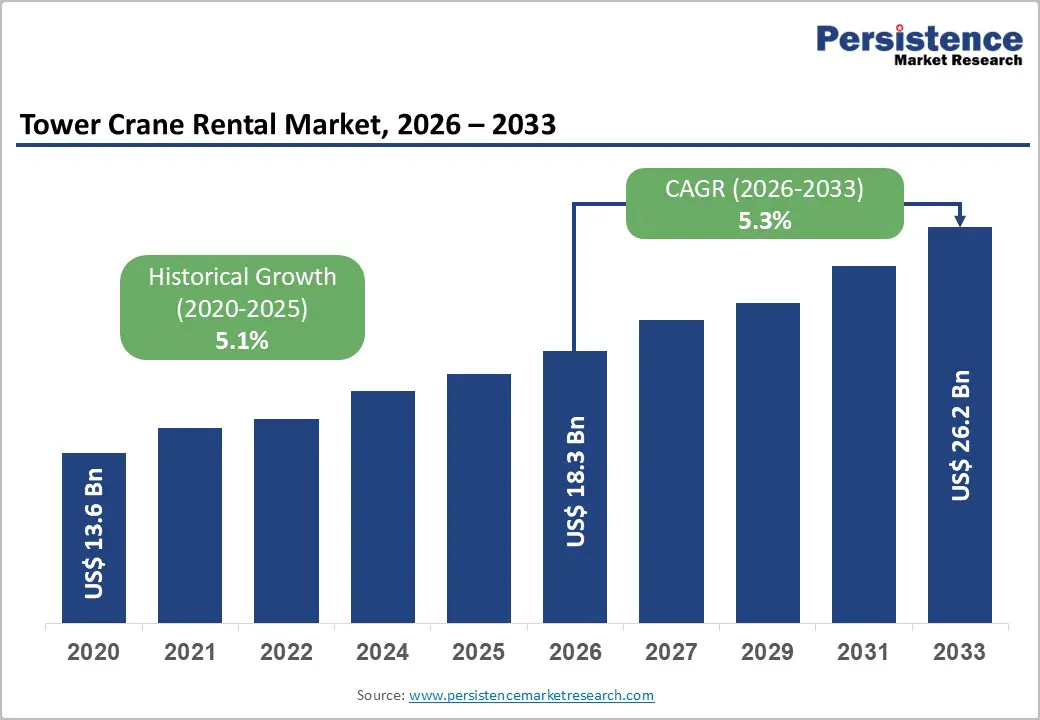
The global tower crane rental market size is likely to be valued at US$18.3 billion in 2026 and is expected to reach US$26.2 billion by 2033, growing at a CAGR of 5.3% during the forecast period from 2026 to 2033, driven by rapid urbanization, the construction of high-rise residential and commercial buildings, and major government-backed infrastructure investments in transportation networks, airports, metros and smart cities, which together fuel sustained demand for flexible lifting solutions that rental models provide.
Renting tower cranes offers significant cost advantages and operational flexibility over outright ownership, enabling contractors to align equipment deployment with project timelines and budgets. Technological trends, including telematics, remote monitoring, anti-collision systems, and digital fleet management, are enhancing safety, utilization, and efficiency across rental fleets.
Key Industry Highlights:
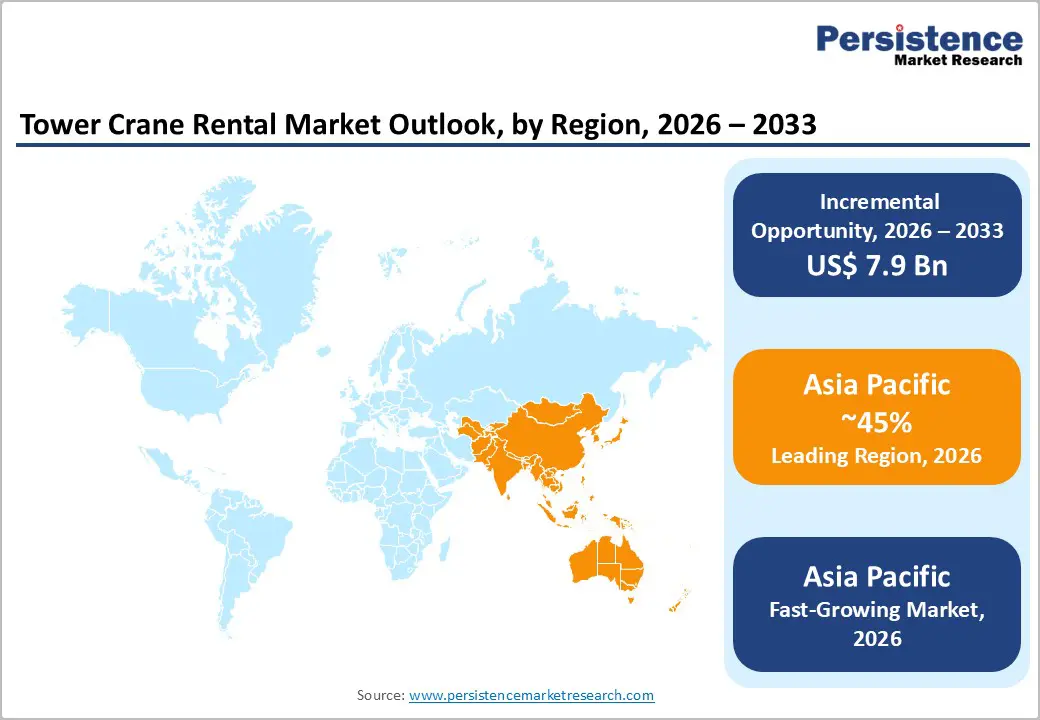
- Leading Region: Asia Pacific is anticipated to be the leading region, accounting for a market share of 45% in 2026, driven by rapid urbanization, infrastructure investments, and high-rise construction projects.
- Fastest-growing Region: Asia Pacific is likely to be the fastest-growing region for Tower Crane Rental in 2026, driven by large-scale infrastructure initiatives, rising real estate development, and increased adoption of rental equipment for cost efficiency.
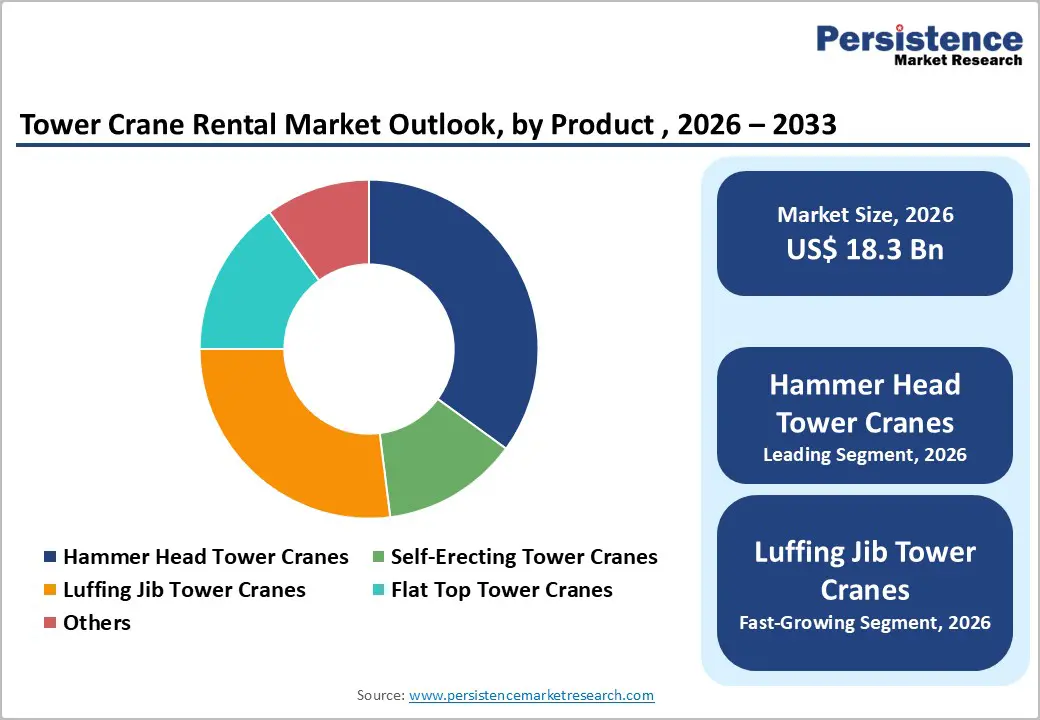
- Leading Product Type: Hammerhead tower cranes are projected to be the leading product type in 2026, accounting for 38% of revenue, driven by their versatility in high-rise and industrial construction projects.
- Leading End-user: Infrastructure is expected to be the leading end-user segment, accounting for over 50% of revenue in 2026, driven by large-scale government-funded road, bridge, and transit development projects.
| Global Market Attributes | Key Insights |
|---|---|
| Tower Crane Rental Market Size (2026E) | US$18.3 Bn |
| Market Value Forecast (2033F) | US$26.2 Bn |
| Projected Growth (CAGR 2026 to 2033) | 5.3% |
| Historical Market Growth (CAGR 2020 to 2025) | 5.1% |
Market Factors – Growth, Barriers, and Opportunity Analysis
Growth Analysis - Growth in Construction and Infrastructure Projects
Rapid urbanization, industrialization, and smart city initiatives in the Asia Pacific, North America, and Europe are creating strong demand for high-rise residential, commercial, and industrial projects. Tower cranes are essential for lifting heavy loads, transporting materials over long distances, and managing complex urban construction logistics.
Government investments in roads, bridges, airports, and metro networks increase rental demand. Contractors prefer renting cranes to avoid high capital expenditure, ensuring equipment availability aligns with project timelines. This trend sustains long-term market growth.
Urbanization and industrial expansion contribute to increased construction project volumes, resulting in greater demand for tower cranes capable of handling high-capacity lifts. Infrastructure projects such as commercial complexes, transit hubs, and mixed-use developments require flexible and reliable crane solutions to ensure timely completion. Rental models allow developers to access advanced crane technology without ownership costs, enabling quick deployment for projects of varying scales.
Advancements in Crane Technology
Modern cranes incorporate telemetry systems, remote monitoring, anti-collision technology, and automated load management, enabling operators to perform complex lifts safely and efficiently. Self-erecting and luffing jib cranes reduce assembly time, making them suitable for dense urban environments. These advancements increase utilization rates for rental fleets, attracting contractors seeking performance and safety benefits.
The adoption of energy-efficient and hybrid cranes also aligns with sustainability goals, providing a competitive advantage for rental companies investing in modern fleets.
Digitalization and smart crane technologies are driving rental demand by enabling real-time tracking of equipment performance, predictive maintenance, and fleet optimization. Advanced software platforms enable operators to plan lifts accurately, minimizing downtime and reducing operational risks.
The integration of IoT-enabled cranes enhances safety compliance and ensures regulatory adherence, both of which are critical for high-rise construction projects. These technology trends make renting newer, smarter cranes more attractive than maintaining older equipment, promoting adoption in both developed and emerging markets.
Barrier Analysis - Preference for Older Cranes among Some Rental Companies
Some rental companies continue to rely on older crane models to reduce capital expenditures, limiting the adoption of advanced and safer equipment. While older cranes may reduce upfront costs, they often lack modern features such as telemetry, anti-collision systems, and energy-efficient designs.
This reliance can restrict operational efficiency, increase maintenance costs, and reduce fleet utilization rates. Older cranes do not comply with evolving safety regulations in certain regions, potentially exposing contractors to legal and operational risks. This cautious approach slows the overall modernization of the tower crane rental market.
Older cranes can also impact contractor decisions, as clients increasingly prefer rental fleets with advanced safety and efficiency features. Delays in upgrading fleets may limit market competitiveness for rental companies in regions where urban construction and high-rise developments require precise operations. Maintenance and repair costs for aging cranes are typically higher, reducing profitability and deterring long-term investment. As construction regulations tighten, reliance on outdated cranes presents operational and reputational challenges.
Skilled Labor Shortages
Efficient and safe operation of high-capacity cranes requires specialized training and certifications, particularly for complex urban and high-rise construction projects. Shortages in skilled labor can lead to operational delays, reduced utilization of rental fleets, and increased safety risks. Contractors may experience project inefficiencies, prompting rental companies to invest in training programs or operator-provided services, thereby increasing operational costs. These challenges are more pronounced in emerging economies with rapid urbanization and infrastructure growth, where demand for trained operators often exceeds supply.
Labor shortages also impact fleet scalability and market expansion. Even with advanced and self-erecting cranes, human oversight remains essential for safety and operational efficiency. A limited pool of certified operators restricts rental companies from deploying cranes across multiple projects simultaneously. This shortage may lead contractors to extend project timelines or rely on alternative lifting solutions, constraining revenue growth for rental firms. Addressing the labor gap through training initiatives, partnerships with vocational programs, or automation in crane operations is crucial to sustaining growth in the tower crane rental market.
Opportunity Analysis - Rising Demand from Renewable Energy Installations
A shift toward renewable energy projects such as wind farms and solar power plants presents a significant opportunity for the tower crane rental market. Wind turbine installations require cranes capable of lifting heavy components to substantial heights, often in remote or confined locations. Renting specialized cranes for these projects reduces capital investment and provides flexibility for seasonal or project-based requirements. Governments invest in renewable energy infrastructure to meet sustainability goals. Demand for reliable, high-capacity lifting solutions is expected to grow, driving expansion in crane rentals.
Renewable energy projects also require cranes with mobility, versatility, and high load capacities, making them ideal candidates for rental rather than purchase. The cyclical and project-based nature of renewable installations favors temporary equipment solutions.
Rental companies can capitalize on this trend by providing specialized crane types, operator support, and customized solutions for wind, solar, and hydroelectric projects. This segment offers potential for long-term growth, particularly in regions investing heavily in green energy infrastructure. Strategic targeting of renewable energy developments can enhance revenue streams and diversify the customer base for tower crane rental providers.
Technological Advancements and Digitalization
The adoption of digital tools, IoT, and automation presents a strong growth opportunity for tower crane rental companies. Real-time monitoring, predictive maintenance, and fleet optimization platforms enhance operational efficiency and reduce downtime. Contractors increasingly prefer rental fleets with digital capabilities, as they improve safety, accuracy, and productivity in high-rise and complex construction projects. Investment in smart cranes with telematics and automated features allows rental companies to differentiate their offerings, attract high-value contracts, and increase utilization rates.
Digitalization also supports data-driven decision-making, enabling rental firms to plan equipment deployment, maintenance schedules, and project timelines more effectively. Enhanced safety compliance, remote supervision, and performance analytics increase contractor confidence in rental solutions.
Integrating software solutions with advanced crane models creates value-added services, increasing profitability and competitiveness. Construction projects grow in complexity, and leveraging technology and digital tools represents a sustainable pathway for market growth and long-term industry leadership.
Category-wise Analysis
Product Type Insights
Hammer head tower cranes are expected to lead the tower crane rental market, accounting for approximately 38% of revenue in 2026, driven by robust design, long reach, and high load-handling capacity, making them ideal for high-rise and industrial construction projects where large-scale lifting is required.
For example, in urban projects such as the construction of the Shanghai Tower in China, Hammer Head Cranes were extensively deployed because they efficiently handled heavy materials across multiple floors. These cranes are favored by contractors and rental companies because they provide versatility, reliability, and operational efficiency in dense city environments where space and load requirements are critical.
Luffing jib tower cranes are expected to be the fastest-growing segment in 2026. These cranes are ideal for urban construction projects with limited space, as their adjustable jib reduces interference with nearby buildings and infrastructure. A prime example is their use in the redevelopment of London’s Canary Wharf district, where high-rise towers and tight sites demanded cranes with precise maneuverability and efficient vertical lifting capabilities. The growth of this segment is driven by increasing demand for high-rise residential and commercial buildings in densely populated cities, as well as regulatory requirements for safe operation in confined spaces.
End-user Insights
Infrastructure is projected to lead the market, accounting for approximately 50% of revenue in 2026, supported by government-funded projects such as roads, bridges, highways, and metro rail systems, which require sustained lifting capabilities over extended project durations.
For example, in India, the construction of the Delhi Metro Phase IV extensively relied on rented tower cranes to efficiently handle concrete, steel, and other materials across multiple sites. Infrastructure projects demand high-capacity cranes that can operate reliably under heavy loads, making rental models more attractive for cost-effectiveness and operational flexibility.
The commercial segment is likely to be the fastest-growing end-user in 2026, driven by the construction of office towers, retail complexes, and mixed-use developments amid rapid urbanization. For example, the ongoing development of the Hudson Yards project in New York City leveraged rented tower cranes to lift heavy steel structures and materials in a dense urban setting, demonstrating the segment’s reliance on flexible rental solutions.
Growth in this segment is supported by rising investments in business districts, smart buildings, and urban commercial hubs, where project timelines are compressed, and equipment mobility is critical. Contractors prefer to rent cranes for these projects to reduce upfront capital expenditures and access advanced, high-capacity models with modern safety and operational features.
Regional Insights
North America Tower Crane Rental Market Trends
North America is likely to be a significant market for tower crane rentals, driven by robust construction activity in the urban and infrastructure sectors and a growing preference for rentals over ownership to manage costs and maintain fleet flexibility. Rental providers are increasingly integrating telematics, IoT, and digital monitoring systems into their fleets to enable real-time performance tracking, predictive maintenance, and improved safety, reflecting broader industry shifts toward smart fleet utilization. Towers cranes play a crucial role in modernizing aging infrastructure across North America by enabling rapid deployment and ensuring compliance with safety standards.
The region’s regulatory focus on worker safety and emissions reduction is also encouraging the adoption of newer, more environmentally efficient crane models. For example, United Rentals, which has introduced battery energy systems in partnership with Termaco to reduce crane fuel use by ~80% and generator runtime by over 90%, showcases the industry’s move toward sustainable operations. This trend highlights how leading companies are enhancing their rental fleets with technology that meets both contractor expectations and regulatory demands, increasing customer confidence and utilization rates.
Europe Tower Crane Rental Market Trends
Europe is likely to be a significant market for tower crane rental in 2026, due to ongoing urban redevelopment, infrastructure modernization, and strict safety and sustainability mandates across major economies such as Germany, the U.K., and France. Strict EU safety standards and environmental targets are encouraging the adoption of energy-efficient, hybrid, and electric crane models among rental companies, enhancing compliance and reducing emissions on urban job sites.
In Germany, for example, companies such as Liebherr-International AG are expanding their equipment offerings with advanced tower cranes that meet stringent European emission and safety norms, attracting contractors seeking modern, compliant rental solutions for dense city projects.
Integrating smart and connected technologies into tower crane operations enhances real-time monitoring, safety management, and fleet optimization. Rental providers are increasingly investing in IoT-enabled cranes and predictive maintenance systems to improve uptime and reduce operational costs, addressing market demand for efficiency and reliability across diverse construction projects.
The expansion of renewable energy infrastructure, particularly offshore and onshore wind farms, which require specialized heavy-lift cranes for turbine installation and maintenance, creates new revenue streams for rental firms beyond traditional building projects.
Asia Pacific Tower Crane Rental Market Trends
The Asia-Pacific region is expected to be the leading region, accounting for 45% in 2026, driven by rapid urbanization, large-scale infrastructure investment, and industrial expansion across countries such as China, India, Indonesia, and Vietnam, where construction activity is rising rapidly. Rental demand is particularly strong for high-rise residential and commercial buildings, public transit infrastructure, and megaprojects, as developers increasingly prefer rental models to minimize capital expenditure and access modern crane fleets tailored for project durations.
A significant trend shaping the Asia Pacific region is the expansion and strategic positioning of major rental and equipment firms that respond to evolving project requirements with diversified and technologically sophisticated offerings. For example, Zoomlion, a leading Chinese crane and heavy equipment manufacturer, is increasingly supporting regional crane rental demand by providing large, modern tower crane fleets that can be deployed quickly across urban and infrastructure construction sites, reflecting how OEM integration strengthens rental value propositions.
Competitive Landscape
The global tower crane rental market exhibits a moderately fragmented structure, driven by a mix of fleet operators, regional specialists, and equipment manufacturers expanding into rental services to meet growing construction and infrastructure demand. Major players maintain competitive positions with extensive crane fleets, technical expertise, and broad geographic footprints, enabling them to support diverse projects from high-rise urban developments to major infrastructure builds.
With key leaders including Bigge Crane and Rigging Co., NFT Group, Maxim Crane Works, L.P., United Rentals, and Zoomlion ElectroMech India Pvt. Ltd., the market is shaped by firms that combine rental services with strong technical support and reach. These players compete through fleet expansion, strategic collaborations, technological integration, and enhanced safety and sustainability features to capture more project contracts and strengthen customer retention.
Key Industry Developments:
- In January 2026, Raimondi launched the T87 flat-top tower crane, expanding its T Series for small to medium jobsites with tight space constraints. The lightweight crane featured a 51 m jib, modular components, and easy transport, allowing full setup with two articulated trucks. It delivered a 1.38 t tip load in UltraLift at full jib length and a maximum hoist speed of 78.7 m/min, combining high performance with simplified logistics for dense urban sites.
- In February 2025, Liebherr introduced the 620 HC-L luffing jib crane for cramped urban sites and large-scale projects. The crane offered a maximum lifting capacity of 18 t in one-fall and 36 t in two-fall operation, with a 65 m jib and a freestanding height of up to 74.3 m using the 24 HC 630 tower system. Its compact design required only 12 m of out-of-service space and a minimum operating position of 4.1 m, enabling efficient multi-crane operation in restricted areas.
Companies Covered in Tower Crane Rental Market
- Liebherr Group
- Bigge Crane and Rigging Co.
- Action Construction Equipment Ltd. (ACE)
- Titan Cranes & Rigging
- Leavitt Cranes
- Zoomlion ElectroMech India Pvt. Ltd.
- WASEL GmbH
- ALL Tower Crane, LLC
- United Crane and Rigging
- FALCON TOWER CRANE SERVICES LTD
- Rapicon Inc.
- Skycrane
- NFT Group
- Maxim Crane Works, L.P.
Frequently Asked Questions
The global tower crane rental market is projected to reach US$18.3 billion in 2026.
The tower crane rental market is driven by rapid urbanization, large-scale construction projects, and the cost advantages of renting over owning heavy equipment.
The tower crane rental market is expected to grow at a CAGR of 5.3% from 2026 to 2033.
Key market opportunities in the tower crane rental market include rising demand from high-rise construction, infrastructure projects, and renewable energy installations.
Liebherr Group, Bigge Crane and Rigging Co., Action Construction Equipment Ltd. (ACE), and Titan Cranes & Rigging are the leading players.


