Light Towers Market Size, Share, and Growth Forecast, 2025 - 2032

Light Towers Market By Product Type (LED, Metal-Halide), Power Source (Diesel Powered, Solar-Hybrid Powered, Hydrogen Others), End-use, and Regional Analysis for 2025 – 2032

ID: PMRREP23410
Calendar

November 2025

198 Pages

Author : Sayali Mali

Key Industry Highlights:

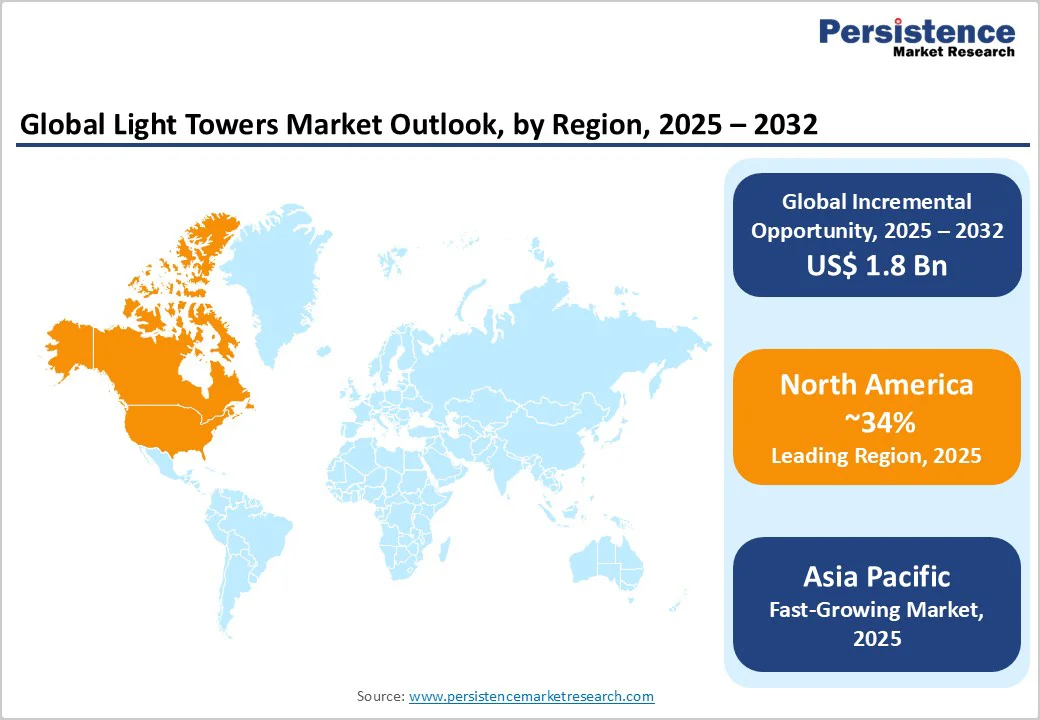
  • Leading Region: North America, commanding a 34% market share in 2025, driven by extensive construction activities, high prevalence of oil & gas operations, and strong R&D activities in the U.S.
  • Fastest-growing Region: Asia Pacific, fueled by rapid urbanization, rising awareness of site safety, and growing investments in infrastructure in China and India.
  • Dominant Product Type: LED, holding approximately 60% of the market share, due to energy efficiency and longevity.
  • Leading Power Source: Diesel Powered, accounting for over 55% of market revenue, driven by reliability in remote areas.
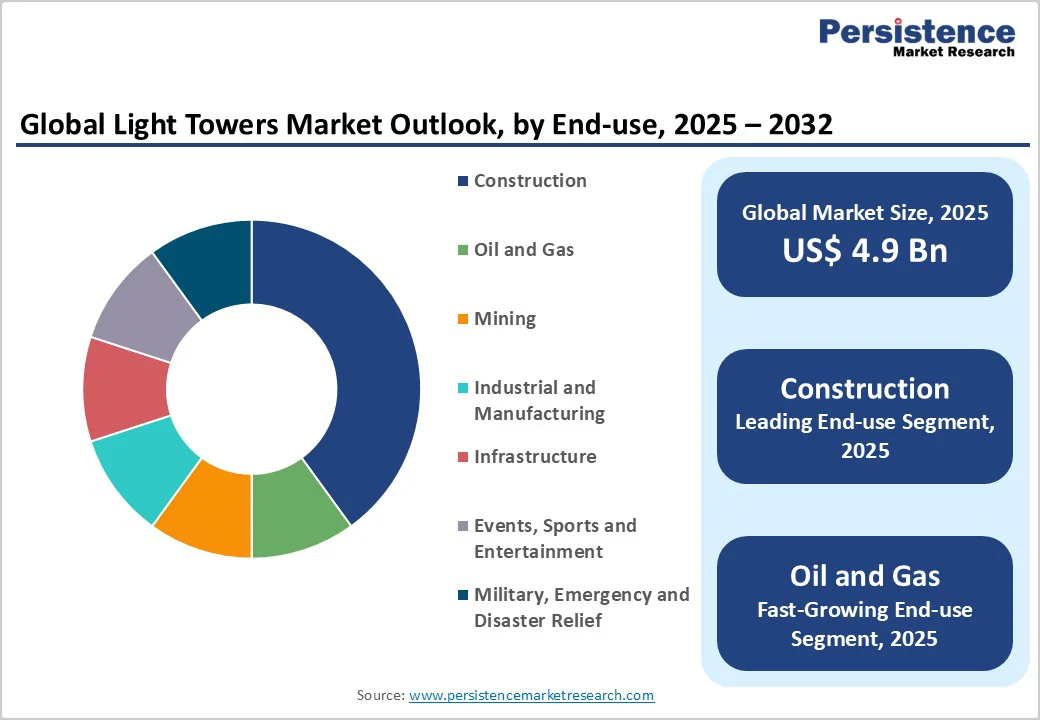
  • Leading End-use: Construction, contributing nearly 40% of market revenue, due to project demands.
  •  Key Market Driver: Rising infrastructure development and industrial activities are driving the demand for efficient, portable lighting solutions.
  • Market Opportunity: Increasing adoption of solar-hybrid and LED-integrated light poles presents significant growth opportunities for sustainable lighting solutions.
Key Insights Details
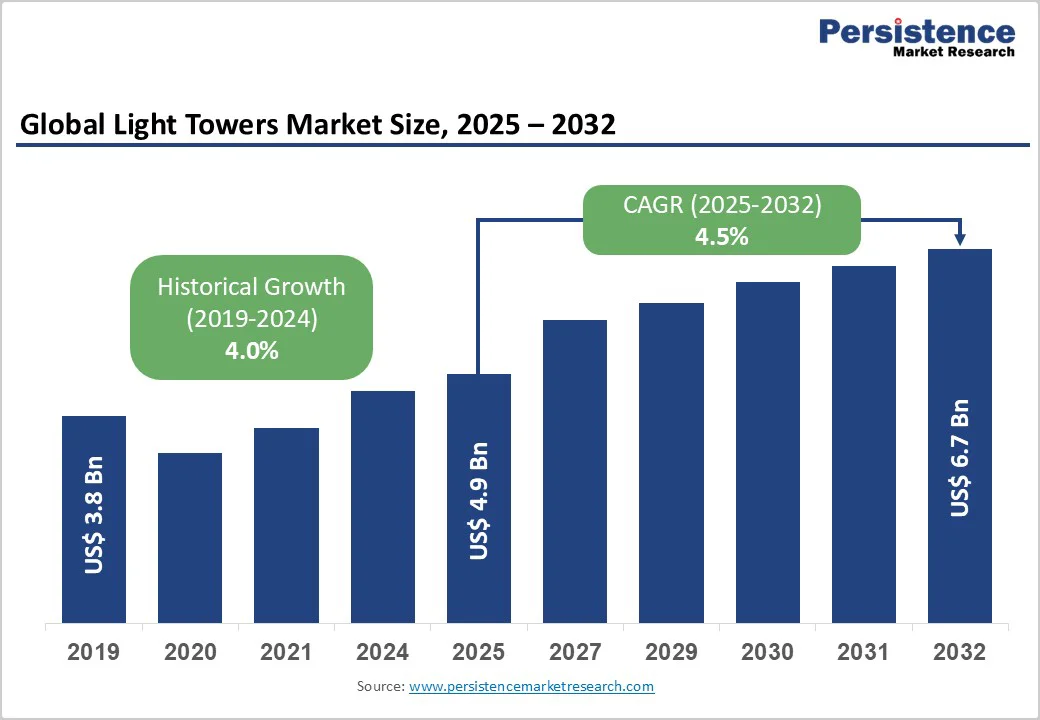
Light Towers Market Size (2025E) US$4.9 Bn
Market Value Forecast (2032F) US$6.7 Bn
Projected Growth (CAGR 2025 to 2032) 4.5%
Historical Market Growth (CAGR 2019 to 2024) 4.0%

global-light-towers-market-size-2025-2032

Market Factors – Growth, Barriers, and Opportunity Analysis

Rising Prevalence of Infrastructure Development and Demand for Reliable Site Illumination

The increasing prevalence of infrastructure development globally is a primary driver of the light towers market. Rapid urbanization, industrial expansion, and government investments in transportation, energy, and smart city projects are fueling the need for efficient lighting solutions across construction and maintenance sites. Countries in Asia Pacific, the Middle East, and Africa are witnessing large-scale infrastructure initiatives, including highways, railways, and renewable energy installations, where continuous and safe operations depend on adequate illumination.

Reliable lighting is crucial for enhancing visibility, ensuring worker safety, and maintaining productivity during nighttime or low-light conditions. Light poles especially those powered by diesel, hybrid, or solar energy offer portable, durable, and high-intensity lighting suited for dynamic project environments. Increasing safety regulations and quality standards in construction and mining sectors further strengthen the demand for dependable illumination systems.

High Initial and Maintenance Costs

The high costs associated with initial purchase and maintenance of light towers pose a significant restraint on market growth. The upfront investment for these technologies is considerably higher than traditional diesel-powered units due to the cost of solar panels, batteries, and smart control components. Integrating advanced features such as telematics, sensors, and automated monitoring systems further increases capital expenditure. For small and medium-scale contractors, these costs can limit adoption, especially in developing regions where budget constraints are prominent.

Maintenance costs also play a crucial role in total ownership expenses. While LED lights and solar components require less frequent servicing, replacing batteries or repairing electronic control units can be costly. In harsh environments such as construction or mining sites, exposure to dust, vibration, and extreme temperatures accelerates wear and tear, increasing maintenance frequency.

Advancements in Solar-Hybrid and LED-Integrated Light Towers

Advancements in solar-hybrid and LED-integrated light poles present significant growth opportunities for the light towers market. Solar-hybrid light poles combine solar panels with battery storage and optional diesel backup, providing continuous illumination with minimal fuel consumption and reduced carbon emissions. These systems are increasingly adopted in remote construction sites, oilfields, mining zones, and disaster relief operations, where grid access is limited. Technological improvements in battery efficiency, photovoltaic cells, and smart control systems have significantly enhanced runtime, reliability, and cost-effectiveness.

The integration of LED technology has revolutionized light tower performance by offering brighter illumination, longer lifespan, and lower energy usage compared to conventional halogen lamps. LEDs also reduce heat generation, maintenance needs, and overall operational costs. Manufacturers are developing intelligent light poles equipped with telematics, motion sensors, and automatic dimming features to optimize energy management.

Category-wise Analysis

Product Type Insights

LED dominates the market, accounting for 60% of the share in 2025. Its dominance is driven by energy savings, brightness, and low heat, making it preferred for construction. LED light poles, such as those from Allmand Bros., Inc., provide instant-on capability, ensuring safety. Its longevity and efficiency make it preferred for manufacturers.

Metal-Halide is the fastest-growing segment, driven by cost in short-term rentals and adoption in events. Metal-Halide offers high output, appealing for large areas. Focus on hybrid innovation accelerates adoption in Asia Pacific and Middle East.

Power Source Insights

Diesel Powered leads the market, holding 55% of the share in 2025. Their dominance stems from long runtime, high power output, and easy fuel availability in off-grid and remote locations. Widely used for construction, mining, and oil & gas operations, their proven reliability continues to drive strong global demand despite rising hybrid alternatives.

Solar-Hybrid Powered is the fastest-growing segment, driven by rising sustainability goals and increasing use in remote or off-grid locations. Its ability to reduce fuel consumption, lower emissions, and ensure reliable lighting aligns with global green energy initiatives, making it a preferred choice for eco-friendly and cost-efficient operations.

End-use Insights

Construction dominates the market, contributing 40% of revenue in 2025. Extensive use across infrastructure and building projects, along with strict safety and illumination standards, drives this dominance. Light poles’ versatility, mobility, and reliability make them the preferred choice for construction and maintenance operations worldwide.

Oil and Gas is the fastest-growing segment, driven by expanding exploration and increasing offshore drilling activities. Demand for durable, high-performance lighting solutions that can withstand harsh environments is accelerating adoption. Robust, energy-efficient, and mobile light poles ensure operational safety and productivity in remote and challenging industrial sites.
global-light-towers-market-outlook-by-end-use-2025-2032

Regional Insights

North America Light Towers Market Trends

North America is accounting for 34% share in 2025, driven by extensive construction, oil & gas, and mining activities, along with increasing demand for outdoor lighting in infrastructure and emergency response applications. The United States and Canada lead the regional market, supported by strong industrialization, infrastructure renovation projects, and stringent safety regulations requiring adequate lighting at worksites. Market players such as Atlas Copco, Generac Power Systems, and Wacker Neuson SE dominate through advanced product portfolios, strong dealer networks, and technological innovation.

The region is witnessing a significant shift toward hybrid, solar-powered, and LED-based light poles, reflecting growing emphasis on sustainability, energy efficiency, and reduced operational costs. The adoption of telematics and remote monitoring systems is expanding, enabling fleet management and performance optimization across large-scale operations. Rental companies are playing a key role by offering flexible solutions for short-term projects and events.

Europe Light Towers Market Trends

Europe hold a 20% share in 2025, supported by increasing infrastructure modernization, construction of renewable energy facilities, and expansion of industrial and mining operations. Countries such as Germany, the United Kingdom, France, and Italy are leading in adopting energy-efficient and sustainable lighting solutions, driven by strict EU emission regulations and environmental standards. The shift from traditional diesel-powered light poles to hybrid, solar, and LED-based models are accelerating as end users seek reduced fuel consumption and carbon emissions. Major players such as Wacker Neuson SE, Atlas Copco, and Generac Power Systems dominate the regional market through strong R&D investments, innovative product offerings, and extensive service networks. Rental demand is also rising, as construction and event sectors prefer flexible, cost-effective lighting solutions. Additionally, the integration of telematics and remote monitoring technologies enhances operational efficiency and maintenance management.

Asia Pacific Light Towers Market Trends

Asia Pacific is the fastest-growing, expected to grow CAGR at 5.3% in 2025, driven by rapid urbanization, infrastructure expansion, and increasing construction and mining activities across emerging economies such as China, India, Indonesia, and Australia. Governments in the region are heavily investing in transportation networks, smart cities, and renewable energy projects, creating strong demand for portable and efficient lighting solutions. The market is witnessing a gradual shift from conventional diesel-powered towers to hybrid and solar-powered light towers, aligned with regional sustainability goals and emission regulations.

Manufacturers such as Mitsubishi Heavy Industries, Atlas Copco, and Generac Power Systems are focusing on localized production and cost-effective technologies to cater to price-sensitive markets. The adoption of remote-controlled and smart monitoring systems is also gaining traction, enabling real-time performance tracking and fuel optimization. Furthermore, increasing demand from oil & gas, events, and emergency response sectors is supporting market expansion.
global-light-towers-market-outlook-by-region-2025-2032

Competitive Landscape

The global light towers market is highly competitive, mix of equipment giants and specialists. In developed regions such as North America and Europe, leading players such as Atlas Copco and Wacker Neuson SE dominate through advanced R&D capabilities, extensive distribution networks, and strong brand portfolios. These companies focus on product innovation, fuel efficiency, and automation to meet stringent emission and safety standards.

In the Asia Pacific region, Mitsubishi Heavy Industries, Ltd. strengthens its market position by offering localized and cost-effective lighting solutions tailored to infrastructure, construction, and mining applications. The growing emphasis on hybrid and solar-powered light poles, driven by sustainability goals and rising fuel costs, is reshaping market dynamics. Strategic partnerships, mergers, and acquisitions are key growth strategies as players aim to expand their global footprint and technological capabilities.

Key Industry Developments

  • In March 2025, Atlas Copco has launched the second generation of solar powered light towers, the, a groundbreaking development in their commitment to providing the market with efficient, safe, and dependable lighting solutions for operators in a wide range of applications from events to oil and gas, construction, and mining.
  • In October 2024, Generac Mobile expanded its GLT tower family with two hybrid models that combine fuel-efficient engines and battery packs to lengthen runtime and curb emissions.
Frequently Asked Questions

The global light towers market is projected to reach US$4.9 Billion in 2025.

The rising prevalence of infrastructure development and demand for reliable site illumination are key drivers.

The market is poised to witness a CAGR of 4.5% from 2025 to 2032.

Advancements in solar-hybrid and LED-integrated light towers are a key opportunity.

Allmand Bros., Inc., Atlas Copco, Generac Power Systems, Inc., Wacker Neuson SE, and Caterpillar are key players.

Global Light Towers Market Report Scope
Report Attribute Details
Historical Data/Actuals 2019 – 2024
Forecast Period 2025 – 2032
Market Analysis Value: US$ Bn
Geographical Coverage
  • North America
  • Europe
  • East Asia
  • South Asia and Oceania
  • Latin America
  • Middle East and Africa
Segmental Coverage
  • Product Type
  • Power Source
  • End-use
  • Region
Competitive Analysis
  • Allmand Bros., Inc.
  • PowerLink
  • MITSUBISHI HEAVY INDUSTRIES, LTD.
  • Atlas Copco
  • Caterpillar.
  • Sigma Search Lights Limited
  • Chicago Pneumatic
  • Doosan Bobcat.
  • Generac Power Systems, Inc.
  • HIMOINSA
  • Progress Solar Solutions
  • The Will Burt Company
  • TRIME s.r.l.
  • PR Industrial Srl Unipersonale
  • Wacker Neuson SE
Report Highlights
  • Market Forecast and Trends
  • Competitive Intelligence and Share Analysis
  • Growth Factors and Challenges
  • Strategic Growth Initiatives
  • Pricing Analysis
  • Future Opportunities and Revenue Pockets
  • Market Analysis Tools
Market Segmentation

By Product Type

  • LED
  • Metal-Halide

By Power Source

  • Diesel Powered
  • Solar-Hybrid Powered
  • Hydrogen Fuel-Cell Powered
  • Direct Grid Powered

By End-use

  • Construction
  • Oil and Gas
  • Mining
  • Industrial and Manufacturing
  • Infrastructure
  • Events, Sports, and Entertainment
  • Military, Emergency, and Disaster Relief

By Region

  • North America
  • Europe
  • East Asia
  • South Asia and Oceania
  • Latin America
  • Middle East and Africa

Related Reports

  1. Executive Summary
    1. Global Light Towers Market Snapshot, 2025 and 2032
    2. Market Opportunity Assessment, 2025 – 2032, US$ Bn
    3. Key Market Trends
    4. Future Market Projections
    5. Premium Market Insights
    6. Industry Developments and Key Market Events
    7. PMR Analysis and Recommendations
  2. Market Overview
    1. Market Scope and Definition
    2. Market Dynamics
      1. Drivers
      2. Restraints
      3. Opportunity
      4. Challenges
      5. Key Trends
    3. COVID-19 Impact Analysis
    4. Forecast Factors – Relevance and Impact
  3. Value Added Insights
    1. Value Chain Analysis
    2. Key Market Players
    3. Regulatory Landscape
    4. PESTLE Analysis
    5. Porter’s Five Force Analysis
    6. Consumer Behavior Analysis
  4. Price Trend Analysis, 2019 – 2032
    1. Key Factors Impacting Product Prices
    2. Pricing Analysis, By Product Type
    3. Regional Prices and Product Preferences
  5. Global Light Towers Market Outlook
    1. Market Size (US$ Bn) Analysis and Forecast
      1. Historical Market Size (US$ Bn) Analysis, 2019-2024
      2. Market Size (US$ Bn) Analysis and Forecast, 2025–2032
    2. Global Light Towers Market Outlook: Product Type
      1. Historical Market Size (US$ Bn) Analysis, By Product Type, 2019-2024
      2. Market Size (US$ Bn) Analysis and Forecast, By Product Type, 2025–2032
        1. LED
        2. Metal-Halide
      3. Market Attractiveness Analysis: Product Type
    3. Global Light Towers Market Outlook: Power Source
      1. Historical Market Size (US$ Bn) Analysis, By Power Source, 2019-2024
      2. Market Size (US$ Bn) Analysis and Forecast, By Power Source, 2025–2032
        1. Diesel Powdered
        2. Solar-Hybrid Powdered
        3. Hydrogen Fuel-Cell Powdered
        4. Direct Grid Powdered
      3. Market Attractiveness Analysis: Power Source
    4. Global Light Towers Market Outlook: End-use
      1. Historical Market Size (US$ Bn) Analysis, By End-use, 2019-2024
      2. Market Size (US$ Bn) Analysis and Forecast, By End-use, 2025–2032
        1. Construction
        2. Oil and Gas
        3. Mining
        4. Industrial and Manufacturing
        5. Events, Sports, and Entertainment
        6. Military, Emergency, and Disaster Relief
      3. Market Attractiveness Analysis: End-use
  6. Global Light Towers Market Outlook: Region
    1. Historical Market Size (US$ Bn) Analysis, By Region, 2019-2024
    2. Market Size (US$ Bn) Analysis and Forecast, By Region, 2025–2032
      1. North America
      2. Latin America
      3. Europe
      4. East Asia
      5. South Asia and Oceania
      6. Middle East & Africa
    3. Market Attractiveness Analysis: Region
  7. North America Light Towers Market Outlook
    1. Historical Market Size (US$ Bn) Analysis, By Market, 2019-2024
      1. By Country
      2. By Product Type
      3. By Power Source
      4. By End-use
    2. Market Size (US$ Bn) Analysis and Forecast, By Country, 2025–2032
      1. U.S.
      2. Canada
    3. Market Size (US$ Bn) Analysis and Forecast, By Product Type, 2025–2032
      1. Cigar
      2. Metal-Halide
    4. Market Size (US$ Bn) Analysis and Forecast, By Power Source, 2025–2032
      1. Diesel Powdered
      2. Solar-Hybrid Powdered
      3. Hydrogen Fuel-Cell Powdered
      4. Direct Grid Powdered
    5. Market Size (US$ Bn) Analysis and Forecast, By End-use, 2025–2032
      1. Construction
      2. Oil and Gas
      3. Mining
      4. Industrial and Manufacturing
      5. Events, Sports, and Entertainment
      6. Military, Emergency, and Disaster Relief
    6. Market Attractiveness Analysis
  8. Europe Light Towers Market Outlook
    1. Historical Market Size (US$ Bn) Analysis, By Market, 2019-2024
      1. By Country
      2. By Product Type
      3. By Power Source
      4. By End-use
    2. Market Size (US$ Bn) Analysis and Forecast, By Country, 2025–2032
      1. Germany
      2. France
      3. U.K.
      4. Italy
      5. Spain
      6. Russia
      7. Rest of Europe
    3. Market Size (US$ Bn) Analysis and Forecast, By Product Type, 2025–2032
      1. Cigar
      2. Metal-Halide
    4. Market Size (US$ Bn) Analysis and Forecast, By Power Source, 2025–2032
      1. Diesel Powdered
      2. Solar-Hybrid Powdered
      3. Hydrogen Fuel-Cell Powdered
      4. Direct Grid Powdered
    5. Market Size (US$ Bn) Analysis and Forecast, By End-use, 2025–2032
      1. Construction
      2. Oil and Gas
      3. Mining
      4. Industrial and Manufacturing
      5. Events, Sports, and Entertainment
      6. Military, Emergency, and Disaster Relief
    6. Market Attractiveness Analysis
  9. East Asia Light Towers Market Outlook
    1. Historical Market Size (US$ Bn) Analysis, By Market, 2019-2024
      1. By Country
      2. By Product Type
      3. By Power Source
      4. By End-use
    2. Market Size (US$ Bn) Analysis and Forecast, By Country, 2025–2032
      1. China
      2. Japan
      3. South Korea
    3. Market Size (US$ Bn) Analysis and Forecast, By Product Type, 2025–2032
      1. Cigar
      2. Metal-Halide
    4. Market Size (US$ Bn) Analysis and Forecast, By Power Source, 2025–2032
      1. Diesel Powdered
      2. Solar-Hybrid Powdered
      3. Hydrogen Fuel-Cell Powdered
      4. Direct Grid Powdered
    5. Market Size (US$ Bn) Analysis and Forecast, By End-use, 2025–2032
      1. Construction
      2. Oil and Gas
      3. Mining
      4. Industrial and Manufacturing
      5. Events, Sports, and Entertainment
      6. Military, Emergency, and Disaster Relief
    6. Market Attractiveness Analysis
  10. South Asia & Oceania Light Towers Market Outlook
    1. Historical Market Size (US$ Bn) Analysis, By Market, 2019-2024
      1. By Country
      2. By Product Type
      3. By Power Source
      4. By End-use
    2. Market Size (US$ Bn) Analysis and Forecast, By Country, 2025–2032
      1. India
      2. Indonesia
      3. Thailand
      4. Singapore
      5. ANZ
      6. Rest of South Asia & Oceania
    3. Market Size (US$ Bn) Analysis and Forecast, By Product Type, 2025–2032
      1. Cigar
      2. Metal-Halide
    4. Market Size (US$ Bn) Analysis and Forecast, By Power Source, 2025–2032
      1. Diesel Powdered
      2. Solar-Hybrid Powdered
      3. Hydrogen Fuel-Cell Powdered
      4. Direct Grid Powdered
    5. Market Size (US$ Bn) Analysis and Forecast, By End-use, 2025–2032
      1. Construction
      2. Oil and Gas
      3. Mining
      4. Industrial and Manufacturing
      5. Events, Sports, and Entertainment
      6. Military, Emergency, and Disaster Relief
    6. Market Attractiveness Analysis
  11. Latin America Light Towers Market Outlook
    1. Historical Market Size (US$ Bn) Analysis, By Market, 2019-2024
      1. By Country
      2. By Product Type
      3. By Power Source
      4. By End-use
    2. Market Size (US$ Bn) Analysis and Forecast, By Country, 2025–2032
      1. Brazil
      2. Mexico
      3. Rest of Latin America
    3. Market Size (US$ Bn) Analysis and Forecast, By Product Type, 2025–2032
      1. Cigar
      2. Metal-Halide
    4. Market Size (US$ Bn) Analysis and Forecast, By Power Source, 2025–2032
      1. Diesel Powdered
      2. Solar-Hybrid Powdered
      3. Hydrogen Fuel-Cell Powdered
      4. Direct Grid Powdered
    5. Market Size (US$ Bn) Analysis and Forecast, By End-use, 2025–2032
      1. Construction
      2. Oil and Gas
      3. Mining
      4. Industrial and Manufacturing
      5. Events, Sports, and Entertainment
      6. Military, Emergency, and Disaster Relief
    6. Market Attractiveness Analysis
  12. Middle East & Africa Light Towers Market Outlook
    1. Historical Market Size (US$ Bn) Analysis, By Market, 2019-2024
      1. By Country
      2. By Product Type
      3. By Power Source
      4. By End-use
    2. Market Size (US$ Bn) Analysis and Forecast, By Country, 2025–2032
      1. GCC Countries
      2. Egypt
      3. South Africa
      4. Northern Africa
      5. Rest of Middle East & Africa
    3. Market Size (US$ Bn) Analysis and Forecast, By Product Type, 2025–2032
      1. Cigar
      2. Metal-Halide
    4. Market Size (US$ Bn) Analysis and Forecast, By Power Source, 2025–2032
      1. Diesel Powdered
      2. Solar-Hybrid Powdered
      3. Hydrogen Fuel-Cell Powdered
      4. Direct Grid Powdered
    5. Market Size (US$ Bn) Analysis and Forecast, By End-use, 2025–2032
      1. Construction
      2. Oil and Gas
      3. Mining
      4. Industrial and Manufacturing
      5. Events, Sports, and Entertainment
      6. Military, Emergency, and Disaster Relief
    6. Market Attractiveness Analysis
  13. Competition Landscape
    1. Market Share Analysis, 2024
    2. Market Structure
      1. Competition Intensity Mapping By Market
      2. Competition Dashboard
    3. Company Profiles (Details – Overview, Financials, Strategy, Recent Developments)
      1. Allmand Bros., Inc.
        1. Overview
        2. Segments and Product Type
        3. Key Financials
        4. Market Developments
        5. Market Strategy
      2. PowerLink
      3. MITSUBISHI HEAVY INDUSTRIES, LTD.
      4. Atlas Copco
      5. Caterpillar.
      6. Sigma Search Lights Limited
      7. Chicago Pneumatic
      8. Doosan Bobcat.
      9. Generac Power Systems, Inc.
      10. HIMOINSA
      11. Progress Solar Solutions
      12. The Will Burt Company
      13. TRIME s.r.l.
      14. PR Industrial Srl Unipersonale
      15. Wacker Neuson SE.
      16. Others
  14. Appendix
    1. Research Methodology
    2. Research Assumptions
    3. Acronyms and Abbreviations

Research Methodology Framework for Market Research Excellence

At Persistence Market Research, we implement a comprehensive, validated, and multi-dimensional approachto market analysis that delivers actionable insights across complex market landscapes. Our methodology combines the analytical rigor of leading consulting firms with innovative research techniques, ensuring robust market assessments that guide strategic decision-making with confidence.

Core Research Philosophy

Our methodology is built on four foundational pillars:

Research Philosophy Image

At Persistence Market Research, our methodology is designed to transcend conventional market studies by combining analytical rigor, multi-source validation, and future-focused insights.

We integrate advanced research frameworks, robust data collection strategies, cutting-edge analytics, and innovative technologies to deliver a 360-degree view of complex markets.

We integrate advanced research frameworks, robust data collection strategies, cutting-edge analytics, and innovative technologies to deliver a 360-degree view of complex markets.

Each stage spanning from strategic scoping and hypothesis-building to competitive intelligence, quality validation, and actionable recommendations is engineered to provide clients with unmatched clarity, precision, and confidence in decision-making.

By embedding innovation and technology at the core, our approach ensures that insights are not only comprehensive but also predictive, empowering businesses to seize opportunities, mitigate risks, and achieve sustainable growth

Research Philosophy Image

Capturing Key Information and Events

During this phase, key research objectives focus on essential information and data points for assessing the market, including:

Research Philosophy Image

TAM-SAM-SOM Framework Implementation

We employ both top-down and bottom-up approaches to ensure accurate market sizing.

Top-Down Market SizingBottom-Up Market Sizing
Universe Definition: Total global/regional market identificationUnit Economics: Average transaction values, purchase frequencies, customer lifecycle
Segmentation Filters: Geographic, demographic, and behavioral constraintsCustomer Segmentation: Detailed buyer persona development and sizing
Market Share Analysis: Competitive landscape assessment and share allocationPenetration Analysis: Market penetration rates by segment and geography
Growth Rate Application: Historical trends and forward-looking growth assumptionsScaling Methodology: Extrapolation techniques with confidence intervals

Validation & Cross-Verification

  • Triangulation: Comparing top-down and bottom-up results for consistency
  • Sensitivity Analysis: Testing key assumptions and parameter variations
  • Peer Benchmarking: Comparison with analogous markets and industry benchmarks
  • Expert Review: External validation through industry specialist consultation

Research Philosophy Image

Forecasting & Projection Modeling

Our proprietary forecasting models incorporate multiple variables and scenarios.

Forecasting Components

  • Historical Trend Analysis: 10-year historical growth patterns and cyclical variations
  • Driver-Based Modeling: Economic indicators, demographic shifts, technology adoption
  • Scenario Planning: Base case, optimistic, and conservative projections
  • Monte Carlo Simulations: Probability-weighted outcomes and risk assessments

Model Validation

  • Back-Testing: Historical accuracy assessment over 3–5-year periods
  • Cross-Validation: Multiple modeling approaches for result comparison
  • External Benchmarking: Comparison with established market forecasts
  • Continuous Calibration: Quarterly model updates based on new data

Comprehensive Data Collection Strategy

Our secondary research phase establishes a robust knowledge base utilizing diverse, credible sources.

Secondary Data Sourcess

  • Industry Publications & Reports
  • Government & Regulatory Data
  • Financial Intelligence (filings & reports)
  • Academic Research & Digital Intelligence

Quality Assurance Protocol

  • Source credibility assessment and publication date validation
  • Data consistency checks across multiple sources
  • Bias identification and neutralization techniques
  • Information gap tracking for primary research prioritization

Research Philosophy Image

Primary Research Excellence

Our primary research methodology employs best-in-class techniques to capture unique market insights.

Quantitative Research Methods

  • Large-Scale Surveys: Statistically representative samples with 95% confidence intervals
  • Survey Methodology: Multi-channel deployment (online, telephone, in-person)
  • Question Architecture and Response Optimization

Qualitative Research Methods

  • Executive Interviews
  • Focus Groups
  • Expert Consultations

Quality Assurance & Validation Framework

Multi-Stage Validation Process

  • Source Verification and Consistency Testing
  • Outlier Detection and Bias Assessment
  • Peer Review Process and External Validation
  • Sensitivity Analysis and Confidence Intervals

Research Philosophy Image

Methodology Validation & Credibility

Our research methodology has been extensively validated through:

  • Academic Partnerships: Collaborations with top-tier business schools and research institutions
  • Client Success Stories: Documented case studies demonstrating research impact and ROI
  • Continuous Benchmarking: Performance comparison with leading global research firms

This comprehensive methodology framework positions Persistence Market Research at the forefront of market intelligence, combining the analytical sophistication of top-tier consulting firms with innovative research techniques. Our approach ensures that every market assessment delivers precise, actionable, and strategically valuable insights that drive business success in competitive market environments.

Ready to unlock your market potential? Contact our research experts to discuss how our validated methodology can transform your strategic decision-making with data-driven market intelligence.

Copyright © 2026 Persistence Market Research. All Rights Reserved

Connect With Us -