




- Beauty & Personal Care
- Toothpaste Tablets Market
Toothpaste Tablets Market Size, Share, and Growth Forecast, 2026 - 2033
Toothpaste Tablets Market by Product Type (Fluoride-based, Fluoride Free), Distribution Channel (Hypermarkets/Supermarkets, Online Stores, Pharmacy & Drug Stores, Others), and Regional Analysis for 2026 - 2033

Toothpaste Tablets Market Size and Trends Analysis
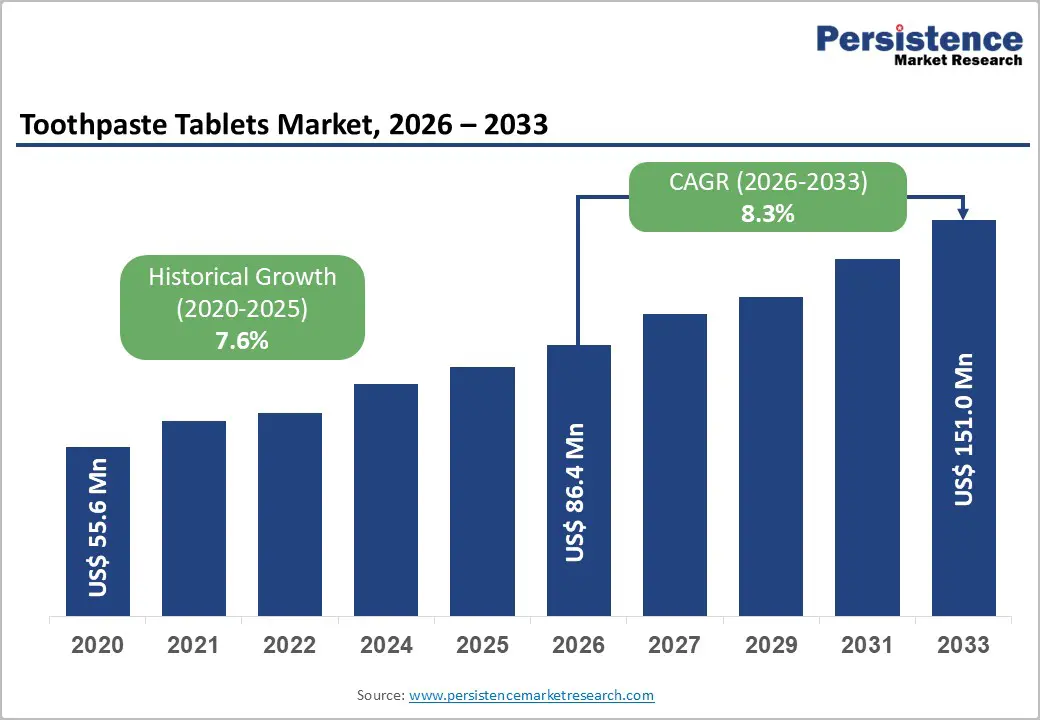
The global toothpaste tablets market size is likely to be valued at US$86.4 million in 2026, and is expected to reach US$151.0 million by 2033, growing at a CAGR of 8.3% during the forecast period from 2026 to 2033, driven by the increasing prevalence of eco-friendly oral care products, rising demand for plastic-free and travel-friendly alternatives, and advancements in fluoride-based and fluoride-free formulations.
The growing demand for convenient, sustainable toothpaste tablets, especially fluoride-free variants, is accelerating adoption across demographics. Advances in chewable and effervescent designs are further boosting uptake by offering more effective, zero-waste options. The increasing recognition of toothpaste tablets as a critical way to reduce plastic tube waste in emerging wellness markets remains a major driver of market growth.
Key Industry Highlights:
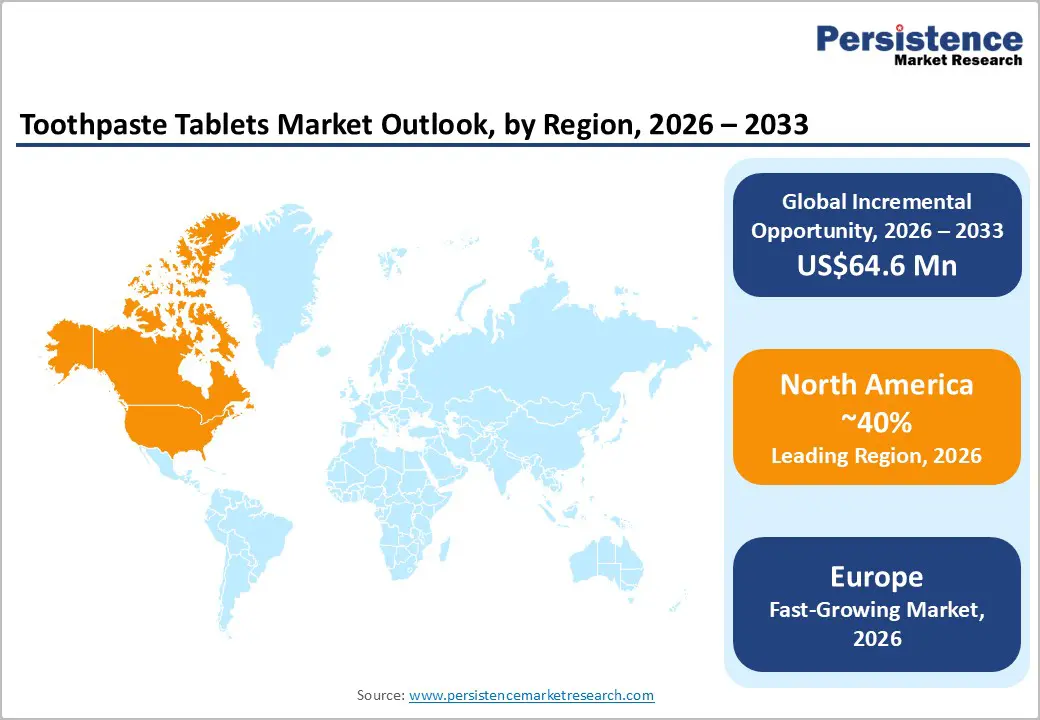
- Leading Region: North America, anticipated to account for a 40% market share in 2026, driven by high environmental awareness, strong e-commerce penetration, and premium demand in the U.S.
- Fastest-growing Region: Europe, fueled by strict plastic reduction regulations, rising zero-waste trends, and growing investments in natural oral care.
- Dominant Product Type: Fluoride-free, to hold approximately 55% of the market revenue, as it appeals to natural and sensitive-teeth consumers.
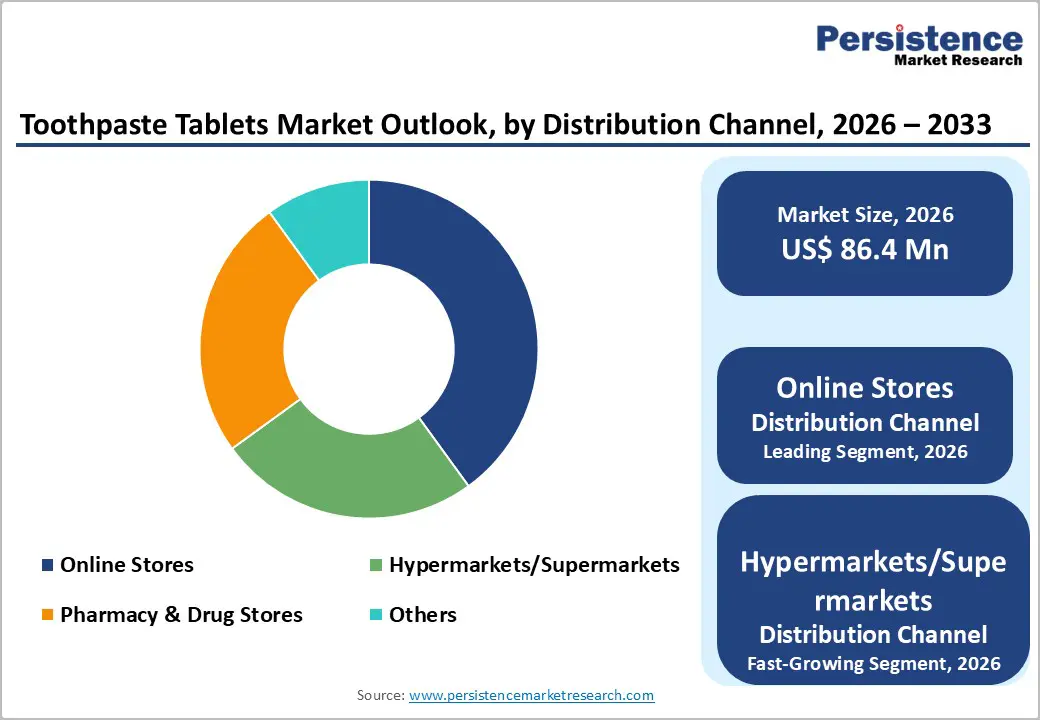
- Leading Distribution Channel: Online stores are expected to account for over 45% of market revenue due to convenience and a wide variety.
| Key Insights | Details |
|---|---|
| Toothpaste Tablets Market Size (2026E) | US$86.4 Mn |
| Market Value Forecast (2033F) | US$151.0 Mn |
| Projected Growth (CAGR 2026 to 2033) | 8.3% |
| Historical Market Growth (CAGR 2020 to 2025) | 7.6% |
Market Factors - Growth, Barriers, and Opportunity Analysis
Rising Demand for Eco-Friendly Oral Care Products and Plastic-Free Alternatives
The rising demand for eco-friendly oral care products and plastic-free alternatives is being driven by growing consumer awareness of environmental sustainability and health-conscious living. Modern consumers are increasingly scrutinizing the environmental footprint of everyday products, including toothpaste, toothbrushes, and mouthwashes. Traditional oral care items often rely on single-use plastics and synthetic ingredients, which contribute to long-term waste and environmental pollution. As a result, demand is shifting toward products made from biodegradable, recyclable, or reusable materials.
Eco-friendly oral care solutions commonly feature bamboo toothbrushes, refillable toothpaste containers, compostable floss, and packaging made from paper, glass, or aluminum. Formulations are evolving to include naturally derived ingredients and avoid harsh chemicals, artificial colors, and microplastics. These products appeal not only to environmentally conscious buyers but also to consumers seeking gentler and safer personal care options. Regulatory pressure to reduce plastic waste, along with global sustainability initiatives, has further accelerated innovation in this segment. Brands are investing in sustainable sourcing, low-carbon manufacturing, and transparent labeling to build trust and align with ethical consumer values.
Availability and Distribution Challenges
Availability and distribution challenges represent a key restraint for the toothpaste tablets market, particularly when compared with conventional toothpaste products. Toothpaste tablets are still a relatively new and niche category, and their presence in mainstream retail channels remains limited. Many supermarkets, pharmacies, and convenience stores prioritize high-turnover oral care products with established demand, leaving minimal shelf space for alternative formats such as tablets. This restricted in-store visibility reduces consumer exposure and slows trial and adoption.
Distribution is also heavily skewed toward online platforms and specialty eco-friendly stores, which may not reach a broad or diverse customer base. In regions with lower e-commerce penetration or limited access to sustainable retail outlets, toothpaste tablets remain difficult to obtain. Small and emerging brands dominate the segment, often lacking the logistics infrastructure, retail partnerships, and marketing budgets needed to scale distribution efficiently. Supply chain constraints further affect availability. Toothpaste tablets require moisture-resistant packaging and controlled storage conditions to maintain product integrity, adding complexity to transportation and warehousing. International expansion can be particularly challenging due to varying regulatory requirements, import restrictions, and certification standards across countries.
Innovations in Effervescent and Natural Delivery Platforms
Innovations in effervescent and natural toothpaste tablet delivery platforms are transforming the global oral care landscape by addressing two major challenges: foaming barriers and synthetic concerns. Effervescent platforms are engineered to achieve instant fizz, reducing reliance on tubes and enabling better cleaning in chewable formats. Innovations such as bicarbonate blends, natural abrasives, essential oil flavors, and rapid-dissolve matrices significantly improve the user experience and reduce waste, lowering environmental costs for brands and consumer campaigns.
Progress in natural platforms, including fluoride-free herbals, vegan-certified tablets, zero-waste refills, and biodegradable packaging, supports more eco-conscious hygiene by minimizing plastics, the product’s first line of defense against pollution. These formats eliminate tubes, enhance portability, and allow versatile use without water waste, making them highly suitable for mass travel programs.
Category-wise Analysis
Product Type Insights
The fluoride free segment is projected to lead the toothpaste tablets market, capturing approximately 55% of total revenue in 2026. This leadership is primarily attributed to growing consumer preference for natural formulations, suitability for sensitive teeth, and the rising influence of clean-label and transparency trends. Fluoride-free tablets are widely perceived as gentler alternatives that align with eco-conscious lifestyles and sustainability goals, making them well-suited for broader wellness-oriented adoption.
Products such as T-Brush Fluoride-Free Toothpaste Tablets and Shunyam Fluoride-Free Toothpaste Tablets exemplify this trend, as they are positioned as natural, plastic-free oral care solutions. These offerings are designed to address increasing consumer demand for products that avoid synthetic additives, including fluoride, while still delivering effective cleaning performance and mild oral care benefits. Their positioning strongly resonates with consumers seeking clean-label, sustainable, and environmentally responsible oral hygiene options.
The fluoride-based segment is likely to be the fastest-growing, driven by its cavity protection and expanding use in mainstream oral care. Its preventive profile makes it ideal for targeted efficacy, reducing the risk of decay. Continuous innovations in micro-dosing are further strengthening its acceptance, driving rapid adoption across North America and Europe, where demand for proven protection is accelerating.
The introduction of Raspberry Fluoride Toothpaste Tablets (125 count) marks a strategic move by ecoLiving to strengthen its sustainable oral care portfolio, combining fluoride-based cavity protection with a plastic-free, vegan, and zero-waste positioning to meet the growing demand of eco-conscious consumers. Fluoride-containing toothpaste tablets are gaining traction with consumers seeking sustainable oral care solutions without sacrificing the clinically validated dental benefits of traditional fluoride toothpaste.
Distribution Channel Insights
Online stores are projected to dominate the distribution landscape, accounting for approximately 45% of market share in 2026, supported by ease of purchase, broad product assortments, and rising demand for direct-to-consumer sales models. Continued expansion of e-commerce platforms is further strengthening accessibility and market reach.
The growing penetration through pharmacy outlets and increased promotional activity in supermarkets also underscores the importance of a multi-channel distribution strategy. Products such as Weldental Chewtab Toothpaste Tablets, which are widely available on online marketplaces including Amazon India and receive strong consumer ratings (around 4.7 out of 5), highlight the robust demand and performance of toothpaste tablets through digital sales channels.
Hypermarkets and supermarkets are expected to register the fastest growth among distribution channels, supported by strong in-store visibility and the expanding presence of toothpaste tablets within conventional oral care aisles. Increased emphasis on impulse purchasing, improved shelf displays, and the introduction of bundled offerings through retail trials are accelerating consumer adoption. Supermarket-focused initiatives by major oral care companies, such as Colgate-Palmolive, further underscore this growth trajectory.
Products such as Toothpaste Tablets Peppermint 180 Tablets from Ecomantraa and Toothpaste Tablets Fresh Mint from Bristlo exemplify this trend, as they are increasingly stocked across large supermarket and hypermarket chains. These brands highlight natural formulations and plastic-free packaging, aligning with the rising demand for sustainable oral care alternatives. As retailers expand eco-friendly personal care sections, such products are benefiting from enhanced shelf visibility, enabling shoppers to easily discover, compare, and make impulse purchases during routine grocery visits.
Regional Insights
North America Toothpaste Tablets Market Trends
North America is expected to dominate, accounting for nearly 40% of the toothpaste tablets market in 2026, driven by the region’s advanced wellness infrastructure, strong research and development capabilities, and high public awareness of the benefits of zero waste. Distribution systems in the U.S. and Canada provide extensive support for sales programs, ensuring wide accessibility of toothpaste tablets across online, pharmacy, and supermarket populations. The increasing demand for fluoride-free, convenient, and easy-to-use forms is further accelerating adoption, as these formats improve portability and reduce barriers associated with tubes.
Innovation in toothpaste tablet technology, including stable effervescent, improved natural delivery, and targeted flavor enhancement, is attracting significant investments from both public and private sectors. Government initiatives and sustainability campaigns continue to promote alternatives to plastic waste, address travel inconveniences, and address emerging eco threats, creating sustained market demand. The growing focus on fluoride-based grades and specialty uses, particularly for families and others, is expanding the target applications for toothpaste tablets.
Europe Toothpaste Tablets Market Trends
Europe is expected to be the fastest-growing region, driven by rising awareness of environmental benefits, robust regulatory frameworks, and government-led zero-waste programs. Countries such as Germany, France, and the U.K. have well-established frameworks that support routine adoption and encourage innovative tablet delivery methods, including toothpaste tablets. These sustainable formulations are particularly appealing to eco-conscious populations, health-conscious consumers, and travel users, thereby improving compliance and coverage rates.
Technological advancements in toothpaste tablet development, such as enhanced natural ingredients, targeted oral care delivery, and improved chewable grades, are further boosting market potential. European authorities are increasingly supporting research and trials for tablets against both routine and specialized needs, strengthening market confidence. The growing emphasis on convenient, plastic-free options is aligned with the region’s focus on preventive hygiene and reducing pollution. Public awareness campaigns and promotion drives are expanding reach in both urban and rural areas, while suppliers are investing in compression and novel variants to increase efficacy.
Asia Pacific Toothpaste Tablets Market Trends
Asia Pacific is driven by rising wellness awareness, increasing government initiatives, and expanding application programs across the region. Countries such as India, China, Japan, and Southeast Asian nations are actively promoting tablet campaigns to address sustainability growth and emerging travel needs. Toothpaste tablets are particularly attractive in these regions due to their portability, ease of scaling, and suitability for large-scale consumer drives across both urban and rural populations.
Technological advancements are enabling the development of stable, effective, and easy-to-produce toothpaste tablets that can withstand challenging climatic conditions and minimize reliance on waste. These innovations are critical for reaching remote facilities and improving overall hygiene coverage. The growing demand for fluoride-free, natural, and travel-friendly applications is driving market expansion. Public-private partnerships, increased wellness expenditure, and rising investment in tablet research and manufacturing capacity are further accelerating growth. The convenience of tablet delivery, combined with improved freshness and reduced risk of spills, positions toothpaste tablets as a preferred choice.
Competitive Landscape
The global toothpaste tablets market is characterized by competition between established oral care leaders and emerging eco-brands. In North America and Europe, The Humble Co. and Huppy lead through strong R&D, distribution networks, and retail ties, bolstered by innovative grades and sustainability programs. In Asia Pacific, local brands advance with localized solutions, enhancing accessibility. Fluoride-free delivery boosts appeal, cuts plastic risks, and enables mass integrations across regions. Strategic partnerships, collaborations, and acquisitions merge expertise, expand flavors, and speed commercialization. Natural formulations solve tube issues, aiding penetration in green-focused areas.
Key Industry Developments
- In December 2025, NOBS executed a growth-focused digital strategy by scaling its hydroxyapatite toothpaste through social commerce, achieving No. 1 sales on TikTok Shop and a top-15 ranking on Amazon, signaling strong consumer adoption of non-fluoride oral care solutions.
- In June 2025, EcoFam advanced sustainability-driven innovation by introducing hydroxyapatite toothpaste tablets in the U.S., positioning tablet-based formats as an environmentally friendly alternative to traditional plastic toothpaste tubes.
- In December 2024, Tidalove expanded its zero-waste oral care portfolio with the launch of fluoride-enhanced toothpaste tablets featuring NHAP+, reinforcing its strategy around enamel protection, sustainability, and travel-friendly packaging.
Companies Covered in Toothpaste Tablets Market
- Toothpaste India
- Archtek
- Colgate-Palmolive Company
- The Humble Co.
- HCP Wellness
- DENTTABS
- Germanics
- Pärla Toothpaste Tablets
- Dental Lace
- Kaylaan LLC
- Huppy
- Nelson Naturals Inc.
Frequently Asked Questions
The global toothpaste tablets market is projected to reach US$86.4 million in 2026.
Key drivers include growing preference for eco-friendly oral care, plastic waste reduction, travel convenience, and natural/vegan formulations, supported by e-commerce and sustainability trends.
The toothpaste tablets market is poised to witness a CAGR of 8.3% from 2026 to 2033.
Opportunities include expansion in natural/fluoride-free variants, e-commerce/subscription models, hospitality adoption, and emerging markets seeking sustainable personal care solutions.
The Humble Co., Huppy, DENTTABS, Nelson Naturals Inc., and Colgate-Palmolive Company are the key players.


